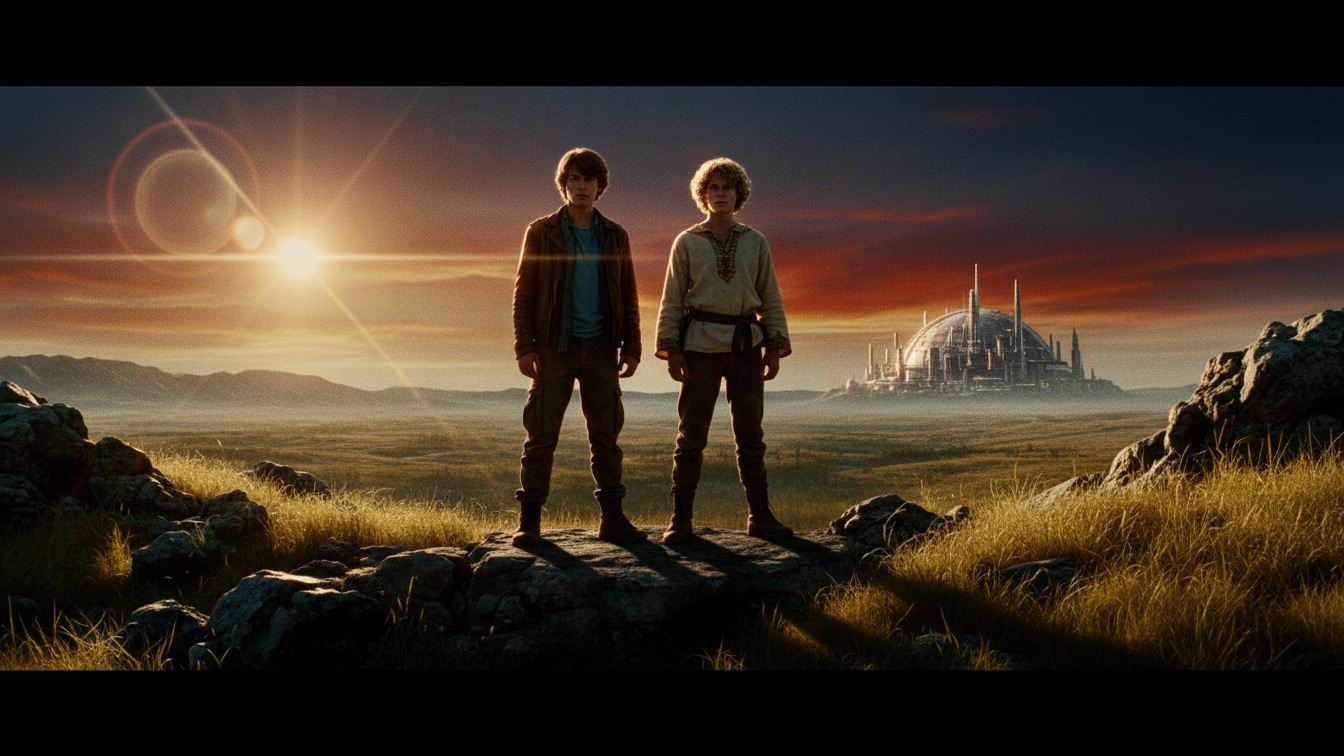
Leo, a seventeen-year-old living in a hyper-regulated dystopian society, spends his final days before a life-altering "Sorting" ceremony scavenging in a polluted riverbank. He discovers a pre-collapse physical drive, an object that exists outside the city’s pervasive digital "Mesh." His friend Jack, who is still deeply integrated into the city’s biometric monitoring systems, attempts to dissuade Leo from his "unregulated" behavior. However, the mystery of the drive and the suffocating nature of their "Optimized" existence push them toward a radical act of rebellion.
After retreating to a lead-lined shed to avoid surveillance, the boys manage to view a video file on the drive showing a girl in a natural, unfiltered forest. This revelation confirms Leo’s suspicions that the world they live in is a curated cage. He severs his haptic connection, becoming a "Ghost" invisible to the city’s sensors, and leads Jack through a series of underground tunnels. They navigate a hidden bunker filled with ancient data and eventually climb to the surface of the "Wilds." The story concludes with the two boys standing on a ridge, looking down at their domed city and preparing to face a raw, un-optimized reality.
The central theme of the narrative is the conflict between algorithmic optimization and human authenticity. The city represents a peak technocracy where every sensory experience, from the temperature of the air to the "harmony" of social interactions, is managed by a central processor. This optimization seeks to eliminate suffering and conflict, but in doing so, it eliminates the reality of the human condition. Leo’s preference for the "greasy, iridescent sludge" of the river over the "synthetic brown" of the parks highlights his innate need for something genuine, even if that something is dirty or decaying.
Another prominent theme is the reclamation of sensory experience as a form of autonomy. Throughout the text, the "Mesh" provides a filtered version of reality that numbs the characters to their environment. By cutting their haptic sleeves, Leo and Jack transition from a state of digital sedation to a state of physical presence. The pain of the heat, the sting of the sun, and the itch of the grass are not presented as negatives, but as essential proofs of life. This suggests that true freedom requires the acceptance of discomfort and the rejection of a "comfortable cage."
The story also explores the concept of the Panopticon in the digital age. The "Sorting" and the constant monitoring of "unregulated emotional variance" create a psychological environment where the characters are forced to perform happiness and stability. Privacy is non-existent because even their heart rates and neurotransmitters are tracked by the state. The act of becoming a "Ghost" is more than just a physical escape; it is a psychological liberation from the gaze of the Algorithm. It allows the characters to move from being data points to becoming individuals with their own destinies.
Leo serves as the story's protagonist and the primary driver of the narrative's rebellious energy. He is characterized by a deep-seated visceral claustrophobia that manifests as a rejection of the city’s artificial comforts. Unlike his peers, he seeks out the "grit" and "copper" smells of the polluted river because they represent a world that has not been sanitized by the Mesh. His decision to cut his haptic sleeve with industrial shears is a symbolic act of self-emancipation, showing that he values his internal truth more than his social harmony score. He possesses a rugged, intuitive intelligence that allows him to see the "Optimization" as a lie designed to facilitate control.
Psychologically, Leo is motivated by a desire for "sharp, biting clarity" over the humid fog of his regulated life. He is not merely a rebel without a cause; he is a seeker of the "outside," both physically and metaphorically. His leadership over Jack demonstrates his conviction, as he is willing to leave behind everything he knows for the sake of a "real" experience. By the end of the chapter, he has transformed from a frustrated student into a pioneer of the Wilds. He views his new status as a "Ghost" not as a loss of identity, but as the birth of his true self.
Jack functions as the psychological foil to Leo, representing the average citizen’s dependency on systemic structures. He is initially defined by his fear of "red-lining" his vitals and his concern for his academic "pathway" credits. Jack’s reliance on his AR glasses and cooling fans illustrates how the city’s technology has atrophied his ability to cope with the natural world. He is a product of a culture that prioritizes safety and "Mountain Breeze" cycles over the unpredictability of nature. His initial resistance to Leo’s discovery is born from a genuine, systemic terror of being "un-synced" from the collective.
However, Jack’s character arc is one of profound psychological transition. When Leo leaves, the silence of the disconnected link becomes more painful for Jack than the "unregulated" emotions he was taught to fear. His decision to rip away his own haptic sleeve is a desperate attempt to find the reality Leo described. While he remains more vulnerable than Leo—noting his blood sugar levels and missing his snacks—he shows significant growth by choosing the "Raw Feed" over the safety of the dome. His journey highlights the idea that even those most conditioned by a system can find the strength to choose reality when faced with the void of an artificial existence.
The author employs a heavy use of sensory contrast to mirror the psychological divide between the city and the Wilds. The digital world is described with clinical, sterile terms like "Optimized," "Universal-Link," and "Skin-Tone Correction." In contrast, the physical world is rendered with gritty, tactile verbs and adjectives such as "suctioning," "greasy," "shimmering," and "jagged." This stylistic choice forces the reader to feel the same sensory deprivation and subsequent overload that the characters experience. The transition from the "translucent temperature widget" to the "violent, un-filtered explosion of white" light at the end of the story effectively communicates the shock of the boys' escape.
The pacing of the narrative is carefully managed to reflect the characters' rising anxiety and eventual liberation. The beginning of the chapter is slow and heavy, bogged down by the oppressive humidity and the weight of the "Sorting." As Leo discovers the drive and the boys enter the "Shed," the prose becomes more rhythmic and urgent. The climb up the ladder is described with a visceral physicality that emphasizes the effort required to break free from a sedentary, managed life. The final scenes on the ridge move with a sense of expansive energy, reflecting the vastness of the world they have just entered.
The narrative voice is a close third-person perspective that stays tightly focused on Leo’s internal state. This allows the author to weave psychological observations into the descriptions of the environment. For example, the river is not just water; it is a "pulsing" entity that Leo feels a "weird kinship" with. This subjective framing helps the reader understand that Leo’s rebellion is not just political, but deeply personal. The dialogue between Leo and Jack is sharp and serves to highlight their differing philosophies, with Leo’s bluntness cutting through Jack’s jargon-heavy, tech-obsessed speech.


