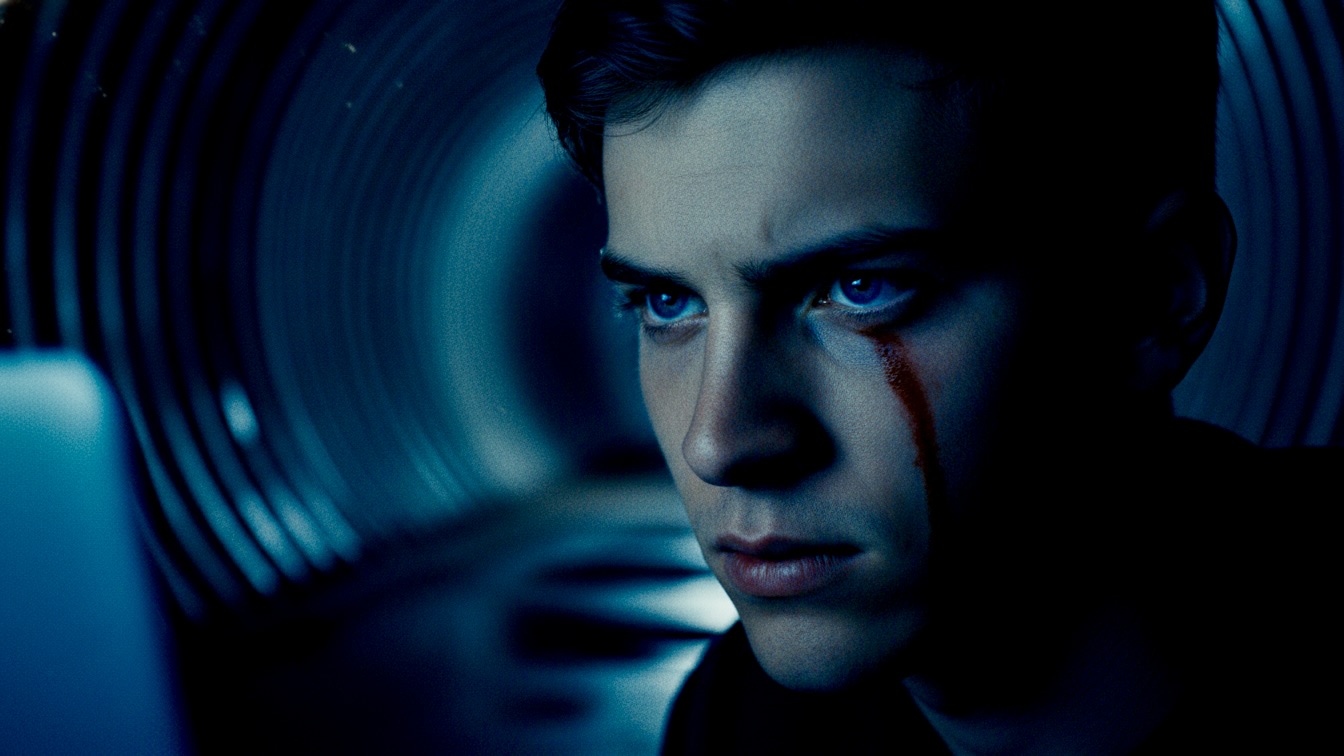
A high-speed collision leaves Tyler grounded on blistering asphalt as he chooses logic over the rising tide of panic.
"Stay down," the voice in my head didn't say.
My lungs didn't work. The air was a vacuum. I tasted copper and felt the grit of the suburban street against my cheek. The bike—a customized carbon-frame gravel rig—was twisted ten feet away. Its front wheel spun with a rhythmic click-click-click that sounded like a countdown.
I hadn't seen the Tesla. It was silent. A white ghost that had drifted out of a driveway at 10:42 PM. The impact had been a dull thud followed by the physics of flight.
"You okay?"
A door clicked. The driver was out. I saw white sneakers. Clean. No scuffs.
"Don't move," the driver said.
I ignored him. My mind was a motherboard trying to reboot after a power surge. I focused on the mantra. Emotions are noise. Logic is the signal. If I stayed down, I was reactive. If I moved, I was the protagonist.
I pushed. My palms burned. The asphalt was still radiating the day's heat, a heat that felt like a physical hand pressing back against me. My left wrist sent a sharp, electric spike of pain up to my elbow.
"Hey, kid, seriously. I'm calling an ambulance."
"No," I said. My voice was a rasp. "Don't."
"You hit my car. You flew like twenty feet."
I looked at the Tesla. The passenger door had a shallow crater. The paint was scuffed, black marks on the pearlescent white.
"I'm fine," I said.
I forced my knees to lock. The world tilted fifteen degrees to the left. I waited for the UI to stabilize. I checked my pockets. The weight was still there. A cold, heavy rectangle in my cargo shorts. The drive.
"You're bleeding," the man said. He was holding a phone. The screen was too bright. It burned my retinas.
"Insurance?" I asked.
"Forget insurance, you need a doctor."
"I don't."
I stepped toward the bike. My vision pulsed in time with my heartbeat. Thump-flash. Thump-flash. The guy reached out to grab my shoulder. I flinched, a jagged movement that made my ribs scream.
"Back off," I said.
"Kid, you're in shock."
"I'm in control."
I grabbed the handlebars. The carbon was splintered. The chain was off. I didn't need the bike to work; I just needed it to not be evidence. I dragged it toward the sidewalk. The sound of metal on pavement was a screech that set my teeth on edge.
"I'm calling the cops," the man said. His voice was getting higher. He was the one panicking. He was the one making reactive decisions.
I stopped. I looked at him. Really looked at him. He was maybe forty. Puffy face. Expensive watch. He was terrified of the liability.
"Call them," I said. "Tell them you hit a minor while exiting your driveway without looking. Tell them about the lack of a turn signal."
He hesitated. The thumb over his screen hovered.
"You came out of nowhere," he muttered.
"Doesn't matter. Look at the angles. You're at fault. I leave, you go home, you fix the door. No cops. No insurance hike. No paperwork."
I watched his face. The calculation was visible. The fear of a lawsuit was battling the fear of my injuries. Logic won. It always does if you frame it right.
"You're sure?" he asked.
"I'm already gone," I said.
I turned and started walking, dragging the ghost of my bike. Every step was a vibration that rattled my brain inside my skull. I didn't look back. I didn't check to see if he was following. That would be an emotional response. I stayed in the lane.
Summer in the suburbs felt like a terrarium. The humidity was a physical presence, a damp shirt against my skin that never dried. The streetlights were pale yellow circles on the blacktop. I reached the corner and ducked into the shadows of a massive oak tree.
I leaned the bike against the trunk. My hand went to the drive again. It was still there.
I pulled out my phone. The screen was cracked from a previous life, a web of glass over the lock screen. I swiped up.
Where are you? Jack had messaged three minutes ago.
Delayed, I typed. Collision. Moving now.
The drive?
Secure.
Don't be a hero, Tyler. Just get here.
I put the phone away. My wrist was swelling. It looked like a balloon was being inflated under the skin. I didn't feel the pain as a feeling anymore; I felt it as a data point. Left hand: 40% utility. Mobility: 80%.
I left the bike. It was a three-thousand-dollar piece of equipment, but now it was just a tether. I had to be unencumbered. I started a slow jog, a rhythmic jarring that I forced myself to ignore.
This was the summer of the pivot. No more reacting to my dad's benders. No more reacting to the school's 'concerns.' I had picked one thing. The drive. The drive worked. It was a ticket out of the loop.
I passed a house with a sprinkler system running. The water hissed as it hit the grass. I felt a few stray drops on my shins. Cold. Sharp. I kept moving.
I needed to reach the drainage tunnel by 11:15. The schedule was the only thing that mattered. If I missed the window, the encryption would rotate. The 'one thing that works' would become a brick.
My breath was coming in short, efficient bursts. I focused on the pavement. The cracks. The discarded gum wrappers. The way the light caught the mica in the concrete.
I was a machine. I was a process. I was stronger than the throb in my arm.
I reached the edge of the park. The grass was long and dry, crunching under my sneakers. The sound was too loud in the quiet of the night. I slowed to a walk, scanning the tree line.
No drones. No headlights.
I descended the slope toward the concrete lip of the storm drain. It looked like a dark mouth waiting to swallow the world. I didn't hesitate. I stepped into the dark.
The temperature dropped instantly. The air here was still, trapped. My sneakers squeaked on the damp concrete floor. I pulled out a small LED torch and clicked it on. The beam was a narrow white needle.
I saw the markings. Red spray paint. A series of dots.
"Jack?" I whispered.
Silence.
I kept walking. The tunnel curved. My light bounced off the corrugated metal walls. I felt the weight of the suburban streets above me. Thousands of people sleeping, making reactive decisions about their morning coffee, while I moved through the guts of the world.
I saw a shadow shift at the edge of the beam.
"Tyler?"
Jack stepped out. He looked tired. His hoodie was oversized, his eyes reflecting the LED light like a cat's.
"You're late," he said.
"I had a run-in with a Tesla."
"Did you break it?"
"The car? No. The bike? Yes."
Jack looked at my arm. "Your wrist is fucked."
"It's a variable," I said. "Do you have the interface?"
Jack nodded. He pulled a ruggedized laptop from his backpack. The fan whirred to life, a low hum that filled the tunnel.
"Give it to me," Jack said.
I handed him the drive. My fingers shook slightly as I let go. The absence of the weight felt strange.
"This is it," Jack muttered. "The one thing that works."
He plugged it in. The screen flickered. A progress bar appeared.
0%... 1%...
"We have ten minutes," I said.
"I know."
We stood there in the dark, watching the bar crawl forward. My wrist throbbed, but I watched the light instead. I watched the numbers. I was stronger than the pain. I was stronger than the fear of what was on that drive. I was the signal.
Jack stared at the screen as if he could pull the data out with his eyes. The blue light cast long, skeletal shadows against the tunnel walls. Every few seconds, the laptop’s fan would kick into a higher gear, a desperate mechanical panting that echoed off the concrete.
"It’s encrypted with a rolling cipher," Jack whispered. "If the handshake doesn’t complete before the next rotation, we’re locked out for twenty-four hours."
"We don't have twenty-four hours," I said. I was leaning against the cold wall, trying to keep the weight off my left side. My ribs were starting to stiffen. Every breath felt like a small, sharp reminder of the Tesla’s bumper.
"I know that, Tyler. Shut up."
Jack’s fingers flew across the trackpad. He wasn't a hacker in the movie sense; he was just a kid who knew how to use the tools other people had built. He was efficient. He didn't make reactive choices. He had decided six months ago that he was going to find a way out of this town, and this drive was the method.
"They’re going to look for the bike," I said.
"The bike is carbon fiber and aluminum. It’s a ghost. Unless they have the serial number, it’s just trash under a tree."
"The guy in the Tesla saw my face."
Jack paused. He looked up, his face pale in the screen glow. "Did he get a good look?"
"Good enough. But he’s scared. He thinks he hit a kid. He doesn’t want the heat."
"People change their minds when they see the repair bill for a Tesla door," Jack said. He turned back to the laptop. "14%. It’s crawling."
I looked back toward the mouth of the tunnel. The moonlight was a silver rectangle in the distance. It felt miles away. Out there, the world was loud and messy. In here, it was just the hum of the fan and the slow march of the progress bar.
"Why did you pick this?" I asked.
Jack didn't look up. "Pick what?"
"This. The drive. The risk. You could have just finished school."
Jack laughed, a dry sound that didn't reach his eyes. "School is a reactive system, Tyler. You do the work because they tell you to. You get the grade because you need the job. You get the job because you need the car. It’s a loop. I wanted something that worked outside the loop."
I understood. That was why we were here. We were the anomalies.
I felt a vibration in my pocket. Not my phone. A different kind of vibration. A low-frequency hum that seemed to come from the ground.
"Do you hear that?" I asked.
Jack froze. He closed his eyes, tilting his head. "Hear what?"
"The ground. It’s vibrating."
Jack looked at the laptop. "18%."
"Jack, listen."
The hum grew louder. It wasn't a car. It was rhythmic. Heavy.
"Pumps?" Jack guessed. "Maybe the city is clearing a line?"
"It’s summer. There hasn't been rain in three weeks. Why would they run the pumps?"
I moved toward the tunnel entrance, keeping my light off. I stayed low, my sneakers silent on the concrete. As I got closer to the opening, I saw it.
Flashlights. Three of them.
They were moving across the park, sweeping the tall grass. They weren't looking for a lost dog. The movements were coordinated. Grid search.
"They’re here," I whispered, retreating back to Jack.
"Who? The cops?"
"No. Cops use sirens. Cops use loud voices. These guys are silent. They’re professional."
Jack’s face went white. "The owners of the drive."
"How did they track it?"
"I don't know. Maybe a hardware pinger? I thought I shielded it."
Jack looked at the progress bar. "22%."
"We have to move," I said.
"I can't unplug it! If I kill the connection now, the drive wipes. It’s a security feature."
I looked at the dark tunnel stretching deeper into the earth. It was a maze of concrete and shadows. If we stayed, we were trapped. If we moved, we risked the data.
"How long?" I asked.
"At this rate? Another twenty minutes."
"We don't have twenty minutes. They’ll reach the drain in five."
I forced my brain to prioritize. My emotions wanted me to run. My fear was screaming to leave the laptop and disappear into the dark. But the 'one thing that works' was on that screen. Without it, the collision, the broken bike, the ruined wrist—it was all just pointless trauma.
"Close the laptop," I said.
"Tyler, I told you—"
"Don't unplug the drive. Just fold the screen. We carry it open. We move deeper."
Jack looked at me like I was insane. "The vibration could skip the needle—"
"It’s an SSD, Jack. There is no needle. Move."
He scrambled to pick up the laptop, cradling it like a newborn. I grabbed his backpack and threw it over my good shoulder. My left arm hung limp, a dead weight that I tucked into my waistband to keep from swinging.
We moved deeper into the tunnel. The air got colder. The smell of damp earth and old concrete was overwhelming. My light was a tiny flicker in the oppressive blackness.
"Left or right?" Jack whispered as the tunnel branched.
I looked at the floor. The left branch had more silt. The right was cleaner.
"Right," I said. "Cleaner means more flow. More flow means it leads to the main artery."
We hurried down the right branch. The ceiling dipped. I had to hunch over, my back protesting the movement. Behind us, I heard a metallic clang.
Someone had stepped onto the concrete lip of the drain.
"Go," I hissed.
We ran, a clumsy, half-bent sprint through the dark. The laptop screen flickered, casting weird shadows on Jack’s face.
28%... 29%...
My breath was a roar in my ears. I focused on the circle of light from my torch. I didn't think about the men behind us. I didn't think about the pain in my ribs. I thought about the numbers.
We reached a ladder. Iron rungs, rusted and slick. It led up to a manhole cover.
"We can't go up," Jack said. "They’ll see us on the street."
"We aren't going up. We’re going past."
I saw a smaller pipe, barely three feet wide, branching off to the side. It was a tight fit.
"In there," I said.
"I can't fit the laptop in there and crawl!"
"You go first. I'll push the laptop behind you."
Jack didn't argue. He scrambled into the pipe, his sneakers disappearing into the gloom. I placed the laptop on a piece of discarded cardboard I found on the floor. I pushed it slowly, carefully, into the pipe.
I followed.
The space was suffocating. The concrete walls pressed against my shoulders. I could feel the heat from the laptop’s exhaust on my face. My left arm screamed as it scraped against the rough surface.
I didn't stop. I couldn't. I was the process.
We crawled for what felt like an hour, but was probably only fifty feet. The pipe opened into a small vaulted chamber—a junction point for several smaller lines.
Jack was already there, panting, checking the screen.
"35%," he gasped.
I sat on the floor, my head between my knees. My heart was a hammer hitting my ribs.
"Did they follow?" Jack asked.
I listened. The silence was absolute. No footsteps. No voices. Only the drip-drip-drip of water somewhere in the distance.
"They’re searching the main lines," I said. "They won't think we went into the crawl-space. Not yet."
"We’re stuck here until it finishes."
"Then we wait."
I turned off my light. We sat in the blue glow of the laptop. It was the only thing that existed. The 'one thing that works.'
I looked at my wrist. It was purple now. I didn't feel it. I had turned off that part of my brain. I was stronger than my emotions. I was stronger than the pain.
I was winning.
The chamber felt like a tomb. It was a concrete box buried under thirty feet of suburban soil. Above us, families were watching Netflix. Above us, the man in the Tesla was probably pouring a drink, trying to forget the kid he’d hit.
In here, the only reality was the blue light.
"48%," Jack whispered. His voice was different now. The panic had been replaced by a strange, hollow focus. He was leaning over the laptop, his shadow stretching up the wall and across the ceiling like a dark giant.
"The vibration is stopping," I said.
I put my hand on the floor. The rhythmic thrum I’d felt earlier had ceased. That wasn't good. Silence meant they had stopped moving. Silence meant they were listening.
"If they find us in here, we’re done," Jack said. "There’s no second exit."
"There’s always a second exit. You just have to make it."
I looked at the ceiling. There was a circular patch of darkness. Another manhole.
"That leads to the middle of the street," I said. "Too exposed."
"We stay here. We wait for the bar."
I watched Jack. He was vibrating. Not from the ground, but from within. He was making reactive decisions in his head, playing out a hundred scenarios where we died.
"Jack," I said.
He didn't look up.
"Jack. Look at me."
He turned his head slowly. His eyes were wide, the pupils blown.
"We are the signal," I said. "Everything else is noise. The guys outside? Noise. Your fear? Noise. My broken arm? Noise. There is only the drive."
He blinked. He took a breath. "The signal."
"Exactly. Control the variables you can. Ignore the ones you can't."
I stood up. My body felt like it was made of glass and lead. I walked to the edge of the crawl-space pipe we’d just exited. I leaned in, listening.
A faint sound. A scrape.
Someone was in the pipe.
"They’re coming," I said. My voice was flat. No emotion. Just a statement of fact.
Jack’s hands shook. "How? How did they find the branch?"
"Thermal," I said. "The laptop is a heat source. In a cold tunnel, it’s a beacon."
"52%."
"We can't stay."
I grabbed the laptop. I didn't wait for Jack to agree. I tucked it under my good arm and started toward the ladder leading to the street.
"You said it was too exposed!" Jack hissed.
"The variables changed. Staying is 100% failure. Going up is 50% failure. We take the 50%."
I started to climb. One-handed. I hooked my left elbow over the rungs, using the friction to pull myself up. Every movement was a white-hot flare of agony. I didn't care. I didn't acknowledge it. The pain was just a notification on my internal UI. I swiped it away.
I reached the top. The manhole cover was heavy iron. I put my shoulder against it.
"Help me," I said to Jack, who was right below me.
He pressed his shoulder against mine. We pushed. The cover didn't budge. It had been sealed by years of grime and asphalt.
"Again," I said.
We strained. I felt a pop in my shoulder. My vision went gray for a second.
The cover groaned. A sliver of street light broke through the gap.
"Again."
With a final, desperate shove, the cover slid back six inches. I scrambled through the opening, dragging the laptop with me. Jack followed, his breath coming in ragged gasps.
We were in the middle of a quiet cul-de-sac. The houses were dark. The air was thick with the scent of mown grass and humidity. It was so normal it felt surreal.
I looked down the street. A black SUV was idling at the corner. No lights.
"Run," I said.
We sprinted toward the nearest backyard. We jumped a low wooden fence. I felt my ribs grate together as I landed. I didn't stop. We wove through a series of manicured lawns, past swing sets and silent swimming pools.
"61%," Jack called out as we crouched behind a shed.
"Keep moving. Don't look back."
We hit a wooded area at the edge of the development. The trees were thick, their leaves blocking the moonlight. I felt branches whip across my face. I didn't feel the scratches.
We reached a small creek. The water was shallow, bubbling over smooth stones.
"In the water," I said. "Masks the thermal signature."
We stepped into the creek. The water was surprisingly warm. We walked downstream, staying under the overhanging branches.
"75%," Jack whispered. "It’s accelerating. The cipher is simplifying."
"Good. Focus on the screen."
I stopped and looked back through the trees. The SUV had moved. It was cruising the perimeter of the woods. A spotlight swept through the trunks, a long finger of white light searching for us.
They were fast. They were organized.
"Who are these people, Tyler?" Jack asked.
"It doesn't matter. They’re just obstacles. We’re the signal."
I felt a strange sense of clarity. The physical world was fading. The pain, the fatigue, the fear—it was all being compressed into a single point of focus. The drive. The drive was the only thing that was real.
We reached a concrete bridge where the creek passed under a main road. We huddled under the arch. The sound of a car passing overhead was a dull roar.
"88%," Jack said. His eyes were fixed on the bar. "Almost there."
I looked at the road. If we could get across, there was a construction site. Lots of hiding spots. Lots of metal to mess with their sensors.
"When it hits 100%, what happens?" I asked.
"It uploads to the cloud. Once the handshake is complete, the physical drive is useless. They can have it."
"Then we just need five more minutes."
I heard a soft crunch on the gravel above us.
I looked up. A figure was standing on the edge of the bridge. He was wearing tactical gear. A helmet with a visor. He wasn't looking at us yet. He was looking at a handheld tablet.
"92%," Jack whispered.
I picked up a heavy stone from the creek bed. I weighed it in my hand. It was cold and wet.
"Jack," I whispered. "When I move, you run for the construction site. Don't look back. Don't stop until it hits 100."
"What are you going to do?"
"I'm going to be the noise."
I didn't wait for his response. I stepped out from under the bridge and threw the stone as hard as I could toward the opposite bank. It crashed through the brush with a loud, violent thud.
The figure on the bridge snapped his head toward the sound. He raised a suppressed weapon.
I ran the other way.
I didn't run like a person. I ran like an animal. Low, fast, erratic. I felt a bullet thud into the concrete arch behind me. No sound, just the puff of dust.
I scrambled up the embankment, my good arm pulling me through the dirt. I hit the pavement of the road and rolled.
Another shot. This one clipped my shoe, tearing the sole.
I didn't feel the impact. I was already on my feet.
I saw the construction site. A skeleton of a half-built apartment complex. I dove behind a stack of cinder blocks.
"98%!" Jack yelled from somewhere in the dark.
I looked up. The man from the bridge was coming across the road. He moved with a terrifying, liquid grace. He didn't rush. He knew he had me pinned.
I looked at my phone. It was 11:58 PM.
"99%..."
I stood up. I stepped out from behind the cinder blocks. I held my hands up. My left arm hung at a grotesque angle. I looked at the man.
"It’s done," I said. My voice was loud and clear.
He stopped. He lowered the weapon slightly. His visor reflected the distant streetlights.
"Where is it?" he asked. His voice was modulated, mechanical.
I smiled. It was a jagged, painful movement.
"It’s everywhere now."
Jack’s voice echoed from the skeleton of the building. "100! Transfer complete!"
A surge of triumph hit me, more powerful than any adrenaline. We had won. The mind had beaten the circumstance.
The man in the visor didn't move. He stood there for a long moment, then reached up and touched his ear.
"Target confirmed," he said. "Package is live. Abort retrieval."
He turned and walked away. He didn't look back. He didn't care about me anymore. I was no longer a variable. I was just trash on the side of the road.
I sank to my knees. The world finally started to rush back in. The pain. The exhaustion. The heat.
I looked at my wrist. It was a mess. I looked at my hands. They were covered in grease and blood.
I felt a hand on my shoulder. Jack. He was holding the laptop. It was closed now. The blue light was gone.
"We did it," he whispered.
"We did it," I agreed.
We sat there in the dirt of the construction site, two kids in the middle of a summer night, while the world above us continued its slow, reactive spin. We were the only ones who knew the signal had changed.
The adrenaline didn't leave all at once. It leaked out, a slow drain that left me feeling hollowed out, like a house after a fire. We didn't move for a long time. The construction site was a graveyard of unfinished dreams—exposed rebar reaching like skeletal fingers toward the stars, the smell of sawdust and stale rain clinging to everything.
"We need to get you to a hospital," Jack said. He was looking at my arm again. In the pale moonlight, it looked even worse—a mottled landscape of purple and gray.
"Not yet," I said. "The SUV is still patrolling. We wait."
"They said abort. You heard him."
"I heard him. I don't trust him. Trust is an emotional reaction. We stay until the shift changes."
Jack sat back against a pile of lumber. He looked small. The bravado of the 'one thing that works' had been replaced by the reality of what we’d just done. We were seventeen. We had just stolen encrypted data from people who carried suppressed weapons and thermal scanners.
"What was on it, Tyler?"
I looked at him. "You don't want to know."
"I think I earned the right to know."
"It was a ledger," I said. "Offshore accounts. Names. Politicians. Developers. The people who own the loop we’re trying to escape."
Jack went quiet. The weight of it seemed to settle on his shoulders. "They’re going to kill us, aren't they?"
"No. They’re going to ignore us. The data is public now. Or it will be in an hour. Once it’s on the darknet mirrors, killing us doesn't fix the leak. It just adds a murder charge to a federal investigation. They’re smart. They’ll cut their losses and vanish."
"You're sure?"
"Logic, Jack. Always logic."
I closed my eyes. My head was spinning. I could feel every heartbeat in my wrist. Thump. Thump. Thump. It was a heavy, dull rhythm.
We waited. The hours crawled by. The sky began to turn from black to a deep, bruised purple. The first birds started to chirp—a sound that felt incredibly out of place.
At 4:00 AM, the world reset. The streetlights flickered and died. The humidity broke slightly, replaced by a pre-dawn chill that made me shiver.
"Let's go," I said.
We walked out of the construction site like two ghosts. We avoided the main roads, sticking to the shadows of the suburban fences. The world was waking up. I saw a newspaper hit a driveway. I saw a light go on in a kitchen.
We reached the park where I’d left my bike. It was still there, leaning against the oak tree. It looked pathetic. A broken toy.
"I'll take you to the ER," Jack said. "I'll tell them you fell off the bike. A hit and run."
"No. I fell. No car involved. Don't complicate the narrative. Simple is believable."
Jack nodded. He helped me into the passenger seat of his beat-up Honda Civic, which was parked three blocks away. The engine turned over with a cough, a sound that felt like a victory.
As we drove toward the hospital, I looked out the window. The sun was just beginning to peek over the horizon, a sliver of orange light hitting the rooftops.
Everything looked the same. The lawns. The Teslas in the driveways. The perfectly paved streets. But it wasn't the same. The grid had been cracked.
"You okay?" Jack asked.
I looked at my reflection in the window. My face was pale, streaked with dirt and dried blood. My eyes looked older.
"I'm fine," I said.
I thought about the man in the Tesla. I thought about the man with the visor. I thought about my dad, probably passed out on the couch right now, unaware that his son had just changed the world.
I felt a strange sense of peace. For the first time in my life, I wasn't reacting. I wasn't waiting for the next blow. I had made a choice. I had picked the one thing that worked, and I had followed it to the end.
My mind was stronger than my emotions.
We pulled into the hospital parking lot. The emergency room sign was a bright, steady red.
"Go home, Jack," I said. "Destroy the laptop. Burn the drive."
"Tyler—"
"Do it. Clean slate. We never met tonight."
He looked at me for a long moment, then nodded. "See you around, signal."
"See you around."
I got out of the car. I walked toward the sliding glass doors of the ER. My steps were slow, but they were steady.
The cool air of the hospital hit me. It felt sterile. Safe.
A nurse at the desk looked up. Her eyes widened when she saw me.
"Oh my god. What happened?"
I looked at her. I didn't feel the pain. I didn't feel the exhaustion. I just felt the truth.
"I had a collision," I said. "But I'm in control now."
She started calling for a gurney. People were moving. Hands were on my shoulders. I let them lead me. I let them do their jobs. It didn't matter.
I lay back on the white sheets. I looked at the ceiling tiles. I counted them. One. Two. Three.
The summer was just beginning. The loop was broken. I closed my eyes and finally, for the first time in years, I slept.
“As the anesthetic began to take hold, I realized I hadn't just broken my wrist; I had broken the world.”


