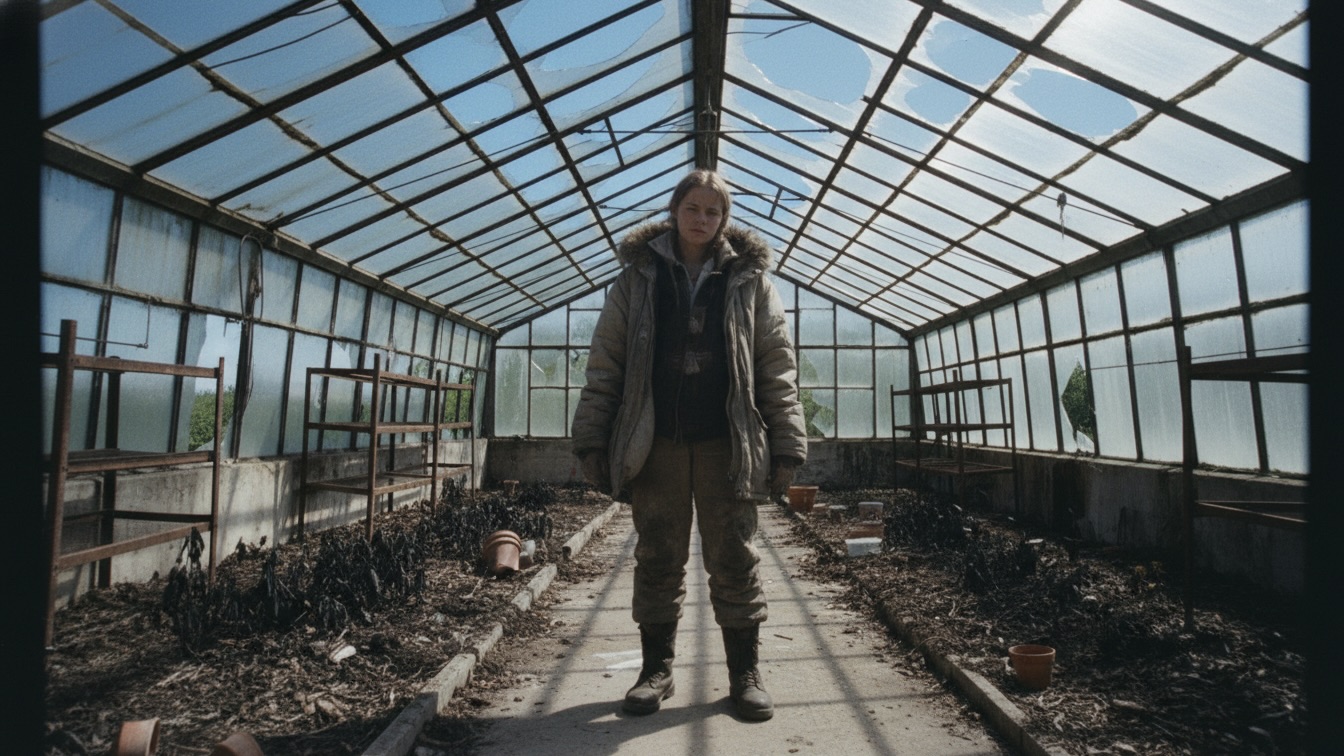
The August sun blasted through the frost-choked glass, illuminating the rot. The tomatoes were completely dead.
The thermometer nailed to the aluminum framing read twelve degrees below zero. Outside the glass, the sky was a searing, cloudless August cobalt. The kind of sky that belonged over a public pool. Here, the sun just glared off the ice-choked panes, throwing blinding white geometric shapes across the dead soil.
I dug my thumbnail into the skin of a sun-tomato. It gave way instantly. Black liquid oozed over my knuckle. The flesh beneath the skin was the consistency of wet ash.
"Shit's dead, Richard."
Richard stood by the door. He didn't have his coat zipped all the way up. He was wearing a thin cotton t-shirt underneath his parka, a stupid choice for the Northern Districts, even in the middle of this cursed summer. He kicked the side of an empty galvanized bucket. It tipped over. It didn't roll. The bottom was frozen to the damp concrete.
"It's been dead for three weeks, Edith."
"The solar-weaves were supposed to hold the heat. Tracey said she patched the grid."
"Tracey says a lot of things." Richard crossed his arms. He looked at the ceiling. The glass panels up there were webbed with frost. The UV lamps were dark. They hadn't kicked on since Tuesday.
I wiped the black tomato sludge onto the thigh of my insulated pants. It left a dark, oily streak. I reached for another tomato on the vine. It crumbled before I could even pull it free. The entire plant was black. The leaves were brittle, shattering like dry leaves in autumn, scattering across the frozen dirt. This was our grandmother's greenhouse. The enchantments woven into the foundation were supposed to keep the soil at a steady seventy degrees, regardless of the unnatural magical winter that had locked the North in permafrost. The enchantments were failing. The extraction mines to the east were draining the ambient magic from the bedrock.
"We can string up the secondary thermal blankets," I said. I looked at the corner where the heavy metallic tarps were folded. "If we double them up over the northern wall, we might save the root vegetables. The carrots are deep. They might survive the freeze."
"I'm not stringing up the blankets."
"It will take twenty minutes."
"I'm not doing it, Edie."
I turned to face him. He was looking at his boots. They were new. Thick tread, reinforced steel toes, insulated synthetic leather. They weren't the seal-hide boots we wore for ice-hunting. They were corporate issue. Standard gear for the Southern Citadels.
"Where did you get those?"
He shifted his weight. The ice on the concrete crunched under his soles. "Guild recruiter came through the outpost yesterday. Set up a folding table in the tavern."
"You talked to a recruiter."
"I signed a contract."
The silence in the greenhouse was absolute. Even the wind outside had stopped. The blinding summer sun beat down on the glass, providing light but absolutely zero heat. My hands were going numb inside my gloves.
"You're leaving," I said.
"My transport leaves tomorrow morning. 0600 hours."
"You're taking a job with the extraction guild. The same people who are bleeding the permafrost. The same people who killed this greenhouse."
"The greenhouse was dying anyway." He pointed a gloved finger at the ruined tomatoes. "Look at this. Look at us. We're starving in the dark, and it's August. The climate is broken. The magic is gone. The ice-hunting legacy is a joke. There are no fish left in the rivers. The herds moved south three years ago."
"The silver-trout are still in the Spirit-Ice lakes."
"A myth."
"Grandma caught them."
"Grandma is dead."
I stepped toward him. My boot caught on a frozen irrigation hose. I stumbled, catching myself on the edge of a wooden planter box. The wood was splintered and covered in rime. "You're abandoning the community. You're abandoning me."
"I'm sending money back. The pay is triple what I'd make doing maintenance on the solar-weaves here. They give you a housing stipend. A food allowance. Real food, Edie. Not rations. Not frozen root vegetables. Fresh meat. Hydroponic greens."
"It's soul-crushing work. You'll be feeding the machines that are freezing us out."
"I'll be surviving."
"Get out."
"Edie—"
"Get out of the greenhouse."
He stared at me for a long time. His jaw worked. He wanted to say something else, something to make himself feel better, to make the betrayal sting less. But he just turned around, shoved the heavy metal door open, and walked out into the glaring, freezing summer day. The door slammed shut behind him. The sound rattled the glass panes. A chunk of frost dislodged from the ceiling and shattered on the concrete floor.
The community council meeting was held in the basement of the old municipal building. The room was lit by flickering fluorescent tubes that buzzed like dying insects. The walls were painted a pale, institutional green, peeling in long strips near the baseboards where the dampness crept in. Rows of mismatched folding chairs faced a low wooden stage.
I sat in the third row. The plastic of the chair was freezing.
Auntie Tracey was at the podium. She wasn't my real aunt, just a woman who had known my mother and grandmother. She wore a heavy knit sweater that hung off her frame. She gripped the edges of the podium so hard her knuckles were white.
"The solar-weaves are operating at fourteen percent efficiency," she said. Her voice echoed off the low ceiling. "Fourteen. We lose another panel on the western ridge, and the entire grid collapses. The secondary generators don't have the fuel to run past October. And that's assuming the extraction mines don't tap the reserve lines again."
Mayor Hayes sat behind a folding table on the stage. He was a small, exhausted man with thinning gray hair and a permanently furrowed brow. He rubbed his temples.
"We submitted the requisition forms to the Capital," Hayes said.
"I don't care about the forms, David. I need the replacement parts. I need the copper wiring. I need the enchantment focuses. The greenhouse is already dead. The residential blocks are dropping below freezing at night. In August."
"The grant money was cut."
The room went entirely still. The buzzing of the fluorescent lights suddenly sounded incredibly loud.
Tracey let go of the podium. "What do you mean, it was cut?"
"The Capital redirected the regional development funds to the Southern Citadels. They're subsidizing the new extraction operations. They determined that our outpost's population density no longer qualifies for the Class-A survival subsidies."
"They cut us off."
"They are offering relocation assistance. For anyone willing to accept placement in the southern labor camps."
A man in the back row stood up. It was Miller, the mechanic. "Labor camps? You mean the guild dormitories."
"They're calling it an integration program," Hayes said. He wouldn't look up from the table.
The system had entirely failed us. There was no rescue coming. The Capital had looked at the spreadsheet, looked at the dwindling numbers of our outpost, and simply deleted our row. We were an acceptable loss.
I didn't stay for the rest of the meeting. I stood up, pushing my chair back. Its metal legs screeched against the linoleum. Several people looked at me. I didn't care. I walked up the concrete stairs and pushed through the heavy double doors into the blinding daylight.
The sun was high and violently bright. It illuminated every crack in the pavement, every rusted vehicle abandoned on the shoulder, every patch of dirty, crystallized snow that refused to melt.
Richard was right about the town. It was dying. But he was wrong about the old ways. He had to be. If the old ways were dead, then we were just waiting to freeze.
I walked straight to my grandmother's shed. The door was locked with a heavy padlock. I knew the combination. Three, zero, nine. The lock snapped open. I pulled the heavy wooden door wide.
Inside, the walls were lined with gear. Coils of synth-rope. Ice axes. Thermal spikes. And in the corner, leaning against the wall, was the ice-auger and the silver-mesh nets.
I dragged the auger out into the light. The metal was dull, scratched from years of use. I tested the manual crank. It groaned, but it turned. I grabbed a heavy canvas rucksack and started pulling supplies off the shelves. Flares. A collapsible tent. High-density rations. A thermos.
I was going to the Spirit-Ice lakes. I was going to hunt the silver-trout. If I could bring back a catch—a real catch, utilizing the old foodways—I could prove to Richard that we didn't have to abandon our legacy. I could prove that the land still provided, even if it was broken. I threw a spool of high-tensile fishing line into the bag.
The trek took six hours. It should have taken three.
The summer heat, useless against the permafrost, was playing havoc with the top layer of the winter ice roads. The magical climate shift created a terrifying landscape. The air temperature was freezing, but the direct UV radiation from the cloudless sky was melting the surface ice just enough to create deadly slush pockets.
I walked with my ice axe in my right hand, tapping the ground ahead of me with every step. The glare off the white surface was blinding. I had to pull my goggles down over my eyes, the polarized lenses turning the world into a harsh, high-contrast landscape of sharp grays and blinding whites.
My boots crunched. Then they squelched.
I tapped the ice ahead of me. The axe head sank straight through. I froze. The ice beneath my left boot gave way with a sickening, wet crack.
I plunged downward. The water was violently cold. It felt like a physical blow to my chest. My left leg went in up to the hip. The slush gripped my thigh like wet concrete.
Panic flared in my chest. I threw my weight backward, driving the pick of the ice axe into the solid shelf behind me. The metal bit deep. I hauled myself up, my muscles screaming, dragging my soaked leg out of the freezing water. I rolled onto the solid ice, gasping.
The water on my pants began to freeze immediately. The fabric stiffened. I dragged myself to a patch of exposed rock and sat down.
I unclasped my rucksack with trembling hands. I pulled out the collapsible tent and jammed the carbon-fiber poles together. My fingers were clumsy, numb and uncooperative. I managed to pitch the small dome against the rock outcropping, out of the wind.
I crawled inside and zipped the flap shut. I tore off the freezing pants. My skin was red, mottled with white patches. I grabbed the spare thermal leggings from my bag and dragged them on. They felt like sandpaper against my raw skin.
I sat there in the dark green light of the tent. My chest heaved. The silence of the lakes outside was absolute.
It broke me.
I threw my head back and screamed. It was a ragged, ugly sound. It tore my throat. I screamed at the canvas roof. I screamed at the sky beyond it. I hit the side of the tent with my fist, the nylon fabric snapping loudly. It was so profoundly unfair. Three hundred miles south, in the Citadels, executives were sitting in climate-controlled towers, eating fresh fruit flown in from the equatorial zones, while their machines sucked the magic out of our bedrock and left us to freeze in August. They gorged. We starved.
I cried until my eyes burned and my lungs ached.
When I finally crawled out of the tent, the sun was beginning its slow descent, turning the sky the color of a bruised peach.
I walked down to the edge of the Spirit-Ice lakes.
Something moved on the far bank.
I stopped. I reached for the flare gun on my belt.
It was a spirit-bear. They used to be the guardians of the lakes, massive creatures with fur that shimmered like starlight and eyes that burned with raw, ambient magic.
This creature did not shimmer.
It was emaciated. Its ribcage protruded sharply against its flanks. Its fur was falling out in massive, ugly clumps, exposing gray, scaly skin underneath. It dragged its back left leg as it walked. It paused at the edge of the lake and lowered its massive head to the ice. It didn't look at me. Its eyes were cloudy, dull, and lifeless. It was poisoned. The runoff from the extraction mine had seeped into the groundwater. The land itself was rotting from the inside out.
The bear turned and lumbered away, disappearing behind a ridge of jagged ice.
I walked out onto the lake. I found a spot where the ice looked dark and solid. I set up the auger.
I cranked the handle. The metal blades ground against the ice. It took forty minutes of exhausting, back-breaking labor to cut through the three-foot shelf. My shoulders burned. My breath plumed white in the air.
When the water finally surged up through the hole, it was black and swirling.
I unwound the silver-mesh net and dropped the line.
I sat on my rucksack. I waited.
One hour. Two hours. The sun dipped below the horizon, and the temperature plummeted drastically. The cold seeped through my boots, through my layers, settling into my bones. My teeth chattered so hard my jaw ached.
Finally, the line snapped taut.
I grabbed it with both hands and pulled. The nylon dug into my gloves. I hauled the net up through the hole, hand over hand, my muscles screaming in protest.
The net cleared the water and hit the ice with a wet slap.
Inside the mesh, a single silver-trout flopped weakly. It was small. Barely the length of my forearm. Its scales were dull, lacking the iridescent glow the stories always described. It gasped, its gills flaring, until the freezing air stilled it completely.
One fish. After all this. It was barely enough to feed myself, let alone the town.
I walked back into the outpost just as the morning sun hit the rusted roofs of the residential blocks. My legs felt like lead. The rucksack was light, but it felt like it weighed a hundred pounds.
I opened the door to our unit. The hinges screamed.
Richard was standing in the middle of the living room. His heavy canvas duffel bag was on the table. He was stuffing a gray thermal shirt into the side pocket. The television in the corner was on, displaying a static-filled broadcast of the Southern Citadels. Towering glass spires. Green parks.
He looked up when I walked in. He saw the ice on my gear. He saw the exhaustion in my posture.
"Where were you?" he asked. His voice was tight.
I dropped the rucksack onto the floor. I reached inside and pulled out the single, frozen silver-trout. I tossed it onto the kitchen counter. It hit the laminate surface with a dull thud.
"The lakes," I said. My voice was hoarse.
Richard looked at the fish. He didn't look impressed. He looked devastated.
"You went out to the rotting ice alone?" He took a step toward me. "Are you out of your mind? You could have fallen through the slush."
"I did fall through. I survived."
"For what?" He pointed at the tiny fish on the counter. "For that?"
"It's proof. The old foodways. They're still there."
"Edith, look at it!" He grabbed the fish by the tail and held it up. "It's practically a minnow. It's starved. Just like the rest of us."
"It's a start."
He slammed the fish back down on the counter. "Tradition doesn't pay the hydro bill or put food on the damn table, Edith! We are dying here!"
"We just have to try harder."
"I am trying!" He grabbed his duffel bag and zipped it shut violently. The zipper snagged on a piece of fabric. He yanked it until it tore loose. "I am leaving everything I know so that I can send credits back so you don't freeze to death in your sleep! I am selling myself to the guild so you can survive!"
I stared at him. The fight drained out of me all at once, leaving behind a crushing, melancholic certainty.
He was right.
I looked at the scuffed linoleum. I looked at the peeling wallpaper. I looked at the pathetic, frozen fish on the counter. The old ways were not enough to fight a broken, modern system. The magic was gone. The land was poisoned. My stubbornness wasn't going to save us.
I walked over to the counter. I picked up a knife.
"Sit down," I said quietly.
We didn't speak while I cleaned the fish. I scraped the dull scales off into the sink. I fileted the meager amount of meat from the bones. I put the filets in a pan with a drop of synthetic oil. The oil hissed.
We sat at the small kitchen table. I divided the fish onto two ceramic plates. It was barely two bites each.
We ate in complete silence. The only sound in the room was the scraping of our forks against the plates, and the low hum of the television broadcasting a world we didn't belong to. The fish was tasteless. It tasted like cold water and nothing else.
The next morning, I stood on the edge of the tarmac. The transport ship was a massive, ugly wedge of dark gray metal. Its engines whined, vibrating the ground beneath my boots. The summer sun was blinding, glaring off the hull.
Richard stood in front of me. He had his duffel bag slung over his shoulder.
He reached out and pulled me into a hug. I hugged him back. His jacket was stiff and cold.
"I'll send the first transfer at the end of the month," he said into my hair.
"Okay."
"Don't do anything stupid while I'm gone."
"I won't."
He pulled away, picked up his bag, and walked up the metal ramp. He didn't look back. The ramp retracted. The heavy doors sealed shut. The ship lifted off the tarmac, blowing a cloud of grit and crystallized snow over me. I watched it become a dark speck against the impossibly blue summer sky.
I walked back to the outpost. I didn't go to the apartment. I went to the greenhouse.
I opened the door. The temperature was still freezing. The dead, black tomatoes still hung from the brittle vines.
I took a small, folded piece of wax paper from my pocket. Inside were the bones of the silver-trout. I knelt down on the concrete. I used my bare hands to dig into the frozen dirt in the corner planter box. The soil tore at my cuticles. My fingernails filled with dark earth.
I scraped out a shallow hole. I placed the bones inside. I covered them with the freezing dirt.
I stood up and wiped my hands on my pants. I looked at the ruined plants, at the frost on the glass, at the glaring, useless sun above. I turned off the light switch and walked out, locking the door behind me.
“I looked at the ruined plants, at the frost on the glass, at the glaring, useless sun above, and locked the door behind me.”


