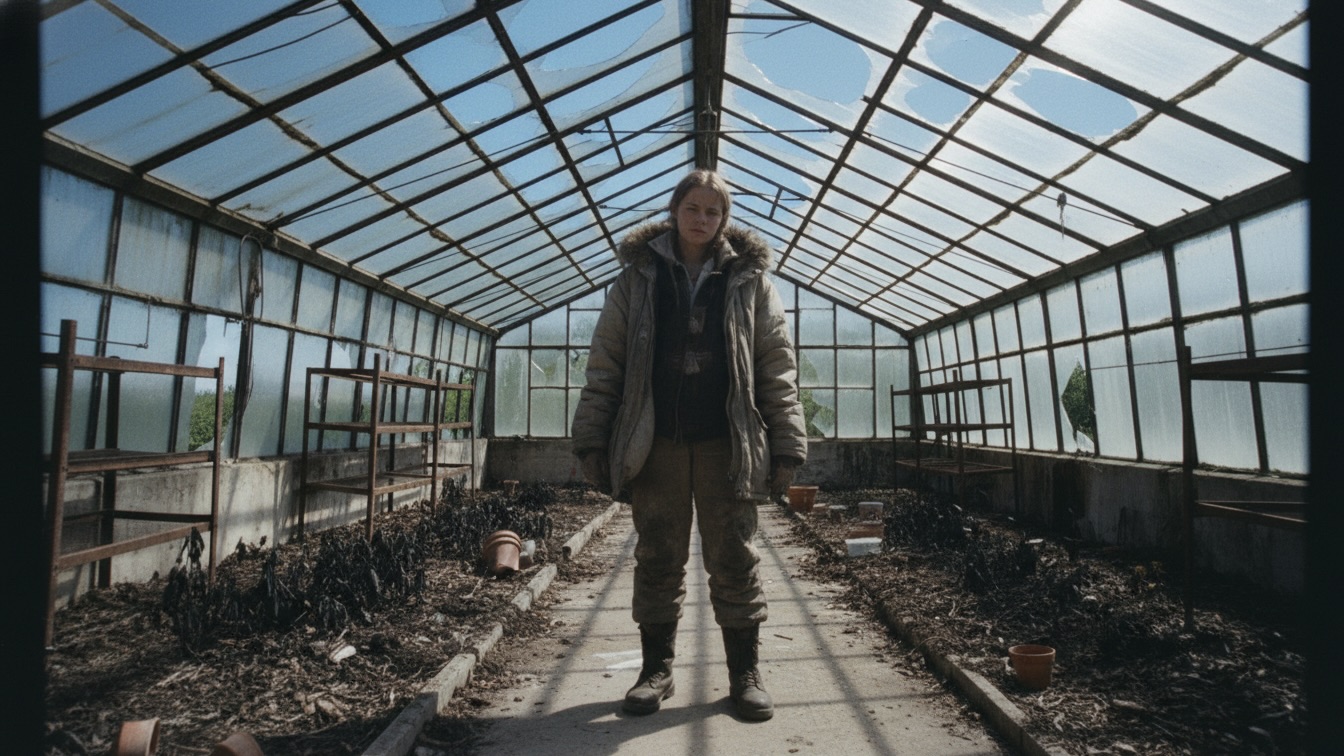
The story opens in a failing greenhouse where Edith and Richard confront the reality of their dying environment. Despite the searing August sun, the Northern Districts are locked in a magical permafrost caused by extraction mines draining the land's natural energy. Richard reveals that he has signed a contract with the very guild responsible for this ecological collapse, intending to move south for survival. Edith, desperate to prove that their traditional way of life is still viable, rejects his pragmatism and witnesses a community meeting where the town is officially abandoned by the Capital.
Driven by a need for validation, Edith embarks on a perilous journey to the Spirit-Ice lakes to hunt the legendary silver-trout. Along the way, she nearly drowns in a slush pocket and encounters a sickly, poisoned spirit-bear, illustrating the total degradation of the wilderness. She eventually catches a single, stunted fish that lacks the magical luster of her grandmother's tales. Returning home, she shares a final, silent meal with Richard before he departs for the Southern Citadels. The narrative concludes with Edith burying the fish bones in the frozen soil of the greenhouse, a quiet act of mourning for a lost world.
The central theme of the narrative is the tension between traditional identity and the brutal necessity of survival. Edith represents the "old ways," clinging to the belief that the land will provide if one remains faithful to the legacy of their ancestors. Her struggle is not merely against the cold, but against the erasure of her cultural heritage by a modern, industrial force. Richard, conversely, embodies the painful transition into a corporate-dependent existence, where survival requires the sacrifice of one's soul and community.
Environmental exploitation serves as a secondary, pervasive theme that mirrors real-world ecological anxieties. The "unnatural magical winter" is a direct consequence of human greed, as the extraction mines hollow out the bedrock for the benefit of distant citadels. This creates a parasitic relationship where the periphery is left to freeze while the core thrives on its stolen resources. The imagery of the "searing, cloudless August cobalt" sky provides a haunting irony, as the sun offers light but no warmth, symbolizing a world that is visually beautiful but functionally dead.
Furthermore, the story explores the theme of institutional abandonment and the cold mathematics of bureaucracy. The Capital’s decision to delete the outpost's row from a spreadsheet highlights how human lives are reduced to data points in a cost-benefit analysis. When the grant money is redirected to subsidize the very operations destroying the North, the cycle of exploitation is complete. This systemic failure leaves the characters with no "good" options, forcing a choice between starving with dignity or surviving in servitude.
Edith is a character defined by her fierce, almost pathological attachment to the past. As a psychologist might observe, her refusal to acknowledge the death of the greenhouse suggests a state of complicated grief. She views the failing enchantments not as a technical reality, but as a personal betrayal of her grandmother’s legacy. This emotional anchor prevents her from adapting, leading her to risk her life for a "proof" that the world has already rendered obsolete.
Her journey to the Spirit-Ice lakes is a desperate attempt to reclaim a sense of agency in a world where she has none. When she falls through the ice, her subsequent breakdown in the tent reveals the fragility beneath her hardened exterior. She is not just angry at Richard; she is terrified of a future where she no longer knows who she is without the land. Her final act of burying the fish bones indicates a shift from denial to a grim, ritualistic acceptance of death.
Richard operates on a psychological framework of pragmatic survivalism. He has moved past the stage of mourning and has entered a phase of cold calculation, recognizing that nostalgia is a luxury they can no longer afford. His decision to wear corporate-issue boots is a symbolic shedding of his local identity in favor of a functional, albeit soul-crushing, future. He perceives his departure not as an abandonment, but as a sacrificial act to provide for Edith through remittances.
His interactions with Edith are marked by a suppressed guilt that manifests as irritation. He mocks the "myth" of the silver-trout because believing in it would make his choice to leave much harder to justify. He represents the segment of a displaced population that chooses "integration" over extinction, even if that integration means feeding the machine that destroyed his home. His silence during their final meal reflects the heavy emotional toll of his decision, as he realizes that even "real food" will taste like ashes.
The prose is characterized by a stark, high-contrast aesthetic that emphasizes the sensory dissonance of the setting. The author uses "searing" and "blinding" to describe the sun, juxtaposing it against the "ice-choked" and "frozen" reality of the ground. This creates a feeling of exposure and vulnerability, where even the light feels hostile rather than life-giving. The description of the sun-tomato as "wet ash" and "black liquid" provides a visceral sense of rot that permeates the entire narrative.
Pacing in the story is deliberate and heavy, mirroring the physical effort required to move through a frozen landscape. The transition from the claustrophobic greenhouse to the vast, empty lakes allows the reader to feel the scale of the isolation. The silence of the environment is a recurring motif, broken only by the "screaming" of hinges or the "rattling" of glass. These sharp, discordant sounds punctuate the stillness, heightening the tension between the characters and their dying world.
The narrative voice is grounded and unsentimental, which makes the moments of magical realism—like the spirit-bear—feel even more tragic. By describing the bear as "emaciated" and "poisoned" rather than majestic, the author grounds the fantasy elements in a gritty, ecological reality. The television broadcast of the Southern Citadels serves as a stylistic window into a different world, providing a jarring counterpoint to the "static-filled" and "peeling" reality of the outpost. This contrast reinforces the sense of a fractured society where the future and the past can no longer coexist.


