He woke to the smell of hot dust and old urine, his ribs grinding against the subway tiles.
The floor of the subway station was a mosaic of filth. Paul lay flat on his back. His cheek rested against the cool, grimy tiles. The grout lines were black with years of compacted dirt. He opened his eyes. The fluorescent lights overhead flickered. They emitted a low, mechanical hum. The sound vibrated in his skull. He blinked. His eyelashes stuck together. Sweat. The air in the station was thick. It was August. The city above was baking, and the heat sank down into the tunnels, trapping the humidity. It smelled of dried urine, hot iron, and stale pretzels.
He tried to sit up. A sharp, electric pain shot through his right side. He gasped. His hand flew to his ribs. He felt the swollen mass beneath his thin, gray t-shirt. The mugging was two days ago. Or maybe three. Time bled together down here. Three men in an alley near the garment district. They didn't even speak. They just hit him. They took his phone, his wallet, and his boots. They left him with a bruised rib, a split lip, and a pair of oversized, discarded hospital socks he had found in a trash can. He pressed his fingers against the rib. He winced. The pain was localized, sharp, and grounding. It reminded him he was still breathing.
He rolled onto his left hip. The effort cost him. He pulled his knees toward his chest. His stomach growled. A hollow, echoing sound. He hadn't eaten since yesterday morning. Half a bag of stale potato chips he found on a park bench. The salt had burned his split lip.
He thought of Chloe. The thought came uninvited. It always did when he was in pain. Her face formed in the shadows near the ticket booth. The way she chewed her bottom lip when she was lying. The way she had looked at him outside the laundromat. The smell of fabric softener and bus exhaust. "I can't do this anymore," she had said. Her voice was flat. Transactional. Like she was canceling a gym membership. She didn't look at him. She looked at a discarded receipt on the sidewalk. "You're broken, Paul. And I don't have the glue." Then she walked away. Two years. Gone in forty seconds.
Paul pushed the memory away. He looked across the tracks. The third rail gleamed dully in the artificial light. A large gray rat scuttled along the edge of the platform. It stopped, sniffed a discarded candy wrapper, and disappeared into the gloom.
Then he saw it.
About ten feet to his left, near a cracked pillar, something bright interrupted the gray. A patch of yellow. He squinted. It was a sunflower. A single, small sunflower growing straight up out of a jagged crack in the concrete platform. The stem was thick and green. The petals were a vibrant, defiant yellow. There was no sunlight down here. There was no soil. Just concrete, trash, and the toxic dust of grinding train brakes. Yet, there it was. Surviving.
Paul stared at it. He felt a strange tightness in his chest. It had nothing to do with his ribs.
Heavy footsteps echoed down the tiled hallway leading to the platform.
Paul didn't move. He didn't have the energy to run. If it was a transit cop, he would just let them arrest him. At least holding cells had cots. At least they had baloney sandwiches.
The footsteps grew louder. A figure emerged from the shadow of the stairwell.
It wasn't a cop. It was Daniel.
Daniel wore a heavy, olive-green army jacket. It was easily ninety-five degrees in the station, but Daniel wore the jacket zipped halfway up. He was sweating profusely. Drops of moisture clung to his eyebrows and rolled down his unwashed neck. His boots were scuffed steel-toe work boots. He carried a canvas duffel bag over one shoulder.
Daniel stopped. He looked down at Paul.
"You look like hell," Daniel said.
"I feel like hell," Paul said.
"You're sleeping on the floor."
"I'm resting."
"Resting is for the dead, kid."
Daniel dropped the duffel bag. It hit the tiles with a heavy thud. He squatted down next to Paul. The smell of unwashed bodies and cheap tobacco rolled off him.
"What happened to your face?" Daniel asked.
"Walked into a door."
"Looks like the door had knuckles."
Paul didn't answer. He looked at the sunflower.
Daniel followed his gaze. He snorted. "Nature finds a way. Or whatever that movie said."
"It shouldn't be growing here," Paul said.
"Lot of things shouldn't be here," Daniel said. He reached into his jacket pocket. He pulled out a crumpled pack of cigarettes. He extracted one bent cigarette. He lit it with a plastic lighter. The flame illuminated the dirt caked in the lines of his face. He took a drag. The cherry glowed red. He blew the smoke up toward the ceiling.
"You hungry?" Daniel asked.
"No."
"Your stomach is louder than the L train."
"I don't have any money."
"I didn't ask if you had money. I asked if you were hungry."
Paul looked back at him. "Yeah. I'm hungry."
"Get up."
"Where are we going?"
"The Copper Pot."
Paul frowned. The pain in his ribs flared as he shifted his weight. "That's a myth."
"It's not a myth. It's on 14th and Avenue D. Underground."
"I've heard the stories. A rogue chef feeding the homeless five-star meals. It's a fairy tale."
"You think I believe in fairy tales?" Daniel asked. He took another drag. "I ate there last week. Braised short rib. Garlic mashed potatoes. Real butter."
Paul swallowed. His mouth was dry. The thought of real butter made his teeth ache.
"Why are you telling me?" Paul asked.
"Because you look like you're going to die on this platform. And I hate the smell of dead bodies."
"I'm not going to die."
"You will if you don't eat. Get up."
Paul rolled onto his hands and knees. The concrete bit into his palms. He pushed himself up. His head spun. The station tilted to the left. He grabbed the tiled pillar to steady himself. The tiles were cold against his palm. He closed his eyes. He counted to three. The vertigo passed. He opened his eyes.
"You got shoes?" Daniel asked, looking at Paul's hospital socks.
"No."
"You're going to walk through the East End in socks?"
"I guess so."
Daniel shook his head. He unzipped the duffel bag. He rooted around inside. He pulled out a pair of black canvas sneakers. The soles were worn flat. The laces were frayed.
"Put these on," Daniel said. He tossed them.
They hit Paul's chest. He caught them. They smelled like mold.
"Thanks."
"Don't thank me. Just don't bleed on them."
Paul slipped the sneakers on. They were a size too big. He pulled the laces tight. He tied a double knot. He stood up straight. The pain in his ribs settled into a dull, manageable ache.
"Let's go," Daniel said. He picked up his bag. He turned and walked toward the stairs.
Paul looked back at the sunflower one last time. It stood there, small and bright against the grime. He turned away and followed Daniel up the stairs, into the suffocating heat of the city above.
The heat index above ground was punishing. As Paul stepped out of the subway entrance, the sun hit him like a physical blow. The air shimmered above the asphalt. The pavement radiated heat, warming the thin soles of the borrowed sneakers. Cars crawled down the avenue, their tires sticky on the melting tar. The noise was constant. Honking horns. Sirens. A jackhammer tearing up the sidewalk a block away.
Daniel walked with purpose. He kept his head down. He hugged the shadow of the buildings.
"Keep up," Daniel said over his shoulder.
Paul quickened his pace. His ribs protested with every step. The oversized sneakers slapped against the concrete.
"How far is it?" Paul asked.
"Twenty blocks east. Then down."
"We're going into monitor territory."
"I know."
"They'll charge a toll just to walk down the block."
"I know."
"Do you have cash?"
"No."
"Then how are we going to pass?"
Daniel stopped. He turned around. He looked at Paul. His eyes were flat. Dead.
"We improvise."
They walked past a row of shuttered storefronts. Plywood covered the windows. Graffiti covered the plywood. Tag after tag. Overlapping colors. Blue over red. Black over silver. A group of men stood on the corner. They wore tank tops. They were passing a brown paper bag back and forth. One of them looked at Paul. He had a tattoo of a tear under his left eye. He didn't smile. He just watched them pass.
Paul kept his eyes forward.
They reached a small park. It was mostly concrete. A few dying trees struggled in square planters. A fountain in the center was dry. The basin was filled with discarded coffee cups and fast-food wrappers.
"Hold up," Daniel said.
He pointed toward a bench under a sickly elm tree. A man in a gray business suit was asleep on the bench. He had a briefcase tucked between his legs. His mouth hung open. A gold filling caught the harsh sunlight. His tie was loosened. Sweat stained the armpits of his suit jacket. He had clearly missed his stop, wandered off the train, and passed out from the heat and the alcohol.
"Look at this guy," Daniel said. His voice dropped to a whisper.
"What about him?" Paul asked.
"He's a walking ATM."
"No," Paul said. "I'm not doing that."
"You want to eat at the Copper Pot?"
"Not like this."
"The monitors won't take IOUs. We need cash."
"We'll find cans. We'll recycle."
"It's twenty blocks. We don't have time for cans. The kitchen closes at three."
Daniel didn't wait for an answer. He walked quietly toward the bench. His work boots made no sound. He moved with practiced ease. He stood over the sleeping man.
Paul watched. His stomach turned over. He felt sick. The heat was making him dizzy. He leaned against a chain-link fence. The metal was hot. It burned through his thin shirt.
Daniel reached into the man's breast pocket. His fingers were quick. He pulled out a silver money clip. It was thick with bills. He slipped the clip into his own jacket pocket. He didn't touch the briefcase. He stepped back. He walked back to Paul.
"Done," Daniel said.
"You're a thief," Paul said.
"I'm a survivor. There's a difference."
"Is there?"
"Yeah. The survivor gets to eat dinner."
Daniel pulled the money clip out. He peeled off a twenty-dollar bill. He handed it to Paul.
"What's this?" Paul asked.
"Your cut. Hold onto it. Case we get separated."
Paul stared at the bill. It was crisp. It felt heavy in his hand. He folded it. He shoved it deep into his front pocket.
They kept walking. Two blocks later, they passed a bodega. The door was propped open with a milk crate. A blast of artificial cold air spilled out onto the sidewalk. It felt like heaven.
"Wait here," Daniel said.
He walked into the bodega. He came out a minute later. He held two brightly colored plastic tubes. Ice pops. They were already melting in the heat.
He handed one to Paul. It was red. Cherry.
"Lunch appetizer," Daniel said.
Paul tore the plastic top off with his teeth. He squeezed the bottom of the tube. The frozen sludge slid up. He took a bite. The artificial cherry flavor exploded in his mouth. It was cold. It was sweet. It was the best thing he had tasted in days.
They sat on the curb. They ate in silence. The ice pop melted fast. Red liquid ran down Paul's wrist. It was sticky. He wiped it on his jeans.
"You're quiet," Daniel said. He was eating a blue one. His tongue was stained purple.
"Just tired."
"You were thinking about a girl. Down in the station. I saw your face."
Paul stopped chewing the ice. "How do you know?"
"You had that look. Like somebody kicked your dog. Only a girl gives a guy that look."
"Her name was Chloe."
"Was?"
"She left."
"They always do."
"She said I was broken."
Daniel laughed. It was a harsh, scraping sound. "Everyone is broken, kid. The whole city is broken. Look around. The streets are cracked. The pipes leak. The politicians steal. The cops look the other way. The girl was just looking for an excuse."
"I loved her."
"Love is a transaction," Daniel said. He squeezed the last of the blue sludge into his mouth. He tossed the plastic wrapper into the gutter. "You trade time and energy for security and warmth. When the trade stops being profitable, the contract is terminated. That's it."
"That's a sad way to live."
"It's an accurate way to live. Saves you a lot of grief."
Paul looked at the red wrapper in his hand. He squeezed the last drops of cherry juice onto his tongue. He didn't want to agree with Daniel. But standing outside the laundromat, looking at Chloe's blank face, he had felt the exact same way. A contract terminated. A transaction complete.
"Come on," Daniel said. He stood up. "We're hitting the border."
Paul stood. He looked down the street. The buildings grew closer together here. The shadows were deeper. At the intersection, four men sat on folding chairs. They blocked the crosswalk. They held baseball bats loosely in their laps.
The block monitors.
Daniel didn't slow down. He walked straight toward them. Paul followed, his heart hammering against his bruised ribs.
The monitors didn't stand up. They didn't have to. The threat was implicit in the way they sat. Relaxed. Bored. Dangerous.
The leader was a heavy-set man wearing a soiled white tank top. A thick gold chain rested on his chest. Sweat glistened on his shaved head. He tapped the end of his aluminum bat against the pavement. Tink. Tink. Tink.
"Toll road," the leader said. His voice was thick with phlegm.
"Just passing through, Mark," Daniel said.
Mark stopped tapping the bat. He looked Daniel up and down. Then he looked at Paul. He sneered.
"Fifty," Mark said.
"It was twenty last week."
"Inflation. Fifty. For both of you."
Daniel didn't argue. He reached into his pocket. He pulled out the silver money clip. He peeled off a fifty-dollar bill. He handed it to Mark.
Mark took the bill. He held it up to the sun, checking the watermark. He grunted. He waved his hand. The other three men shifted their chairs back an inch. Just enough room to squeeze through.
"Keep moving," Mark said.
Daniel and Paul squeezed past. Paul held his breath. He could smell Mark's sour body odor. He felt the cold stare of the other men on his back until they turned the corner.
"You know him?" Paul asked once they were out of earshot.
"I know everyone who holds a bat in this zip code," Daniel said.
They walked another three blocks. The neighborhood decayed rapidly. The bodegas were gone. The sidewalks were littered with broken glass and burnt foil. People slept in doorways. Some muttered to themselves. Some lay perfectly still, their chests rising in shallow, erratic rhythms.
Daniel slowed down. He was looking at the trash cans.
"What are you doing?" Paul asked.
"Looking for dessert."
Daniel stopped at a large green municipal trash can. It was overflowing. Flies swarmed in a thick black cloud above it. The smell of rotting garbage hit Paul's nose. He gagged.
Daniel didn't seem to notice the smell. He dug his hands into the trash. He moved a greasy pizza box. He pushed aside a pile of wet newspapers.
"Got something," Daniel said.
He pulled his hands out. He held a crumpled white paper bag. Grease stained the bottom. He opened it and peered inside.
"Jackpot."
He pulled out half a sandwich. It was wrapped in clear plastic. Salami and provolone on a hero roll. The bread was slightly hard around the edges, but the meat looked untouched.
"Someone took three bites and threw it away," Daniel said. He marveled at it. "Rich people. God bless them."
He unwrapped the plastic. He offered the sandwich to Paul.
"Eat."
Paul looked at the sandwich. Then he looked at the trash can. The flies buzzed louder. His stomach cramped with hunger, but his throat closed up.
"I'm not eating garbage."
"It's wrapped in plastic. It's clean."
"It was in the trash, Daniel."
"Your loss."
Daniel took a massive bite. He chewed loudly. He closed his eyes. "Mustard. Good mustard, too."
"Hey!"
A voice echoed down the alley to their left.
Paul turned. Three young men stepped out of the shadows. They were thin. Emaciated. Their eyes were wide and erratic. Junkies. The one in the middle had a jagged scar running from his ear down to his collarbone. He was shirtless. His ribs showed through his skin.
"That's our can," the scarred man said. He pointed a trembling finger at the trash bin.
Daniel stopped chewing. He swallowed the bite of sandwich. He didn't look scared. He looked annoyed.
"I didn't see your name on it," Daniel said.
"We work this block. Everything in that can belongs to us."
"It's half a sandwich," Daniel said. "You want it? Come get it."
He held the sandwich out. A taunt.
The scarred man reached into the back pocket of his jeans. He pulled out a switchblade. He pressed the button. The blade snapped out with a sharp click. The metal caught the sunlight. It was dull and spotted with rust.
"Give us the bag," the man said. "And your pockets. Empty them."
The other two men stepped forward. One of them picked up a broken glass bottle from the gutter.
Paul stepped back. His hands went up. "We don't want any trouble."
"Too late," the scarred man said. He lunged.
He moved fast. Faster than Paul expected. The knife arced toward Daniel's stomach.
Daniel dropped the sandwich. He sidestepped the thrust. He grabbed the scarred man's wrist with both hands. He twisted hard. A loud pop echoed in the alley. The man screamed. The knife clattered to the pavement.
Daniel didn't stop. He drove his heavy steel-toe boot into the side of the man's knee. Another crack. The man collapsed, howling in pain.
The other two stopped. They looked at their leader writhing on the ground. They looked at Daniel.
"Run," Daniel yelled.
He grabbed Paul by the shirt. He shoved him forward.
They sprinted down the street. Paul's ribs screamed. Every step was a jolt of pure agony. He tasted blood in his mouth. He was breathing too hard. The hot air burned his lungs.
They turned a corner. Then another. They ran past an abandoned factory. The windows were shattered.
"In here!" Daniel yelled.
He pointed to a gap in the chain-link fence surrounding an old, disused subway entrance. The stairs led down into absolute blackness. The grate that usually covered it had been torn away.
They squeezed through the gap in the fence. They hurried down the concrete stairs. The temperature dropped immediately, but the air was stale and heavy.
At the bottom of the stairs, they stopped. They stood in the dark. Listening.
Silence. Just the sound of their own ragged breathing.
"I think we lost them," Paul gasped. He leaned against the damp concrete wall. He clutched his ribs.
Daniel was breathing hard, but he recovered faster. He reached into his jacket. He pulled out a small flashlight. He clicked it on. A narrow beam of yellow light cut through the dark.
The tunnel was massive. It wasn't a passenger tunnel. It was an old maintenance access shaft. The ground was covered in stagnant water. The walls were lined with rusted pipes. The smell of rot was overpowering.
"Where are we?" Paul asked.
"Under the East End. This connects to the old pneumatic tube system. It'll take us right to the Copper Pot."
Daniel shined the light down the tunnel. The beam didn't reach the end.
"Come on," Daniel said. He started walking.
Paul followed. The water splashed around his borrowed sneakers. It seeped through the canvas. His feet were instantly soaked in cold, grimy sludge.
They walked for ten minutes. The silence was heavy. The only sound was the sloshing of water.
"You're pretty good in a fight," Paul said.
"I'm good at surviving."
"You broke his arm."
"He was going to stab me over a piece of salami. He earned it."
Daniel stopped. He turned around. He shined the flashlight directly into Paul's face.
Paul squinted. He threw a hand up to block the glare. "Hey. Watch it."
"I need that twenty," Daniel said.
His voice was different. It wasn't conversational anymore. It was flat. Hard.
"What?" Paul asked.
"The twenty I gave you. Hand it over."
"You said it was my cut. In case we got separated."
"We're about to get separated."
Before Paul could react, Daniel lunged. He didn't use a knife. He used the heavy metal casing of the flashlight. He swung it hard. It caught Paul flush on the cheekbone.
Paul saw a flash of white light. His vision blurred. He stumbled backward. He tripped over a submerged pipe. He fell hard into the stagnant water. The water filled his nose. He choked.
He tried to get up. A heavy steel-toe boot slammed into his already bruised ribs.
Paul screamed. The sound echoed down the long, dark tunnel.
He curled into a ball in the water. He couldn't breathe. The pain was absolute. It consumed his entire world.
He felt hands digging into his pockets. Rough hands. They found the twenty-dollar bill. They pulled it out.
"Nothing personal, kid," Daniel's voice floated down from above. "Like I said. Love is a transaction. So is survival. Thanks for the distraction with those junkies."
Footsteps splashed away. The beam of the flashlight bounced against the walls, growing fainter and fainter.
Then, total darkness.
The dark was absolute. It was a physical weight pressing against his eyeballs. Paul lay in the water. The cold seeped into his bones. His ribs throbbed in time with his racing heartbeat. His cheek was swollen. He tasted mud and blood.
He wanted to stay there. It would be easy. Just close his eyes. Let the water rise. Let the city bury him. Chloe was right. He was broken.
But then he smelled it.
It was faint at first. A ghost of a scent drifting through the damp air. Garlic. Roasting pork. The sharp tang of caramelized onions. It cut through the smell of rot and stagnant water like a knife.
His stomach knotted. The hunger was stronger than the pain. The instinct to survive overriding the desire to quit.
He forced himself onto his hands and knees. The water dripped from his chin. He pushed himself up. He leaned against the curved wall of the tunnel. The concrete was slick with slime. He took a breath. Fire flared in his chest.
He began to walk.
He kept his right hand on the wall, using it as a guide. He dragged his feet, testing the ground before committing his weight. Every step was a negotiation with agony. The smell grew stronger. The rich, intoxicating aroma of fat dripping onto hot coals.
Minutes stretched into hours. Time lost all meaning in the dark.
Then, he saw a flicker. A dim orange glow bouncing off the wet walls ahead.
He moved toward it. The tunnel curved slightly to the left. As he rounded the bend, the glow intensified.
At the end of the tunnel stood a heavy, rust-covered iron door. It was propped open with a cinderblock. Light spilled out from the opening, illuminating the muddy water at Paul's feet.
He reached the door. He leaned his forehead against the cold iron. He closed his eyes. He had made it. The Copper Pot. The myth was real.
He stepped inside.
The room was vast. It looked like an old, subterranean boiler room. Thick pipes crisscrossed the ceiling. The heat in the room was stifling. It was easily a hundred degrees.
But it wasn't a five-star restaurant. It wasn't a secret haven for the city's lost souls.
It was a grim, industrial soup kitchen.
Long folding tables were set up in rows. They were covered in cheap, plastic tablecloths that were sticky with old grease. Dozens of people sat at the tables. They were hunched over plastic bowls. They ate in silence. The only sound was the scraping of plastic spoons and the roar of industrial fans trying to push the heavy air around.
The people were hollow-eyed. Addicts. Runaways. The truly desperate. There was no joy here. No relief. Just the mechanical process of caloric intake.
At the far end of the room stood the kitchen area. A massive, dented aluminum vat sat over an open gas burner. That was the Copper Pot. It wasn't copper. It was cheap steel.
A man stood behind the vat. Chef Simon. He didn't look like a chef. He wore a stained white undershirt and a grimy apron. He was sweating heavily, stirring the vat with a wooden paddle that looked like a boat oar. Two men in sharp suits stood near the wall behind him. They weren't there to serve food. They were there to watch the door. Mob enforcers. This wasn't charity. This was a front.
Paul walked forward. His wet sneakers squeaked on the concrete floor. No one looked up at him. They were too focused on their bowls.
He reached the serving line. Chef Simon didn't make eye contact. He just dipped a plastic ladle into the vat and dumped a measure of liquid into a flimsy styrofoam bowl. He shoved it across the metal counter.
Paul looked down at the bowl.
It wasn't braised short rib. It wasn't garlic mashed potatoes. It was a thin, watery broth. A few oil slicks floated on the surface. A solitary piece of boiled cabbage bobbed in the center.
The smell of roasting pork and garlic had been a trick. It was coming from a small rotisserie oven behind the counter, where three whole chickens were roasting. But those weren't for the line. Those were for the men in the suits.
Paul picked up the bowl. His hands shook. He walked to the nearest empty seat at a folding table. He sat down.
He looked at the person across from him. An older woman. Her hair was matted. She was missing most of her teeth. She didn't acknowledge him. She just kept dipping her spoon into her bowl, bringing it to her mouth, and swallowing.
In the center of the table sat a cracked glass jar. Inside the jar was a sunflower. It was dead. The petals were brown and withered. The stem was bent in half, resting against the rim of the glass. The water in the jar was murky and smelled of decay.
Paul picked up his plastic spoon. He dipped it into the broth. He brought it to his lips.
It tasted like nothing. Warm, salty water. The oil coated the roof of his mouth. He swallowed. His stomach seized, rejecting the sudden intake, but he forced it down.
He took another spoonful. And another. He ate mechanically. He didn't think about Chloe. He didn't think about Daniel. He didn't think about the stolen twenty dollars or the switchblade or the dark tunnel.
He just ate the tasteless soup.
Life was a series of transactions. Daniel was right. The city demanded payment for everything. For passage down a street. For a moment of safety. For a bowl of hot water. And Paul had paid. He had traded the last soft parts of himself for survival.
He finished the bowl. He set the spoon down.
He stood up. He didn't look back at Chef Simon or the men in the suits. He walked past the tables, past the silent eaters, and toward a narrow staircase at the back of the room. The stairs led up. Toward the street level.
He climbed the stairs. His ribs ached, but the pain felt distant now. Dull. He pushed open the heavy metal door at the top of the stairwell.
The afternoon sun hit him instantly. The blinding, punishing summer light. The heat wrapped around him, suffocating and absolute. The noise of the city rushed in to fill the silence of the tunnel. Sirens. Horns. The low, rumbling hum of millions of people scrambling for their own survival.
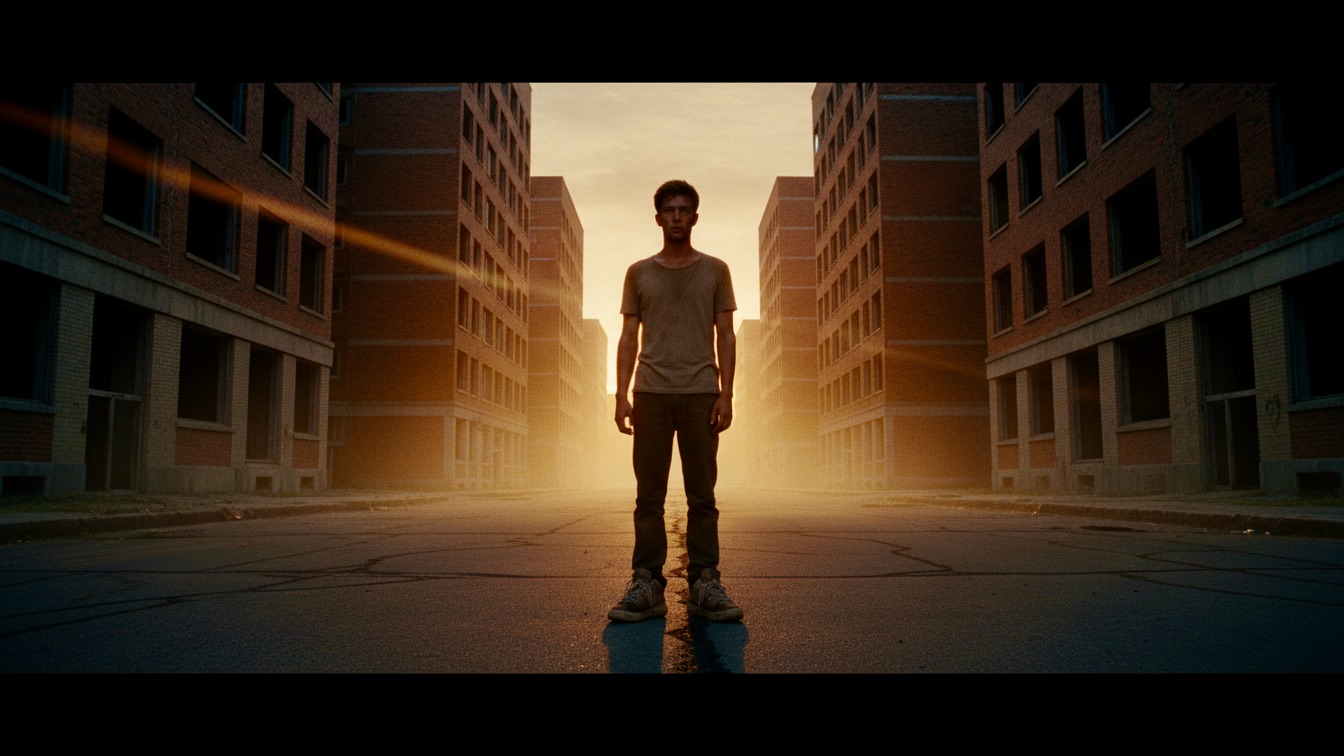
Paul stepped out onto the concrete. He adjusted his stolen, oversized sneakers. He wiped a streak of drying blood from his cheekbone. He looked down the long, shimmering avenue, his eyes narrow, his expression flat, ready to negotiate the next transaction.
“He looked down the long, shimmering avenue, his eyes narrow, his expression flat, ready to negotiate the next transaction.”


