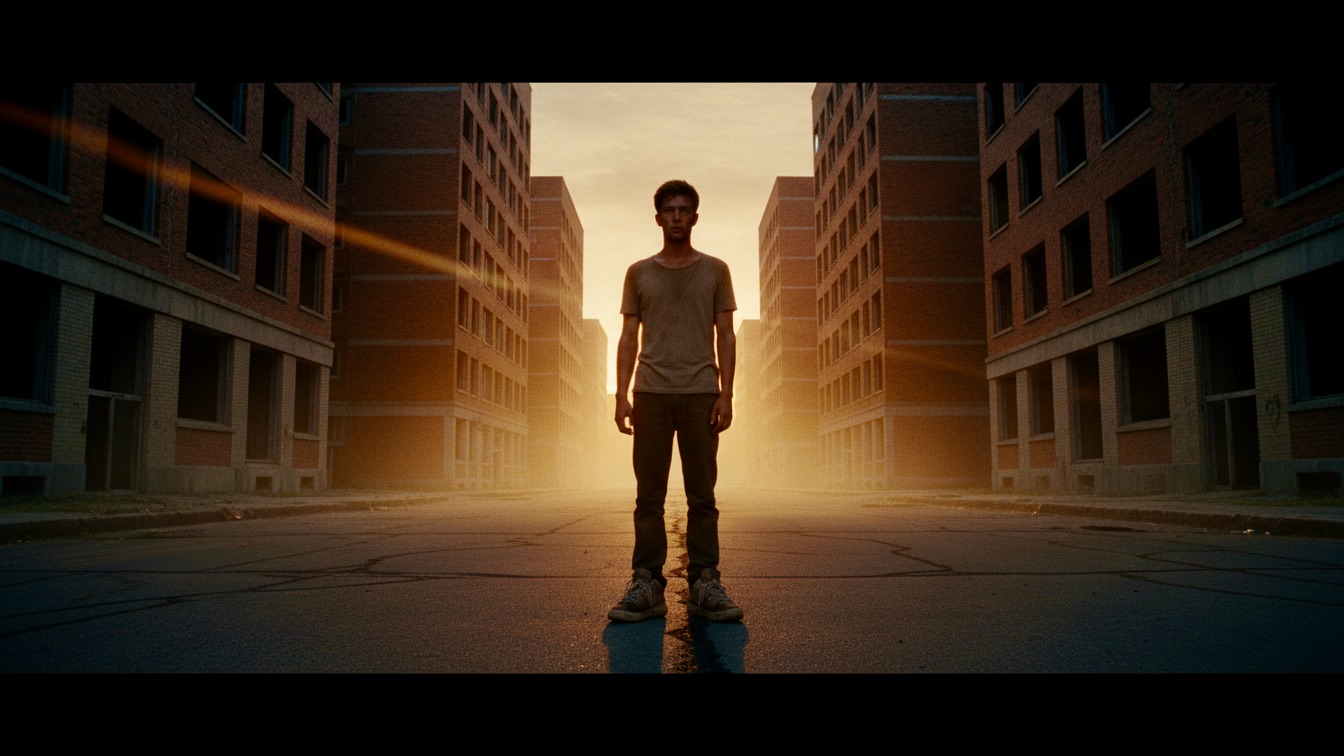
The story begins with Paul, a young man physically and emotionally shattered, lying on the floor of a grimy subway station after a violent mugging. He is discovered by Daniel, a hardened survivor who offers him a pair of shoes and the promise of a legendary meal at a place called the Copper Pot. Their journey through the sweltering, hostile city streets serves as an initiation into a world defined by cruelty and desperation. Paul witnesses Daniel’s cold pragmatism as he steals from a sleeping man and pays off violent block monitors to secure their passage.
The tension reaches a breaking point when the two men are forced to fight off junkies in an alley over a discarded sandwich. Following the altercation, Daniel leads Paul into a dark maintenance tunnel, where he reveals his true nature by assaulting Paul and stealing the last of his money. Left alone in the dark, Paul follows the scent of cooking to finally reach the Copper Pot. Instead of the five-star sanctuary of urban legend, he finds a bleak, industrial soup kitchen serving watery broth under the watchful eyes of mob enforcers. He consumes the tasteless meal and returns to the surface, having finally discarded his idealism for the cold reality of survival.
The central theme of the narrative is the brutal transition from idealism to a purely transactional existence. Daniel serves as the mouthpiece for this philosophy, explicitly stating that love and survival are merely contracts to be terminated when they are no longer profitable. Paul initially resists this worldview, clinging to his moral compass when he refuses to steal from the sleeping businessman. However, the sequence of events systematically strips away his resistance until he is forced to accept that every interaction in the city has a cost.
Another prominent theme is the deceptive nature of hope in a decaying environment. The sunflower growing in the subway station acts as a symbol of resilience, suggesting that beauty can flourish in the most toxic conditions. This symbol is subverted at the end of the story when Paul sees a dead, withered sunflower in a jar of murky water at the Copper Pot. This transition mirrors Paul’s internal journey, suggesting that while hope may sprout spontaneously, it cannot survive the sustained pressure of a predatory society.
The story also explores the concept of urban dehumanization through its sensory descriptions. The city is portrayed as a living, breathing antagonist that uses heat, filth, and noise to wear down the human spirit. The characters are frequently compared to animals or machines, such as the "walking ATM" or the "mechanical process of caloric intake." By reducing human needs to basic mechanics, the narrative highlights how extreme poverty and violence strip individuals of their unique identities, leaving behind only the raw instinct to persist.
Paul is a character defined by his state of being "broken," a label given to him by his former partner, Chloe. At the start of the chapter, he is physically vulnerable and emotionally raw, seeking meaning in the small beauty of a subway sunflower. His journey is a psychological descent where his initial empathy and moral hesitation are beaten out of him by the environment and Daniel’s betrayal. By the end of the story, he has undergone a profound transformation, moving from a victim of the city to a cold participant in its grim reality. He no longer looks for signs of hope but instead focuses on the "next transaction," signaling the death of his former self.
Daniel represents the shadow archetype of the mentor, providing Paul with the tools for survival while simultaneously preparing to prey upon him. He is a man who has completely integrated the cruelty of his environment into his personality, viewing every person as either a resource or a threat. His actions are governed by a cold, internal logic that justifies theft and betrayal as necessary components of life. He does not see himself as a villain but as a realist who has successfully navigated the "contract" of the city. His ultimate betrayal of Paul is not just a theft of money, but a final lesson intended to destroy Paul’s lingering naivety.
While Chloe only appears in Paul’s memories, she functions as the catalyst for his current state of psychological collapse. Her description of Paul as "broken" serves as a lingering trauma that he carries alongside his physical injuries. She represents the first "terminated contract" in Paul’s life, teaching him that even the most intimate human connections are subject to the laws of profit and loss. Her flat, transactional tone during their breakup mirrors the coldness of the city, suggesting that the rot Paul finds in the streets was already present in his personal life. She is the ghost that haunts his journey, driving his need for the comfort he hopes to find at the Copper Pot.
The author employs a gritty, naturalistic style that relies heavily on visceral sensory details to establish an oppressive atmosphere. The descriptions of the subway’s "mosaic of filth" and the "toxic dust of grinding train brakes" create a sense of claustrophobia that persists even when the characters move above ground. The heat is treated as a physical weight, described as "baking" and "suffocating," which heightens the reader's sense of Paul's exhaustion. These details serve a psychological purpose, grounding the reader in the same sensory overload that eventually numbs the protagonist.
The pacing of the narrative mirrors Paul’s physical and mental state, beginning with a slow, lethargic rhythm in the subway and accelerating during the violent encounter with the junkies. The short, punchy sentences during the fight and the subsequent flight through the tunnels create a sense of urgency and panic. This contrast effectively highlights the moments of stillness, such as the silent consumption of the ice pops or the final, hollow meal at the Copper Pot. The shift in pacing allows the reader to feel the jarring transitions between moments of quiet desperation and sudden, sharp violence.
The narrative voice is detached and clinical, which reinforces the theme of dehumanization. Even during moments of extreme pain or betrayal, the prose remains focused on the physical reality of the situation rather than indulging in sentimentality. This stylistic choice reflects the hardening of Paul’s own perspective as the story progresses. By the final scene, the language has become as flat and transactional as the world it describes, leaving the reader with a profound sense of nihilism. The dead sunflower in the jar serves as the perfect closing image, a stylistic bookend that confirms the total erasure of the story's initial spark of hope.


