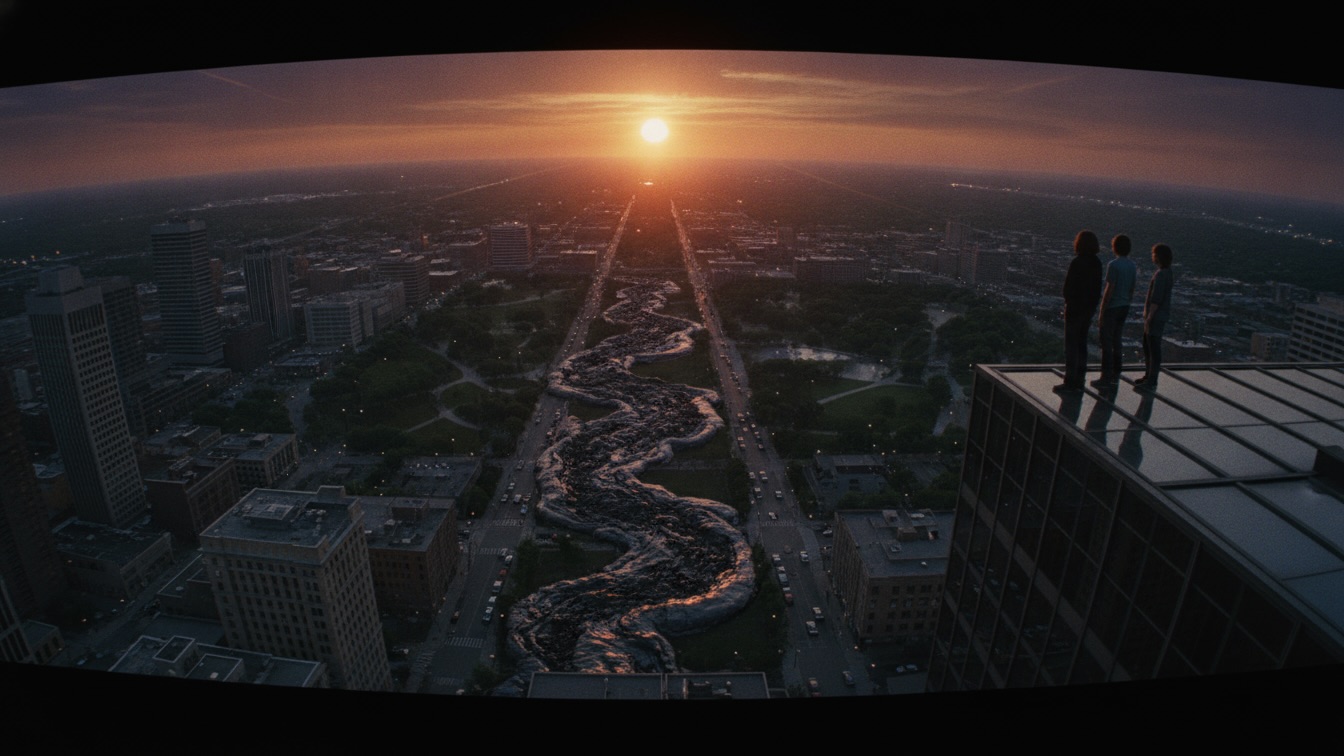
A mundane afternoon in Winnipeg’s Central Park turns into a biological glitch as ants reclaim the sun-scorched grass.
Kendra was doing that thing where she taps the back of her phone against her chin, a rhythmic, hollow sound that usually meant she was about to say something she didn’t actually believe. The sun was aggressive, the kind of mid-July heat that makes the horizon look like it’s vibrating. We were sitting on a bench that had three different layers of peeling green paint, none of which matched the others. The park was full. Not the good kind of full, but the kind where you can hear four different Bluetooth speakers at once and they’re all losing a fight against each other.
"I think the algorithm is actually dead," she said. She didn't look at me. She was looking at a group of kids near the splash pad. "Like, I’m getting ads for tractor insurance. I don't even own a car. I don't own a lawn. Why does it think I have a tractor?"
"Maybe it’s a vibe thing," I said. I was busy trying to peel a sticker off the bottom of my sneaker. It was one of those stubborn ones from a fruit shop, half-translucent and gummy. "Maybe you have big farmer energy. Deep down. Beneath the layers of irony."
"Shut up, John."
"I’m serious. The data doesn't lie. It sees your soul. Your soul wants a John Deere."
She finally looked at me, her eyes squinting against the glare coming off the glass of the apartment towers across the street. "My soul wants an iced coffee that isn't eighty percent ice. Look at the fountain. Is it even on?"
I looked. The fountain in the middle of Central Park was dry. It had been dry since June. Now it was just a concrete bowl full of discarded Slurpee cups and a single, lonely-looking flip-flop. It was a monument to things that stopped working. I realized then what was missing from the scene. The sound of water. Usually, there was a hum, a background noise that masked the sirens from the North End. Without it, the park felt exposed. Raw. You could hear every single person’s individual misery.
"It’s been broken for weeks," I said. "They aren't going to fix it. The city budget is basically a pack of gum and a prayer at this point."
I went back to the sticker. It tore in half, leaving a white, fuzzy patch on my sole. I felt a surge of irritation that was way out of proportion for the situation. It was the heat. It was the way the air felt like it was being pushed into my lungs through a straw. I looked down at my feet, and that’s when I saw the first one. It wasn't even on me. It was on the pavement, a single black ant, moving with a weird, jerky urgency. It wasn't wandering. It was heading somewhere.
"You ever think about how much stuff we lose in here?" I asked, gesturing to the grass. "Like, physically. Not just time."
Kendra stopped tapping her phone. "My AirPods. Left one. Last August. It’s probably in the stomach of a squirrel by now."
"I lost a house key when I was ten. Right over there by the slides. My mom made me sleep on the porch for two hours until she got home. I still look for it sometimes. Like it’s just going to be sitting on top of the mulch, waiting for me to come back for it."
"That’s pathetic, John."
"It’s not pathetic. It’s consistent."
I noticed another ant. Then three more. They were all coming from the same direction, emerging from the cracks in the concrete like a slow leak. They were larger than the ones I usually saw in my kitchen. These were thick-bodied, with legs that looked too long for their frames. They moved over the uneven surface of the walkway with a terrifying efficiency. I watched one climb over a discarded gum wrapper. It didn't go around. It went over, its mandibles twitching.
"Hey," Kendra said, her voice dropping. "Look at that family. Over by the big oak."
I followed her gaze. A family of four was spread out on a red checkered blanket. The dad was standing up, shaking his leg violently. He looked like he was trying to perform a one-man dance routine that involved a lot of slapping at his calves. The mom was frantically brushing off the corner of the blanket, her movements sharp and panicked. The two kids were just staring at the ground, frozen.
"Ants?" I asked.
"A lot of ants," Kendra replied. She sat up straighter. She wasn't looking at her phone anymore. "Like, a weird amount."
I looked back at my own feet. The three ants had become thirty. They were swarming over the white patch of the sticker I’d just failed to remove. They weren't biting yet. They were just... exploring. Mapping me. I felt a cold prickle start at the base of my spine and work its way up. It wasn't the heat anymore. It was the realization that the ground wasn't the color it was supposed to be. The grey of the concrete was being overwritten by a shifting, liquid black.
"Kendra," I said. My voice sounded thin. "We should probably move."
"Where?" she asked. She pointed toward the playground. "Look at the slides."
The plastic yellow of the slide was almost entirely covered. It looked like it had been dipped in tar. From this distance, you could see the movement—a roiling, chaotic vibration that made my skin crawl. A toddler at the bottom of the slide started screaming. It wasn't a 'I fell down' scream. It was a high-pitched, rhythmic wail of pure, unadulterated terror.
"Oh my god," Kendra whispered. "John, they're everywhere."
I stood up. I didn't think about it. I just reacted. As soon as my feet hit the ground, I felt them. They were already on my socks. They were inside the vents of my sneakers. They weren't biting, not yet, but I could feel the microscopic friction of thousands of legs against my skin. It felt like a low-voltage current. It felt like the air itself was starting to crawl.
"Run?" I asked, though it felt like a stupid question.
"Run," she confirmed.
We didn't look back at the bench. We didn't look for the missing AirPods or the lost house key. Those things didn't matter anymore. The only thing that mattered was the fact that the grass was no longer green. It was moving. It was breathing. And it was coming for us.
The transition from a quiet afternoon to a frantic scramble happened in the space of a dozen heartbeats. It wasn't like a movie where there’s a swell of music to warn you. It was just a shift in the frequency of the park. The ambient noise of children playing and distant traffic was replaced by a collective, sharp intake of breath, followed by the sound of a hundred people slapping their own skin. It was the sound of a terminal glitch in the natural world.
"Get them off!" someone screamed from the splash pad. "They’re in the water!"
I looked over. The shallow pool where kids had been splashing minutes ago was now a dark, churning slurry. The ants weren't drowning. They were forming rafts. They were clinging to each other, creating floating islands of chitin and hunger that drifted toward the ankles of the panicked children. The water, which should have been a refuge from the heat, was now a trap.
"John, look out!"
Kendra grabbed my arm and yanked me to the right. I’d almost stepped into a literal river of them. They were pouring out of a drainage grate, a thick, black rope of insects that seemed to have no end. They weren't just crawling; they were falling over each other, a desperate, surging mass that ignored everything but the forward momentum.
"This isn't normal," I said, my voice cracking. "This is... this is some end-of-the-world shit, Kendra."
"Don't think about it," she snapped. Her face was pale, the freckles on her nose standing out like tiny islands. "Just get to the street. If we can get to the asphalt, maybe..."
But the asphalt wasn't a sanctuary. The heat of the road usually kept bugs away, but these ants didn't seem to care about the temperature. They were bubbling up through the cracks in the pavement, emerging from the very foundation of the city. I looked at the red blanket family again. They were gone. Not gone-gone, but they had abandoned everything. The blanket was a solid block of black. The picnic basket was buried under a mound of insects. A plastic fork, white and pristine seconds ago, was being carried away by a hundred of them, moving like a macabre palanquin toward a hole in the dirt.
"My legs," Kendra gasped. She stopped and started franticly brushing at her jeans. "They're inside. John, they're inside my clothes!"
I looked down and felt a wave of nausea. Her denim was crawling. You could see the lumps moving underneath the fabric. I started hitting her legs, trying to crush them, trying to brush them off, but for every ten I knocked away, twenty more took their place. My hands were becoming covered in them. They felt cold. That was the weirdest part. They didn't feel like warm-blooded pests. They felt like ice-cold needles.
"Keep moving!" I shouted. "Don't stop!"
We reached the edge of the park where the grass met the sidewalk. A woman was leaning against a lamp post, her eyes wide and glassy. She was covered from the waist down. She wasn't even moving. She was just staring at her hands, which were encased in a living glove of black. She looked like she’d been turned to stone, or like she was waiting for a bus that would never come.
"Hey!" I yelled at her. "You have to move!"
She didn't respond. She just blinked, and I saw a single ant crawl across her eyelid. I felt a surge of genuine, visceral horror. I grabbed Kendra’s hand—her palm was sweaty and I could feel the ants trapped between our skin—and pulled her toward the street.
"We can't help her," Kendra sobbed. "We can't help anyone."
"I know," I said. "I know."
We stepped onto the road. The traffic had stopped. Cars were idling in the middle of the intersection, doors flung wide. A bus was slanted across two lanes, its windshield obscured by a layer of black that was growing thicker by the second. The driver was outside, spinning in circles, his shirt torn open. He was screaming something about the vents. They had come through the AC.
I looked back at the park. The fading light of the afternoon was hitting the scene in a way that made it look beautiful, if you didn't know what you were looking at. The way the black mass moved across the green grass had a fluidity to it, like a shadow passing over the land. But it wasn't a shadow. It was a census. Every living thing in that park was being counted and processed.
"Where are we going?" Kendra asked. She was hyperventilating now. "John, where do we go?"
"The high-rise," I said, pointing toward the glass tower at the corner. "It’s sealed. It has to be. All that glass and steel. They can't get through steel, right?"
"I don't know," she said. "I don't know anything anymore."
We ran. Our sneakers slapped against the pavement with a wet, crunching sound. Every step was a massacre. We were killing thousands of them, but it didn't matter. There were millions. Billions. The entire subterranean world of Winnipeg was emptying itself into the light.
I thought about the things I’d lost. The house key. The AirPods. My sense of security. It all felt so small now. The heat was still there, pressing down on us, but I didn't care about the sweat. I didn't care about the dry fountain. I just wanted to be somewhere where the floor didn't move. I wanted to be somewhere where I could hear my own heart without the sound of a billion tiny legs clicking in unison.
As we reached the glass doors of the tower, I saw a reflection of us in the tinted surface. We looked like shadows of ourselves. We were covered in the black static of the swarm. Kendra looked at her reflection and let out a sound that I will never forget—a broken, jagged laugh that died in her throat.
"We're vibrating," she whispered. "John, we're vibrating."
I didn't answer. I just grabbed the door handle. It was covered in ants. I didn't care. I pulled.
The lobby of the glass tower was a vacuum of silence that felt like a physical blow. The air conditioning was humming, a clean, mechanical sound that made my ears ring. For a second, I thought we were safe. I leaned against the heavy glass door, my chest heaving, watching the black tide wash against the exterior of the building. They were piling up against the glass, a living drift of insects that was already six inches deep.
"Check yourself," I said, my voice sounding like it belonged to someone else. "Kendra, check your clothes."
She was already doing it. She was frantic, stripping off her light hoodie and shaking it out. Ants fell to the polished marble floor like black hail. She was slapping at her jeans, her movements jerky and uncoordinated. I did the same, shaking my shirt, feeling the tiny bodies fall away. I felt a sharp pinch on my neck, then another on my ribs.
"They're biting now," I groaned. "Shit. They're biting."
It wasn't a normal ant bite. It didn't itch. It burned. It felt like someone was pressing a lit cigarette against my skin for a fraction of a second. I looked at Kendra. She had red welts blooming across her collarbone. She was crying silently, her breath coming in short, jagged gasps.
"We need to get higher," she said. "They'll find a way in. The vents, the drains... they're already in the city's plumbing. I saw them in the fountain."
I looked around the lobby. It was one of those modern, minimalist spaces that felt more like a museum than a workplace. There was a large desk made of dark wood, a few designer chairs that looked uncomfortable, and a wall of elevators. The security guard was nowhere to be seen. His hat was lying on the floor next to a half-eaten sandwich that was now a pulsing mound of black.
"The stairs," I said. "The elevators are too risky. If they stall..."
"Okay. Stairs. Fine."
We sprinted across the marble. The sound of our footsteps was too loud, too heavy. Every time I looked down, I saw another ant. Just one or two, here and there, wandering the vast expanse of the lobby floor like scouts. They had gotten in. Maybe through the door when we opened it, or maybe they were already here, waiting in the walls.
We hit the stairwell door and burst through. The air in the concrete shaft was cooler, but it felt stale. We started climbing. One flight, two, three. My legs were screaming. The adrenaline was starting to wear off, leaving behind a hollow, shaky fatigue.
"How many..." Kendra started, then paused to catch her breath. "How many floors?"
"I don't know. Thirty? Forty? As high as we can go."
We kept moving. By the tenth floor, the sounds from outside were gone. No more screaming. No more sirens. Just the sound of our breathing and the rhythmic thud of our sneakers on the concrete. It was a slow, deliberate ascent into a world that felt increasingly disconnected from the one we’d left behind.
On the fifteenth floor, Kendra stopped. She slumped against the wall, her head between her knees. "I can't. John, I can't. My heart... it feels like it’s going to explode."
I sat down next to her. The concrete was cold. I looked at my hands. They were shaking. I noticed a small black speck on my thumb. I went to brush it off, but it didn't move. It wasn't an ant. It was a bite mark that had already started to bruise.
"Do you think it’s everywhere?" she asked. Her voice was small, stripped of the irony she used as a shield. "Not just the park. Like... the whole city?"
"I don't know," I said. I thought about my house. My mom was probably at work, in a building just like this one. Or maybe she was caught in traffic. I thought about the bus driver spinning in circles. "It felt... intentional. Did you see how they moved? They weren't just looking for food. They were taking space."
"It’s a glitch," Kendra whispered. "The world just... broke. We're the bugs now, John. We're the ones being cleared out."
I didn't have a counter-argument for that. It felt true in a way that facts didn't. We sat there in the dim light of the stairwell for what felt like hours. I watched a spiderweb in the corner of the landing. It was empty. Even the spiders had probably fled, or been consumed. The absence of other life was the most terrifying part. It was just us and the ants.
I stood up and walked over to the small, wire-reinforced window in the stairwell door. It looked out over the north side of the city. From here, Winnipeg looked normal. The sun was beginning to dip toward the horizon, casting long, golden shadows across the rooftops. But then I looked closer.
The streets weren't grey anymore. They were a matte, charcoal black. The movement was visible even from fifteen stories up—a slow, shifting tide that filled the canyons between the buildings. It looked like the city was being erased, one block at a time.
"Kendra," I said, but I couldn't finish the sentence.
She didn't get up. She just stayed there, curled into a ball on the concrete landing. "Don't tell me. I don't want to see it."
I turned away from the window. The silence in the stairwell was starting to feel heavy. It wasn't the kind of silence you get in a library. It was the silence of a tomb. I thought about the fountain again. I thought about the way it looked when it was working—the spray of water catching the light, the sound of it drowning out the world. I missed that sound. I missed the way it made everything feel temporary and safe.
Now, everything felt permanent. The black tide was the new reality. The ants weren't a temporary infestation; they were a restructuring. I looked at Kendra’s phone, which had fallen out of her pocket. The screen was cracked. It was dark.
"Is it still July?" she asked suddenly.
"Yeah. July 14th."
"It feels like winter," she said. "Everything feels... dead."
I reached out and touched her shoulder. She didn't flinch. We were just two kids in a concrete box, waiting for the world to finish its reboot. I looked up the stairwell, toward the floors we hadn't climbed yet. There was no light coming from above. Just more concrete. More silence.
I thought about the ants. I wondered if they were climbing the outside of the building. I pictured them as a solid sheet, millions of them, scaling the glass, looking for a crack, a seal that wasn't quite tight enough, a way into the heart of the machine. I wondered how long it would take them to reach the fifteenth floor.
"We should keep going," I said.
"Why?"
"Because standing still is worse."
She looked up at me then. Her eyes were red-rimmed, but there was a spark of something—not hope, but a stubborn, survivalist flick of anger. "Fine. But if I die on floor twenty, I’m haunting you."
"Deal," I said.
We stood up together, two ghosts in a dying city, and started to climb again. Every step felt like a victory against a force that didn't even know we existed.
We reached the roof an hour before sunset. The door was heavy, but it wasn't locked. When we pushed it open, the heat hit us again, but it was different now. The air was still, devoid of the usual city scents—exhaust, hot asphalt, the faint metallic tang of the trains. It felt sterilized.
The roof was a vast, flat expanse of gravel and HVAC units. We walked to the edge, to the waist-high parapet that overlooked the park. From here, the world was a map of our own insignificance. Central Park was a black hole in the middle of the city. The trees were still there, their leaves a vibrant, mocking green, but the ground beneath them was a solid, moving mass of ink.
"It’s beautiful, in a sick way," Kendra said. She was leaning against the ledge, her chin resting on her hands.
I looked down. The silence from fifteen stories up was now absolute at thirty. The city had stopped breathing. No cars, no sirens, no shouting. Just the faint, rhythmic clicking that I realized wasn't coming from the ground, but from the building itself. They were here. They were in the walls.
"Look at the playground," I whispered.
The yellow slide was gone. Not physically, but it was completely submerged under a mound of ants so thick it had lost its shape. It looked like a growth, a tumor on the face of the park. I thought about the toddler I’d seen earlier. I hoped they’d made it out. I hoped their parents had been faster than the tide.
"What do you think they want?" Kendra asked.
"I don't think they want anything. That’s the problem. They just... are. It’s like a forest fire or a flood. You don't ask what a flood wants."
"But a flood eventually recedes," she said. "This feels... permanent."
I looked toward the horizon. The sun was a bloated orange disc, sinking into the haze of the prairies. In the distance, I could see the smoke from the wildfires that were always burning somewhere to the north. It felt like the whole world was being dismantled—burned from the top and eaten from the bottom.
I reached into my pocket and felt the empty space where my keys should have been. I thought about the house key I’d lost years ago. It was down there somewhere, buried under a billion insects. It was a part of the landscape now. Everything we’d ever owned, everything we’d ever cared about, was being incorporated into the swarm.
"I’m sorry I said your house key thing was pathetic," Kendra said softly.
"It’s okay. It was a little pathetic."
"No, it wasn't. It was real. I get it now. We spend our whole lives leaving pieces of ourselves behind, thinking we can always go back and find them. But the ground is always moving."
She looked at me, and for the first time since the park, she smiled. It was a small, sad thing, but it was there. She reached out and took my hand. This time, there were no ants between our palms. Just skin on skin. It was the only thing that felt real in a world made of static.
We watched the sun go down. The sky turned a bruised purple, then a deep, oceanic blue. The lights of the city didn't come on. The grid had finally failed. One by one, the buildings went dark, leaving us in a world illuminated only by the stars and the faint, ghostly glow of the swarm below.
"John?"
"Yeah?"
"I don't think anyone is coming for us."
I looked at the dark towers surrounding us. They looked like teeth. "No. I don't think they are."
"So what do we do?"
I looked at the gravel on the roof. I looked at the heavy door we’d come through. I looked at the girl standing next to me. We were seventeen. We were supposed to be thinking about university applications and whether or not our crushes would text us back. We were supposed to be arguing about movies and complaining about the heat.
Instead, we were witnesses.
"We wait," I said. "We wait for the morning. And then we see what’s left."
I sat down on the gravel, pulling her down with me. We leaned against the parapet, our shoulders touching. The air was cooling down, finally. The heat was receding, replaced by a sharp, crisp stillness. I closed my eyes and tried to remember the sound of the fountain. I tried to remember the way the water felt on my skin, cold and clear and mindless.
I couldn't. All I could hear was the clicking. It was louder now, a rhythmic, pulsing sound that seemed to be coming from the very stone beneath us. The building was humming. The world was humming.
Kendra leaned her head on my shoulder. I felt her breath steady, then slow. She was falling asleep. I didn't know how she could, but I was glad for it. I stayed awake, watching the stars, waiting for the first hint of light on the eastern horizon.
I thought about the red blanket. I thought about the white plastic fork. I thought about the way the ants had carried it, with such purpose, such collective will. They were building something. I didn't know what it was, and I didn't think I wanted to know.
As the last bit of orange disappeared from the sky, I felt a single, sharp pinch on my ankle. I didn't move. I didn't look down. I just held Kendra’s hand a little tighter and watched the dark.
“The building was humming, and as the last of the light died, I felt the first cold needle sink into my skin.”


