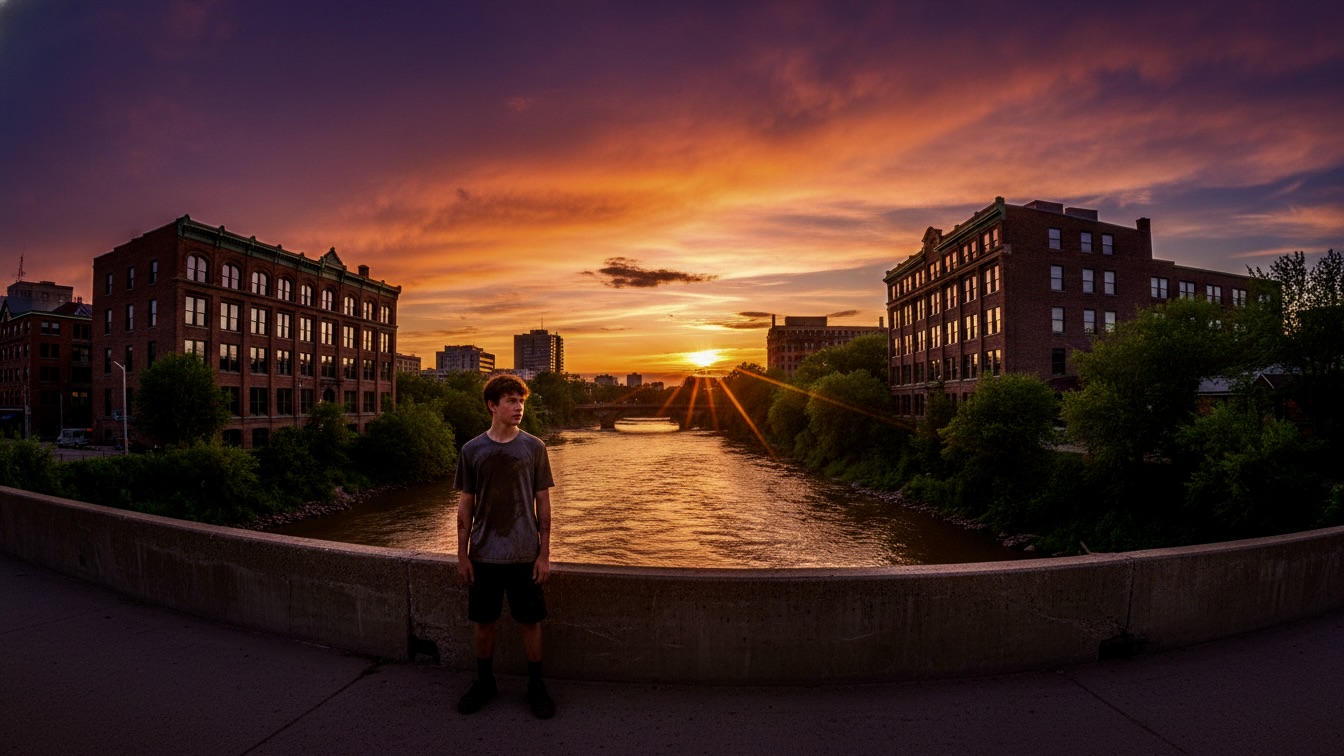
Format: Short Film / Anthology Episode | Est. Length: 10-12 minutes
Imagine a gritty, sweat-soaked anthology series titled The Perimeter, where each episode explores a different soul trapped in the sweltering, claustrophobic urban landscape of a city on the brink of collapse. This episode serves as a high-tension entry that establishes the environment not just as a setting, but as an oppressive character that forces its inhabitants into impossible moral corners. The series focuses on the "snap points" of ordinary people, weaving a broader narrative arc about the erosion of the social contract in the face of extreme economic and environmental pressure.
A broke teenager stands at a crumbling, sun-bleached bus stop in 35-degree heat, watching his last chance at a stable life drive away while a magnetic, dangerous stranger offers him a ride into a digital nightmare.
A desperate warehouse worker accepts a ride from a charismatic predator during a record-breaking heatwave, only to be coerced into a high-stakes criminal delivery. As the city prepares for a manufactured blackout, he must choose between financial salvation and his own moral survival.
The primary theme is the "Snap Point"—the precise moment where economic desperation overrides a lifetime of moral upbringing. It explores the predatory nature of modern "hustle culture" and how the urban poor are recruited as disposable assets in larger criminal machinations, highlighting the invisibility of the working class.
The story also functions as a critique of the digital divide and the fragility of urban infrastructure. It pits the analog struggle of manual labor against the cold, calculated efficiency of cyber-crime, suggesting that in a world of "jammers" and "blackouts," the only thing that remains real is the physical weight of one's choices.
For Paul, the stakes are existential and immediate: if he fails the delivery, he loses his job and the ability to support his mother; if he succeeds, he risks a lifetime of incarceration and the loss of his integrity. For Jesse, the stakes are professional and ego-driven, as his reputation and a high-value heist depend on using an "invisible" proxy to bypass security systems.
The external conflict is a classic man-vs-environment struggle against the oppressive heat, coupled with the physical threat posed by Jesse and his silent enforcer, Kaleb. Internally, Paul battles his own resentment toward his socioeconomic status versus his innate desire to remain a "good kid" in a city that seemingly rewards only the ruthless. Jesse serves as the primary antagonist, a psychological predator who uses the promise of friendship and wealth to manipulate Paul into a position of no return.
Paul, a seventeen-year-old drowning in poverty and heat-induced exhaustion, is stranded at a bus stop when he is picked up by Jesse, a smooth-talking opportunist in a vintage jersey. Jesse deconstructs Paul’s desperate life with surgical precision, mocking his work ethic while pitching a "delivery" job that pays five hundred dollars—a month's wages—for five minutes of work. Having already missed his warehouse shift and effectively burning his bridge to a legal life, Paul accepts the heavy messenger bag, crossing the threshold into active criminality.
The delivery takes Paul into a high-end loft where he meets "V," a paranoid technician who reveals that the bag contains signal jammers intended to cripple the city's infrastructure for a heist. Realizing he is a pawn in a massive crime, Paul receives the cash but is warned to run before the "blackout" begins. In a final confrontation at the riverbank, Paul chooses to destroy the money and flee rather than join Jesse’s world, escaping into the night just as the police arrive and a threatening text message confirms that his ordeal has only just begun.
Paul (17): Paul begins the story as a rigid, rule-following youth paralyzed by anxiety and the crushing weight of poverty, characterized by a frantic tapping foot and a tight jaw. His psychological arc is one of radical deconstruction; he moves from a state of passive desperation to one of active, defiant agency. By the end of the episode, he has shed his "invisible" status, choosing the uncertainty of being a fugitive over the certainty of being a tool for others.
Jesse (19): Jesse is a sociopathic "influencer" of the criminal underworld who uses aesthetic charm and a "blue raspberry" vape cloud to mask his predatory nature. He remains psychologically static throughout the episode, serving as a mirror for Paul’s desperation and a catalyst for his transformation. His easy confidence and "gliding" movement contrast with Paul’s static tension, marking him as a creature who thrives in the chaos he creates.
Kaleb (20s): Jesse’s brother and the silent muscle of the operation, Kaleb represents the physical threat of the "hustle." He is a vacant, menacing presence behind the wheel of a beat-up Civic, serving as the grim reality behind Jesse’s polished sales pitch. His role is to block the exits, both literally and figuratively, ensuring that once Paul is in the car, he stays in the game.
Beat 1 (The Stop): Paul waits in the suffocating heat at a bruised city corner, his bank account empty and his job on the line as the bus fails to arrive. Jesse appears like a mirage in a vintage jersey, offering a cool car and an escape from the "minimum wage grind" that Paul can no longer endure. Paul hesitates but ultimately chooses the air-conditioned uncertainty of Jesse’s beat-up Civic over the certainty of heatstroke and unemployment.
Beat 2 (The Ride): Inside the car, Jesse deconstructs Paul’s life with surgical precision, mocking his work ethic while pitching a "delivery" job that pays a month's wages in five minutes. Paul realizes he has already missed his shift, effectively burning his bridge to a legal life and leaving him vulnerable to Jesse’s predatory "opportunity." The tension peaks as they enter the Exchange District, and Paul accepts the heavy messenger bag, crossing the threshold into active criminality.
Beat 3 (The Delivery): Paul enters the upscale loft to meet the jaded "V," only to discover the bag contains high-end signal jammers intended to cripple the city's infrastructure. Realizing he is a pawn in a massive heist rather than a simple courier, Paul receives the cash envelope but is warned by V to run before Jesse’s plan goes live. He exits the building into the orange glow of dusk, caught between the security of the money and the horror of the act it funded.
Beat 4 (The River): In the alley, Paul confronts Jesse about the jammers, leading to a violent standoff where the charismatic mask finally slips to reveal Jesse’s true, ugly nature. Paul flees to the muddy banks of the Red River, where he chooses to destroy the money—throwing it into the wind—rather than let Jesse have it or keep it for himself. As the police arrive in the distance, Paul escapes into the night, free of the money but marked by a threatening text that suggests his ordeal is far from over.
The episode begins with a sense of "Static Anxiety," characterized by the humid, heavy atmosphere and Paul’s internal monologue of failure. As Paul enters the car, the mood shifts to "Seductive Danger," where the cool AC and Jesse’s charm provide a false sense of relief. The midpoint brings "Cold Realization," as the scope of the crime is revealed, leading to a final act of "Cathartic Terror," where the heat finally breaks into a frantic, adrenaline-fueled escape.
If expanded, the season would follow Paul as he navigates the fallout of his defiance, becoming a target for Jesse’s larger criminal syndicate. The "blackout" hinted at in this episode would serve as the mid-season finale, plunging the city into a lawless state where Paul must use his knowledge of the "invisible" parts of the city to survive.
The thematic escalation would move from individual desperation to systemic collapse, exploring how different characters across the city react when the "lights go out." Paul’s evolution would see him becoming a reluctant folk hero, a "ghost in the machine" who sabotages Jesse’s operations from the shadows of the North End.
The cinematic style is "Gritty Hyper-Realism," utilizing high-contrast cinematography that emphasizes the sweat, grime, and heat-haze of the urban summer. The color palette is dominated by jaundiced yellows, burnt oranges, and deep, soot-stained reds, creating a visual sense of feverish discomfort. Long lenses will be used to create a "compressed" feeling in the street scenes, making the city feel like it is closing in on Paul.
Tonal influences include the claustrophobic, high-stakes tension of Uncut Gems and the neon-noir desperation of Good Time. The soundtrack should be a mix of low-frequency industrial hums and frantic, uneven percussion that mimics Paul’s heartbeat and the "static" in his brain.
The target audience is Young Adults and fans of urban crime thrillers (Ages 16-35) who gravitate toward "A24-style" elevated genre content. It appeals to viewers who enjoy character-driven stories with high stakes, social commentary, and a strong sense of place, typically found on premium streaming platforms like HBO or Hulu.
The episode follows a "Pressure Cooker" structure, with a slow, rhythmic build-up in the first three minutes to establish the atmospheric weight. Once Paul enters the car, the tempo increases steadily, with the dialogue becoming faster and the cuts becoming sharper. The final four minutes are a relentless "Sprint," maintaining a high-octane pace from the moment Paul enters the loft until the final, haunting text message.
Production requires authentic urban locations that capture the contrast between the "bruised heart" of the North End and the polished "creative agencies" of the Exchange District. The heat must be a visible, tangible element; this will require heavy use of glycerin for skin texture and practical heat-haze filters on cameras to ensure the audience feels the 35-degree temperature.
Special attention must be paid to the "Signal Jammer" props and the "Red River" sequence, which requires a muddy, overgrown shoreline for the climax. The use of a real beat-up Civic and authentic Winnipeg transit signage will be crucial for grounding the "Short Film" format in a believable, lived-in reality.


