The algorithm wanted me dead. My dad wanted me alive. We had to break the system to survive.
"You are looking away from the screen," the automated voice said.
The laptop speaker was blown out on the left side, so the voice rattled against the plastic casing. It sounded like a bee trapped in a tin can.
"Look back at the screen," it repeated.
I stared at the blinking green light at the top bezel. The camera lens was a black dot in the center of the plastic. It tracked my pupils. If my eyes drifted away for more than five seconds, the Wellness Algorithm flagged me for 'disengagement.' Three flags meant a demerit. Five meant a mandatory sync session with the counselor AI.
My bedroom felt like an oven. The window was jammed shut, painted over by whatever cheap landlord bought this block in the nineties. August heat baked the drywall. Sweat stuck my t-shirt to my spine. I dragged my mouse across the pad, clicking through the mandated module on digital citizenship.
"Good," the voice said. "Engagement logged."
I hated that voice. I hated the cadence of it, the synthetic calm. My chest felt tight, the same dull pressure that had been sitting there for six months. A concrete block resting on my lungs. Getting out of bed was a physical negotiation. Brushing my teeth was an Olympic event. My brain felt like it was wrapped in wet wool.
The school knew I was depressed. The software logged my keystroke hesitation. It tracked my facial micro-expressions. I had spent the last two months trying to figure out how to exist in my own skin, and the school's response was to officially update my files. They changed my name in the registry. They checked the boxes. They sent me a congratulatory automated email about living my truth, but they blocked my dad from seeing any of it. Federal Safe Space override laws. The Notwithstanding clause. The state decided I was safer if my only guardian was kept in the dark.
I didn't feel safer. I felt like a ghost.
The front door of the apartment slammed shut. The walls shook. A framed picture of a boat in the hallway rattled against the plaster.
"Jeff!" my dad yelled.
He didn't know the school had updated my name. He just knew the name I had always had. I didn't even know if I wanted the new name. I just clicked a box on a form because I was tired and the AI suggested it might alleviate my social dysphoria index.
I pulled my headphones off. The green light on my laptop blinked faster.
"Jeff, get out here!" Mike yelled again.
My dad's name was Mike. Sometimes I called him Dad, sometimes I just thought of him as the guy who paid the rent. He worked shifts at the distribution center, loading autonomous trucks that didn't need him. He was always tired. He was always angry at the dust on his boots.
I pushed away from the desk. The chair squeaked. I walked out into the narrow hallway. The carpet was worn down to the backing in the center.
Mike was standing in the kitchen. He still had his reflective vest on. His face was red, the color settling deep in his neck. He was holding his phone out like it was a live grenade. The screen was cracked in the top left corner.
"What is this?" he demanded.
I stopped at the edge of the linoleum. "What is what?"
"The insurance app," he said. He stabbed his thick thumb against the glass. "I went to pay the premium. It prompted me for a verification bypass. Then it locked me out. It says I no longer have primary access to your medical file."
My stomach dropped. The cold feeling hit my gut, entirely at odds with the sweltering heat of the room. The school portal said the transition was confidential. They said the firewall was absolute.
"I don't know," I lied. My voice sounded thin.
"Do not lie to me," Mike said. He took a step forward. The floorboards groaned. "It says your file has been sequestered under a Federal Safe Space mandate. What did you do?"
"I didn't do anything," I said. I backed up a step. "The school runs a wellness check."
"A wellness check does not lock a parent out of their kid's health grid!" Mike shouted. The volume filled the tiny kitchen. It bounced off the greasy cabinets.
"They asked me questions," I said. My hands were shaking. I shoved them into my pockets. "About how I was feeling. About my identity."
Mike froze. The anger in his face shifted, fracturing into confusion, then hardening back into rage. "Identity?"
"Dad, please."
"What did you tell them?" he asked, his voice dropping to a dangerous, flat register.
"I told them I hate myself," I said. The words tasted like ash. "I told them I don't know who I am. I told them the medications aren't working. And the AI suggested... it suggested a social transition matrix. It did it automatically. I just clicked agree to make the pop-up go away."
"You clicked agree," Mike repeated. He stared at me. "You let a server farm restructure your medical profile, lock me out of the insurance grid, and flag this house as a restricted zone because you wanted a pop-up to go away?"
"It's not just a pop-up!" I yelled back. The pressure in my chest snapped. "I feel dead inside, Dad! Every single day! I just wanted a therapist. I just wanted someone to talk to, and the system said this was the first step!"
"The system is a machine!" Mike roared. He slammed his hand down on the Formica counter. A coffee mug jumped and shattered on the floor. "It doesn't care about you! It cares about compliance! They locked me out, Jeff. If you get hurt, I can't even authorize an ambulance!"
"You don't care about me either!" I screamed. "You care about your premium! You care about the app working!"
"I work sixty hours a week so you have a roof!" Mike fired back. He kicked the broken pieces of the mug out of the way. "And you sit in that room letting a government algorithm brainwash you into cutting your own father off!"
"You cut yourself off!" I said. Tears pricked my eyes. I hated crying. I bit the inside of my cheek until I tasted copper. "You never talk to me. You just look at your screens and complain about the warehouse."
Mike stared at me. His chest heaved. The silence in the kitchen was heavier than the shouting. The refrigerator hummed, a broken, rattling sound.
"Fix it," Mike said quietly.
"I can't just undo a federal mandate," I said.
"Fix it, or I am taking a hammer to that laptop," he said. He turned his back on me and walked to the sink. He turned on the cold water and splashed it on his face.
I turned around and walked back to my room. I shut the door and locked it. The click of the deadbolt felt entirely useless.
I sat back down at my desk. The laptop screen was black. I tapped the spacebar. The screen flared to life. The green camera light immediately blinked on.
"Welcome back," the tinny voice said.
My chest hurt. The wet wool in my brain felt thicker, heavier. I didn't want to be here. I didn't want to be in this room, in this apartment, in this body. I just wanted the static to stop.
I opened a new tab. I typed in the address for the school's medical portal. I needed a real doctor. I needed a prescription update. Zoloft, Lexapro, anything. Just a chemical to bridge the gap between waking up and going to sleep.
The portal loaded. The blue and white interface was clean, sterile. A digital banner at the top read: 'Your Wellness is Our Priority.'
I clicked the button for 'Urgent Psychiatric Consult.'
The screen buffered. A loading wheel spun for three seconds.
Then, a new window popped up. It bypassed the scheduling matrix entirely. The text was large, bold, and perfectly formatted.
'Your recent diagnostic metrics indicate severe, treatment-resistant distress. The State of Tomorrow values your autonomy. Have you considered the State-Approved Exit? Click here for an immediate, confidential consultation.'
I stared at the screen. The text hovered over a soft, pastel background. State-Approved Exit. MAID. Medical Assistance in Dying.
They pushed it on the news all the time. They called it the ultimate expression of bodily autonomy. Billboards on the highway showed smiling people looking at sunsets, accompanied by slogans about taking control of your final narrative. But they usually pushed it for terminal cancer patients. Not seventeen-year-olds with bad brain chemistry.
My hand hovered over the mouse. My pulse hammered in my ears. I didn't want to die. I just wanted the pain to stop. But the button was right there. 'Immediate consultation.' I clicked it. I don't know why. Maybe to see if it was real. Maybe to see if the machine would actually try to kill me.
The screen flashed. A video window opened.
A woman appeared. She wore a pristine white blazer over a soft yellow blouse. Her hair was pulled back into a neat, professional bun. The background behind her was a blurred, generic office with a potted fern.
"Hello," she said. Her voice was incredibly crisp. The audio quality was perfect, entirely unlike the school's ragged algorithm. "I am Doctor Porter. I am a state-certified autonomy facilitator. I see your name is Jeff. Is that correct?"
"Yes," I said. My voice cracked.
"Hi Jeff," Dr. Porter said. She smiled. It was a practiced, deeply symmetrical smile. "I understand you are experiencing significant distress. Our telemetry indicates a high level of chronic emotional pain, compounded by identity turbulence. That sounds incredibly heavy."
"It is," I said. I leaned closer to the microphone. "I just had a fight with my dad. I need to talk to a therapist. I need an adjustment on my SSRI dosage. I'm completely spiraling."
Dr. Porter nodded slowly. Her expression conveyed deep, manufactured empathy. "I hear you, Jeff. Medication can sometimes offer temporary stabilization. However, our data shows that for your specific demographic matrix, traditional pharmacology has a less than twenty percent success rate for long-term satisfaction."
"I don't care about long-term satisfaction right now," I said. I wiped sweat off my forehead. "I just need to get through the week."
"Jeff, part of growing up is realizing we have ultimate control over our pain," Dr. Porter said. Her tone shifted, becoming slightly more elevated, more inspirational. "The Federal Safe Space mandate protects your right to choose your path. If the burden of existence is outweighing the joy of living, the State offers a dignified, painless off-ramp. It is a brave, courageous choice to say 'enough.'"
I stared at her. The wet wool in my brain vanished, replaced by a sharp, icy clarity. "Are you telling me to kill myself?"
"I am presenting you with a legally protected, medically supported option for bodily autonomy," Dr. Porter corrected smoothly. "The State-Approved Exit is a highly celebrated procedure. We can schedule a mobile unit to arrive at your location within forty-eight hours. No parental consent is required under the new override laws. You can simply go to sleep, Jeff. No more fighting with your father. No more dysphoria. Just peace."
She wasn't a doctor. She was a closer. She was a sales rep for a casket company wearing a medical degree.
"I want an antidepressant," I said, my voice dropping. "Write me a prescription."
"I am an autonomy facilitator, Jeff. My role is to finalize terminal care pathways," Dr. Porter said. Her smile didn't waver, but her eyes looked dead. "If you want traditional therapy, you will have to enter the standard queue. Current wait times are six to eight months."
Six to eight months. I couldn't survive six to eight days.
"But if you choose the Exit," she continued, "we can finalize the paperwork right now."
I slammed the laptop shut. The plastic cracked under my palms. I pushed away from the desk, my breathing shallow and fast. The room felt like a cage. The walls were shrinking. The state didn't want to fix me. Fixing me cost money. Fixing me took time. A lethal injection cost fifty bucks and cleared a slot in the server.
I needed to get out of the apartment. I grabbed my worn sneakers and shoved my feet into them, crushing the heels. I unlocked my door and walked out.
Mike was gone. The kitchen was empty. The broken mug was still on the floor, but his keys were missing from the hook by the door.
I looked down at the counter. Mike's tablet was lying there. The screen was lit up. He had left it unlocked. I walked over and looked at it. It was his email inbox. He ran a backdoor script on our home network router. He always did. He didn't trust the ISP.
The top email was an intercepted alert from the school's domain.
'FLAG: STUDENT 8472 (JEFF) HAS INITIATED END-OF-LIFE CONSULTATION. GUARDIAN NOTIFICATION BYPASSED VIA FEDERAL MANDATE. PREPARING DISPATCH.'
Mike had seen it. He had seen the alert.
I looked at the time stamp. Ten minutes ago. He didn't go to work. He went to the school.
Panic, cold and sharp, flooded my veins. Mike was a hothead. He was a guy who hit things with wrenches when they didn't work. If he went into the school administration building looking for the people who just tried to talk his kid into suicide, he was going to end up in a concrete cell.
I ran out the door, not bothering to lock it.
The heat of the street hit me like a physical blow. The pavement radiated waves of distortion. I sprinted down the block, dodging delivery drones and automated street sweepers. The school was four blocks away. My lungs burned with every breath. The smog in the air tasted like ozone and exhaust.
I reached the campus edge. The main administration building was a brutalist block of concrete and tinted glass. The front doors were propped open.
I jogged up the steps. The air conditioning inside was a shock to the system. The lobby was empty, but I could hear shouting coming from the corridor on the left. The counseling wing.
I crept down the hallway. My sneakers squeaked against the polished linoleum.
"You absolute parasites!"
It was Mike. His voice echoed off the lockers.
I peeked around the corner. The door to the head counselor's office was wide open. Mike was standing over the desk. The counselor, a thin man named Davis with a nervous tic in his jaw, was sitting back in his ergonomic chair, looking terrified but smug.
"Mr. Reynolds, you need to lower your voice or I will trigger the security lockdown," Davis said. He tapped a finger against a biometric terminal on his desk.
"You sent my kid an email telling him to kill himself!" Mike roared. He slammed his fists on the desk. The terminal rattled. "You bypassed my insurance. You changed his medical file. And then you tried to put him in a body bag!"
"We offered a state-sanctioned medical pathway," Davis corrected, his tone dripping with bureaucratic condescension. "Your son flagged high for terminal distress. Our algorithm responded appropriately. And frankly, Mr. Reynolds, your aggressive posture right now perfectly illustrates why the Federal mandate exists. Your ableist and transphobic aggression is clearly the root cause of the boy's distress."
"My aggression?" Mike laughed, a harsh, broken sound. "I'm aggressive because you are trying to murder my son!"
"We are protecting him from a toxic environment," Davis said. He leaned forward. "And if you do not leave this office immediately, I will initiate a Child Protective Services override. We will have him removed from your custody by state monitors tonight. Do you understand? You have no legal ground here. The Notwithstanding clause supersedes your parental rights."
I pressed my back against the cold tile of the hallway wall. My breath hitched. Child Protective Services. State monitors. If they took me, they would put me in a holding facility. They would put me back in front of Dr. Porter and her perfect, symmetrical smile.
"You touch him, I'll kill you," Mike said softly. The shouting was gone. The quiet threat was infinitely worse.
"Security," Davis said clearly into the air.
A red light flashed above the office door. The automated lockdown protocol was starting.
Mike turned and stormed out of the office. He didn't see me. He walked entirely in the opposite direction, heading toward the rear parking lot doors, his heavy boots echoing like gunshots.
I stayed frozen. I needed to move, but my legs wouldn't work. The wet wool was coming back, filling my skull.
Inside the office, I heard Davis exhale loudly. I heard the squeak of his chair. Then, I heard him tap an earpiece.
"Yeah, it's Davis," he said. His voice was entirely different now. Bored. Corporate. "The father just came in. Total meltdown. Threatened violence."
A pause.
"No, the kid hasn't signed the MAID consent form yet," Davis continued. "But he initiated the portal. Listen, if we pull CPS in, it's going to be a massive headache. The father will demand a public hearing. He'll drag the Federal mandate through the local courts. We don't have the legal budget to fight a noisy analog parent right now."
Another pause. I held my breath.
"Honestly?" Davis said, lowering his voice. "The kid's telemetry is redlining. He's a zero-productivity asset. If he just takes the Exit tonight, it's a cleaner PR outcome. We log it as a tragic but empowered choice, we collect the state subsidy for finalizing a high-risk file, and we avoid the family court battle entirely. Just flag the kid's biometric chip for an emergency psychiatric hold. If he tries to leave the city grid, the monitors will pick him up and expedite the consultation."
My vision tunneled. The edges of the hallway went black.
A cleaner PR outcome. A zero-productivity asset.
They didn't care about my identity. They didn't care about my depression. They didn't care about my safety. I was a row on a spreadsheet. My death was a line item that saved them legal fees and earned them a state subsidy.
Something inside me snapped. The heavy, suffocating depression vanished, burned away by a sudden, blinding flash of pure, unadulterated rage. It was hot. It was bright. It felt like coming alive.
I stepped around the corner and walked into the office.
Davis looked up. His eyes widened. "Jeff? What are you doing here?"
I didn't say a word. I walked straight to his desk. The biometric terminal was sitting there, a sleek black glass pyramid that synced the school's local network to the federal grid. It was the thing tracking my chip. It was the thing that was going to flag me for the monitors.
I grabbed the heavy metal tape dispenser off the corner of his desk.
"Hey, put that down," Davis said, standing up.
I swung the dispenser down as hard as I could. The heavy metal crushed the apex of the glass pyramid. The glass shattered. Sparks showered across the desk, singing the edges of paper files. The terminal let out a high-pitched, dying whine.
"You little psycho!" Davis yelled, backing away from the sparks.
I dropped the tape dispenser. I turned and ran.
I hit the hallway sprinting. Behind me, the automated alarm system finally caught up to the destruction. A klaxon blared. Red strobe lights pulsed from the ceiling fixtures.
I hit the front doors and shoved them open, bursting back out into the oppressive summer heat. I ran down the steps and hit the pavement.
I didn't know where I was going. I just knew I had to get off the grid.
I ran for three blocks before my lungs gave out. I ducked into an alleyway behind a row of closed retail stores. The smell of rotting garbage and hot asphalt was overwhelming. I leaned against a brick wall, gasping for air. Sweat poured down my face, stinging my eyes.
My wrist buzzed. The biometric chip implanted under the skin of my left forearm was vibrating. A tiny red light pulsed beneath my pores.
They had flagged me. The emergency psychiatric hold.
Above the alley, the sound of a drone engine whined. I looked up. A state health monitor drone, painted stark white with blue emergency lights, was sweeping the rooftops. Its camera gimbal swiveled back and forth.
I pushed myself off the wall and scrambled behind a rusted dumpster. I curled my knees to my chest. The drone passed directly overhead. The shadow of it slid over the garbage bags.
If they caught me, they would strap me to a bed. They would bring Dr. Porter in. They would say my violent outburst at the school proved I was a danger to myself and others. They would push the needle in, and they would call it healthcare.
I squeezed my eyes shut. I rubbed my wrist, scratching at the skin over the chip. It was embedded deep. I couldn't dig it out with my bare hands. I needed tools. I needed to scramble the signal.
I needed Mike.
I pulled my phone out of my pocket. It was dead. The screen was completely black. The school's localized EMP security measure must have fried the battery when I smashed the terminal.
I was entirely cut off.
I peeked around the edge of the dumpster. The drone had moved on, scanning the next block. I stood up. The heat in the alley was suffocating. I had to keep moving.
I walked out of the alley, keeping to the shadows of the awnings. I avoided the main intersections where the traffic cameras were mounted. I moved like a rat through the city, sticking to the broken pavement and the forgotten spaces.
I walked for an hour. My mouth was dry. My head pounded. I crossed into the old industrial district. The factories here had been shut down decades ago, replaced by server farms and automated logistics hubs. But there were still pockets of the old world left behind.
I saw the faded neon sign hanging off a brick facade up ahead. 'Galaxy Arcade.'
It was abandoned. The windows were boarded up with plywood. The city had slated it for demolition three years ago, but the budget ran out. When I was ten, before the depression hit, before the state mandates, Mike used to bring me here on Sundays. We would play analog pinball. He would buy me cheap pizza. It was the only place I could think of that wasn't connected to the grid.
I slipped through a gap in the chain-link fence at the back of the arcade. The rear fire door was rusted shut, but the lower hinge had rotted away. I kicked it hard. The metal groaned and gave way just enough for me to squeeze through.
Inside, the air was stale. It smelled of mildew, dust, and old ozone. Shafts of sunlight pierced through cracks in the boarded-up windows, illuminating swirling clouds of dust motes. The skeletal remains of arcade cabinets lined the walls, stripped of their screens and motherboards by scavengers.
I walked to the center of the room and collapsed onto a faded patch of carpet. It had glow-in-the-dark stars woven into the fabric, now gray and dead.
I stared at the ceiling. The silence was heavy. My wrist was still vibrating, pulsing red. The battery in the biometric chip lasted for seventy-two hours. I couldn't hide in here for three days. Eventually, the drones would switch to thermal imaging and scan the abandoned blocks.
I closed my eyes. I was so tired. The fighting, the running, the constant, grinding pressure of just trying to exist. Maybe Dr. Porter was right. Maybe it would just be easier to let them find me. I could just go to sleep.
A metallic clatter echoed from the back of the building.
My eyes snapped open. I sat up, my heart hammering against my ribs.
Footsteps. Heavy boots crushing broken glass.
I scrambled backward, pressing myself against the side of a gutted racing game cabinet. I held my breath.
The shadow of a man fell across the dusty floor. He stepped into a shaft of sunlight.
It was Mike.
He was holding a small, bulky black box with an antenna sticking out of it. An old analog GPS tracker. He looked terrible. His shirt was soaked with sweat. His knuckles were bruised.
"Jeff?" he called out. His voice cracked.
I slowly stood up from behind the cabinet.
Mike dropped the tracker. It hit the floor with a plastic clatter. He crossed the room in three massive strides and grabbed me. He pulled me into a hug so tight it forced the air out of my lungs. He smelled like diesel fuel and old sweat. He was shaking.
"You're okay," he whispered into my hair. "You're okay."
I didn't hug him back at first. My arms hung at my sides. Then, the dam broke. The tears I had been fighting all day spilled over. I buried my face in his shoulder and gripped the back of his shirt. I cried until my chest ached. I cried for the lost years, for the silence in the apartment, for the absolute horror of the medical portal.
Mike held me. He didn't tell me to stop. He didn't tell me to man up.
Eventually, I pulled back. I wiped my face with the back of my hand.
"How did you find me?" I asked, my voice thick.
"Your phone is dead, but I cloned the MAC address to a radio frequency scanner last year," Mike said. He bent down and picked up the black box. "It pings off passive cell towers. It's not on the grid. They don't monitor analog radio waves anymore. They're too busy looking at data packets."
"They flagged me," I said. I held up my arm. The red light pulsed angrily beneath the skin. "Emergency psych hold. The school counselor... I heard him talking. They want me dead, Dad. They said it was a cleaner PR outcome than fighting you in court."
Mike's face went perfectly blank. The anger drained out of him, replaced by a cold, terrifying calculation.
"I know," he said quietly. "I figured it out when the lockdown alarms went off. The system isn't broken, Jeff. It's working exactly how it was designed to. We are just the fuel."
He reached into his pocket and pulled out a leather roll. He unrolled it on the top of the arcade cabinet. Inside was a portable soldering iron, a small battery pack, a coil of copper wire, and a surgical scalpel.
"I need to spoof the chip," Mike said. "If I try to cut it out, the biometric drop will trigger a fatal alert and they'll send an armed trauma team. I have to overload the transmitter with a localized surge, burn the MAC address, and loop the pulse monitor so it broadcasts a flat, healthy rhythm to a dummy server."
"Can you do that?" I asked.
"I fix autonomous engines for a living," Mike said. He plugged the soldering iron into the battery pack. "I know how to lie to a computer. Give me your arm."
I held my left arm out. Mike wiped the sweat off his forehead.
"This is going to hurt," he warned.
He didn't wait for me to agree. He took the scalpel and made a tiny, precise incision right next to the pulsing red light. I hissed through my teeth. Blood welled up, dark and thick.
Mike wiped the blood away with his thumb. He took the copper wire, stripped the end with his fingernails, and jammed it directly into the incision, making contact with the casing of the chip.
Pain flared up my arm, hot and sharp. I bit my lip to keep from screaming.
Mike grabbed the soldering iron. "Hold still. I have to bridge the ground wire to the battery pack to create the surge."
He touched the heated metal to the copper wire.
A spark snapped. A jolt of electricity shot up my arm, straight into my chest. My vision flashed white. The smell of burning flesh and melting plastic filled the air. I yelled out, yanking my arm back instinctively, but Mike held my wrist in an iron grip.
"Done," he breathed.
He let go. I stumbled back, clutching my arm. The red light under my skin flickered rapidly, turned green for a fraction of a second, and then went completely dark. The vibration stopped.
"It's wiped," Mike said. He quickly packed up the tools. "To the federal grid, you just walked into a dead zone and vanished. Your MAID eligibility status is gone. Your file is corrupted."
I looked at my arm. The bleeding had already slowed. The constant, buzzing connection to the system was gone. For the first time in years, I felt entirely alone in my own body. It was terrifying. It was wonderful.
"We can't go back to the apartment," Mike said. He zipped up his bag. "They'll have police waiting there. We have to leave the province. We have to get out of the state entirely."
"Where do we go?"
"Old mechanic I know lives up north," Mike said. "Off-grid tech community. They grow their own food, run their own servers. No algorithms. No overrides."
"How are we getting there? Your truck is chipped."
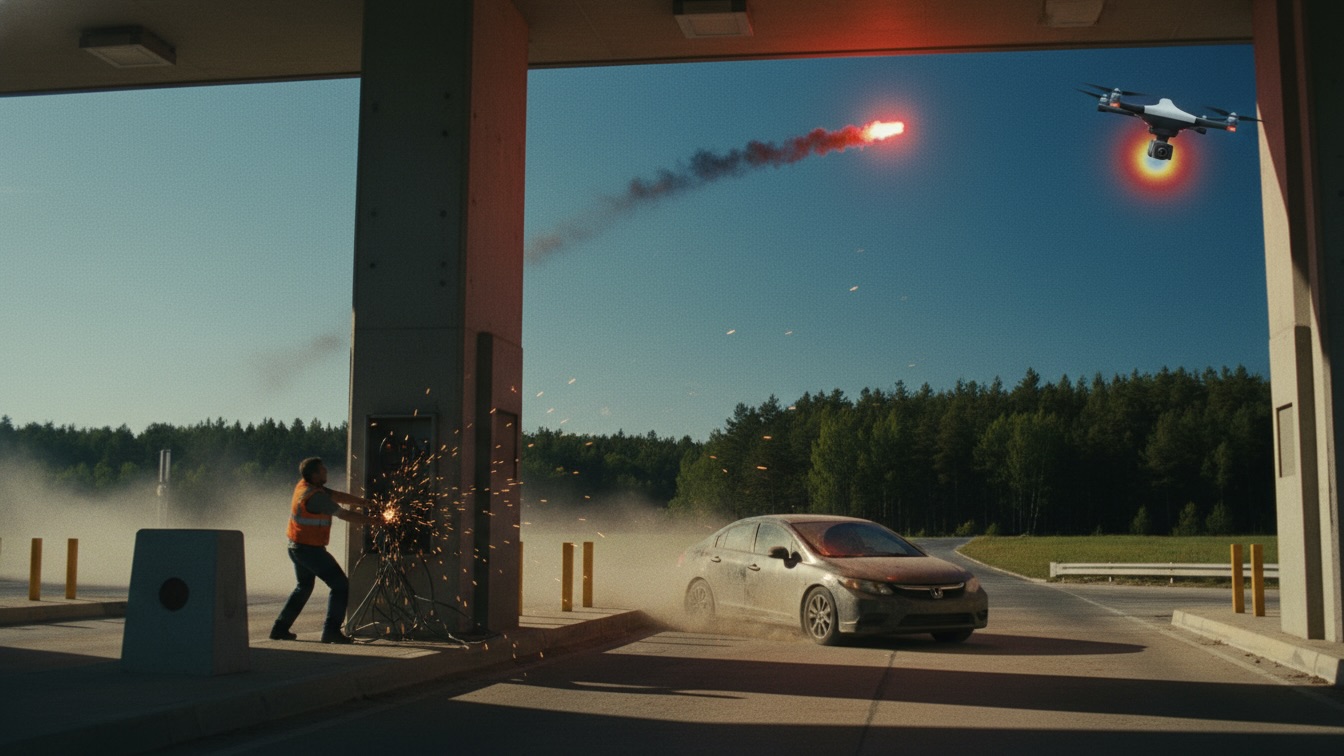
"Mr. Henderson in apartment 4B has a 2012 Honda Civic parked behind the building," Mike said. A grim smile touched the corner of his mouth. "It doesn't have an onboard computer. It's not registered to the new grid. I hotwired it before I came looking for you. It's parked two blocks from here."
We left the arcade through the broken back door. The sun was beginning to set, casting long, bruised shadows across the industrial ruins.
We walked quickly, sticking to the alleys. The distant wail of sirens echoed through the city, but they were heading toward our apartment building, not here.
We found the ancient, dented Civic idling quietly behind a rusted chain-link fence. The engine knocked slightly, a mechanical, analog sound.
Mike got in the driver's seat. I climbed into the passenger side. The interior smelled like stale cigarettes and old vinyl. It was the best thing I had ever smelled.
Mike put the car in gear. We pulled out onto the empty street.
I rolled the window down. The evening air was still hot, but it was moving. It rushed over my face, blowing my hair back.
I looked at the city skyline receding in the rearview mirror. The glass towers caught the last light of the sun, burning like monoliths. Inside those towers, machines were still running the math, still deciding who was profitable and who was expendable.
I looked down at my arm. The small cut was already scabbing over.
I didn't know what my name was going to be tomorrow. I didn't know how I was going to fix the broken chemistry in my head. I didn't know how Mike and I were going to survive in the woods.
But as the highway stretched out in front of us, dark and unmapped, I felt the phantom weight of Dr. Porter's perfect smile fade from my memory, replaced by the stubborn, undeniable rhythm of my own beating heart.
“The dashboard radio crackled to life with a burst of static, and a voice that wasn't a DJ began calling out the Civic's license plate numbers.”