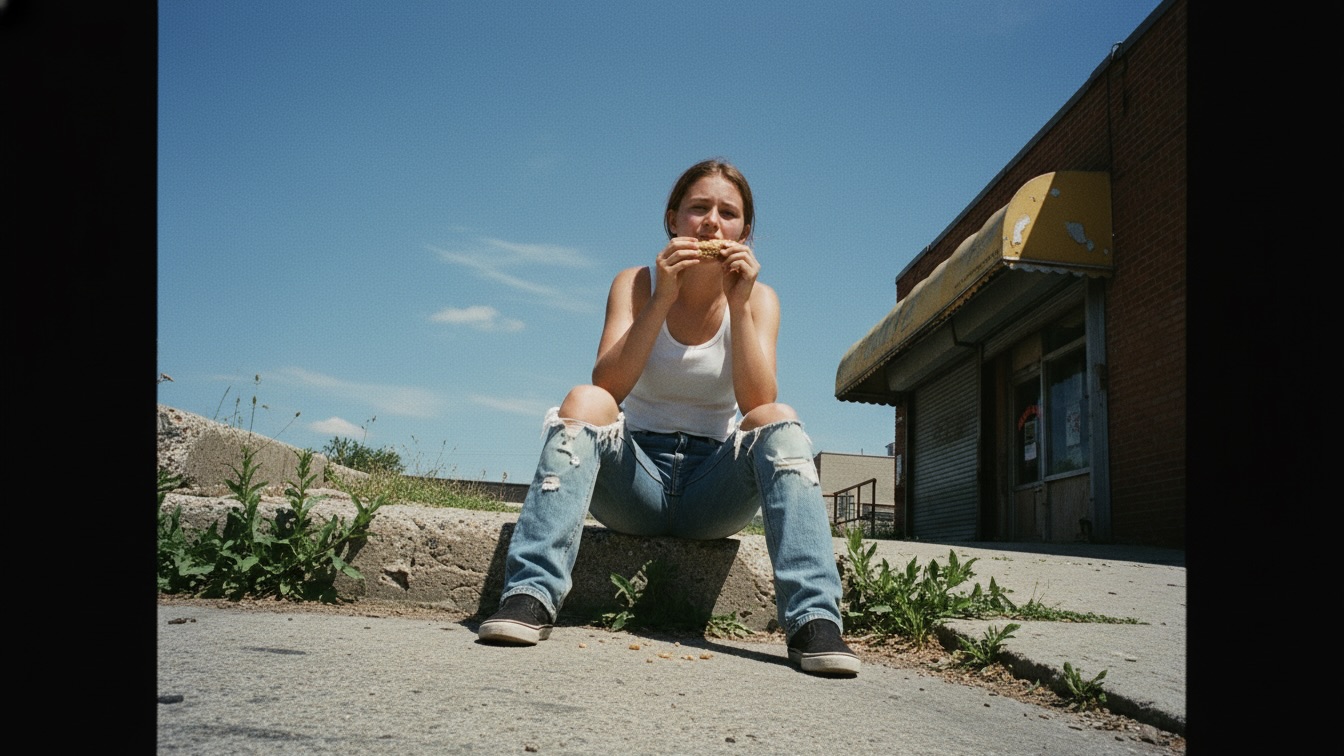
Jada scrubbed the dark stain from the jacket, wondering if love was supposed to taste like battery acid.
The toothbrush was meant for corners of the bathroom sink, not this. Jada gripped the plastic handle until her knuckles turned white. She dipped the frayed bristles into the small plastic cup of hydrogen peroxide. The liquid was warm. The entire apartment was warm. It was ninety-eight degrees outside, and the broken window unit in the corner was doing nothing but pushing hot, stale air across the living room. She pressed the wet brush against the thick fabric of the denim jacket. She scrubbed. Back and forth. Four times. She paused. Her jaw ached. She realized she was clenching her teeth. She forced her mouth open, pulling in a breath of air that smelled like bleach and copper.
The stain was dark brown, almost black against the faded blue denim. It was blood. Wes had told her it was from a nosebleed, but people did not get nosebleeds on the back of their shoulders. Jada knew this. She just did not want to think about it. Thinking required energy she did not have. Her right foot tapped against the scuffed linoleum floor. Tap. Tap. Tap. The rhythm was fast, completely out of sync with the sluggish heat of the summer afternoon.
"You are doing it wrong," Wes said. He was pacing. He had been pacing since he walked through the door twenty minutes ago. His boots hit the floorboards with a heavy, deliberate sound. He stopped behind her. She could feel the heat radiating off his body.
"I am doing it the way the internet said to do it," Jada said. She did not look up. She kept scrubbing. The peroxide bubbled against the fabric. A tiny white foam appeared on the dark stain.
"The internet is for civilians," Wes said. He leaned over her shoulder. He smelled like cheap cologne, stale cigarette smoke, and old sweat. "You have to put muscle into it, Jada. We cannot leave any traces. Not today. Today is the day everything changes."
Jada stopped scrubbing. She looked at the cup of peroxide. Her stomach turned over. It felt like a heavy, cold stone dropping into a pool of acid. She used to think this feeling was butterflies. She used to think this chronic nausea, this absolute tightness in her chest, was what true love felt like. Ride or die. That was the aesthetic. That was the script. She was the loyal girlfriend fixing the wounds of the misunderstood anti-hero. She was essential to him.
"We are leaving this city, Jada," Wes said. His voice was theatrical. He always spoke like he was delivering a monologue to a camera that only he could see. "One last run. Los Angeles is waiting for us. We are going to be kings. No more walking up three flights of stairs in the heat. No more scrubbing clothes in the sink. I promise you this."
Jada stared at the stain. Kings. Right. They were barely surviving in a rented box above a laundromat, and he was talking about Los Angeles. Her foot tapped faster. The cognitive static in her brain was getting louder. She was nineteen years old. She was supposed to be deciding between taking a morning shift at the coffee shop or going to community college orientation. Instead, she was destroying forensic evidence.
"Okay," Jada said. Her voice was flat. She dipped the brush again. Scrubbed. The stain was not coming out. It was just spreading, turning into a wider, lighter brown smudge.
"Do you believe me?" Wes asked. He grabbed her shoulder. His grip was tight. Too tight. It was a physical demand for compliance. He spun her around so she had to look at him. His eyes were wide, wired, dilated despite the bright sunlight streaming through the dirty window.
"I said okay," Jada said. She tried to pull her shoulder back, but he held on. Her heart rate spiked. The shallow breaths started. In, out. Barely past her collarbone.
"I need you to believe me," Wes said. His tone shifted from grand and theatrical to a low, dangerous whisper. "I am doing this for us. I built this reality for us. You are nothing without me, Jada. Do you understand that? You would just be another girl working a register. I gave you a life with purpose."
Jada looked at his hand on her shoulder. The knuckles were bruised. There was a fresh scrape across his thumb. She swallowed hard. Her throat was totally dry.
"I understand," she said. It was the easiest thing to say. It was the only thing to say that would make him let go.
He released her shoulder and smiled. It was a sharp, perfect smile. The kind of smile that had hooked her a year ago when she was just a bored high school senior looking for a spark. He turned and walked to the kitchen counter, grabbing his keys.
"I have to meet Mark," Wes said. "I will be back in two hours. Finish the jacket. Then pack a bag. Just the essentials."
"Where are we going tonight?" Jada asked.
"Do not worry about the logistics," Wes said. He opened the front door. The hallway smelled like boiling cabbage and floor wax. "Just be ready. I love you."
He did not wait for her to say it back. The door slammed shut. The lock clicked. Jada stood in the middle of the room, alone in the suffocating heat. She dropped the toothbrush. It clattered against the linoleum. She looked down at her hands. They were shaking. Not a little tremor, but a violent, uncontrollable shake. She pressed her palms flat against her thighs, trying to force her nervous system to calm down. It did not work.
Three loud knocks on the door made her jump entirely off the floor. She gasped, spinning around. Her heart hammered against her ribs like a trapped bird. Wes? Did he forget something? Did he leave his phone again?
She walked to the door, her legs feeling like lead. She looked through the scratched peephole. It was not Wes. The distorted glass showed a head of frizzy gray hair and a floral blouse. It was Mrs. Parter from apartment 3B.
Jada unlocked the deadbolt and pulled the door open a few inches. She kept her body blocking the view of the jacket on the floor.
"Hi, Mrs. Parter," Jada said. Her voice cracked. She cleared her throat and tried again. "Hello."
The elderly woman stood in the hallway holding a heavy glass Pyrex dish covered in aluminum foil. The heat coming off the dish smelled like baked cheese and tomato sauce. It was a profoundly normal smell. It was so normal it made Jada want to cry.
"You look terrible, sweetheart," Mrs. Parter said. She did not whisper. She had the loud, unapologetic voice of a woman who had lived in the same building for forty years and did not care who heard her. "You look like you have not slept in a month. And you are too thin. Your face is all hollow right here."
Mrs. Parter reached out and poked Jada on the cheekbone with a wrinkled finger.
"I am fine," Jada said. She tried to smile, but her facial muscles felt stiff. "It is just the heat."
"The heat does not make you look like a ghost," Mrs. Parter said. She shoved the heavy dish toward Jada. Jada instinctively put her hands out to take it. The glass was hot against her palms. "Baked ziti. I made too much. My grandson was supposed to come over, but he canceled. Teenagers. Anyway, you take it. Eat something real. Not those little granola bars I see you buying at the bodega."
Jada looked down at the foil-covered dish. The weight of it in her hands was grounding. It was a tangible, heavy object of care. There was no theatrical speech attached to it. There was no demand for loyalty. There was no promise of a grand escape to Los Angeles. It was just baked ziti because she looked thin.
"Thank you," Jada said. Her voice was barely a whisper. The tightness in her chest loosened, just a fraction of an inch.
"Make sure you return my dish," Mrs. Parter said. She turned and began shuffling back down the hallway toward her own door. "And tell that boy of yours to stop stomping around in heavy boots. We have downstairs neighbors, for heaven's sake."
"I will," Jada said. She closed the door and locked it. She walked to the kitchen counter and set the dish down. She carefully peeled back a corner of the foil. Steam rose up, carrying the smell of garlic and oregano. Jada stared at the food. Her stomach growled violently. She was starving. She realized she had not eaten anything since yesterday morning. She had been too busy managing Wes's moods, running Wes's errands, existing entirely within Wes's chaotic orbit.
She grabbed a fork from the drawer and ate straight from the dish. The food was hot and heavy. It burned her tongue, but she did not care. She ate three huge bites, chewing rapidly. She leaned against the counter, closing her eyes. The physical act of eating grounded her. The food hit her stomach, sending a small wave of actual, biological comfort through her exhausted body. For three minutes, the apartment was totally silent, save for the hum of the broken air conditioner. But the silence was a temporary illusion.
The illusion shattered at exactly four in the afternoon. The deadbolt clicked loudly. Jada was sitting on the edge of the mattress in the bedroom, staring blankly at the wall. She heard the heavy boots hit the linoleum. She stood up, smoothing down the front of her white tank top. The fabric clung to her sweaty skin. She walked out into the living room.
Wes stood in the center of the room. He was carrying a faded blue canvas duffle bag. The bag looked heavy. The straps pulled tight against his hands. He did not look triumphant. He looked wired, his jaw set in a hard line. The grand, theatrical confidence from earlier was gone, replaced by a frantic, jagged energy.
He dropped the bag. It hit the floor with a dull, heavy thud that vibrated through the floorboards and into the soles of Jada's sneakers. Dust kicked up from the rug. The sound was wrong. It was not the sound of clothes or cash. It was the sound of dense metal.
"What is that?" Jada asked. Her voice was flat. The numbness was creeping back in.
"Insurance," Wes said. He knelt down on the rug and grabbed the scratched silver zipper. He yanked it open. The teeth separated with a loud ripping sound.
Jada took a step closer. She looked inside the bag. There were six rectangular boxes. Burner phones. Cheap prepaid cell phones in blister packaging. And sitting on top of the boxes, wrapped in a dirty white towel, was a revolver. It was dark, heavy metal. It smelled sharply of machine oil and burnt powder.
Jada stopped breathing. Her lungs simply refused to expand. She stared at the gun. She had seen guns in movies, in music videos, on the news. But seeing one sitting on her own rug, three feet from her own shoes, was entirely different. It was not a prop. It was a tool designed specifically to destroy human tissue. The physical reality of it crashed into her brain.
"Wes," Jada said. She could not get enough air. The word came out as a squeak.
"Do not panic," Wes said. He stood up, wiping his forehead with the back of his hand. "It is a temporary hold. Mark got spooked. The cops are sweeping his block. We just need to stash this stuff for forty-eight hours until the heat dies down. Then we take it back, get our cut, and we are on the road to California."
Jada looked from the bag to Wes's face. The cognitive static in her head was a deafening roar now. "You brought that here? To the apartment?"
"No, I cannot keep it here," Wes said. He paced to the window, looked out through the blinds, and paced back. "The landlord has been asking questions about the rent. He might try to come in. It is not safe here."
"Then where?" Jada asked.
Wes stopped pacing. He looked directly at her. He put his hands on her shoulders, sliding them up to cup her face. His thumbs pressed into her cheekbones. It was supposed to be a romantic gesture, but it felt like a trap.
"You are going to take the bag to the daycare center," Wes said. His voice was smooth again. The theatrical tone was back. "You pick up Maya at five o'clock anyway. You walk in, you put the bag in her little cubby in the back room. Nobody checks the kids' stuff. It sits there until Friday. I come get it. We leave."
The words hit her ears, but her brain rejected the meaning. Maya. Her four-year-old sister. The daycare center on 14th Street with the finger-painted windows and the smell of apple juice.
"Put a gun in Maya's cubby," Jada repeated. The words tasted like ash in her mouth.
"It is perfectly safe," Wes said. He squeezed her face. "It is unloaded. I think. Look, it does not matter. The kids cannot reach the top shelf anyway. It is the perfect blind spot, Jada. The cops will never look there. You are a genius for having that connection."
Jada felt the floor drop out from under her. The panic attack did not start in her mind; it started in her body. Her vision tunneled. The edges of the room went dark, blurring into a gray vignette. The sound of the broken air conditioner faded away, replaced by a high-pitched ringing in her ears. Her hands went completely numb. The tingling started in her fingertips and shot up her arms.
She pulled away from Wes's hands. She stumbled backward, hitting the edge of the kitchen counter. She gripped the Formica edge. It was solid. It was real. Everything else was spinning.
This was not a spark. This was not the thrill of a dangerous romance. This was her nervous system screaming at her that she was going to die. This was chronic dysregulation. She was trading her sanity, her life, and now her sister's safety, for a guy who used 3-in-1 body wash and spoke in stolen movie quotes.
She closed her eyes. The darkness made the spinning worse. She forced her eyes open. She remembered the school counselor, Mr. Harrison. She had sat in his office three months ago, crying because she could not focus on her math test. He had taught her Acceptance and Commitment Therapy tools. Grounding techniques. She thought they were stupid at the time. Now, they were a lifeline.
Name five things you can see. Jada stared at the room. The blue duffle bag. The dark heavy metal of the gun. The broken plastic vent of the air conditioner. The brown stain on the linoleum rug. Wes's scuffed leather boots.
Name four things you can feel. She focused on her body. The sweat pooling at the back of her neck. The rough edge of the Formica counter digging into her lower back. The heavy, sluggish air sitting on her skin. The flat soles of her sneakers pressing against the floorboards.
Name three things you can hear. The ringing in her ears. The rattle of the window unit. Wes's breathing.
Name two things you can smell. The harsh chemical scent of the bleach she used earlier. The machine oil from the gun.
Name one thing you can taste. The stale, metallic tang of fear.
She dropped the anchor. The spinning stopped. The gray vignette receded from her vision. The room snapped back into sharp, agonizing focus. The heat was still oppressive. The bag was still on the floor. Wes was still staring at her, looking impatient.
"Are you done?" Wes asked. He crossed his arms over his chest. "I do not have time for you to space out right now. Grab the bag. It is almost four-thirty. You need to walk over there before the rush hour traffic gets bad."
Jada let go of the counter. The numbness in her hands was gone. Her fingers felt heavy, strong, and entirely her own. She looked at Wes. She saw the sweat on his upper lip. She saw the slight tremor in his hands. He was not a king. He was a terrified, selfish boy trying to use a child's daycare as a shield.
She took a deep breath. The air went all the way down to her diaphragm. She did not feel brave. Bravery was a myth sold in movies. She just felt a cold, hard clarity. A core value had been breached. The boundary was not a line drawn in the sand; it was a concrete wall.
"No," Jada said.
The word hung in the hot air. It was a single syllable, but it carried the weight of a thousand silent resentments.
Wes blinked. He uncrossed his arms. The theatrical mask slipped entirely. "What did you say?"
"I am not taking that bag to the daycare," Jada said. Her voice did not shake. "I am not bringing a gun anywhere near Maya."
The silence that followed was heavy and dangerous. Wes did not yell. He did not throw his hands up in a dramatic gesture. He just stared at her, his facial features going completely slack. The charm evaporated. The 'ride or die' aesthetic melted away, leaving only the cold reality of a cornered animal.
He took one step toward her. The floorboards creaked.
"You do not tell me no," Wes said. His voice was flat, devoid of any theatrical inflection. It was the most terrifying sound Jada had ever heard from him. "I make the plans. You follow the plans. That is how this works. I pulled you out of your boring, pathetic life. I gave you something real."
Jada stood her ground. She could feel the adrenaline pumping into her bloodstream, prepping her muscles for action. "This is not real, Wes. This is just a mess. And I am not dragging my little sister into it."
"She is a toddler!" Wes snapped, his volume suddenly spiking. He pointed a finger at her face. "She will not even know it is there. You are being completely irrational. You are letting your emotions ruin our future."
Jada looked at the finger pointing at her. She realized, with blinding clarity, that there was no future. Los Angeles was a lie. The money was a lie. The love was a transaction where she paid with her safety and he took whatever he wanted.
"I am not doing it," Jada repeated.
Wes lunged forward. He moved faster than she anticipated. He grabbed her by the shoulders and slammed her back against the kitchen counter. The impact knocked the wind out of her lungs. The edge of the Formica dug sharply into her spine. His face was inches from hers. His breath was hot on her cheek.
"Listen to me very carefully," Wes hissed, his eyes wide and dark. "Mark will kill me if I lose this bag. And if I go down, you go down. You scrubbed the jacket. You wiped the prints. You are an accessory. You belong to this now. Pick up the bag."
Jada stared into his eyes. She saw the absolute desperation. She realized he would physically force her to carry the bag out the door if he had to. She could not fight him. He was heavier, stronger, and running on pure panic.
She had to act. Not out of bravery, but out of raw survival. The ACT tools had grounded her, but they did not provide a physical escape route. She had to create one.
"Okay," Jada whispered. She relaxed her body, letting her shoulders slump. She made herself look defeated. "Okay, you are right. Let me go. I will take it."
Wes held her for a second longer, searching her face for deception. He must have seen what he wanted to see, because he slowly released his grip. He took a step back, smoothing his shirt. The theatrical posture returned.
"Good," he said, breathing heavily. "That is my girl. I knew you would see reason. We are a team, Jada. Remember that."
Jada did not reply. She pushed herself off the counter. She walked slowly toward the center of the room where the blue duffle bag sat on the rug. She bent down. She zipped the bag shut, hiding the phones and the heavy black metal of the revolver. She grabbed the canvas straps.
She stood up, holding the bag in her right hand. It was heavier than she expected. It pulled her shoulder down.
Wes was standing near the kitchen, watching her. He reached into his pocket to pull out his keys. That was his mistake. Both of his hands were occupied for a fraction of a second.
Jada did not think. She just moved. She pivoted on her left foot and threw her body toward the front door. She grabbed the brass handle, yanked it down, and threw the door open.
"Hey!" Wes yelled. The sound of his keys hitting the floor echoed in the room.
Jada bolted into the hallway. The stale smell of boiling cabbage hit her face. She did not look back. She hit the first step of the staircase and practically threw herself down the flight. Her sneakers slapped loudly against the wooden treads. She skipped the last two steps of the first landing, hitting the floor hard. Her ankle rolled slightly, but she ignored the sharp flare of pain. Adrenaline masked it.
"Jada!" Wes roared from the top of the stairs. His heavy boots thundered onto the landing.
She kept running. Second flight. First flight. She burst through the heavy glass door at the bottom of the stairwell and hit the sidewalk. The summer heat hit her like a physical blow. It was suffocating. The glare of the sun on the concrete was blinding. The noise of the street—cars honking, a distant siren, a radio blasting from an open window—crashed over her.
She turned right and sprinted down the block. The blue duffle bag bounced against her leg with every stride. The heavy metal inside banged painfully against her thigh. She gripped the straps tighter.
She did not run toward the daycare. The daycare was three blocks north. She ran south. She ran toward the avenue.
She could hear Wes behind her. He was screaming her name. People on the sidewalk were turning to look. A woman pushing a stroller pulled it sharply to the side as Jada sprinted past. An old man sitting on a stoop lowered his newspaper.
Jada's lungs burned. The hot air seared her throat. Her legs felt heavy, but she pushed them harder. The pavement burned through the thin rubber soles of her sneakers. She needed a safe space. She needed a physical barrier. She could not outrun him forever.
Up ahead, on the corner of 12th and Avenue B, was the faded yellow awning of 'Luis & Sons Bodega.' It was an anchor in the neighborhood. It was open twenty-four hours. It was brightly lit. It was mundane. It was exactly what she needed.
Jada pushed her legs faster. The gap between her and Wes was closing. He was faster on a straight sprint. She could hear his boots hitting the pavement, much closer now. She gripped the bag and aimed for the open door of the bodega.
Jada crashed through the open doorway of the bodega. The transition from the blinding street glare to the fluorescent hum of the store was jarring. The air conditioning hit her face, cold and smelling aggressively of artificial cherry and cardboard dust. She slipped on the shiny linoleum floor, her sneakers screeching, but she caught her balance on the edge of a display rack of potato chips. Plastic bags crinkled loudly under her hand.
Luis, the shift manager, was standing behind the high counter, ringing up a customer. He was a thick-set man in his forties with a permanent scowl and a faded Mets cap. He looked up, his eyes widening as he saw Jada gasping for air, clutching the heavy blue duffle bag to her chest.
"Jada?" Luis asked, his hand pausing over the cash register scanner. "You okay, kid? You look like you are running from a ghost."
Jada could not form a complete sentence. Her chest was heaving violently. She pointed a shaking finger toward the glass front doors.
"Lock it," Jada gasped. The words tore at her dry throat. "Luis. Lock the door. Now."
Luis did not ask questions. He knew the neighborhood. He knew the look of genuine, unfiltered terror. He dropped the scanner, stepped out from behind the counter, and walked quickly to the front doors. He grabbed the heavy metal handles and pulled them shut. He threw the deadbolt just as a body slammed against the outside of the glass.
It was Wes. He hit the glass with his palms, his face twisted in rage. The glass rattled in its frame, but it held.
Jada backed away, retreating deeper into the store. She moved past the aisle of canned beans and the cooler full of sodas. She stopped near the back room door, hiding partially behind a cardboard cutout of a beer model.
Wes banged his fists against the glass. He was shouting, but the thick door muffled the sound. Luis stood near the register, his arms crossed, staring at Wes through the glass. The customer, a woman holding a loaf of bread, backed away toward the dairy section.
"Open the door!" Wes yelled, his voice barely audible over the hum of the store's refrigerators. When Luis did not move, Wes shifted his tactics. The rage melted away, replaced instantly by the theatrical, manipulative mask. He pressed his face closer to the glass, trying to look past the chip racks to find Jada.
"Jada!" Wes called out. His voice took on a pleading, dramatic tone. "Jada, baby, come on. We belong together! You cannot deny fate! Do not let these people interfere with our destiny!"
Jada leaned against the cold metal door of the back room. She listened to his words. A month ago, those words would have worked. She would have felt guilty. She would have thought she was ruining a grand romance. Now, standing in the harsh fluorescent light of a bodega, smelling artificial cherry, the words just sounded like garbage. They were massive red flags. It was not destiny. It was toxic trauma dumping. It was a guy throwing a tantrum because he lost control of his accessory.
Luis picked up his cell phone from the counter. He dialed a number without breaking eye contact with Wes.
"Hey, Hector," Luis said into the phone. "Get the guys up from the domino tables. Yeah. Front door. We got a problem."
Within thirty seconds, Jada saw movement outside the glass. Three older men, the neighborhood watch regulars who always sat on milk crates by the corner, walked up behind Wes. They were not imposing men individually—one had a cane, another wore thick glasses—but together, they formed a physical barricade. They stood close to Wes, crowding his space. The man with the cane tapped it against the concrete. They did not touch him. They just looked at him with the collective disapproval of a community that had seen boys like him come and go for decades.
Wes looked at the men. He looked back at the locked door. The grand narrative was falling apart. He was not a king. He was just a nuisance blocking the sidewalk. He spat on the glass, turned, and shoved his way past the old men, walking quickly down the avenue until he disappeared into the crowd.
Jada let out a breath she felt she had been holding for a year. Her legs gave out. She slid down the metal door, sitting hard on the linoleum floor. She pulled her knees to her chest and rested her forehead against her arms.
Luis walked to the back of the store. He looked down at her, then looked at the blue duffle bag sitting beside her.
"You want to tell me what is in the bag, Jada?" Luis asked quietly.
"No," Jada said. She kept her head down. "But I need you to call Officer Davis. Is he walking the beat today?"
Luis nodded slowly. "Yeah. He is usually around 10th Street right now. I will text him. You stay put."
Ten minutes later, the back alley door of the bodega opened. Officer Davis, a young cop who bought coffee from Jada every Tuesday, stepped into the cramped, dusty stockroom. Jada stood up. She picked up the blue duffle bag by the canvas straps. She did not hesitate. She handed it directly to him.
"I found this in my apartment," Jada said. Her voice was steady. The cognitive static was gone. "It belongs to Wes Carter. He told me he was moving it for a guy named Mark. I want it out of my life."
Officer Davis took the bag. He unzipped it, looked inside, and his expression hardened. He zipped it back up immediately.
"You did the right thing, Jada," Davis said. "I am going to call this in. We have been looking for Mark's stash house all week. Are you safe? Do you need an escort home?"
"I am safe here," Jada said. "Thank you."
Two hours later, Jada sat on the cracked concrete curb outside the bodega. The sun was beginning to set, casting long, golden shadows across the street. The oppressive heat was finally breaking. A cool breeze blew down the avenue, rustling the green weeds pushing up through the cracks in the pavement.
She held a Nature Valley granola bar in her hand. It was stale. She took a bite. It tasted like sweet cardboard. Crumbs fell onto her faded jeans. She chewed slowly, feeling the dry texture in her mouth. It was not a cinematic dinner in Los Angeles. It was a stale snack on a dirty curb. But it was real. It was hers. The bitter flavor of leaving a toxic situation was settling in, but underneath the bitterness was a profound, quiet peace.
Her phone buzzed in her pocket. It was a text from her mother. Maya's play starts in 20 mins. Are you coming?
Jada brushed the crumbs off her jeans. She stood up, tossing the empty wrapper into a nearby trash can. She typed back. I am on my way.
Later that evening, Jada sat in the folding metal chair in the elementary school gymnasium. The air conditioning was working perfectly. The room smelled like floor wax and construction paper. On the wooden stage, her four-year-old sister, Maya, stood dressed in a brown shirt and green cardboard leaves. She was playing a tree. She was not doing a good job. She kept waving at the audience and scratching her nose.
It was the most boring, unglamorous event Jada had ever attended. There were no high stakes. There was no theatrical dialogue. There was no adrenaline.
Jada leaned back in the uncomfortable metal chair. She watched her sister sway under the bright stage lights. She felt her feet resting flat against the floor. She felt the cool air on her skin. She took a deep breath, filling her lungs completely. The curtain fell on the stage, but Jada kept her eyes on the exit doors, wondering how long the quiet would last.
“The curtain fell on the stage, but Jada kept her eyes on the exit doors, wondering how long the quiet would last.”


