The stolen Civic’s radio screams our names while the summer heat turns the dashboard into a blistered landscape.
"You hear that, right?" I asked.
Mike didn't look at me. His hands were white-knuckled on the steering wheel of the 2012 Honda Civic. The plastic rim was peeling, leaving little gray flakes on his palms. He looked like he was trying to strangle the car into submission. The engine made a rhythmic tapping sound, a metallic heartbeat that felt entirely too loud in the dead air of the cabin.
"It's just a broadcast, Jeff," he said. His voice was flat, but I could see the muscle in his jaw jumping. "It's a local loop. They don't have a lock on us yet."
"They just read the plate," I said. I leaned forward, my chest tightening. "They read the plate and then they said my student ID. How does a DJ in the middle of nowhere have my student ID?"
"It’s not a DJ," Mike snapped. He reached out and twisted the volume knob. The static got louder, a digital hiss that felt like sandpaper on the inside of my skull. "It’s a protocol. The emergency broadcast system is slaved to the health grid now. If you're flagged as a high-risk asset, the system pushes the alert to every available frequency. It’s automated. It’s just math."
"I’m not an asset," I whispered. I looked out the window. The cornfields were a blur of dusty green under the oppressive August sun. The heat was a visible thing, shimmering off the blacktop in waves that distorted the horizon. The sky was a pale, washed-out blue, drained of color by the humidity. My t-shirt was plastered to my ribs. Every time I moved, the fabric pulled at my skin.
"To them, you're a row in a ledger," Mike said. He shifted gears. The transmission groaned, a low, mechanical protest. "A row that isn't generating a return on investment. That’s why Porter was so eager to sign you off. A dead kid doesn't need a subsidy. A dead kid doesn't need a therapist. A dead kid is a closed file."
I rubbed my left arm. The spot where Mike had fried my biometric chip was a dark, angry welt. It throbbed in time with my pulse. The skin around it was red and tight, but the vibration was gone. The constant, low-level hum of being connected—the digital tether that had been there since I was six—was finally severed. It felt like a limb was missing. It felt like I was floating.
"What happens at the border?" I asked.
"We cross it," Mike said.
"It's not that simple anymore, Dad. You saw the news before the internet went out. They retrofitted the booths. Mass-scanners. Thermal imaging. They aren't looking for drugs. They're looking for heartbeats that aren't registered to the local grid."
Mike looked at me then. His eyes were bloodshot, the corners crusted with salt. He looked older than he had this morning. The rage that had carried him through the arcade was starting to leak out, leaving something hollowed-out and desperate underneath.
"Then we give them something else to look at," he said.
He reached into the footwell and pulled out a heavy, orange plastic tube. A flare gun. He tossed it into my lap. The weight of it was surprising. It felt solid, real, and dangerously analog.
"The drone will have a gimbal-mounted sensor array," Mike said, his eyes back on the road. "It’s programmed to prioritize high-heat signatures. If we get stuck at the gate, you wait for my signal. You aim for the tree line on the left, not the drone. You give it a bigger target to track."
"I've never fired one of these," I said. My fingers traced the trigger guard. It was cold despite the heat in the car.
"It’s a trigger, Jeff. You pull it, things burn. You’ve played enough games to know the mechanics."
"Games have a reset button," I said.
"We’re past the tutorial," Mike replied. He slowed the car as the road began to widen. Up ahead, the shimmering heat on the pavement resolved into the sharp, brutal lines of a provincial checkpoint. It looked like a fortress made of shipping containers and LED arrays. "Put the gun under your seat. Don't pull it out until I tell you. And for God's sake, don't look at the cameras."
I shoved the flare gun under the passenger seat. My hand brushed against a discarded fast-food wrapper, the paper brittle and dry. I sat back and tried to breathe. The air in the car was stagnant. The Civic didn't have functional A/C, and the open windows only invited in more of the furnace-blast summer.
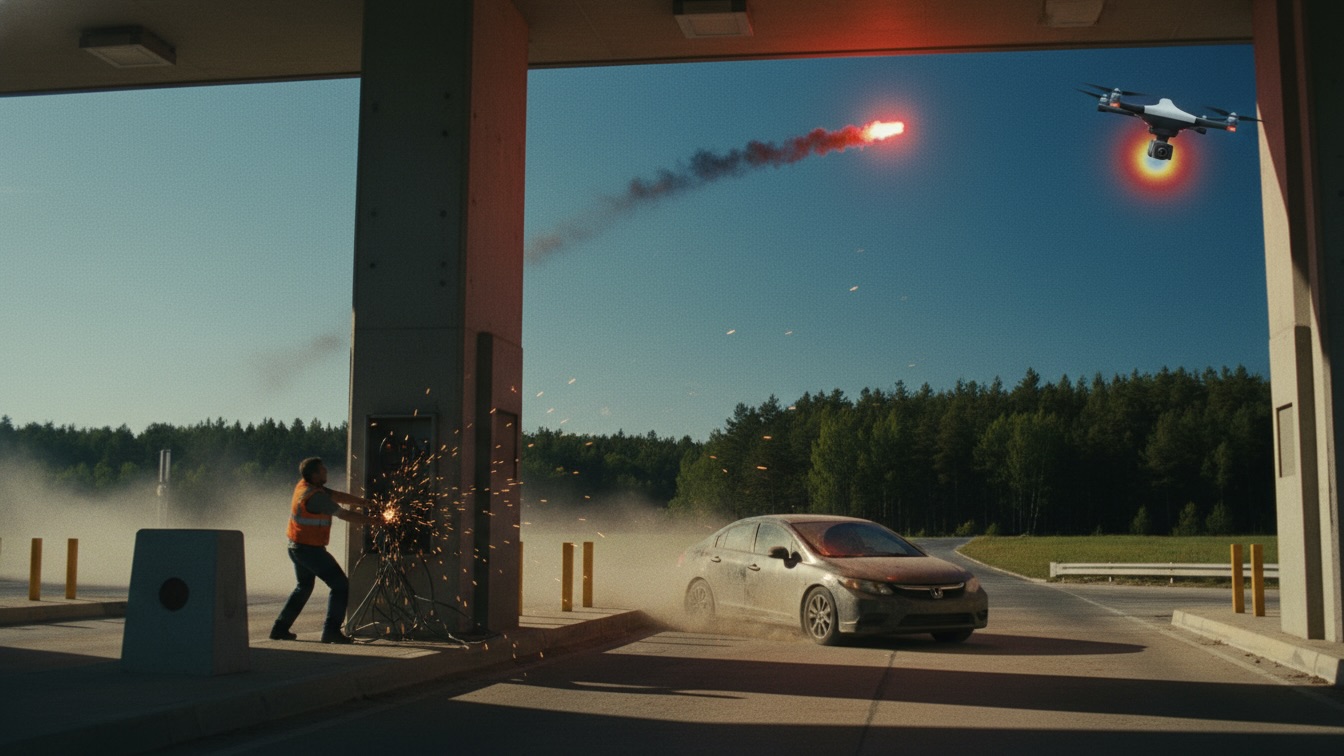
I watched the checkpoint get closer. A white drone, the size of a lawnmower, hovered thirty feet above the lead gate. Its rotors hummed, a high-pitched whine that cut through the engine noise. It looked like a predatory insect, its camera eye swiveling with mechanical precision.
"Engagement logged," I whispered, mimicking the school's AI voice.
Mike didn't laugh. He just gripped the wheel tighter and steered us into the lane.
"Just be ready," he said. "The second I hop out, you move to the driver's seat. If that gate goes up, you don't wait for me. You drive until the gas runs out."
"I'm not leaving you," I said.
"This isn't a movie, Jeff. It’s a logistics problem. You're the cargo. I'm the carrier. The cargo has to reach the destination. Everything else is secondary."
His voice was harsh, but his hand trembled as he reached for the gear shift. I realized then that he wasn't being brave. He was just out of options. We were two ghosts in a stolen car, driving toward a wall that was built to keep people exactly like us on the wrong side of history.
The toll booth loomed like a guillotine. It wasn't the old-fashioned kind with a human being in a plexiglass box tossing change. This was a streamlined, automated throat. Four lanes of concrete channeled into a single exit point. Above us, a massive digital sign displayed a rotating series of warnings in high-contrast yellow: 'GRID ENFORCEMENT ACTIVE,' 'BIOMETRIC SCAN IN PROGRESS,' 'STAY IN YOUR VEHICLE.'
We crawled forward. The Civic’s engine was stumbling now, the idle dipping dangerously low. Every time the car shuddered, I felt it in the base of my spine.
"The scanner is going to hit the VIN first," Mike muttered. He was leaning forward, his forehead almost touching the windshield. "Then it’s going to look for the transponder signal. When it doesn't find one, the gate will stay down. That’s our window."
"How is a window?" I asked. I could see the drone now. It had dropped lower, hovering near the roof of the car in front of us—a sleek, black SUV that passed through the gate with a polite, digital chirp. "If the gate stays down, we're trapped."
"The gate is hydraulic," Mike said. He reached into the center console and pulled out a multi-tool. He unfolded the pliers with a metallic snap. "The override is in a junction box on the exterior of the pillar. It’s legacy tech, Jeff. They built the high-tech sensors on top of a thirty-year-old frame. They never updated the physical failsafes because they assumed the digital ones were unbreakable."
We were next. The SUV sped away, its taillights disappearing into the summer haze of the highway beyond. The arm of the toll gate—a heavy, striped bar reinforced with carbon fiber—dropped into place with a thud that vibrated through the pavement.
Mike brought the Civic to a halt six inches from the barrier.
Immediately, a red light on the pillar began to strobe. A synthetic voice, deeper and more authoritative than the one at school, boomed from a speaker array overhead.
"VEHICLE IDENTIFICATION FAILURE. REMAIN STATIONARY. A SECURITY MONITOR HAS BEEN DISPATCHED."
"That's our cue," Mike said. He didn't hesitate. He threw the door open and rolled out of the car.
"Dad!" I yelled.
He was already moving. He stayed low, ducking behind the concrete pylon of the toll booth. I watched him through the side mirror. He looked small against the massive infrastructure. He was a middle-aged guy in a sweat-stained work shirt, trying to fight a continental network with a pair of pliers.
I scrambled over the center console. My foot caught on the gear shift, knocking it into neutral. The car started to roll back. I slammed my foot on the brake, my heart leaping into my throat. I shoved myself into the driver's seat, my hands trembling as I gripped the wheel. The seat was adjusted for Mike’s longer legs; I had to lean forward just to reach the pedals.
Above me, the drone reacted.
It didn't make a sound, but the change in its flight pattern was obvious. It tilted forward, the camera gimbal locking onto the open driver’s side door. It began to descend, the downdraft from its rotors kicking up a cloud of grit and dried leaves from the roadside.
"ATTENTION," the overhead voice boomed. "UNAUTHORIZED VEHICLE EXIT DETECTED. RETURN TO YOUR VEHICLE IMMEDIATELY."
I looked at the junction box. Mike had the cover off. Sparks were flying—bright, blue-white flashes that looked like tiny stars against the gray concrete. He was elbow-deep in the wiring, his face contorted with concentration.
"Jeff! The flare!" he screamed over his shoulder.
I reached under the seat. My fingers closed around the cold plastic of the flare gun. I pulled it out. The orange casing felt oily. I fumbled with the break-action barrel, sliding a thick, red shell into the chamber. I snapped it shut. The sound was a solid, mechanical clack.
I leaned out the window. The drone was twenty feet away now, its sensors glowing a dull, predatory red. It was scanning the car, looking for the heat signature of the driver. It hadn't seen Mike yet, but it would in seconds.
I aimed the flare gun at the woods to the left of the highway. The trees were tinder-dry, the leaves brown and curled from the three-week heatwave.
I squeezed the trigger.
The kick was harder than I expected. The gun jumped in my hand, the recoil bruising my palm. A streak of brilliant crimson light tore through the air, trailing a ribbon of thick gray smoke. It arched over the fence and slammed into the dry brush fifty yards away.
There was a soft whump of ignition.
A wall of orange flame erupted instantly. The dry grass went up like it had been soaked in gasoline. The heat from the flare was intense, a sudden spike in the environment that the drone couldn't ignore.
I watched the drone’s gimbal. It twitched. The red sensor eye flickered. The logic gates inside its processor were weighing the two signals: a stationary, low-heat car and a sudden, massive thermal event in the perimeter.
The flare won.
The drone pivoted away from the Civic, its rotors screaming as it accelerated toward the treeline. It was programmed to contain threats, and a forest fire was a priority-one environmental hazard.
"The gate!" I yelled, looking back at Mike.
He wasn't looking at me. He had a thick bundle of wires in his left hand and the pliers in his right. He gritted his teeth and yanked.
There was a sound like a gunshot—a hydraulic line snapping. A spray of dark fluid coated Mike’s arms and the side of the booth. The carbon-fiber arm of the gate shuddered, groaned, and then began to rise. It didn't glide up smoothly like it did for the SUV. It jerked upward in three-inch increments, the metal screaming as the remaining pressure forced it open.
"Go!" Mike shouted. He dropped the wires and sprinted for the car.
I didn't wait for him to get in. I shifted into drive and floored it. The tires spun on the oily pavement, smoking and screaming, before they finally caught. The Civic lunged forward.
Mike grabbed the door handle as the car was already moving. He hauled himself into the passenger seat, his boots dragging on the asphalt for a second before he pulled them in and slammed the door.
We shot under the rising gate with inches to spare. The carbon-fiber bar caught the roof of the car, a long, screeching scrape that sounded like a giant fingernail on a chalkboard.
Then we were through.
I didn't look back at the fire. I didn't look at the drone. I just kept my foot flat on the floor, the speedometer climbing past eighty. The old engine was screaming, the vibration so intense I thought the doors might shake off their hinges.
"We made it," I gasped. My lungs felt like they were full of ash.
"Not yet," Mike said. He was leaning back in the seat, gasping for air. His arms were covered in black hydraulic fluid. It looked like war paint in the harsh afternoon light. "They'll have the plate logged at the exit point. They'll know we breached. We have five miles before the car becomes a liability."
I looked at the dashboard. A red light I hadn't noticed before was blinking. The temperature gauge was pinned in the red. A thin wisp of steam began to curl from the edges of the hood.
"The car is already a liability," I said.
The Honda died three miles past the border. It wasn't a dramatic explosion. It was a pathetic, wheezing surrender. The engine gave one final, metallic thud, and then the power steering vanished. I fought the wheel, guiding the coasting hunk of metal onto the narrow, gravel shoulder.
We rolled to a stop in front of a wall of dense, unmanaged forest. The silence that followed was deafening. No engine hum. No radio static. Just the ticking of the cooling metal and the distant, rhythmic drone of cicadas in the trees.
"Out," Mike said. He was already grabbing his bag from the backseat. "Now. They'll track the GPS on the car's emergency transponder even if the engine is dead."
"I thought you said this car didn't have a computer," I said, stumbling out into the heat. My legs felt like jelly.
"It doesn't have a smart-grid interface, but every car since 2010 has a passive locator for insurance recovery," Mike said. He kicked the passenger door shut. "It’s a low-frequency ping. They'll have a cruiser here in twenty minutes."
He handed me a backpack. It was heavy, filled with water bottles and canned food. I slung it over my shoulders. The weight pulled at the raw skin on my arm, a sharp reminder of the chip Mike had carved out of me.
"We go north," Mike said, pointing into the trees. "The treeline is thick enough to break the drone's line of sight, but we have to keep moving. If we stop, our thermal signature will pool. The sensors can see heat through the canopy if you stay in one spot for too long."
We climbed over the rusted guardrail and plunged into the woods.
The transition was jarring. The highway was a world of gray and black, of heat and speed. The forest was a riot of tangled brown and deep, dusty green. The air was different here—stagnant and heavy, trapped under the thick ceiling of leaves. There was no breeze. The sun hit the forest floor in jagged, white-hot needles where the canopy broke.
I followed Mike. He moved with a surprising, frantic energy, pushing through the underbrush without regard for the thorns that caught at his clothes. He was a man running from a ghost, and the ghost was the life he had spent forty years building.
"Dad, slow down," I panted. I was already sweating through my shirt again. My throat felt like it had been scrubbed with steel wool.
"We can't," he said. He didn't turn around. "The tech commune is at the base of the ridge. If we make it there before dark, we're safe. They have a localized jammer. It creates a dead zone five miles wide. The state won't fly drones into a dead zone; they're afraid of losing the hardware."
"Why would they help us?" I asked. I tripped over a rotted log, my sneakers sliding on the loose mulch. "We're just more mouths to feed."
"I spent three years shipping them refurbished processors and analog circuit boards through the warehouse backdoor," Mike said. "They owe me. And they need people who know how to work on the old machines. The world is moving to a place where nobody knows how to fix anything that doesn't have a 'repair denied' software lock. I'm an asset to them. A real one."
I looked at his back. He was a warehouse worker. A guy who loaded trucks. I had spent my whole life thinking he was just a part of the machinery, a cog that was slowly wearing out. I never knew he was a smuggler. I never knew he was planning an exit long before I clicked that button on the school portal.
"You knew this was coming," I said. It wasn't a question.
Mike stopped. He turned around, wiping sweat from his eyes with the back of his hand. His face was a map of exhaustion and regret.
"I saw the updates to the insurance policy, Jeff. I saw the way they were categorizing the kids at the distribution center. 'Low-yield biometric profiles.' 'Non-essential social units.' They were preparing the ground. I didn't know they'd come for you this fast. I thought we had another year."
"The algorithm accelerated the timeline," I said. I looked down at my hands. They were shaking. "I was sad, Dad. That's all. I was just sad, and the computer decided that meant I was broken beyond repair."
"You aren't broken," Mike said. His voice was low, cracking with a sudden, raw emotion. "The system is a mirror, Jeff. It only shows you what the people who built it want to see. They want a world of perfect, productive little units. They don't know what to do with a human heart that hurts. So they try to delete the heartbeat."
A high-pitched whine drifted through the canopy.
We both froze.
It wasn't the white drone from the toll booth. This was different. A deeper, more resonant hum.
"Health Monitor," Mike whispered. "It’s a search-and-rescue model. High-fidelity thermal."
I looked up. I couldn't see it through the leaves, but I could feel the vibration of its rotors in my teeth. It was circling, sweeping the woods in wide, methodical arcs.
"Down," Mike hissed.
He grabbed my shoulder and shoved me into a shallow depression beneath the roots of a massive, fallen oak. We scrambled into the dirt, pressing ourselves against the cool, damp earth. Mike pulled a camouflage-patterned tarp from his bag—it looked old, military-surplus—and draped it over us.
"Stay still," he breathed. "Don't move a muscle. Don't even blink."
I pressed my face into the dirt. It tasted like minerals and decay. I could feel a beetle crawling across the back of my neck, its tiny legs prickly against my skin. I didn't flinch.
The hum grew louder. The drone was directly above us now. I could hear the air being whipped into a frenzy by its blades. A beam of white light—the searchlight—swept across the forest floor, visible even through the gaps in the tarp. It flickered over the bark of the fallen oak, a sterile, artificial glare that felt like an interrogation.
I closed my eyes. My heart was a drum in my chest. I was certain the drone could hear it. I was certain it could see the heat of my fear radiating through the tarp.
Zero-productivity asset identified. Initiating recovery protocol.
The words played in my head like a loop of corrupted code.
The light lingered for an eternity. The drone hovered, its sensors processing the data. It was looking for the shape of a human. It was looking for the 98.6-degree signature of life.
Then, the hum began to fade. The light moved on, dancing across the trees as the drone continued its sweep toward the north.
Mike didn't move for five minutes. Neither did I. The silence of the forest returned, but it was different now. It felt like the woods were holding their breath with us.
Finally, Mike threw back the tarp. He looked at me, his eyes wide and dark.
"We have to run," he said. "That thing will be back on its return leg in ten minutes. We have to be in the dead zone before then."
He stood up and hauled me to my feet. We didn't talk. We didn't look for a trail. We just ran. We ran through the heat, through the briars, through the suffocating weight of the summer air, two small sparks of defiance trying to stay lit in a world that wanted to blow us out.
The ridge was a wall of gray granite that seemed to grow out of the forest floor like a jagged tooth. My legs were burning, the muscles in my thighs screaming with every step. My vision was starting to blur at the edges, a symptom of the heat and the dehydration that I couldn't ignore anymore.
"Almost there," Mike panted. He was staggering now, his breath coming in ragged, wet gulps. "The entrance... it's behind the rock fall."
We scrambled up a steep slope of loose scree. Every time I gained a foot, the rocks shifted, sliding me back six inches. I dug my fingers into the dirt, my fingernails breaking against the stones. I didn't care. I could see the top.
Behind us, the sun was beginning to dip below the horizon, turning the sky into a bruised palette of purple and deep, bloody orange. The heat hadn't broken, but the shadows were getting longer, stretching out like fingers trying to pull us back into the dark.
I heard the drone again.
It was closer this time. It had finished its sweep and was coming back, low and fast. It knew we were here. It had found the car, it had found our trail, and now it was closing the gap.
"Dad!" I screamed, pointing back at the treeline.
A black shape emerged from the foliage, hovering a hundred yards away. It was a Health Monitor, but it wasn't alone. Two smaller, faster tactical drones—the kind used for 'compliance enforcement'—were flanking it. They looked like silver darts, their rotors a blur of motion.
"Go!" Mike yelled. He shoved me toward a narrow cleft in the rock face.
I scrambled into the opening. It was narrow, the stone cold and damp against my shoulders. I turned around and reached out my hand for Mike.
He was halfway up the slope when the tactical drones fired.
They didn't use bullets. They used high-frequency sonic pulses designed to disrupt the nervous system. I heard a sound like a giant glass sheet shattering, a vibration that made my teeth ache and my vision swim.
Mike collapsed. He didn't scream; he just crumpled, his body sliding down the scree like a rag doll.
"NO!" I lunged out of the cleft, but a hand caught my collar and yanked me back.
"Stay down, kid!" a voice barked.
I spun around. A man in a heavy, grease-stained parka and a pair of vintage night-vision goggles was standing in the shadows of the cave. He was holding a device that looked like a cross between a satellite dish and a shotgun.
"My dad!" I yelled, fighting against his grip. "They hit him!"
"I see him," the man said. He stepped forward, raising the device. "Cover your ears."
He pulled a trigger. There was no noise, but the air in front of us rippled. The two tactical drones suddenly veered off course, their flight stabilization systems failing as the man's jammer flooded their sensors with white noise. One of them slammed into a pine tree and exploded in a shower of sparks. The other spiraled into the ground, its rotors snapping against the rocks.
The larger Health Monitor paused, its internal logic struggling to compensate for the sudden loss of its escort.
Two more people emerged from the cave. They were wearing tattered clothes and carrying heavy coils of rope. They moved with the practiced efficiency of mountain climbers. They slid down the scree toward Mike, their boots kicking up clouds of dust.
I watched, my heart in my throat, as they reached him. They looped a harness under his arms and began to haul him up the slope. Mike was conscious, but his limbs were twitching, his brain still trying to reboot from the sonic strike.
They dragged him into the cave entrance. I fell to my knees beside him, grabbing his hand. His skin was cold despite the heat.
"Dad? Dad, look at me."
Mike’s eyes drifted to mine. He tried to speak, but only a dry, rattling sound came out. He squeezed my hand, a weak, trembling pressure.
"He'll be okay," the man with the jammer said. He was watching the horizon. The Health Monitor was retreating, its mission parameters overridden by the hostile electronic environment. "The pulse is non-lethal. It just messes with the inner ear and the motor cortex. He'll have a hell of a headache for a week, but he'll live."
He looked at me then, pulling his goggles up onto his forehead. His eyes were sharp, intelligent, and deeply skeptical.
"You're Mike's kid?" he asked.
"I'm Jeff," I said.
"Well, Jeff, welcome to the end of the world," the man said. He gestured toward the back of the cave. "We've got water and a medic inside. And a firewall that'll take the state ten years to crack."
I looked at Mike. He was breathing more regularly now, his eyes focusing on the jagged ceiling of the cave. He looked at me and gave a tiny, almost imperceptible nod.
I stood up and helped the others carry him deeper into the mountain.
The cave widened into a massive, man-made cavern. It was filled with the hum of servers and the soft, amber glow of old-fashioned filament bulbs. People were moving everywhere—working on circuit boards, tending to hydroponic gardens, talking in low, urgent tones. There were no screens tracking their eyes. There were no algorithms monitoring their pulse.
It was a world of ghosts, living in the cracks of a system that thought they were dead.
We laid Mike on a cot in a small, partitioned area. A woman with silver hair and a stethoscope began to examine him. I sat on a wooden crate next to the bed, my head in my hands.
The adrenaline was fading, leaving a cold, hollow exhaustion in its place. I looked down at my arm. The wound where the chip had been was dirty and inflamed, but it didn't throb anymore.
I looked around the cavern. It was harsh. It was crowded. It smelled of ozone and old paper. It was the least comfortable place I had ever been.
But as I watched the silver-haired woman check Mike's vitals, and I felt the cool, unmonitored air of the mountain on my face, I realized that for the first time in my life, I wasn't waiting for a pop-up to tell me how to feel.
I was just here.
I reached into my pocket and pulled out the small, jagged piece of the school’s biometric terminal that had caught in my sleeve when I smashed it. I looked at the shattered glass, the way it caught the amber light.
I wasn't a zero-productivity asset.
I wasn't a closed file.
I was a person who had crossed a border that wasn't on any map.
Outside, the summer sun finally vanished, leaving the world in a darkness that the drones couldn't penetrate.
I leaned back against the stone wall and closed my eyes, listening to the sound of my father’s steady, stubborn breathing.
“But as the deep hum of the mountain's hidden generators vibrated through the floor, I saw the commune leader looking at the radio, his expression hardening as a new, more aggressive signal began to override their jammer.”


