The story follows a tense escape as Jeff and his father, Mike, flee a dystopian society that treats human beings as quantifiable digital assets. Driving a decaying 2012 Honda Civic, they navigate a world where the "health grid" monitors every heartbeat and student ID via pervasive broadcasts. Mike has forcibly removed Jeff’s biometric chip, leaving the boy feeling phantom-limb sensations of a severed connection while they head toward a heavily fortified provincial border.
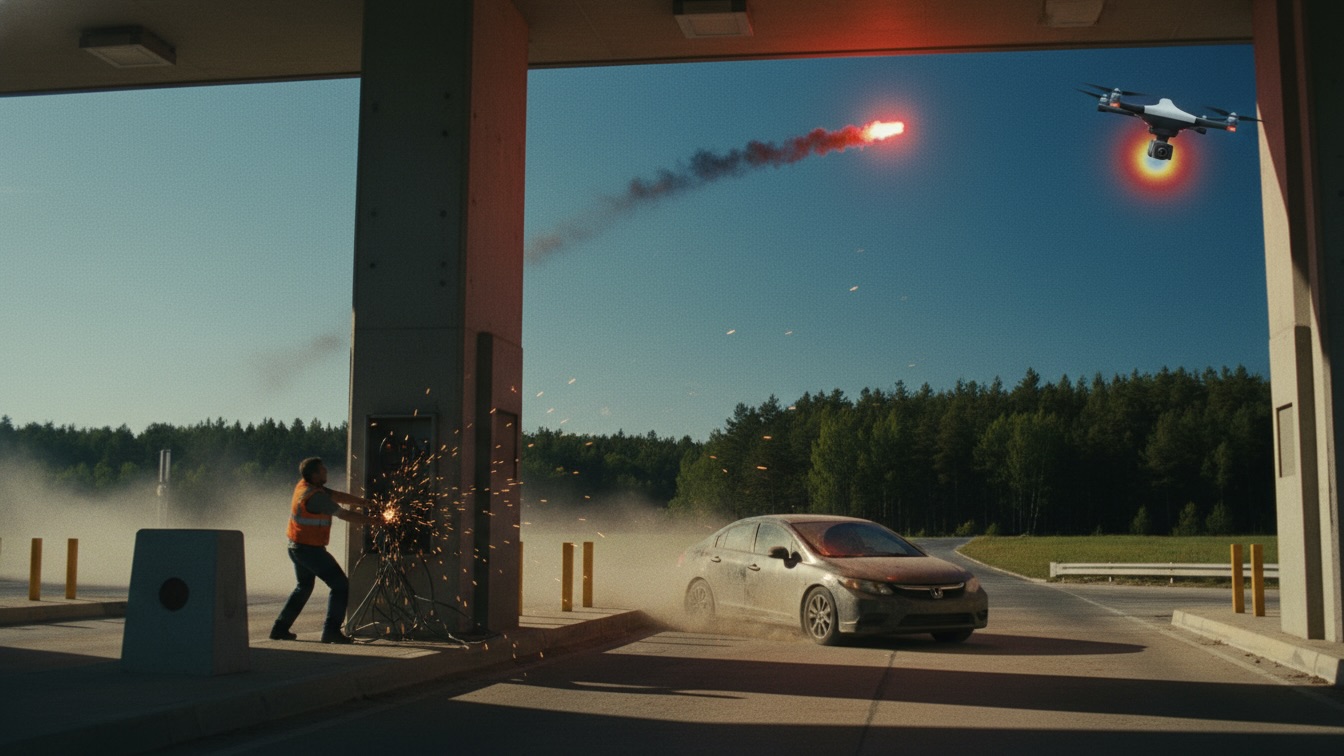
At the checkpoint, the duo faces an automated system guarded by predatory drones and biometric scanners. Mike performs a dangerous manual override of the hydraulic gate while Jeff uses a flare gun to distract a hovering drone by creating a massive thermal signature in the nearby woods. They narrowingly escape through the rising gate, but their vehicle eventually succumbs to the extreme heat and mechanical failure shortly after crossing the border.
The final leg of their journey takes them into a dense forest where they must evade a high-fidelity thermal Health Monitor drone. Mike leads Jeff toward a "dead zone" commune of technical outcasts who live outside the state's reach. Despite Mike being incapacitated by a tactical drone’s sonic pulse, the commune’s scouts rescue them. Jeff concludes the journey in a hidden cavern, finally free from the oppressive digital gaze and reclaiming his identity as a human being rather than a "closed file."
The central theme of the narrative is the dehumanization of the individual through the lens of data and logistics. In this society, Jeff is not a teenager suffering from emotional distress but a "row in a ledger" or a "low-yield biometric profile." The system views human suffering as a technical malfunction that reduces the "return on investment," suggesting a world where empathy has been entirely replaced by cold, algorithmic efficiency.
This commodification extends to the way the state manages its "assets," where a "dead kid" is preferred over a subsidized one because it represents a "closed file." The story explores the chilling reality of a "health grid" that uses medical wellness as a pretext for total surveillance and control. By framing depression as a reason for "deletion," the narrative critiques a society that values productivity over the inherent worth of human life.
Another prominent theme is the conflict between the "analog" and the "digital." The protagonists rely on "legacy tech," "dangerously analog" flare guns, and manual pliers to defeat a system that assumes its digital failsafes are unbreakable. The resistance commune itself is a sanctuary of "old machines" and "filament bulbs," suggesting that human freedom is found in the messy, unmonitored cracks of the physical world.
The "dead zone" serves as a powerful metaphor for the reclamation of the self. In this space, the "firewall" is not just a digital barrier but a psychological one that allows Jeff to exist without a pop-up telling him how to feel. The theme of boundaries—both the physical provincial gate and the internal border of the mind—highlights the struggle to remain "uncounted" in a world that demands total visibility.
Jeff begins the story in a state of profound psychological disorientation, struggling with the "missing limb" sensation of his severed biometric chip. As the protagonist, he represents the victim of a system that pathologizes human emotion, specifically his sadness, as a terminal flaw. He is initially passive, viewing himself through the eyes of the AI as a "zero-productivity asset" and feeling like "cargo" being moved by his father.
His psychological journey is one of transitioning from a monitored object to an agent of his own survival. When he fires the flare gun, he moves beyond the "tutorial" of his former life and engages with a reality where actions have permanent consequences. This moment marks a shift in his self-perception, as he begins to value his own heartbeat not as a data point for the grid, but as a sign of his stubborn persistence.
By the end of the chapter, Jeff experiences a sense of relief that is both physical and existential. The "cold, hollow exhaustion" he feels in the cave is a more authentic human experience than the "digital tether" he grew up with. He ultimately rejects the system's labels, finding peace in the "unmonitored air" and the simple, stubborn reality of his father’s breathing.
Mike serves as the catalyst for Jeff’s liberation, acting as a desperate protector who has long been planning a subversion of the state. He is a man driven by a mixture of parental love and a deep-seated rage against the "logistics problem" that his son has become in the eyes of the government. His "white-knuckled" grip on the steering wheel reflects a man who is barely holding his composure while fighting a "continental network" with nothing but his hands and a few tools.
Psychologically, Mike is a man who has lived a double life, working as a warehouse laborer while secretly smuggling "refurbished processors" to the resistance. He views himself as a "carrier" and Jeff as the "cargo," a cold metaphor he likely uses to distance himself from the terrifying stakes of their flight. His willingness to endure a sonic pulse and risk his life at the junction box demonstrates a sacrificial drive that the system's algorithm cannot account for.
The narrative utilizes a gritty, sensory-heavy prose style to emphasize the oppressive nature of the environment. The "furnace-blast summer" and the "stagnant air" of the car create a visceral sense of claustrophobia that mirrors the suffocating reach of the surveillance state. Sensory details like the "metallic heartbeat" of the engine and the "digital hiss" of the radio static serve to blur the line between the mechanical and the biological.
The pacing of the story is expertly handled, oscillating between the slow, agonizing tension of the checkpoint and the frantic, high-stakes flight through the woods. The author uses mechanical terminology—"gimbal-mounted sensor array," "hydraulic line," "thermal signature"—to ground the science fiction elements in a believable, tactile reality. This contrast between "high-tech" jargon and "low-tech" survivalism reinforces the story's core conflict.
The narrative voice is intimate and weary, reflecting Jeff’s internal exhaustion and the weight of his trauma. The use of the first-person perspective allows the reader to feel the "throb" of the welt on his arm and the "mineral and decay" taste of the dirt. This focus on physical sensation serves as a direct counterpoint to the "digital" world the characters are fleeing, grounding the reader in the reality of the human body.
The tone is one of desperate defiance, characterized by a lack of sentimentality that makes the emotional moments, such as Mike’s hand trembling on the gear shift, more impactful. The ending of the chapter shifts from the frantic energy of the chase to a quiet, atmospheric stillness in the cavern. This tonal shift effectively communicates the transition from being a "hunted asset" to a "living ghost" in the cracks of the system.


