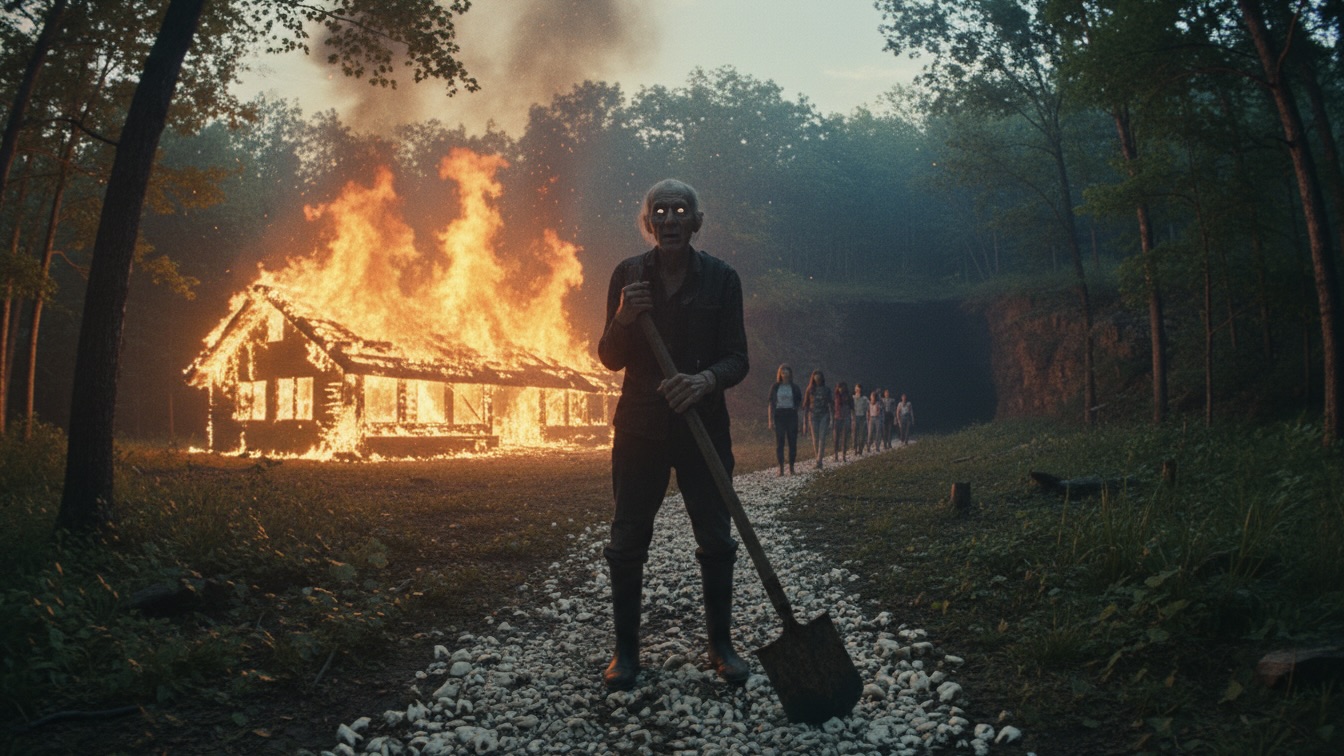
Toby is the weary groundskeeper of Camp Blackwood, a location where the boundary between reality and a predatory forest is dangerously thin. He manages a supernatural ledger that records the names of those consumed by the woods while witnessing the arrival of a new group of campers. Among them is a boy who mirrors Toby’s own appearance and a counselor named Pete who is losing his sanity to the forest's influence. As the summer solstice approaches, Pete attempts to burn the camp down to escape the "static" in his head. Toby eventually undergoes a physical and metaphysical transformation, becoming a spectral Shiver-man and ceding his duties to the mysterious boy.
The primary theme of the story is the cyclical nature of trauma and the inevitability of replacement within a closed system. Camp Blackwood functions as a metaphysical loop where individual identities are harvested to sustain the forest’s existence. Toby’s transition from a man to a "Shiver-man" suggests that the role of the groundskeeper is a temporary stay against entropy, one that must be renewed through the sacrifice of self. The forest does not merely kill its victims; it rewrites them, turning human memories into "paper trees" and "rivers of phosphorus." This suggests a theme of environmental parasitism where nature is an ancient, lonely force that requires human observers to validate its existence.
Another significant theme is the breakdown of reality and the failure of memory. The characters struggle to hold onto their pasts, symbolized by the fading ink in the ledger and Toby’s inability to recall his own last name. Pete’s memories of the "fire" act as a glitch in the forest's illusion, showing that suppressed trauma can disrupt even the most powerful supernatural constructs. The "static" that Pete feels is the psychological manifestation of a reality that is being overwritten. Ultimately, the story suggests that memory is both a burden that anchors a person to humanity and a currency that the forest demands as payment for the "loop" to continue.
Toby functions as a tragic archetype of the guardian who has been eroded by the very thing he protects. From a psychological perspective, he exhibits chronic dissociation, viewing his own physical changes—such as his thick, grease-stained hands—with a detached sense of inevitability. His internal conflict is defined by the struggle to maintain a coherent ego while the forest systematically strips away his memories and identity. He is a man who has already accepted his replacement, showing a weary resignation that suggests he has been "the groundskeeper" for far longer than he can consciously recall. By the end of the chapter, his transformation into a Shiver-man represents the final collapse of his individual psyche into a collective, spectral consciousness.
Pete serves as the narrative’s emotional powder keg, representing the violent rejection of the forest's parasitic influence. He is plagued by "static," a psychological metaphor for the sensory and cognitive overload caused by the forest’s reality-warping presence. His obsession with the red jerrycan and the fire at the mess hall indicates a desperate need for a "reset," an attempt to use physical destruction to stop a metaphysical process. Pete’s tragedy lies in his awareness; unlike the other campers who are hollowed out, he remembers the "red can" and the "orange air," making his descent into madness a conscious and agonizing experience. His final disappearance into silver sparks suggests that even his radical act of rebellion was eventually co-opted by the forest’s hunger.
The Boy is a chilling figure who represents the cold, inevitable continuity of the Camp Blackwood cycle. He displays a level of psychological detachment that is far beyond his apparent years, treating the ledger and its names with a clinical, almost administrative focus. He does not fear the forest so much as he understands its mechanics, viewing the trees and the "static" as a system to be managed. His resemblance to Toby suggests a recursive timeline, where he is not just a replacement but a younger iteration of the same soul. By taking the shovel and the clove cigarette, he accepts the burden of the groundskeeper with a terrifying calm, indicating that the forest has already groomed him for his role.
The author employs a visceral, sensory-heavy style to ground the surreal elements of the plot. Descriptions of the heat as a "wet wool blanket" and the gravel turning into "teeth" create a sense of physical revulsion and claustrophobia. These sensory anchors, such as the medicinal smell of clove cigarettes and the sharp scent of gasoline, provide a stark contrast to the shifting, "glitchy" nature of the camp. The use of body horror—specifically the "extra knuckles" and the "papery skin"—effectively communicates the protagonist’s loss of humanity. This tactile approach ensures that the reader feels the weight of the environment alongside the characters.
The pacing of the narrative is masterfully handled, beginning with a lethargic, heat-soaked atmosphere that gradually accelerates into a frantic climax. The rhythmic "thump-thump-thump" of Toby’s foot serves as a metronome for the rising tension, mirroring a heartbeat that is no longer entirely his own. The narrative voice is one of terminal weariness, reflecting Toby's psychological exhaustion and his detached observation of his own dissolution. This first-person perspective allows for a deep dive into the "static" of his mind, making the eventual transition to the "paper forest" feel like a necessary, albeit terrifying, release. The final twist, involving a gargantuan Pete and a mountain-sized jerrycan, shifts the tone from personal horror to a grand, apocalyptic scale.


