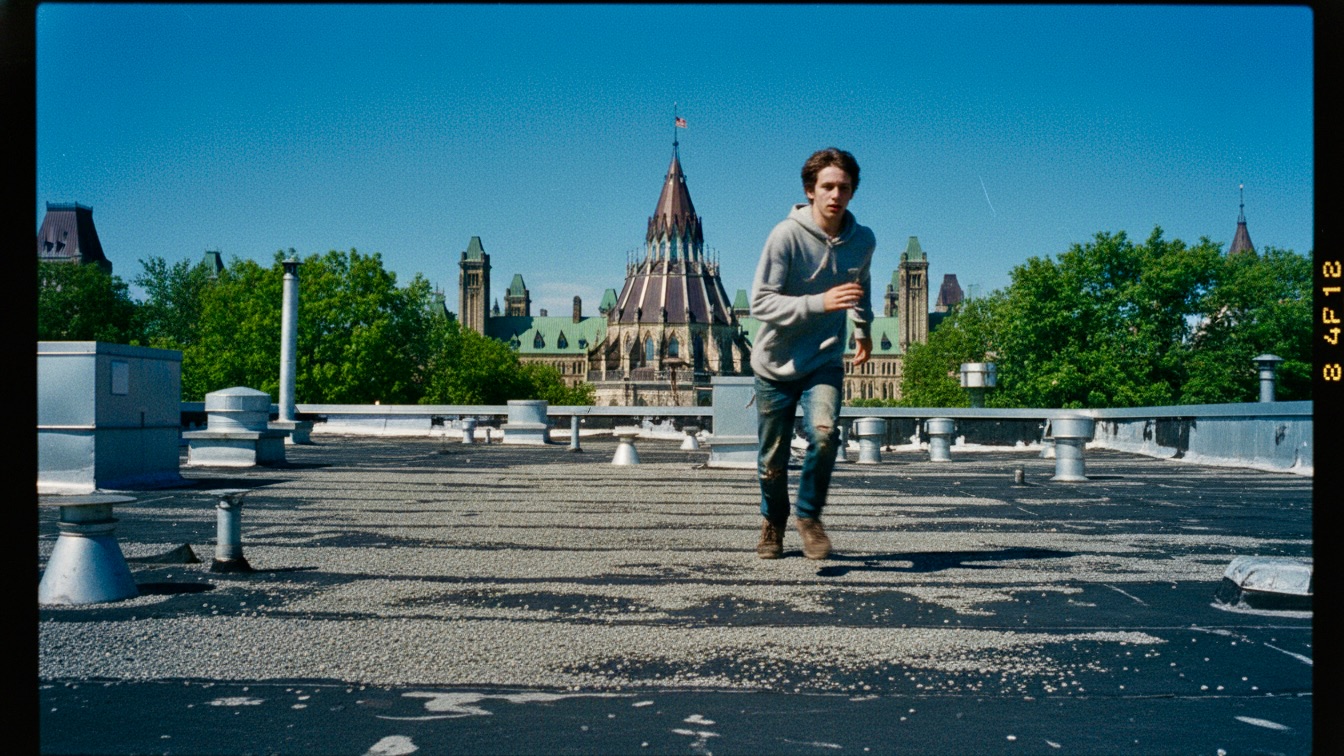
The story opens in a tension-filled kitchen in Ottawa, where young Kenny witnesses the physical and emotional decay of his father, Mike. Mike is a former trucker whose life has been dismantled by the government's freezing of his bank accounts following his involvement in protests. Kenny’s mother, Diane, is a high-ranking official in the Prime Minister's Office who cold-bloodedly justifies these measures as necessary for state stability. This domestic friction serves as the catalyst for Kenny to flee the house and head toward the heart of the ongoing protests at Parliament Hill.
While navigating a chaotic police sweep, Kenny encounters a dying man in an alley who entrusts him with a military-grade USB drive containing evidence of state overreach. Kenny narrowly escapes tactical teams and facial recognition surveillance by navigating the city's underground and service corridors. He eventually reaches a gaming cafe where a hacker helps him bypass the encryption, revealing that his own mother authorized the "kill switch" that destroyed his father's finances. This discovery transforms Kenny's flight into a mission of exposure.
The climax occurs when Kenny returns home to confront Diane, only to find her ready to arrest him to protect the secret. He manages to escape her and the tactical teams, utilizing his parkour skills to reach a tech hub overlooking the protest zone. There, he uploads the incriminating files to massive public screens, exposing the government’s financial enforcement protocols to the world. Though he is ultimately captured and detained, the chapter ends with the sounds of a public uprising, suggesting that while Kenny has lost his personal future, he has ignited a national reckoning.
The central theme of the narrative is the weaponization of the digital economy as a tool of state surveillance and social control. The "kill switch" mentioned in the text represents a shift from physical incarceration to digital execution, where a citizen's ability to survive is tied to their political compliance. By focusing on the bank statements and the red lines of locked accounts, the story highlights how modern governance can bypass traditional due process to exert immediate, life-altering pressure on dissenters.
Another profound theme is the disintegration of the nuclear family as a microcosm of a fractured nation. The household is divided between the "grease-stained" laborer and the "charcoal wool" bureaucrat, representing a class war happening across a dinner table. Diane’s belief that she is "saving" her family by destroying the rights of others demonstrates a deep psychological compartmentalization. This conflict suggests that ideological purity and state loyalty have become more potent than blood ties, leading to a profound sense of domestic betrayal.
The story also explores the concept of the "panopticon" in a modern urban setting. Through the use of facial recognition, tactical cruisers, and digital footprints, the city of Ottawa is portrayed as a sentient trap that monitors its inhabitants' every move. Kenny’s journey from the suburbs to the core is a struggle against this omnipresent eye. His success in the end is not just a leak of information, but a temporary blinding of the system that seeks to categorize and neutralize every "data point" in its path.
Finally, the narrative touches upon the heavy price of truth and the loss of innocence. Kenny begins the day as a teenager frustrated by his parents’ bickering and ends it as a political prisoner who has effectively dismantled his mother’s career and his own safety. The recurring phrase "no cap" evolves from youthful slang into a revolutionary slogan, symbolizing a demand for unvarnished reality in a world built on "filtered air" and professional registers. The "freedom" Kenny feels at the end is paradoxical, as it comes only after he has lost everything.
Kenny serves as the moral compass of the story, caught between the visceral suffering of his father and the cold pragmatism of his mother. He possesses a physical and digital literacy that allows him to navigate both the rooftops of Ottawa and the complexities of encrypted data. His transition from an observer to an actor is driven by a psychological need to resolve the cognitive dissonance created by his mother’s professional identity. He is not motivated by a specific political ideology but by a fundamental reaction to the cruelty he sees inflicted on his father.
Psychologically, Kenny displays significant resilience and a high capacity for risk-taking, likely honed through his hobby of parkour. This physical agility mirrors his mental ability to process the trauma of his mother’s betrayal in real-time. By the end of the chapter, he accepts his role as a martyr, showing a level of self-actualization that far exceeds his eighteen years. He chooses the "uncomfortable truth" over a "comfortable lie," a decision that defines his transition into adulthood.
Diane is the personification of the "banality of evil" within a modern technocracy. She views the world through the lens of macro-economics and "stabilization measures," which allows her to ignore the human cost of her decisions. Her clothing—the stiff, charcoal wool armor—serves as a psychological barrier between her and the reality of her husband’s poverty. She truly believes that her actions are protective, showing a messiah complex where she feels she must "save" her son from the very chaos she helped incite.
Her betrayal of Kenny at the end of the chapter reveals the depth of her indoctrination into the state apparatus. When she calls the tactical teams on her own son, she is choosing the survival of the "system" over the survival of her family unit. She is a tragic figure in her own right, as she has traded her humanity for a seat on "the Hill." Her inability to see Kenny as anything other than a "subject" to be managed highlights the total erosion of her maternal instincts.
Mike represents the discarded working class, a man whose identity was tied to his labor and is now tied to his bitterness. He is a ghost in his own home, still carrying the grease of a job he is no longer allowed to perform. His psychological state is one of "learned helplessness," as he spends his days staring at the digital evidence of his own erasure. He serves as the primary motivation for Kenny’s actions, acting as a living reminder of the consequences of Diane’s policies.
The pacing of the chapter is expertly handled, beginning with a slow-burn domestic drama and escalating into a high-stakes techno-thriller. The author uses the oppressive heat of an Ottawa August as a sensory metaphor for the rising political and social tension. This "swamp-like" atmosphere makes the clinical coldness of the PMO offices and the server rooms feel even more jarring. The transition from the quiet kitchen to the "howl of frustration" at the protest zone creates a powerful narrative crescendo.
The narrative voice is sharp and cynical, utilizing industrial and digital imagery to ground the story in a near-future reality. Descriptions like "digital execution," "museum of a dead marriage," and "plastic toys under the sun" reinforce the themes of dehumanization and artifice. The author effectively uses the contrast between the "filtered air" of the elite and the "burning pepper" of the streets to emphasize the class divide. These sensory details make the political conflict feel visceral rather than theoretical.
The use of short, punchy dialogue, especially during the confrontation between Kenny and Diane, heightens the emotional stakes. Diane’s shift into her "professional register" creates a chilling effect, showing how language can be used as a weapon of distancing. Meanwhile, the rhythmic clack of batons and the hum of servers provide a mechanical soundtrack to Kenny’s journey. This blend of organic human emotion and cold mechanical precision creates a tone that is both haunting and urgent, perfectly reflecting the story's core conflict.


