2026 Summer Short Stories
Neural Upgrades and Horrific Nightmares - Treatment
by Jamie Bell | Treatment
by Jamie Bell | Treatment
Format: Short Film / Anthology Episode | Est. Length: 10-12 minutes
Imagine a world where academic and professional success is no longer a matter of effort, but of hardware; this story fits into an anthology series titled The Optimization, exploring the dark, visceral consequences of a society obsessed with bio-digital efficiency. Each episode examines a different facet of the "Apex" ecosystem, from corporate boardrooms to the elite youth camps where the next generation is literally hard-wired for productivity. The series utilizes a "near-future" aesthetic where high-tech invasive surgery is treated with the same mundanity as a dental cleaning, highlighting the erosion of human autonomy in the face of algorithmic perfection.
A teenage boy sits in the back of a luxury SUV, his hand trembling as he reaches for a raw, titanium port surgically embedded behind his ear, while his mother coldly reminds him to swab the wound for infection without ever looking up from her tablet.
At an elite summer camp for neural enhancement, a teenager discovers that the price of academic perfection is a shared, hardware-induced nightmare. To escape the digital haunting, he must use obsolete technology to sabotage the very system designed to optimize him.
The primary theme is the dehumanization inherent in "hustle culture" and the commodification of the human mind, specifically through the lens of parental expectation. It explores the tension between organic human experience—messy, emotional, and slow—and the sterile, high-bandwidth demands of a hyper-competitive future. The story posits that "optimization" is a form of erasure, where the unique anxieties of the individual are processed as system errors to be overwritten.
Secondary themes include the generational divide regarding technology and the concept of "technological nostalgia" as a form of resistance. By using an obsolete iPod and a rusted spoon to bypass a multi-million dollar mainframe, the protagonist asserts that human imperfection and "low-tech" reality are the only true escapes from a curated, digital existence.
For Lane, the stakes are his sanity and his sense of self; if he remains connected, the "optimization" will leave him a hollow, high-functioning shell of a person. For the parents and Director Askew, the stakes are social status and the success of a multi-million dollar investment, prioritizing data points over the psychological well-being of the children. Failure to "optimize" results in social ostracization and the loss of a competitive future, creating a "life-or-death" pressure within a purely academic context.
The external conflict is the Apex Mainframe and Director Askew, representing a corporate-educational complex that views teenagers as "processing engines" rather than people. Internally, Lane struggles against the crushing pressure of his father’s expectations and the fear of failure, which manifests as a literal, hardware-driven nightmare of being crushed by standardized test bubbles. The auditors represent the ultimate threat: a cold, clinical force that seeks to "patch" any remaining human resistance in the campers' neural caches.
Lane is dropped off at Camp Apex, a sterile, glass-and-concrete facility where teenagers receive neural upgrades to "optimize" their cognitive bandwidth for the upcoming school year. After the initial calibration—a painful process that leaves the campers in a state of hyper-focused silence—Lane begins experiencing vivid, terrifying nightmares of giant Scantron bubbles crushing his world. He soon discovers that the mainframe is forcing his brain to process abstract academic anxiety as physical trauma, a side effect the camp directors ignore in favor of "flawless" productivity logs.
Lane meets Dani, a peer who shares similar haunting visions of being "erased" by giant mechanical pencils, and together they realize the camp's hardware is frying their minds. Using a smuggled, obsolete iPod and a rusted spoon found in the dirt, they create a crude magnetic "spoof" that allows them to bypass the mainframe and find a few hours of natural sleep. When corporate auditors arrive to perform a manual data scrape, Lane and Dani realize their hack will be discovered, leading them to a final, desperate act of sabotage: uploading the raw data of Lane’s nightmares into the mainframe to wake up the entire camp.
Lane Miller: A quiet, pressured teenager who begins the story as a passive participant in his own life, obediently following his father's demands for "optimization." His psychological arc moves from submissive compliance to active rebellion as he realizes that his "defects"—his fears and anxieties—are what make him human. By the end, he is a saboteur who has reclaimed his autonomy, accepting the social consequences of failure in exchange for his mental freedom.
Dani Rojas: A cynical, tech-savvy peer who acts as the catalyst for Lane’s rebellion, providing the technical insight needed to understand the mainframe's damage. She starts in a state of sleep-deprived mania, her eyes bruised by dark circles, representing the physical toll of the "Apex" lifestyle. Her arc concludes in a moment of shared defiance, as she helps Lane execute the system crash, finally finding relief in the chaos they create.
Director Askew: The sweaty, desperate face of the Apex program, whose psychological state is tied entirely to the "flawless" data logs of his campers. He is less a villain and more a middle-management cog, terrified of the corporate auditors and willing to sacrifice the children's sanity to maintain his "one percent of the one percent" status.
Beat 1 (The Arrival): Lane is delivered to the geometric, glass-walled Camp Apex by parents who treat him like a piece of hardware being sent for a firmware update. The tension is established through the sterile environment and the physical discomfort of the fresh titanium port behind Lane's ear, which he is forbidden to touch. He is dropped off with a cold "Optimize" from his father, highlighting the lack of emotional connection in this high-stakes world.
Beat 2 (The Calibration): Director Askew initiates the neural sync in a cold, ozone-scented auditorium, triggering a painful, high-frequency hum that forces Lane into a state of "hyper-productivity." That night, Lane experiences the first horrific nightmare of giant graphite bubbles crushing his high school, waking up in a cold sweat to find his cabin-mates in a terrifying, catatonic-like sleep. The contrast between the "perfect" daytime productivity and the "horrific" nighttime processing establishes the episode's central conflict.
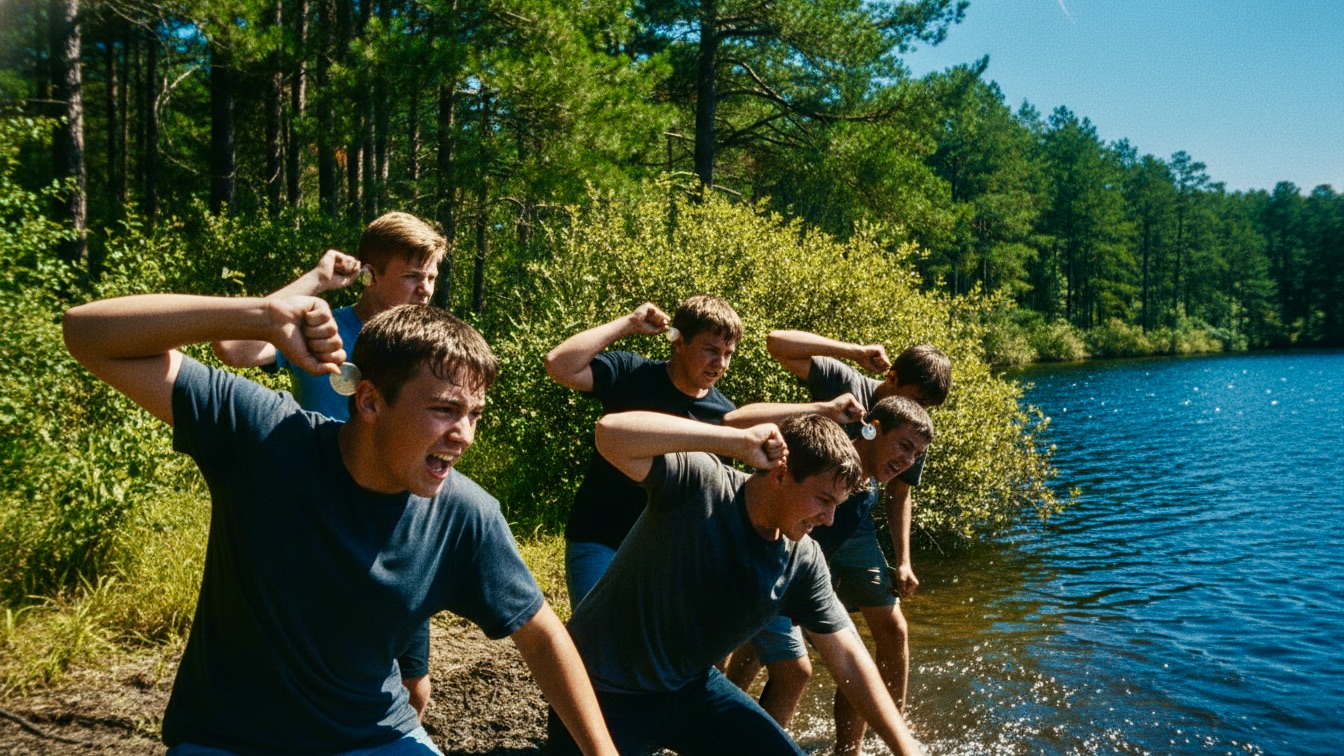
Beat 3 (The Alliance): In the mess hall, Lane meets Dani, and they realize their shared nightmares are the mainframe’s way of processing their suppressed anxiety as physical trauma. They decide to "spoof" the system using Lane’s smuggled, obsolete iPod and a rusted spoon to create a magnetic loop that mimics deep-focus brainwaves. This allows them to spend their "Independent Focus Block" sleeping in the dirt behind a maintenance shed, finding a brief, pastoral reprieve from the digital hum.
Beat 4 (The Sabotage): When auditors arrive for a manual data scrape that would reveal their hack, Lane and Dani decide to go on the offensive rather than wait for discovery. They break into the cooling exhaust of the auditorium and tap into the main data trunk line using the frayed wires of Lane's iPod. Instead of spoofing focus, Lane plays the recorded "static" of his nightmare, broadcasting the raw data of his terror directly into the camp's mainframe.
Beat 5 (The Fallout): The camp descends into chaos as three hundred teenagers simultaneously experience Lane's nightmare, leading them to rip the ports from their heads in a frantic act of collective liberation. Director Askew watches in horror as his "baseline" is destroyed, while Lane and Dani stand amidst the wreckage of the program. The episode ends with Lane’s father driving him home in a silent, hot SUV, where Lane finally finds peace in the messy, loud reality of the summer wind.
The episode begins with a sense of sterile, clinical dread, transitioning into a surreal, body-horror-infused nightmare sequence. The middle act offers a brief, pastoral reprieve as the characters find peace in nature, before escalating into a frantic, high-stakes techno-thriller climax. The final mood is one of somber defiance—a "pyrrhic" victory where the protagonist is punished socially and financially but saved psychologically, leaving the audience with a sense of uneasy relief.
If expanded, the season would follow the fallout of the "Spoon Incident," as the Apex corporation attempts to suppress the news of the psychological breakdown to protect its stock price. Lane and Dani would become reluctant symbols of a growing "Naturalist" movement, hunted by corporate auditors who seek to "re-calibrate" them as part of a damage-control initiative.
The thematic escalation would involve the discovery that the "nightmares" were not a bug, but a feature designed to harvest raw emotional data for a new AI-driven marketing algorithm. As the season progresses, the characters would move from sabotaging a single camp to attempting to take down the entire Apex network, exploring the difficulty of living "off-grid" in a world where neural connectivity is mandatory for survival.
The visual style should contrast the "Apex" world—sharp lines, over-saturated blues, and clinical whites—with the "Natural" world, which should feel grainy, warm, and handheld. The nightmares should be shot with a distorted, wide-angle lens to emphasize the scale of the graphite bubbles and pencils, creating a sense of "corporate surrealism" where mundane objects become instruments of terror.
Tonal influences include the cold, architectural dread of Severance and the visceral, body-horror elements of early David Cronenberg. The sound design is critical, utilizing a constant, low-frequency hum that only cuts out when the "spoon hack" is active, creating a physical sense of relief for the audience during the characters' moments of rebellion.
The target audience consists of young adults and adults (ages 16-40) who consume speculative fiction and social commentary. It appeals specifically to viewers interested in the intersections of technology, mental health, and the "hustle culture" pressures prevalent in modern academic and professional environments.
The pacing is deliberate and suffocating in the first half to mirror the "optimized" environment of the camp, emphasizing the repetitive, sterile nature of the routine. The tempo shifts into a rapid, chaotic pace during the climax (the "nightmare broadcast"), utilizing quick cuts and jarring sound transitions. The 10-12 minute runtime ensures a "lean" narrative that prioritizes visual storytelling and visceral atmosphere over lengthy expository dialogue.
The "titanium ports" should be handled with high-quality practical prosthetics to emphasize the physical invasiveness of the technology; the skin around the ports should appear irritated and "un-healed" to contrast with the clean glass of the buildings. Practical effects should be used for the "spoon rig" to ground the sabotage in a tactile, "lo-fi" reality.
The "nightmare" sequences require a mix of practical scale models and CGI to give the giant bubbles a sense of physical weight and presence. The production must also factor in the "artificial lake" location, which should be color-graded to look unnaturally blue and stagnant, reinforcing the idea that everything in the Apex world is a manufactured, "optimized" imitation of life.


