2026 Summer Short Stories
Neural Upgrades and Horrific Nightmares - Analysis
by Jamie Bell | Analysis
by Jamie Bell | Analysis
The story follows Lane Miller, a teenager sent by his performance-obsessed parents to Camp Apex, a specialized facility designed to "calibrate" the neural ports implanted in the students' skulls. While his father views the camp as a necessary step toward elite networking and cognitive optimization, Lane quickly discovers the horrific psychological cost of the procedure. The neural connection to the camp's mainframe induces vivid, traumatic nightmares where standardized testing symbols, such as Scantron bubbles and mechanical pencils, physically destroy his world. These dreams serve as a manifestation of the extreme academic and social pressure placed upon the campers by their families and the institution.
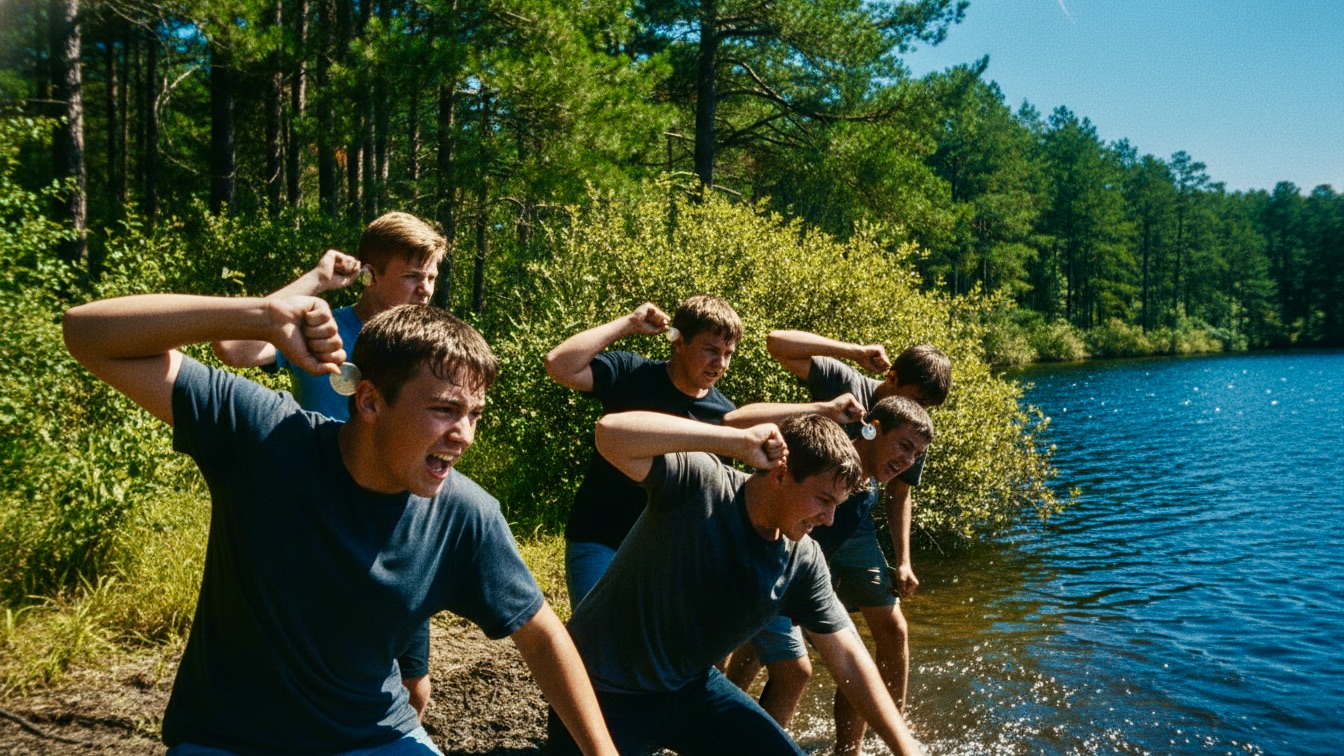
In the mess hall, Lane meets Dani, a fellow camper who is experiencing similar nightmarish hallucinations and recognizes that the hardware is dangerously overloading their brains. Together, they devise a plan to bypass the system's invasive monitoring using Lane’s vintage iPod and a rusted spoon found near a maintenance shed. By using the spoon as a crude conductor, they spoof their neural signals to mimic a state of deep productivity, allowing them to find a few hours of mental peace in the woods. This temporary respite allows them to recover some of their humanity away from the sterile, high-pressure environment of the glass buildings.
The arrival of technical auditors forces Lane and Dani into a desperate act of sabotage to avoid being permanently "hard-wired" by a new system update. Instead of merely hiding, they decide to fight back by uploading the raw data of Lane’s nightmares directly into the camp’s mainframe. This broadcast triggers a mass panic among the three hundred campers, who collectively revolt by ripping the magnetic nodes from their heads in an act of visceral liberation. Although Lane is ultimately expelled and faces the cold fury of his disappointed parents, he ends the story feeling a sense of relief, finally disconnected from the hum of the machine and reconnected to the chaotic reality of the world.
The central theme of the narrative is the dehumanizing nature of extreme meritocracy and the commodification of human potential. Camp Apex represents a world where children are no longer viewed as individuals, but as "processing engines" that must be optimized for maximum output. The parents in the story, particularly Lane’s father, demonstrate a chilling detachment, prioritizing "cognitive bandwidth" and "networking" over the emotional well-being of their son. This reflects a psychological landscape where the worth of a human being is measured solely by their utility and their ability to outperform their peers in a competitive hierarchy.
Linked to this is the theme of technology as an instrument of psychological trauma. The "neural upgrades" do not actually improve the students' lives; instead, they force the brain to process abstract anxieties as physical threats. The recurring imagery of giant Scantron bubbles and erasers symbolizes how the pressures of the education system have become a literal weight that crushes the individual. The story suggests that when we attempt to bypass the natural limits of the human mind through artificial means, the subconscious rebels by transforming suppressed stress into horrific, inescapable visions.
Finally, the story explores the theme of rebellion through "low-tech" humanity. Lane and Dani do not defeat the advanced mainframe with superior coding, but with a rusted spoon and an obsolete music player. This choice of weaponry highlights the power of the analog and the imperfect in a world obsessed with digital perfection. Their victory is not one of logic, but of raw emotion and sensory grounding. By choosing the "miserable, hot, sticky summer" over the "aggressively cold" and sterile cabins, they reclaim their right to experience life as it is, rather than as a calibrated data point.
Lane is a protagonist defined by his quiet observation and his internal struggle between compliance and self-preservation. At the beginning of the story, he is passive, echoing his father’s mantras and suppressing his own discomfort to satisfy his parents' expectations. He moves through the world with a sense of rigid control, his knees pressed together and his hands flat on his thighs, mirroring the "clamped" state of his own mind. This physical tension suggests a boy who has been conditioned to minimize his own presence and needs in favor of his "optimization."
Psychologically, Lane suffers from deep-seated performance anxiety that he is unable to articulate until it is externalized by the neural port. His nightmares about the giant graphite bubbles reveal a subconscious mind that feels utterly flattened by the demands of his environment. Despite his apparent submission, he possesses a latent technical ingenuity and a core of resilience. His decision to bring a vintage iPod to the camp suggests a subconscious desire to hold onto a piece of the past that is not linked to the "mainframe" of his current life.
As the story progresses, Lane’s character arc moves from silent endurance to active defiance. The shift occurs when he realizes that the "advantage" his parents want for him is actually a form of mental imprisonment. By taking the risk to upload his nightmares, he chooses a future of "reputational damage" over a future of hollow success. In the final scene, his act of rolling down the car window signifies a total rejection of the controlled, air-conditioned environment of his upbringing. He accepts the "hot summer wind" and the disappointment of his parents as the price of his own sanity and freedom.
The narrative utilizes a cold, clinical tone that mirrors the sterile environment of Camp Apex and the detached nature of the characters' relationships. Short, punchy sentences create a sense of tension and physical discomfort, particularly when describing the heat of the SUV or the "aggressive" cold of the concrete cabins. This minimalist style effectively conveys Lane’s sense of isolation and the lack of emotional warmth in his life. The author avoids flowery language, instead focusing on hard, industrial nouns like "titanium," "concrete," "glass," and "ozone" to build a world that feels hostile to organic life.
Sensory details are used with precision to contrast the artificial with the natural. The lake is described as "too blue" and "stagnant," while the pine needles are "brown and drooping," suggesting that the camp’s presence is literally draining the life out of the surrounding forest. In contrast, the descriptions of the "rusted spoon" and the "black ants" provide a sense of grounding and reality. These sensory anchors allow the reader to feel the same relief Lane feels when he finally disconnects from the hum of the mainframe and reconnects with the "hot, metallic air" of the real world.
The pacing of the story mirrors the escalating pressure of a technological system on the verge of a crash. It begins with a slow, stifling dread during the intake process and accelerates into a frantic, chaotic climax as the "nightmare data" is released. The transition from the silent, "hollow-eyed" campers to the screaming, "animal terror" of the revolt is a powerful stylistic shift that emphasizes the explosion of repressed human emotion. The final scene returns to a quiet, but fundamentally different, atmosphere. The silence is no longer one of forced productivity, but one of exhaustion and hard-won clarity.


