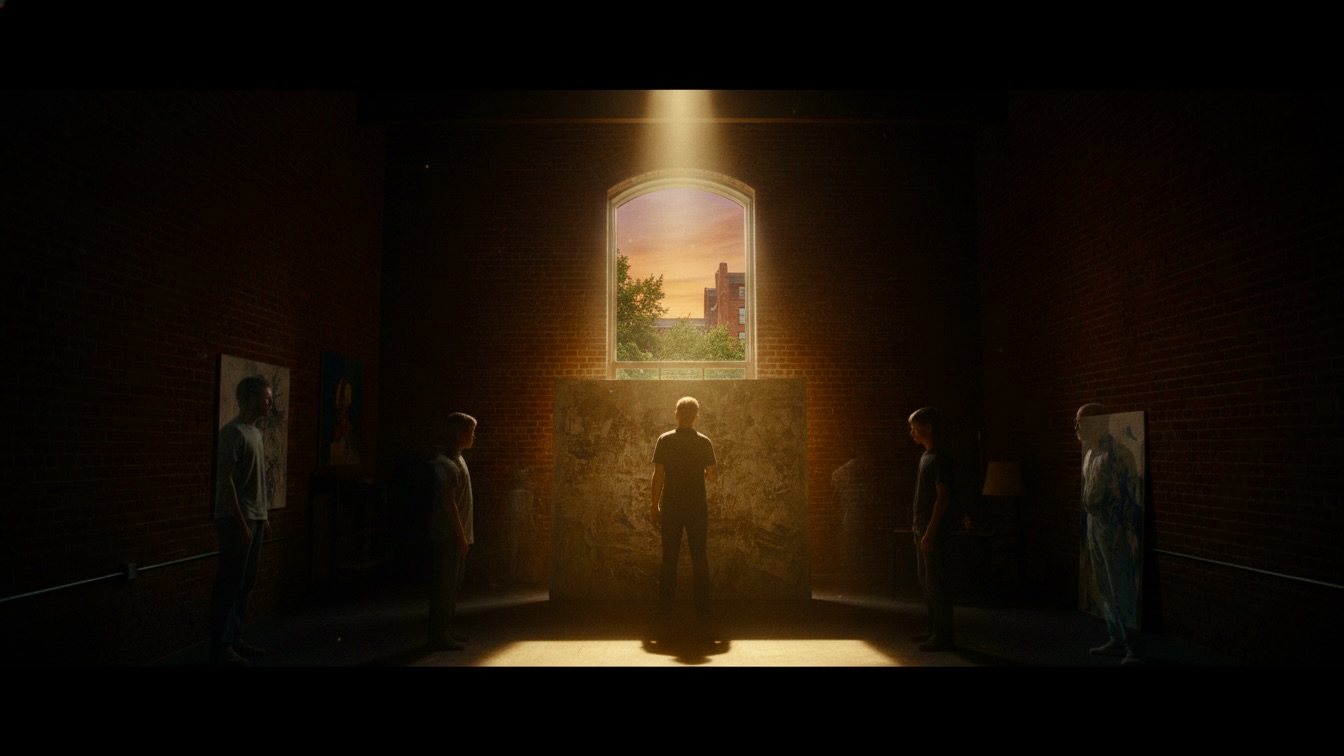
A struggling photographer in Winnipeg confronts physical manifestations of his past creative failures during a brutal summer heatwave.
The heat in the Exchange District didn't just sit; it pressed. It was July 2026, and the Winnipeg sun had turned the red brick warehouses into ovens that never quite cooled down. I stood in my fourth-floor studio, staring at a blank canvas that felt like an insult. My skin was tacky with a fine layer of sweat and grit. The ceiling fan hummed, a low, rhythmic vibration that did nothing but move the warm, stagnant air around the room. I wiped my palms on my denim apron. The fabric was stiff with dried acrylic and old ink. I looked at the wall. It was a mess of half-finished ideas and sketches for projects I’d long since abandoned.
I reached for my water bottle. It was lukewarm. I drank it anyway, the plastic crinkling under my grip. I could feel the history of the building in my bones. It used to be a garment factory. Then a printing press. Now, it was a collection of overpriced spaces for people like me who were trying to capture something that didn't want to be caught. I looked out the window. Across the street, a ghost sign for a flour company was fading into the brick. The letters were pale, almost invisible, but I knew what they said. I’d looked at them every day for three years. They were a reminder of things that once mattered and now were just texture.
My phone buzzed on the workbench. It was a notification from an old cloud drive. 'Ten years ago today,' it said. I didn't want to look. I knew what was in there. Photos from my first exhibition. The one where I thought I was going to change the world. The one that sold exactly zero pieces. I felt a familiar tighten in my chest, a physical knot of regret that lived just under my ribs. I turned the phone face down. The screen was cracked in the corner, a jagged spiderweb that caught the harsh afternoon light.
I heard a sound from the hallway. It was a soft, shuffling noise, like someone dragging a heavy bag of grain across the floorboards. I froze. The building was supposed to be empty on Saturdays. Most of the other artists were at the lake, escaping the humidity. I walked to the door and pulled it open. The hallway was empty. The air out there was even hotter, smelling of floor wax and the faint, metallic tang of the old elevator cables. I stepped out, my boots echoing on the hardwood.
"Anyone there?" I asked. My voice sounded thin.
No one answered. I walked toward the freight elevator. The cage was closed, the iron bars casting long, striped shadows across the floor. I saw something move in the corner of my eye. A figure. It was standing near the back staircase. It looked like me. Not the me that stood there now, thirty-four and tired, but a younger version. It wore the same thrift-store jacket I’d burned in a bonfire six years ago. It held a camera—the old Nikon film body I’d lost on a bus in Vancouver.
I blinked, and the figure was gone. My heart was thumping against my ribs. I told myself it was the heat. Dehydration. I hadn't eaten anything since a piece of dry toast at six AM. I went back into my studio and locked the door. My hands were shaking. I needed to focus. I picked up a charcoal stick, but it snapped in my fingers. The black dust stained my cuticles.
I sat on my stool and closed my eyes. The sound of the trains shunting in the CP yards drifted through the open window. It was a low, industrial groan that never stopped. It was the sound of the city moving things from one place to another, a constant cycle of arrival and departure. I felt like I was stuck in the middle, a permanent resident of the transit zone.
I thought about the house party in Wolseley back in 2019. I’d spent three hours explaining my 'vision' to a girl who just wanted to know where the bathroom was. The memory made my skin hot with shame. It was a spectral echo, a version of myself I wanted to exorcise. But the ghost signs on the brick outside told a different story. They said you can't just paint over the past. It always bleeds through.
I looked at the corner of the room. The shadow there seemed deeper than it should be. It didn't move with the light. It stayed fixed, a dark smudge against the white-painted brick. I walked over to it. The air was colder there. Not a refreshing cold, but a damp, cellar chill that made the hair on my arms stand up. I reached out a hand. My fingers brushed the wall. It didn't feel like brick. It felt soft. Like skin.
I pulled my hand back. My fingertips were black, but not from charcoal. It looked like ink. I wiped it on my apron, but it wouldn't come off. It stained the fabric, a dark, spreading blotch. I looked back at the shadow. It was growing. It was taking the shape of a person. A person sitting at a desk. My old desk. The one with the cigarette burns and the broken drawer.
I stepped away, tripping over a stack of canvases. They tumbled to the floor, the sound like a series of gunshots in the quiet room. I scrambled to my feet, my breath coming in short, jagged gasps. The figure in the shadow turned its head. It didn't have a face. It just had a blur of features, like a long-exposure photograph where the subject moved too fast.
"What do you want?" I whispered.
The figure didn't speak. It reached into its pocket and pulled out a handful of dust. It let the dust fall through its fingers. I watched it settle on the floor. It wasn't dust. It was tiny fragments of paper. Scraps of the poems I’d written in college and then ripped up. Lines I thought were profound and then realized were garbage. They were all there, fluttering in the dead air of the studio.
I felt a wave of nausea. This wasn't a haunting. It was an inventory. A physical manifestation of everything I’d tried to leave behind. I looked at the door. I wanted to run, but my legs felt heavy, as if I were wading through waist-deep water. The heat in the room surged, a wall of humidity that felt like a hand pressing against my mouth.
I looked at the shadow-self again. It was standing now. It pointed to the blank canvas on my easel. Then it pointed to me. I understood. It wasn't here to hurt me. It was here to remind me that I wasn't finished. That these failures weren't dead; they were just waiting for me to acknowledge them.
I picked up a brush. My hand was still shaking, but I dipped it into a jar of black paint. I didn't try to draw something new. I started to trace the outlines of the ghost sign from across the street. I painted the fading letters, the chipped edges, the layers of old advertisements. I painted the things that were supposed to be forgotten.
As I worked, the shadow in the corner began to recede. The air grew warmer again, the normal, stifling heat of a Winnipeg summer. The shuffling in the hallway stopped. I didn't look back. I just kept painting, the black ink on my fingers blending with the paint on the brush. I was a repository of every failed attempt, and for the first time, that didn't feel like a burden. It felt like weight. It felt like grit. It felt like the air I was finally allowed to breathe.
I left the studio at noon. The sun was a white disc in a pale blue sky, bleaching the color out of the world. I walked down Princess Street, my boots clicking on the uneven pavement. The heat bounced off the concrete, hitting me in waves. I felt like a ghost myself, moving through a landscape that had seen too many versions of me. I passed the old cinema that had been turned into a tech hub. I remembered standing in line there for a midnight screening when I was twenty. I’d been wearing a ridiculous hat and talking about French New Wave. I winced at the memory.
I saw Leo sitting outside a cafe. He was nursing a cold brew, his eyes hidden behind dark sunglasses. Leo was a sculptor who hadn't made anything out of metal in five years. Now he made digital assets for a gaming company in Montreal. He looked clean, professional, and entirely bored.
"Riley," he said, nodding. "You look like you’ve been living in a furnace."
"Close enough," I said. I sat down across from him. The metal chair was searing. I shifted, trying to find a spot that wouldn't burn through my jeans.
"Still at it?" he asked. He didn't mean the heat.
"Yeah. Still at it."
"The gallery called me," Leo said. He took a sip of his coffee. "They’re doing a retrospective. Local artists from the last decade. They wanted some of my old welding pieces."
"You going to give them some?"
Leo laughed. It was a dry, rasping sound. "Those pieces are in a scrapyard in Transcona, Riley. I melted them down for the copper. I needed the money for rent back in '22."
I felt a pang of loss. I remembered those sculptures. They were jagged, angry things that looked like they were trying to claw their way out of the ground. They were honest.
"That’s a shame," I said.
"Is it?" Leo leaned forward. "The version of me that made those things was a mess. He was drunk half the time and broke the other half. I like having a 401k and a shower that works."
"But you don't make anything anymore."
"I make money," Leo said. "It’s a different kind of art."
He looked past me, his expression shifting. I turned around. Across the street, near the entrance to the park, I saw a person standing perfectly still. It was the younger me again. Same jacket. Same camera. He was looking right at us. No, he was looking right at me.
"You see that guy?" I asked, my voice barely a whisper.
Leo squinted. "Which guy? The one in the vest?"
"No. The kid in the green jacket. By the fountain."
Leo looked for a long time. "There’s no one by the fountain, Riley. Just a pigeon and some trash."
I looked back. The kid was gone. The heat shimmer on the pavement made everything look like it was underwater. I felt a drop of sweat run down my spine. I was losing it. The localized paranoia I’d felt in the studio was following me into the light.
"You okay?" Leo asked. He sounded genuinely concerned, which was worse than if he’d mocked me.
"Fine. Just the sun."
"Drink some water. You look grey."
I stood up. "I have to go. I have work to do."
"Don't work too hard," Leo called after me. "The world doesn't need more ghosts."
I walked faster. I headed toward the river, hoping the water would bring a breeze. But the Red River was low and sluggish, a brown ribbon of silt and runoff. I stood on the bank, watching a piece of driftwood snag on a shopping cart submerged near the shore. I thought about the 'what ifs.' What if I’d moved to Toronto when I had the chance? What if I’d taken the corporate gig Leo was talking about? I’d be in an air-conditioned office right now, looking at spreadsheets instead of a blank canvas and a haunted studio.
I felt a presence behind me. I didn't turn around. I knew who it was.
"You were better then," a voice said. It wasn't my voice. Not exactly. It was higher, more confident. It was the voice of a twenty-two-year-old who hadn't been beaten down by a decade of indifference.
"I was an idiot," I said to the river.
"You were brave," the voice countered. "You didn't care about the rent. You cared about the light. You cared about the way the shadows hit the grain elevators at sunset."
"The grain elevators are mostly condos now," I said.
"So? The light is the same."
I turned around. The kid was standing there. Up close, he looked frayed. The edges of his jacket were unraveling. His skin looked like paper. He wasn't a solid thing. He was a projection of a memory, a layer of the past that refused to vacate the premises.
"Why are you here?" I asked.
"You summoned me," the kid said. He held up the Nikon. "You started looking at the archives. You started thinking about the failures. You gave me a place to sit at the table."
"I want you to leave."
"I can't. I’m part of the texture. You can't scrub me off the wall, Riley. You should just lean into the transparency."
He stepped toward me, and for a second, I thought he was going to push me into the river. Instead, he just walked through me. A wave of intense, localized cold hit my chest. It felt like swallowing a handful of ice. I gasped, clutching my shirt. When I opened my eyes, I was alone on the riverbank.
I walked back to the Exchange. I passed the warehouses with their ghost signs. I looked at the flour advertisement again. It wasn't a scar. It was a layer. I saw another sign beneath it, even older, for a hardware store. And beneath that, just the brick. The brick had been there for a hundred years. It had seen everything.
I reached my building. The lobby was empty. I didn't take the elevator. I took the stairs. I needed to feel the physical effort of moving through the space. By the time I reached the fourth floor, I was gasping for air, my lungs burning. I opened the door to my studio.
It was waiting for me. Not just the kid, but others. A version of me from 2015, wearing a suit for an interview I’d botched. A version from 2021, hunched over a laptop, trying to learn how to code. They were scattered around the room like furniture. They didn't move. They were just there, providing the texture for the air I was breathing.
I walked to my easel. I didn't look at them. I looked at the painting I’d started. The black ink was dry now. It looked like a bruise on the canvas. I picked up a palette knife and started to scrape. I wasn't removing the paint. I was moving it around, creating new shapes out of the old ones.
I worked for hours. The sun began to set, casting long, orange bars of light across the studio. The heat didn't break. It just changed character, becoming heavier and more oppressive. The trains in the yard started their evening shunting. Clang. Thud. Hiss.
I felt a sense of dignity I hadn't felt in years. I wasn't trying to be 'new.' I was being old. I was being everything I’d ever been. I was participating in a long, echoing conversation with every version of myself. The failures were the bridge. And the bridge was holding.
By 9 PM, the studio was a cavern of shadows. The only light came from a single industrial lamp clamped to my workbench and the blue glow of my old external hard drive. I’d plugged it in, despite the voice in my head telling me to leave it alone. The fan inside the drive whirred—a desperate, high-pitched sound, as if the hardware knew it was dying.
I clicked through folders. 'Old Projects.' 'Abandoned.' 'Demos.' These were the digital graveyards of my twenties. I found a folder labeled 'Wolseley Poems 2019.' I opened a file. The text was formatted in a pretentious font. I read the first line: The prairie is a mouth that never stops eating.
I groaned and put my head in my hands. The 'cringe' was a physical sensation, a localized itch in my throat. I wanted to delete the whole drive. I wanted to wipe the slate clean. But as I sat there, the air in the room seemed to thicken. The shadow of the man in the suit—the 2015 version of me—shifted. He moved toward the workbench and sat on the edge of the table.
"The interview wasn't that bad," he said. His voice was muffled, as if he were speaking through a thick curtain.
"You called the CEO 'dude,'" I said, not looking up.
"I was trying to be relatable."
"You were trying to be someone you weren't. That’s why you didn't get the job."
"If I’d gotten it, we’d be in a condo in River Heights right now. We’d have a car that doesn't make a grinding noise when you turn left."
"We’d also be dead inside," I snapped.
He didn't argue. He just sat there, a grey, flickering presence. I looked back at the screen. I found a folder of photos from 2012. I’d spent a month taking pictures of puddles in the Exchange District. I’d thought they were metaphors for the soul. They were just blurry pictures of dirty water.
I clicked on one. It was a shot of a puddle reflecting the ghost sign across the street. It was actually... good. Not profound, but the composition was solid. The way the oil slick on the water caught the light was beautiful. I’d forgotten I was capable of that.
"See?" a voice whispered. This time it was the kid with the Nikon. He was standing right behind me. I could smell the faint scent of old film canisters and cheap cigarettes—the smell of my life twelve years ago.
"I see it," I said.
"You didn't fail," the kid said. "You just hadn't finished the thought."
I felt a tear prick my eye. I wiped it away with a paint-stained knuckle. The room felt crowded now. Every version of me was leaning in, looking at the screen. The poet, the photographer, the failed businessman, the guy who almost moved to Toronto. They weren't monsters. They were just data points. They were the dust motes dancing in the light.
I started a new file on my computer. I didn't delete the old ones. I started a collage. I dragged the puddle photo into the workspace. Then I typed out the line about the prairie being a mouth. I changed the font. I broke the sentence. I made it part of something else.
I worked through the night. The humidity was a constant companion, a damp blanket draped over my shoulders. I drank cold coffee and listened to the trains. At 3 AM, the shunting sound changed. It became a low, industrial haunting that seemed to vibrate the very foundations of the building. It was the sound of the world moving while I waited for a breakthrough.
I looked at my painting on the easel. It was no longer a bruise. It was a map. A map of every mistake I’d ever made. The layers were bleeding through, creating a rich, complicated accumulation of experience. It was blurry. It was out of focus. It was the most honest thing I’d ever made.
I felt a sudden, sharp pain in my stomach. A hunger pang, or maybe something else. I stood up and walked to the small kitchenette in the corner. I opened the fridge. It was mostly empty, save for a jar of pickles and a half-eaten sandwich that was probably three days old. I took a bite of the sandwich. It tasted like mustard and stale bread. It was real.
I looked at the shadow-selves. They were fading. Not because they were going away, but because they were becoming part of the room. They were settling into the floorboards and the cracks in the brick. They were becoming the archive.
"You’re staying?" I asked.
No one answered. The silence was absolute, broken only by the hum of the fridge and the distant whistle of a locomotive.
I went back to the workbench. I felt a sense of peace that was almost frightening. I’d been so afraid of these ghosts, so desperate to exorcise them. But they were the very things that gave my work its resonance. They were the grit in the paint.
I opened a window. The air outside was finally starting to cool, a slight breeze coming off the prairie. It smelled of sun-baked grass and distant rain. I breathed it in. I felt my internal clock slow down. I wasn't losing time. I was accumulating history.
I looked at my hands. The black ink was still there, deep in the creases of my skin. It wouldn't come off with soap. It wouldn't come off with time. I realized I didn't want it to. I wanted to carry it with me.
I sat back down and picked up my brush. There was still a lot of night left. There were still a lot of layers to add. I looked at the 2015 version of me. He was almost gone now, just a wisp of grey light near the radiator.
"I’ll remember the interview," I whispered.
He nodded once and vanished.
I turned back to the canvas. I wasn't making something for the 'now.' I was participating in the long, echoing conversation. I was building a bridge. And for the first time in my life, I wasn't afraid to cross it.
The hour of the shunt is a specific kind of purgatory in Winnipeg. At 3 AM, the city is at its most transparent. The noise of the rail yards travels through the humid air with surgical precision. Each clack of a coupling is a period at the end of a sentence I haven't finished yet. I stood by the open window, the breeze finally tugging at the edges of the sketches pinned to my wall. The ghosts were still there, but they were quiet now. They were watching the trains with me.
I felt a presence beside me. It was the version of me I feared the most. The one from six months ago. The one who had almost given up entirely. He looked exhausted. His eyes were bloodshot, and his hands were curled into tight fists. He was the one who had considered jumping from the bridge near The Forks.
"You're still here," he said. His voice was a rasp, like sandpaper on glass.
"Yeah," I said. "I'm still here."
"Why?"
I looked out at the skyline. The lights of the skyscrapers were flickering, a digital pulse in the dark. "Because the story isn't done. The paint is still wet."
He looked at the canvas on the easel. It was a chaotic mess of black and grey, with flashes of the old ghost signs peeking through. It looked like a city under a storm. It looked like a life.
"It's ugly," he said.
"It's honest," I countered. "Ugly is just what we call things we aren't ready to look at yet."
He let out a long, shuddering breath. I felt the cold from him, a localized winter in the middle of a July night. I didn't pull away. I let the cold touch me. I let it remind me of the stakes.
"It hurts to remember," he whispered.
"I know. But the memory is the weight. Without it, we'd just float away. We'd be nothing but signal with no noise."
I reached out and touched his shoulder. My hand went right through him, but I felt a resistance, like moving through thick smoke. He looked at me, and for the first time, I saw a flicker of something other than despair in his eyes. It was curiosity.
"What happens next?" he asked.
"I finish the painting. I go to sleep. I wake up and do it again."
He nodded slowly. He began to dissolve, his form breaking apart into tiny black motes that drifted toward the canvas. They settled into the paint, adding a texture I couldn't have achieved with a brush. They gave the black a depth that seemed to go on forever.
I felt a sudden surge of energy. I grabbed a jar of white paint and a palette knife. I didn't think. I just moved. I started to add highlights to the canvas. I wasn't painting light; I was painting the absence of shadow. I was painting the moments where the past breaks open to let the present through.
I worked with a frantic, focused intensity. The minimalist and terse dialogue of my internal monologue had been replaced by a singular, rhythmic drive. The trains provided the beat. Clang. Thud. Hiss. My brush followed the rhythm.
I thought about the city. Winnipeg is a place built on layers of prairie mud and railway steel. It’s a place that forces you into isolation, into the long loops of spectral 'what ifs.' But that isolation is where the archives are kept. It’s where the history accumulates.
I looked at my phone. It was 4:15 AM. The sky was beginning to turn a bruised purple. The heat was still there, but it felt different now. It felt like a womb rather than an oven. It was the environment where growth happened.
I stepped back from the canvas. It was done. It wasn't perfect. It was blurry in places, and the colors were a bit muted. But it had weight. It had grit. It looked like it had been pulled from the bottom of the Red River.
I felt a profound sense of exhaustion wash over me. I walked to my cot in the corner and sat down. My boots were covered in paint. My hands were stained black. I looked around the studio. The ghosts were gone. The room was just a room again. An old warehouse space with high ceilings and creaky floors.
But the air felt different. It felt charged. I knew they were still there, tucked into the corners and the layers of the wall. They were the foundation of everything I was going to do next.
I lay back on the cot. The mattress was thin and smelled of old dust, but it felt like the most comfortable place in the world. I closed my eyes. The sound of the trains was fading now, the night shift coming to an end.
I thought about the girl at the party in Wolseley. I thought about the failed interview. I thought about the photos of puddles. I let them all sit at the table. I gave them a place in the archive.
Kindness to yourself looks like giving your past versions a place to sit at the table. I understood that now. You don't need to exorcise the parts of you that feel 'cringe' or outdated. You need to use them as the pigment for your next work.
I felt a sense of peace. The summer heat would return in a few hours. The city would bake again. I would wake up and face another day of being an artist in a place that didn't always care. But I wouldn't be alone. I had a whole gallery of previous versions to help me hold the weight.
I drifted off to sleep. My last thought was of the ghost sign across the street. Even in the dark, I could see it. It was still there. It was still telling its story. And so was I.
“I closed my eyes, but as the first ray of sun hit the canvas, the black paint began to move on its own.”


