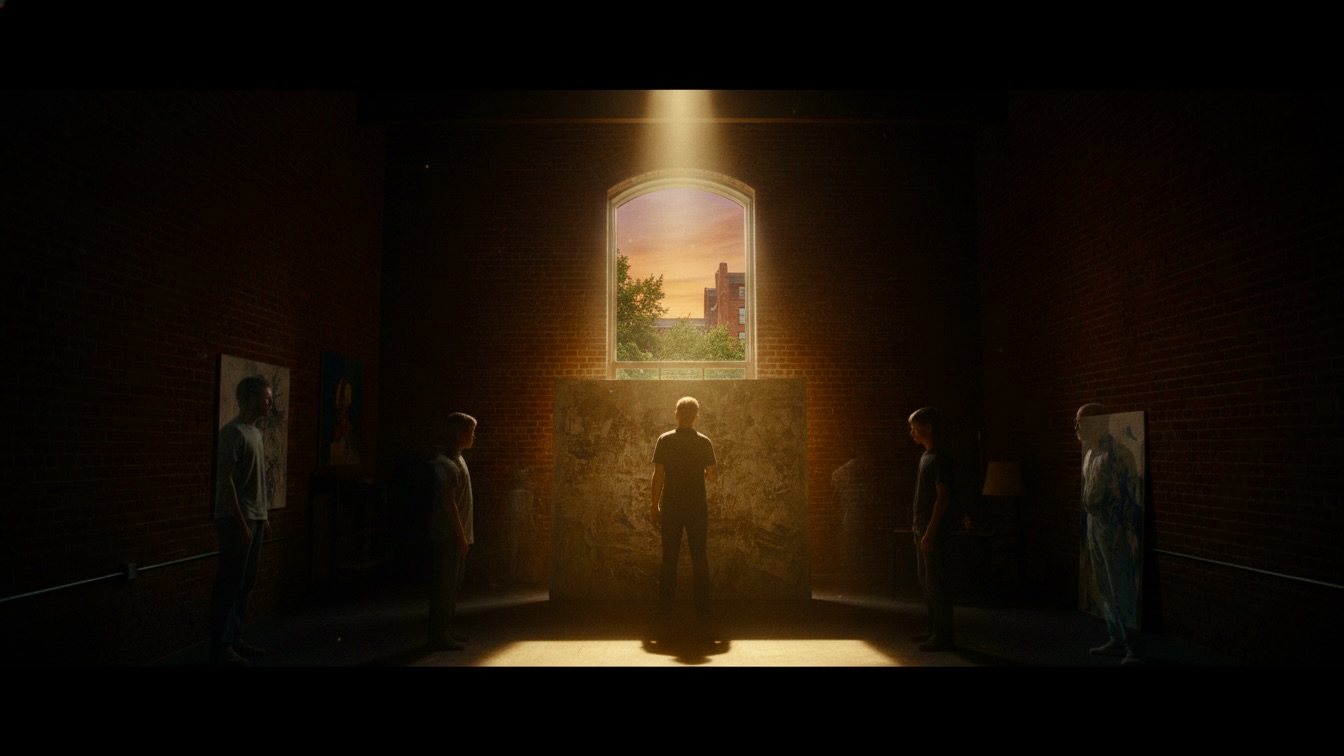
Riley is a thirty-four-year-old artist living and working in a stiflingly hot studio within Winnipeg’s historic Exchange District. As he struggles with a creative block and the weight of his perceived failures, he begins to see literal manifestations of his past selves wandering the halls and his workspace. These apparitions represent different eras of his life, from a pretentious twenty-year-old to a version of himself who recently contemplated suicide. After a brief and discouraging encounter with a former artist named Leo, who has traded his passion for corporate stability, Riley returns to his studio with a new perspective. Instead of trying to exorcise his past or paint over his mistakes, he begins to incorporate his history into his art. By the time the sun sets, he has transformed his shame into a complex, layered painting that acknowledges the value of every failed version of himself.
The central theme of the narrative is the concept of the psychological palimpsest, where the past is never truly erased but remains visible beneath the surface of the present. The "ghost signs" on the brick buildings of the Exchange District serve as a powerful metaphor for Riley’s own internal architecture. He initially views his fading memories and past failures as "texture" that has lost its meaning, yet he eventually discovers that trying to "paint over" his history only results in a shallow, unconvincing facade. True artistic and personal maturity comes from allowing the "bleed-through" of previous identities to inform the current one. The story suggests that identity is not a destination but a continuous accumulation of layers that must be acknowledged to achieve authenticity.
Another significant theme is the redemptive power of self-compassion and the integration of "cringe." Riley initially feels physical nausea and shame when recalling his youthful pretension, his failed professional attempts, and his social awkwardness. He views these moments as monsters to be exorcised, but the narrative reframes them as essential "data points" and "grit." By the end of the story, he realizes that kindness toward the self involves inviting these flawed versions to "sit at the table" rather than attempting to silence them. This shift in perspective allows him to move from a state of paralysis to one of focused productivity, using his history as the very pigment for his creative expression.
The story also explores the tension between artistic integrity and the crushing weight of modern economic survival. This is most clearly seen in the contrast between Riley and Leo, the latter of whom has abandoned his sculptures for the comfort of a 401k and a working shower. While Leo appears clean and professional, he is described as "entirely bored" and admits to melting down his honest work for scrap copper. The narrative posits that the "ghosts" Riley sees are not just burdens but signs of life. To live without them, as Leo does, is to become a "ghost" in a different sense—a person who has lost their connection to their own history and creative spark.
Riley is a man caught in the "transit zone" of his own life, feeling stuck between his youthful ambitions and the reality of his mid-thirties. He suffers from a profound sense of regret, symbolized by the "physical knot" under his ribs and the cracked screen of his phone that catches the "harsh afternoon light." His psychological state is one of high anxiety and creative stagnation, driven by the fear that his best years are behind him and were ultimately wasted. He is a deeply introspective character who perceives the world through a lens of history and failure, making him both vulnerable to his memories and uniquely capable of capturing them.
His interaction with the "shadow-selves" suggests a dissociative response to extreme stress and creative block, as he literally projects his internal conflicts onto his environment. Each apparition represents a different facet of his unfulfilled potential or his perceived inadequacies, from the kid with the Nikon to the man who "botched" a corporate interview. By touching the shoulder of his most desperate self from six months prior, Riley performs an act of radical self-acceptance. He stops viewing his past as a haunting and begins to see it as a repository of experience that grants his work "weight" and "grit." This evolution marks his transition from a victim of his own history to its curator.
Throughout the chapter, Riley’s motivation shifts from a desire for external validation—the kind he sought at his first exhibition—to a need for internal honesty. He realizes that the "vision" he once tried to explain to others was less important than the "light" and "shadows" he actually observed. His decision to stay in the Exchange District, despite the heat and the lack of financial success, highlights his stubborn commitment to his craft. He eventually finds peace not by succeeding in the eyes of the world, but by finding "dignity" in the process of building a bridge between his past and present selves.
The pacing of "Ghost Signs" is deliberately sluggish and heavy, mirroring the oppressive humidity of a Winnipeg July. The author uses the external environment to reflect Riley’s internal stagnation, with the "stagnant air" and "lukewarm water" emphasizing his lack of momentum. As Riley begins to paint and accept his ghosts, the narrative rhythm shifts, becoming more rhythmic and driven. This change in pacing reflects his transition from passive suffering to active creation, culminating in the "frantic, focused intensity" of his work during the 3 AM shunt.
Sensory details are used with exceptional precision to ground the supernatural elements in a gritty, industrial reality. The metallic tang of elevator cables, the smell of floor wax, and the rhythmic "clang" of the train yards create a vivid atmosphere that feels both modern and ancient. These details prevent the story from becoming too abstract, treating the "shadow-selves" with the same tactile weight as the "denim apron" or the "stale sandwich." The "bruise" on the canvas and the "black ink" in the creases of Riley's skin serve as physical markers of his psychological journey.
The narrative voice is a first-person perspective that is both cynical and deeply observant, providing a "minimalist and terse" internal monologue. This voice allows the reader to experience Riley’s "cringe" and shame firsthand, making his eventual self-acceptance feel earned rather than sentimental. The use of the Winnipeg setting is not merely incidental; the city acts as a character itself, a place of "prairie mud and railway steel" that forces its inhabitants into long loops of reflection. The final tone of the piece is one of hard-won peace, suggesting that while the heat will return, the protagonist is no longer afraid of the shadows it casts.


