Format: Short Film / Anthology Episode | Est. Length: 10-12 minutes
Imagine this story as a cornerstone episode of The Exchange, an anthology series set in the historic warehouse district of Winnipeg, where the extreme prairie climate acts as a catalyst for the physical manifestation of the city's collective and personal histories. In this world, "temporal bleeding" is a documented phenomenon during heatwaves, forcing residents to confront "ghost signs"—not just faded advertisements on brick, but the living, breathing remnants of their own past failures. The series explores the intersection of urban decay, artistic struggle, and the supernatural, where the architecture itself serves as a repository for the versions of ourselves we tried to leave behind.
In the oppressive, 40-degree heat of a Winnipeg July, a disillusioned painter discovers that the faded "ghost signs" on the warehouse across the street are beginning to manifest inside his studio as physical, shivering versions of his younger self.
A struggling artist in a haunted warehouse district must confront the physical apparitions of his past failures during a record-breaking heatwave. To reclaim his creative voice, he must stop trying to erase his history and instead learn to use his regrets as the very pigment for his work.
The primary theme is the "archaeology of the self," exploring the idea that personal growth is not about replacing old versions of oneself, but about layering them like paint on a canvas. It examines the weight of the "creative archive," suggesting that what we perceive as "cringe" or failure is actually the necessary grit that gives a life—and a work of art—its resonance and texture.
The episode also delves into the concept of "Honest Failure" versus "Successful Stagnation." Through the contrast between Riley’s haunting and Leo’s corporate comfort, the story argues that a life lived in dialogue with one's ghosts is more authentic than a life lived in an air-conditioned vacuum where the past has been melted down for scrap.
The stakes are Riley’s psychological survival and his vocational identity; if he cannot integrate the apparitions, he risks a total mental break or a permanent descent into the "localized winter" of his own despair. Failure to acknowledge these ghosts means becoming like Leo—a man who is "clean" but creatively dead—or worse, becoming a permanent, faceless shadow trapped in the transit zone of the Exchange District.
The conflict is primarily internal and psychological, manifested through the "Shadow-Selves" that haunt the studio. These apparitions act as antagonistic mirrors, forcing Riley to relive his most shameful moments, from botched interviews to failed exhibitions. External conflict is provided by the environment: the suffocating heat and the relentless, industrial noise of the CP rail yards, which serve as a ticking clock that heightens Riley’s sensory overload and pushes him toward a breaking point.
Riley, a 34-year-old artist, is trapped in a creative paralysis within his sweltering Exchange District studio. As the heat intensifies, he begins to see "The Kid"—a twenty-two-year-old version of himself—haunting the hallways and the riverbank. These sightings are accompanied by a physical "inventory" of his past: scraps of failed poems and the smell of old film canisters. After a demoralizing meeting with his friend Leo, who has abandoned art for corporate stability, Riley realizes he cannot run from his history; the "ghost signs" of his life are bleeding through the white-painted brick of his present.
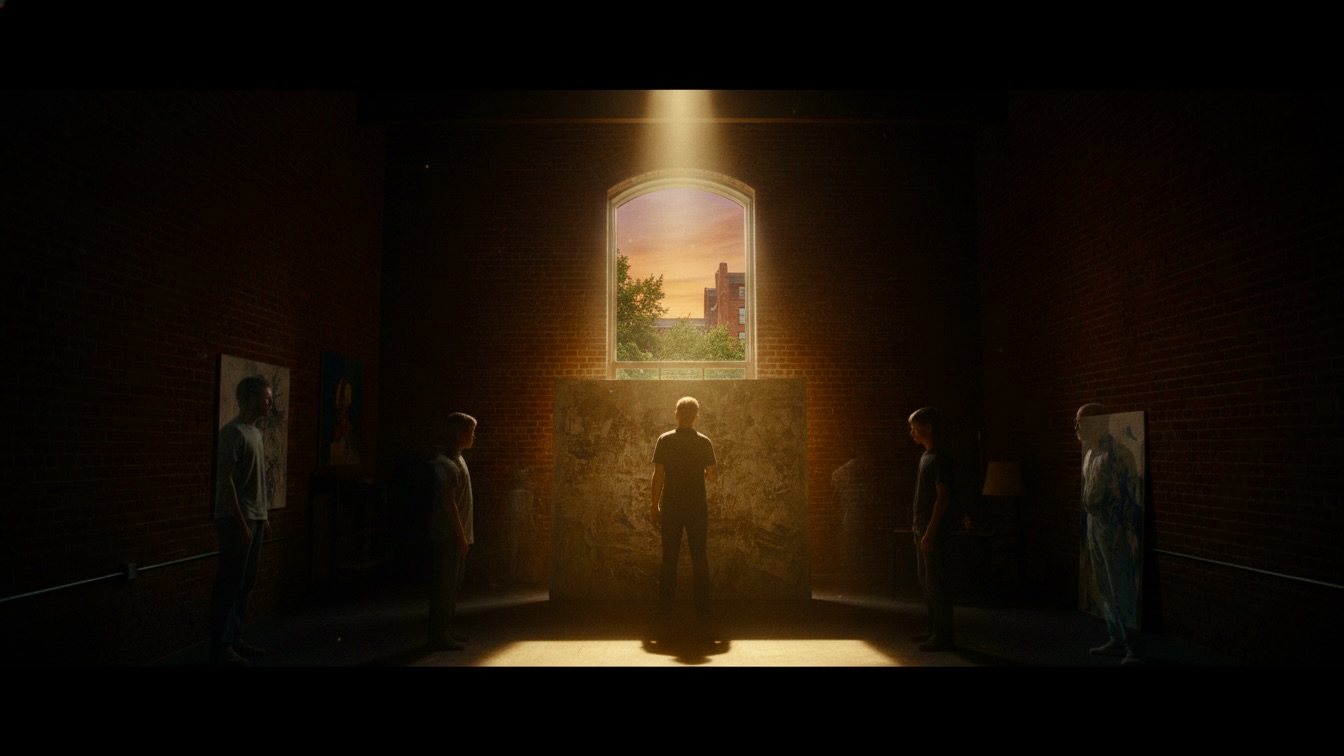
In the climax of the episode, Riley returns to his studio at 3 AM during the "hour of the shunt." He finds the room filled with every version of himself he has ever hated, including a suicidal version from six months prior. Instead of exorcising them, Riley begins to paint, using the "ink" of his regrets and the silhouettes of his ghosts to create a chaotic, honest masterpiece. As dawn breaks, the apparitions dissolve into the canvas, and Riley finds peace, realizing that his failures are not burdens, but the very foundation of his artistic bridge.
Riley (34): A weary, paint-stained artist who feels like a "permanent resident of the transit zone." He begins in a state of defensive isolation, ashamed of his past, but undergoes a psychological arc from avoidance to radical self-acceptance, eventually viewing his history as a source of strength.
The Kid (22): A flickering, paper-thin apparition of Riley from a decade ago, wearing a thrift-store jacket and carrying a lost Nikon camera. He represents Riley’s lost bravery and idealism, serving as a haunting reminder that "the light is the same" even if the man has changed.
Leo (Supporting): A former sculptor who "melted down his art for copper" to afford a working shower and a 401k. He serves as a cautionary tale for Riley, representing the hollow peace of someone who has successfully erased their own ghosts.
The Oven: Riley stands in his stifling studio, staring at a blank canvas while the heat presses against him like a physical weight. He notices the ghost sign outside fading into the brick and receives a digital notification of a decade-old failure, triggering the first appearance of "The Kid" in the hallway. The tension peaks as Riley touches a shadow on his wall that feels like human skin, leaving his fingers stained with unremovable black ink.
The Cafe and the River: Riley meets Leo at a sun-bleached cafe, where the contrast between Leo’s sterile success and Riley’s gritty struggle is laid bare. Riley sees his younger self by the riverbank, leading to a chilling confrontation where the Kid walks through him, leaving a sensation of localized, intense cold. This encounter forces Riley to realize that his past is "part of the texture" and cannot be scrubbed away.
The Shunt: Back in the studio at 3 AM, Riley faces an "inventory" of his shadow-selves as the industrial noise of the rail yards vibrates the building. He stops fighting the ghosts and begins to paint, tracing the outlines of the apparitions and the fading ghost signs onto his canvas. The episode concludes as the sun rises, the ghosts settle into the floorboards, and Riley falls asleep, finally having integrated his "cringe" into a work of honest, heavy art.
The episode begins with a sense of Stifling Anxiety, characterized by the claustrophobic heat and the weight of a blank canvas. It transitions into Uncanny Dread as the hauntings begin, peaking with a sense of Existential Nausea during the cafe scene. The final act shifts into Cathartic Intensity as Riley begins to paint, ending on a note of Grounded Peace, where the audience feels the "cool breeze" of self-acceptance finally breaking the heatwave.
If expanded, the season would follow Riley as he becomes a "curator of ghosts," helping other residents of the Exchange District navigate their own temporal hauntings. Each episode would introduce a new "layer" of the city’s history—from the 1919 General Strike to the neon-soaked 1980s—showing how these historical echoes impact the modern-day characters.
The overarching narrative would involve a "Great Erasure" threatened by a massive redevelopment project that seeks to sandblast the ghost signs and demolish the old warehouses. Riley and a collective of "spectral artists" must find a way to preserve the city’s layers, culminating in a finale where the past and present merge to prevent the district from losing its soul to sterile modernization.
The visual style is "Industrial Gothic," utilizing a palette of burnt oranges, deep brick reds, and "ink-stain" blacks. The cinematography should feel haptic and tactile, with extreme close-ups on the texture of the brick, the grit of the charcoal, and the sweat on Riley’s skin. Tonal influences include the urban isolation of Nighthawks and the supernatural realism of Twin Peaks, where the mundane and the metaphysical coexist in a state of constant tension.
The tone is minimalist and terse, relying on environmental storytelling and sound design rather than heavy dialogue. Comparables include the atmospheric dread of A Ghost Story and the gritty, artistic struggle depicted in Inside Llewyn Davis, but with a distinctively "prairie" sense of isolation and endurance.
The target audience is adults (25-45) who gravitate toward psychological dramas, magical realism, and "elevated genre" content. It appeals to viewers who enjoy atmospheric, slow-burn narratives and stories that explore the complexities of the creative process, mental health, and the weight of nostalgia in a rapidly changing urban landscape.
The pacing is rhythmic and "shunting," alternating between long, static shots of the studio and quick, jagged bursts of movement during the hauntings. The 10-12 minute runtime is structured into three distinct movements: The Pressure (0-4 mins), The Encounter (4-8 mins), and The Integration (8-12 mins), with the sound of the trains acting as a metronome for the narrative progression.
Practical Hauntings: The "shadow-selves" should be achieved through practical in-camera effects—such as double exposures, forced perspective, and the use of "shadow puppets" or silhouettes—to maintain a visceral, analog feel that matches the 1920s warehouse setting.
Soundscape: The production must prioritize a complex, multi-layered sound design. The "shunt" of the trains, the hum of the industrial fan, and the crinkle of plastic water bottles should be heightened to create an immersive, sensory-heavy experience that mirrors Riley’s internal state.


