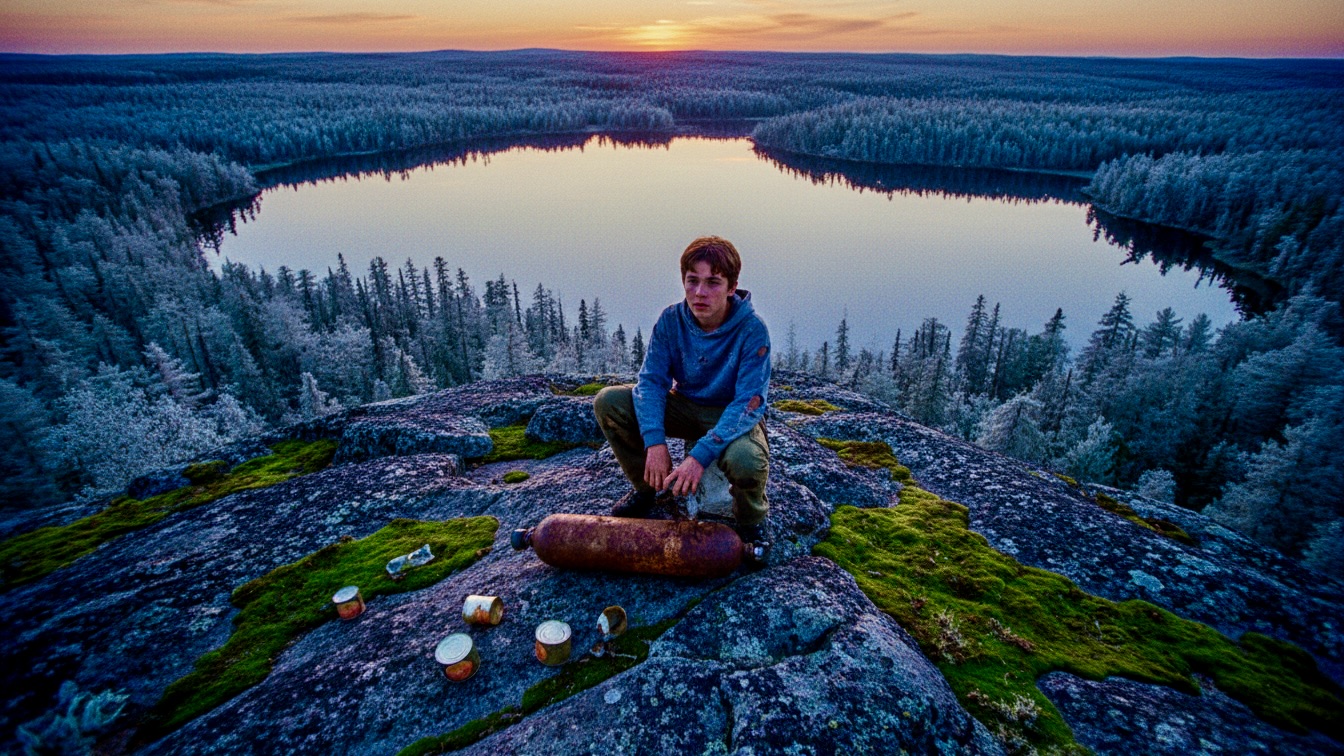
A rigid silver plague consumes the Ontario summer, turning Lake of the Woods into a massive, unmoving mirror landscape.
The heat in Kenora usually felt like a wet wool blanket. Today, it felt like static. It was mid-July, the kind of afternoon where the air should have been buzzing with dragonflies and the smell of pine needles baking in the sun. Instead, there was a weird, flat silence. Nick wiped sweat from his forehead with the back of a hand that felt uncomfortably dry. He looked at Jay, who was busy trying to get a signal on a phone that had been searching for service for three hours. Jay’s screen was cracked in a spiderweb pattern, a legacy of a party three weeks ago that felt like it happened in a different century.
They were standing near the edge of the yacht club, or what used to be the yacht club. The water of Lake of the Woods didn't ripple. It didn't lap against the wooden pilings. It sat there, a sheet of polished, dark chrome that reflected the sun with a bruising intensity. It looked heavy. It looked like it had been poured out of a vat and allowed to set. Nick threw a pebble. Usually, there would be a satisfying plink and a series of concentric circles. This time, the stone hit the surface with a metallic clack and skittered across the lake like it was sliding on ice. It didn't sink. It just stopped about ten feet out, a tiny grey dot on a perfect mirror.
"That’s not right," Jay said. He didn't look up from his phone, but his voice was thin. "Nick, that’s actually not okay. Tell me you saw that."
"I saw it," Nick said. He walked closer to the dock. The wood felt different under his boots. It didn't creak. It felt like walking on a sidewalk. He looked down and saw a seagull. It wasn't dead, or at least, it didn't look dead in the way animals usually do. It was caught in the middle of a takeoff, wings spread wide, neck arched. But it wasn't moving. Every feather had been turned into a needle of solid, polished silver. The eyes were tiny, reflective beads. It looked like something you’d buy in a high-end gift shop for way too much money, but it was just stuck there, hovering an inch above the silver water, frozen in a moment of panic.
Nick reached out, his fingers hovering just an inch from the bird’s wing. He wanted to touch it, and he absolutely didn't want to touch it. The air around the bird felt cold, a localized pocket of winter in the middle of a ninety-degree day. He flicked the wing with his fingernail. Ting. The sound was high-pitched and pure. It lingered in the air longer than it should have. The seagull didn't budge. It was anchored to the very air itself, which seemed to be thickening around it.
"Don't touch the water," Jay snapped, finally shoving his phone into his pocket. He was pale, the kind of white that made his freckles look like dirt splattered on his face. "My dad said the guys at the marina tried to boat out this morning. The propeller just sheared off. Like they hit a rock, but there was nothing there. Just the water."
"It's not water anymore," Nick muttered. He looked toward the horizon. The treeline on the far islands looked stiff. The deep greens of the white pines were being replaced by a dull, metallic grey. It was moving fast. It wasn't like a spill; it was like a change in the code of the world. A glitch that was overwriting the grass, the trees, and the lake.
Behind them, the sound of a heavy engine approached. Nick’s dad, Mr. Youngsen, pulled up in his old Ford. The truck looked out of place, its rusted fenders and mud-caked tires a messy contrast to the increasingly sleek world. He hopped out, his face set in a grim mask of confusion. He was carrying a plastic bucket, probably intending to take a sample of whatever the hell was happening to the lake. He’d lived in Kenora for fifty years, and he treated every disaster like a plumbing issue that just needed the right wrench.
"Get back from the edge," Mr. Youngsen called out. He sounded tired. "The radio’s gone. Tower in town just... stopped. They're saying it's some kind of chemical thing from the mines, but that’s a load of shit. This isn't chemicals."
He walked past the boys toward the water’s edge. He didn't see the seagull until he was right on top of it. He stopped, staring at the frozen bird. He didn't make a sound, but his shoulders slumped. He knelt down at the very edge of the concrete boat ramp, where the silver 'water' met the land. He reached out with a small glass jar, intending to scoop some up. But the substance didn't flow. It was like trying to scoop up a floor.
He shifted his weight, his boot slipping on a patch of moss that had already started to turn brittle. He stumbled, his hand shooting out to steady himself. His palm slapped flat against the surface of the lake. He didn't fall in, because there was no 'in' to fall into. He just hit the hard, cold mirror. He recoiled instantly, hissing through his teeth.
"Dad?" Nick took a step forward.
Mr. Youngsen held his hand up. He was staring at it with a look of pure, unadulterated horror. A splash of the silver liquid had coated his palm and wrapped around his thumb. It wasn't wet. It didn't drip. Within seconds, the grey color deepened, turning into a hard, unyielding shell. He tried to flex his fingers, but the silver part stayed rigid. The skin at the edges of the transformation began to pull and tear, but no blood came out. Instead, the wound itself seemed to be filled with a shimmering, viscous grey gel.
"It’s cold," Mr. Youngsen whispered. "Nick, it’s so cold. I can’t... I can’t feel the air on it. But I can feel the pressure. Like my hand is caught in a vice."
He tried to rub the silver away with his other hand, but it was like trying to rub off a tattoo made of steel. The more he touched it, the more the silver seemed to enjoy the contact. A small smear of it transferred to his healthy fingertips. He pulled away, panting. The three of them stood there in the oppressive summer heat, watching as the silver shell on his hand began to creep toward his wrist, one millimeter at a time. It wasn't a slow process. It was a steady one. It was inevitable.
"We need to go," Jay said, his voice cracking. "We need to get to the house. We need to get inside."
"Inside won't matter," Nick said, looking at the silver grass beneath his feet. The blades didn't bend when he stepped on them anymore. They snapped like glass. "It’s in the ground, Jay. It’s in the water. It’s coming up through the pipes."
Mr. Youngsen didn't move. He was just looking at his hand, which now looked like a piece of modern art. A silver hand, frozen in a half-clench. The transition was perfectly smooth, catching the sunlight in a way that was undeniably beautiful and utterly terrifying. He looked up at Nick, and for the first time in his life, Nick saw his father look small.
"Go to the hardware store," Mr. Youngsen said, his voice gaining a sudden, desperate edge. "The tanks. The oxygen tanks for the torches. Grab them. All of them."
"Why?" Nick asked.
"Look at the trees, Nick," his father said, pointing his silver hand toward the forest. The pines were no longer swaying in the light breeze. They were standing perfectly still, their needles glinting like thousands of tiny knives. "They aren't breathing anymore. If they aren't breathing, we won't be for long either."
The drive into Kenora felt like navigating a graveyard of the future. The town was quiet, but it wasn't the peaceful quiet of a Sunday morning. It was a heavy, suffocating silence. As they drove, the radio in the Ford hummed with a low, rhythmic pulse that sounded like a heartbeat underwater. Then, even that stopped. Nick looked out the window and saw the radio tower on the hill. It was a local landmark, a spindly red-and-white needle that kept the town connected to the rest of Ontario. Now, it looked like a giant sculpture of frozen lightning. The silvering had climbed the guy-wires and encased the entire structure in a shimmering, metallic growth that seemed to defy gravity. It didn't just coat the metal; it replaced it, thickening the struts into organic, curving shapes that looked like bones made of mercury.
"The signal’s dead-dead," Jay said, tapping his phone against the dashboard. "Not even an emergency broadcast. It's just... nothing."
They pulled up to Miller’s Hardware. The parking lot was empty except for a shopping cart that had been tipped over, its wheels already fused into the silvering asphalt. The front windows of the store were fogged over from the inside, a strange condensation that looked like frost but didn't melt in the July sun. Nick grabbed a tire iron from the floor of the truck. He didn't want to use it, but the world felt like it required a bit of violence now.
He smashed the glass of the front door. It didn't shatter into shards; it crumbled into tiny, square cubes of silvered glass that sounded like a thousand coins hitting the floor. The air inside the store was heavy. It felt thick in Nick’s lungs, like he was trying to inhale through a damp cloth. Every breath took effort. He could see his own breath, a faint silvery mist that hung in the air long after he exhaled.
"Find the welding section," Nick told Jay. "The green tanks. And regulators. We need everything they have."
They moved through the aisles, their boots clicking on the floor. The hardware store was a museum of the mundane, now turning into a collection of artifacts. A row of lawnmowers sat at the back, their plastic casings turning a dull, matte grey. A display of garden hoses looked like a coil of petrified snakes. Nick felt a surge of panic as he realized how fast it was moving. The silvering wasn't just on the surface; it was structural. It was rewriting the molecular weight of everything it touched.
In the back, they found the oxygen tanks. There were six of them, heavy and awkward. Nick grabbed two, the cold metal of the cylinders biting into his palms. He didn't care about the weight. He cared about the way his chest felt tight, a dull ache starting behind his ribs. He looked at Jay, who was struggling with a large tank, his face turning a worrying shade of purple.
"Is it... is it getting harder to talk?" Jay wheezed.
"Don't talk," Nick said. "Just move. We need to get these to the truck."
As they were heading for the exit, a movement in the shadows of the paint aisle caught Nick’s eye. He froze. A man was standing there, dressed in a faded high-vis vest and grease-stained jeans. He wasn't moving. He was staring at a row of paint cans that had burst open, the liquid inside frozen into silver stalactites. The man turned his head slowly. His eyes were wide, and the skin around his mouth was already starting to turn that familiar, rigid grey.
"It’s the upgrade," the man whispered. His voice sounded like sandpaper on a chalkboard. "Can't you feel it? The world is finally getting its shit together. No more rot. No more decay. Just... permanence."
"He’s one of them," Jay hissed, pulling on Nick’s sleeve. "The Preach-Bots. My mom said they were starting a group on Facebook before the net went down. They think this is supposed to happen."
"It’s beautiful, isn't it?" the man said, taking a step toward them. His movements were jerky, as if his joints were already beginning to fuse. He reached out a hand—a silver hand, identical to Nick’s father’s—and gestured toward the window. "No more hunger. No more bills. Just the silver. We’re all going to be perfect. You should just let it happen. Stop fighting. It hurts less if you don't fight."
"Get away from us," Nick said, raising the tire iron. He didn't feel brave; he felt sick. The man’s face was a map of transition. One side was human, sweaty and terrified. The other side was a smooth, expressionless mask of silver. It was like watching a statue being carved from the inside out.
"You’re just delaying the inevitable," the man said, a strange, serene smile breaking across the human half of his face. "The water is already silver. The air is next. You can't run from the atmosphere."
Nick didn't wait to hear more. He shoved past the man, the weight of the oxygen tanks a grounding presence in his hands. They scrambled back to the truck, where Mr. Youngsen was waiting. He had wrapped his silver hand in a shop rag, but the grey was already creeping past the knot, turning the fabric itself into a stiff, metallic bandage. He looked at the tanks and nodded, his eyes fixed on the forest.
"The Shield," Mr. Youngsen said, his voice cracking. "The high ground. The rock is denser there. Maybe it’ll take longer for the groundwater to soak through the granite. We need to get high up."
"What about Mom?" Nick asked, his heart hammering against his ribs.
Mr. Youngsen didn't answer. He just looked at the silvering radio tower and put the truck in gear. The silence in the cab was louder than any engine noise. They drove through the outskirts of Kenora, past houses where the lawn sprinklers were still running, spraying arcs of liquid silver that turned the grass into a field of needles. They saw a dog frozen in a backyard, its tail mid-wag, a statue of a golden retriever that would never bark again. Everything was becoming a still-life. Everything was becoming a memory that wouldn't fade because it was literally carved in metal.
As they hit the highway leading toward the Shield, Nick looked back at the town. The sun was starting to dip, and the light hit the silvered buildings, turning Kenora into a blinding, radiant crown of metal. It was gorgeous. It was the most beautiful thing he had ever seen, and it made him want to scream until his lungs gave out. He gripped the oxygen tank between his knees, the cold pressure a reminder that he was still made of flesh, for now.
The drive toward the high Shield rock was a slow crawl through a world losing its color. They had to stop at Nick's house first. It wasn't a choice; it was a compulsion. Mr. Youngsen didn't even ask. He just steered the truck into the driveway of the little split-level where Nick had spent the last sixteen years. The house looked the same from a distance, but as they got closer, the wrongness became physical. The white siding was turning a dull, brushed aluminum. The flowerbeds, which his mother had spent every Saturday tending, were now a collection of jagged, metallic shards. The petunias were silver bells that didn't ring.
"I'm going in," Nick said. His voice was flat. He didn't wait for permission.
"Nick, don't," Jay whispered, but he followed anyway. Jay was always following. It was the dynamic they’d had since kindergarten. Nick led, Jay complained, and somehow they both survived.
They stepped onto the porch. The porch swing, a heavy wooden thing that Nick used to read on during summer storms, was halfway through its transformation. The chains were already solid rods of silver, and the seat was a heavy, unyielding block. Nick tried to push it, but it wouldn't budge an inch. It was fused to the air, to the porch, to the history of the house. It was no longer a swing; it was a monument to the idea of swinging.
Inside, the air was even thinner. It felt like breathing through a straw. Nick went to the kitchen. A half-eaten sandwich sat on the counter, its crust now a hard, grey rim. A glass of water had turned into a solid cylinder of silver, the condensation on the outside frozen into tiny, sharp beads. There was no sign of his mother. The back door was wide open, swinging slightly on its hinges—the only thing in the house that still seemed to have motion.
"Mom?" Nick called out. He knew it was useless. The house felt empty in a way that had nothing to do with people. It felt structurally vacant.
He found her in the backyard, by the bird feeder. She wasn't a statue yet. She was sitting on the bench, her back to the house. She was looking at the forest. Nick walked toward her, his feet crunching on the silvered grass. It sounded like walking on dry cereal. When he reached her, he saw that her legs were gone. From the knees down, she was fused to the bench, which was fused to the ground. The silvering had moved up her body like a slow-rising tide. It was at her waist now, a smooth, shimmering waistband that was slowly cinching tighter.
"She's still breathing," Jay said, his voice trembling.
She turned her head. Her eyes were still clear, still human, but there was a profound tiredness in them. She didn't look scared. She looked like someone who had finished a very long shift and was just waiting for the bus home.
"The peaches," she said. Her voice was a faint rasp. "In the pantry, Nick. Take them. They’re in cans. The silver... it hasn't gotten inside the cans yet. Take the fruit. You’ll need the sugar."
"Mom, we can get you out," Nick said, reaching for her shoulder. He stopped himself. He could see the silver creeping up her spine, a delicate, lace-like pattern of metal under her skin. If he pulled her, she would just break. She was already part of the scenery.
"Don't touch me, honey," she said, a small, sad smile on her lips. "It’s faster if you touch it. Just... go. Go with your father. He’s always been better at the high ground than I was."
Nick stood there for a long time. He wanted to say something meaningful, something that would anchor this moment in his mind forever, but all he could think about was the way the silver made her look like a saint in a cathedral. She was becoming something eternal, and he was still just a boy who needed to breathe. He turned away. He didn't look back. He couldn't. If he looked back, he’d stay, and he wasn't ready to be a statue yet.
He met Jay in the pantry. They grabbed every can of fruit they could find. Peaches, pears, fruit cocktail. They shoved them into a backpack with a desperation that bordered on manic. These were the last organic things in their world. The last bits of sun and soil that hadn't been processed by the Silvering.
They ran back to the truck. Mr. Youngsen was slumped over the steering wheel, his breathing heavy and wet. His silver arm was now complete, all the way to the shoulder. He looked like a cyborg from a low-budget movie, a man made of meat and metal. He looked up as they climbed in, his eyes glazed with pain.
"Did you find her?" he asked.
"She told us to take the peaches," Nick said.
Mr. Youngsen nodded. He didn't ask anything else. He put the truck in gear and drove. They headed north, toward the Shield. The road began to incline, the engine of the Ford straining against the slope. The world below them was a sea of silver. The trees were a forest of chrome. The Lake of the Woods was a single, massive mirror that reflected the setting sun with such intensity that it felt like the world was on fire.
"Look," Jay whispered, pointing out the window.
In a clearing by the side of the road, a group of people were gathered. They were standing in a circle, their arms raised toward the sky. They were all in various stages of the Silvering. Some were already complete, standing like pillars of salt in a modern Sodom. Others were still moving, their bodies stiff and awkward. In the center stood a man in a white robe—the Preacher. He was shouting something, his voice amplified by the strange, metallic resonance of the air.
"The flesh is a lie!" he screamed. "The rot is the enemy! Welcome the silver! Welcome the permanence! We are the new world! We are the upgraded!"
One of the followers, a girl who couldn't have been older than Nick, walked toward the truck as it slowed for a bend. She was almost entirely silver, her skin a buffed, matte grey. She held out a hand, her fingers elongated and sharp. She looked like she was made of moonlight.
"Join us," she said. Her voice wasn't human. It was a chord, a harmony of metallic tones that vibrated in Nick’s teeth. "It doesn't hurt once the heart goes. It’s just... peace."
Mr. Youngsen floored the accelerator. The truck roared, the tires spinning on the silvered asphalt before catching. They left the cultists behind, a cluster of statues-to-be in the dying light. Nick watched them through the rearview mirror until they were just glints of light in the distance. He felt a cold knot of dread in his stomach. The Preacher was right about one thing: the flesh was losing. The world was being paved over by a perfection that didn't have room for blood, or breath, or boys who were scared of the dark.
The air at the summit of the Shield rock was thin, but it was still air. They had parked the truck when the road finally became a solid, impassable sheet of silver, and they had hiked the last mile. Every step was a struggle. The oxygen tanks were heavy, and the air felt like it was made of wool. Nick carried two tanks, the straps of the bag digging into his shoulders. Jay carried the bag of peaches and the last tank. Mr. Youngsen didn't carry anything. He couldn't. His entire left side was now silver, his leg dragging behind him like a heavy, metallic anchor. He moved with a grim, rhythmic scraping sound that echoed off the rocks.
They reached the top just as the moon began to rise. The view was impossible. The entire province of Ontario seemed to have been dipped in liquid mercury. The forests were a frozen sea of needles. The lakes were flat, unmoving mirrors. There were no lights from the towns, no flickers of campfires. Just the cold, blue reflection of the moon on a dead world.
"We're straight-up cooked, aren't we?" Jay said. He sat down on a patch of granite that hadn't yet turned grey. He sounded exhausted, a bone-deep weariness that went beyond physical effort.
"We're here," Nick said. It was a stupid thing to say, but it was the only fact they had left.
They sat in silence for a while, the only sound the hiss of the oxygen regulators. The air was getting harder to find. The trees below them were no longer processing carbon dioxide; they were just standing there, beautiful and useless. Nick opened a can of peaches with a pocketknife. He handed the first slice to his father, who took it with his one remaining human hand.
Mr. Youngsen ate the peach slowly. He closed his eyes, a look of intense concentration on his face. "I can still taste it," he whispered. "Sweet. It’s still sweet."
Nick took a bite. The peach was slimy and over-syrupy, the kind of thing he usually hated, but tonight it tasted like life itself. It was soft. It was organic. It was a rebellion against the hard, silver world. He passed the can to Jay, but Jay didn't take it. He was staring at his boot.
"Jay?" Nick asked.
Jay slowly pulled up his pant leg. His ankle was gone. In its place was a smooth, silver cylinder that moved with his calf. The transition was halfway up his shin. It wasn't a splash; it was a slow, internal conversion.
"Two days," Jay said, his voice trembling. "I tripped in the creek two days ago. I thought I just scratched it. But it didn't heal. It just... hardened."
"Why didn't you say anything?" Nick felt a surge of anger, followed immediately by a crushing weight of grief.
"What was the point?" Jay asked, looking up. His eyes were watering, the tears shimmering like mercury before they even left his lids. "To watch you look at me like I'm a statue? I wanted to stay human for as long as I could. I wanted to finish the peaches."
Nick didn't know what to do. He reached out and grabbed Jay’s hand. It was still warm. It was still soft. He squeezed it, trying to anchor Jay to the present, to the flesh.
"I'm not leaving you," Nick said.
"You’ll have to," Jay said. "Once I stop breathing, I’m just... I’m just furniture, Nick. You need to keep going. Maybe the Shield is high enough. Maybe it stops at a certain altitude."
Nick looked at his father. Mr. Youngsen was leaning against a rock, his eyes closed. He wasn't moving. The silver had reached his neck, a high, metallic collar that was slowly closing in on his throat. He looked peaceful, in a terrifying sort of way. He had fought as long as he could, and now he was just letting the upgrade finish its work.
Nick pulled out his phone. It was dead, the screen a black void, but he held it up anyway. He went through the motions of recording a video. He described the moon. He described the taste of the peaches. He described the way Jay was looking at the horizon. He did it for the memory, even if the memory was only going to exist in a brain that would eventually turn to silver too.
"It’s beautiful, in a fucked up way," Jay whispered.
He was right. The world was perfect. There was no more pollution, no more war, no more hunger. There was just the silver. It was a clean, quiet end. It was the ultimate Gentrification of the planet.
A soft sound began to drift down from the sky. It wasn't the pitter-patter of rain. It was a rhythmic, melodic chiming. Tink. Tink. Tink-tink.
Nick looked up. The clouds were no longer soft and wispy. They were heavy, metallic plates, and from them, the first silver rain began to fall. Each drop was a tiny, solid pellet of metal. They hit the granite with the sound of a thousand tiny bells. They hit the oxygen tanks. They hit the truck.
Nick felt a drop hit his forehead. It didn't splash. It didn't run down his face. It sat there, a cold, hard bead of silver that immediately began to bond with his skin. He looked at Jay. Jay was covered in the silver rain, his hair turning into a nest of metallic wires. He looked like a prince from a forgotten fairy tale.
"It’s starting," Jay said. He closed his eyes and leaned back, his body finally giving in to the weight.
Nick didn't move. He sat there in the silver rain, the oxygen mask hissing in his ear, watching as his world became a single, flawless mirror. He gripped the empty peach can, the last piece of the old world, and waited for the silver to reach his heart.
“As the silver rain grew heavier, Nick felt the cold weight of the metal spreading across his chest, and he finally stopped fighting the urge to close his eyes.”


