A reclusive beekeeper discovers his bees are communicating via radio, triggering a town-wide panic during a sweltering summer heatwave.
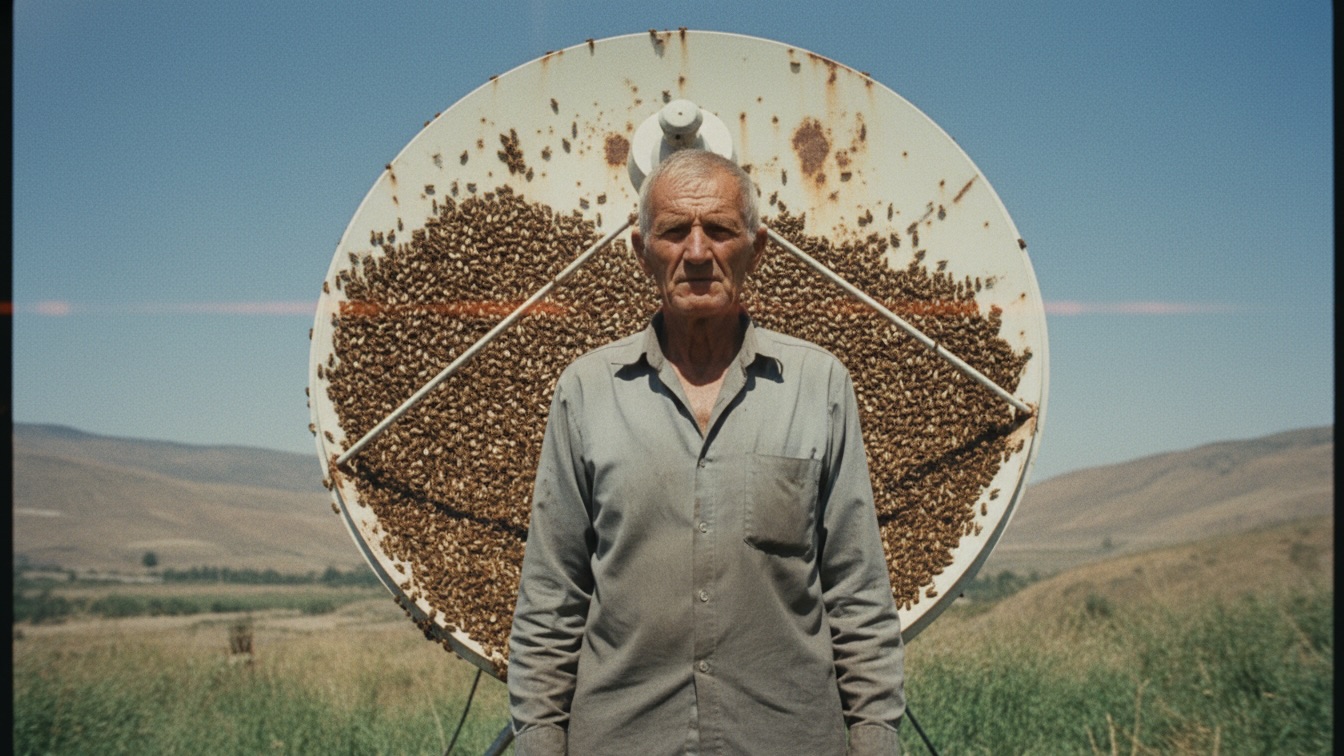
The heat didn't just sit on the valley; it pressed down like a physical weight, thick with the scent of sun-baked pine and dry dust. Sam Edisten wiped his forehead with a grease-stained rag, his joints groaning as he knelt in the tall, yellowed grass. At seventy-two, the summer wasn't an invitation anymore; it was an adversary. He looked at the white satellite dish he’d bolted to a cedar stump three decades ago. It was supposed to be for long-range radio experiments, a relic of his days at the lab, but today it was covered in a vibrating, golden carpet. Thousands of honeybees weren't in their white-painted boxes. They were clinging to the parabolic curve of the dish, forming a perfect, shivering hexagonal grid that moved with a mechanical precision that made the hair on Sam’s arms stand up. It wasn't a swarm. It was an installation.
He pulled his handheld frequency scanner from his back pocket. The device was old, its plastic casing cracked and held together by electrical tape, but the needle was jumping like a panicked heartbeat. He shouldn't be getting a signal out here. He was miles from the nearest cell tower, tucked into a dead zone where even the FM radio usually gave up the ghost. But the scanner was screaming. A high-pitched, rhythmic pulse was radiating from the dish. It wasn't random noise. It was a modulated burst, a digital heartbeat coming from the very bodies of the bees. He watched a single worker bee detach from the mass, its wings a blur. As it flew past his ear, the scanner spiked. The sound wasn't just a buzz; it was a data stream.
"What are you doing?" Sam whispered. His voice was raspy from disuse. He didn't talk to people much these days, but he talked to the hives. They usually ignored him, busy with the business of nectar and wax. But this was different. They were positioned like an antenna array. He adjusted the dial on the scanner, trying to find the center of the frequency. 440 megahertz. Exactly. He frowned, his mind racing through old schematics and signal processing math. That was a protected band. If he was picking this up, someone else was too.
A cloud of dust appeared on the horizon, trailing behind a black-and-white SUV that was moving far too fast for the gravel road. Sam didn't need to see the decals to know who it was. Sheriff Connor didn't visit unless something was broken or someone was complaining. Sam shoved the scanner into his pocket and stood up, his knees popping like dry twigs. He watched the vehicle bounce over the ruts, the sunlight glinting off the light bar. The Sheriff pulled up ten feet from the dish, the engine idling with a rough, metallic tick. The door swung open, and Connor stepped out, his boots crunching on the dry earth. He looked like he hadn't slept in three days. His uniform was crisp, but there were dark circles under his eyes that suggested a man living on caffeine and bad news.
"Sam," Connor said, nodding. He didn't come closer. He stayed by the door of his cruiser, his hand resting near his belt. Not on his gun, but close enough to make the point. "Beautiful day for it."
"It’s hot, Jim. If you’re here for the honey, the spring harvest is already gone," Sam said. He kept his hands visible. He knew the look of a man who was looking for a reason to be suspicious. It was a look that had become more common in the last year, as the world outside the valley seemed to be fraying at the edges.
"I'm not here for honey," Connor said. He gestured toward the satellite dish. "We’ve been getting reports from the regional monitoring station over in Fayette. They’re picking up interference. High-frequency bursts. They traced the triangulation right back to this ridge. You running that old radio gear again? You know the FCC rules about unauthorized broadcasting, Sam. Especially now. People are twitchy."
Sam looked at the bees. They were still there, a solid mass of gold and black against the white plastic. "I’m not running anything, Jim. The dish isn't even plugged in. I cut the cables back in '14."
Connor walked forward, his eyes narrowing as he saw the movement on the dish. He stopped four feet away, his face twisting in a mix of confusion and disgust. "What the hell is that?"
"Bees," Sam said simply. "They like the shape, I guess."
"They're vibrating," Connor noted. He reached out as if to touch the rim of the dish, but Sam stepped forward, intercepting him.
"I wouldn't. They’re busy. And Jim, I’m telling you, I haven't powered up a transmitter in years. If there's a signal coming from here, it’s not coming from a machine."
Connor pulled a small, government-issue handheld device from his belt. It was a newer model than Sam’s, sleek and black. He held it up, and it immediately began to chirp. A red light flashed on the display. "This says otherwise, Sam. This says there's a localized EM field strong enough to fry a pacemaker if you get too close. You're telling me insects are doing that?"
"I'm telling you I don't know," Sam said, his heart hammering against his ribs. He felt a sudden, sharp clarity. This wasn't a malfunction. It was a transition. "But you might want to back off. They're sensitive to pheromones. You smell like stress and cheap coffee, Jim. It makes them nervous."
Connor didn't back off. He leaned in, peering at the hexagonal grid. "There’s a lot of talk in town, Sam. People seeing lights in the woods. Equipment failing. They think someone’s setting up a cell. Some kind of domestic interference. I told them you were just a cranky old man who liked his privacy, but if I go back and tell them your bees are broadcasting on a restricted band, they aren't going to send a sheriff next time. They'll send the National Guard."
"Let them come," Sam said, though his stomach churned. "They can interview the queen. See what she has to say about national security."
"This isn't a joke," Connor snapped. He looked back at his car, then at the woods surrounding the property. "There’s a blackout scheduled for tonight. Maintenance on the main line. The whole county is going dark for four hours. If that signal is still hitting the towers when the power comes back up, it’s going to trigger a security audit. I can't protect you from that."
Sam looked at the sky. The blue was so pale it was almost white, the sun a relentless eye. "The power's going out?"
"Ten PM," Connor said. "Clean it up, Sam. I don't care how you do it. Move the bees. Smash the dish. Just make it stop."
Connor didn't wait for an answer. He got back in his car and reversed down the drive, leaving a fresh plume of dust that hung in the stagnant air. Sam stood alone with the hum. It was louder now, a physical pressure in his ears. He looked at his hands. They were shaking. He wasn't afraid of the Sheriff, or even the military. He was afraid of what he was starting to understand. The bees weren't just sitting there. They were waiting for something. And according to the Sheriff, that something was coming at ten o'clock tonight.
He walked back to his small, clapboard house. The porch groaned under his weight. Inside, the air was slightly cooler, smelling of old paper and beeswax. He went to his desk, clearing away a stack of technical journals from the nineties. He found a notebook and a pencil. He began to sketch the pattern he’d seen on the dish. It wasn't just a grid. There were gaps. Specific points where the bees clustered thicker. It looked like a map. Or a circuit board.
He spent the afternoon watching them. He didn't eat. He didn't drink. He just watched. As the sun began to dip toward the horizon, painting the sky in bruised purples and burnt oranges, the hum changed. It lowered in pitch, becoming a deep, resonant thrum that he could feel in the floorboards of the porch. It was the sound of a giant engine warming up.
He checked his watch. 9:45 PM. The valley was falling into shadow. The usual night sounds—the crickets, the owls—were silent. It was as if the entire forest was holding its breath. Sam went back out to the dish. In the twilight, the bees seemed to glow with a faint, bioluminescent shimmer. It was impossible, he knew. Honeybees didn't glow. But there it was—a soft, pulsing amber light emanating from the center of the mass.
Then, at exactly ten o'clock, the world went black. Not just the lights in his house, which he’d left off anyway, but the distant glow of the town over the ridge. The streetlights on the highway vanished. The silence was absolute for three seconds.
And then the bees began to scream.
It wasn't a sound made by wings. It was a purely electronic shriek that tore through the air, a burst of energy so powerful that Sam felt the static electricity lift the hair on his head. The satellite dish acted as a focal point, a beam of invisible force shooting straight up into the night sky. Sam staggered back, shielding his eyes as if from a physical blow. The air around the dish began to shimmer, distorted by a massive thermal bloom.
"No," Sam whispered, clutching his chest. "Not a strike. Not a strike."
He looked toward the horizon, toward the town. He expected to see explosions, or the flash of a weapon. But there was nothing. Just the deep, velvet dark of the countryside. He looked back at the dish. The bees were vibrating so hard they were a blur of motion. The frequency scanner in his pocket melted, the plastic casing fusing into a lump of hot slag.
He realized then that the power grid hadn't just gone down for maintenance. He could feel the tension in the air—the sharp, ozone bite of a massive electrical surge. The bees weren't attacking. They were grounding. They were acting as a massive, organic capacitor, absorbing a surge that should have fried every transformer in the county.
He sat down in the grass, the heat from the dish warming his face. He was an old man in the middle of a field, watching a miracle he couldn't explain to a soul. He knew what the town would think. He knew what Connor would see. They would see a signal. They would see a threat. And he was the only one who knew that the threat was already underneath them, and the bees were the only thing holding the line.
The darkness was absolute, a heavy velvet shroud that felt thicker than the summer air. Sam sat on his porch, his eyes slowly adjusting to the void. The only light came from the satellite dish, which continued to pulse with that eerie, amber rhythm. It looked like a heartbeat in the middle of a graveyard. He could hear the distant sound of car engines—panicked people in town, no doubt, wondering why their backup generators hadn't kicked in. They didn't realize that the surge the bees had absorbed would have melted the transfer switches. The town was safe, but it was blind.
A pair of headlights cut through the trees at the bottom of the drive. They were moving fast, swaying wildly as the vehicle hit the ruts. Sam stood up, his hand gripping the porch railing. He expected the Sheriff. He expected men in tactical gear. But as the car screeched to a halt, he recognized the silhouette of a beat-up electric hatchback. It was white, or it had been once, before the dust of the valley claimed it.
The door flung open, and a woman stepped out. She was backlit by the high beams, her shadow stretching long and thin across the yard. She didn't look like a soldier. She looked like a woman who had been driving for twelve hours straight.
"Dad?"
Sam froze. The voice was sharper than he remembered, carry a weight of years and unspoken arguments. "Sarah?"
She ran toward the porch, her boots thudding on the wood. She was thirty-four now, her hair pulled back in a messy knot, wearing a tech-company hoodie that looked out of place in the humidity. She grabbed his shoulders, her hands cold despite the heat. "We have to go. Right now."
"What are you doing here, Sarah? You're supposed to be in Seattle."
"I was in Seattle until the monitoring stations started lighting up like a Christmas tree," she said, her words tripping over each other. She was a systems architect, a wizard with networks. She lived in a world of data, a world Sam had left behind. "Dad, do you have any idea what's happening? Every SIGINT sensor in the Northwest is pointed at this coordinate. They think it’s a beacon. They think it’s a precursor to a kinetic strike."
"It's not a beacon," Sam said, trying to keep his voice steady. "It's the bees."
Sarah stopped. She looked out at the yard, her eyes finally landing on the glowing satellite dish. She went silent, the kind of silence that usually preceded a very loud argument. "The bees?"
"Look at them, Sarah. They're regulating the grid. There was a surge—something massive. If they hadn't been there, the Fayette substation would be a crater right now."
"Dad, you're sounding like a conspiracy theorist," she whispered, but she didn't look away from the dish. She pulled a tablet from her bag, the screen glowing bright in the dark. She tapped a few icons, her fingers moving with practiced speed. "I’ve been tracking the signal on the way down. It’s not just a pulse. It’s a complex, multi-layered frequency. It’s mimicking the resonance of the local geology. Why would bees be doing that?"
"I don't know why. I just know they are. I’ve lived with them for ten years, Sarah. They’ve changed. The environment is changing, and they're keeping up. We’re the ones lagging behind."
"The military doesn't care about your philosophy, Dad," she said, her voice trembling. "I saw the convoys on the interstate. They’re moving in disruptor units. They’re going to saturate this area with high-output microwave bursts to scramble whatever is broadcasting. It’ll kill everything, Sam. It’ll kill the bees, and if you’re standing here, it’ll cook your brain."
Sam looked at the dish. The bees were shifting again. The amber glow was fading, replaced by a deep, resonant violet. They were changing the frequency. "They’re not done. They’re still reacting to something."
"We’re leaving," Sarah insisted, grabbing his arm. "I’m not losing you to a swarm of insects and a bunch of paranoid colonels. Get your boots. Get your meds. We’re going."
"I can't," Sam said. He pulled his arm away gently. "If I leave, they’ll destroy this place. And if they destroy the hives, whatever they're holding back is going to break loose. You said it yourself—they’re mimicking the geology. They’re not just looking at the sky, Sarah. They’re looking down."
She looked at him then, really looked at him. She saw the old man who had taught her how to solder her first board, the man who had explained the beauty of a Fourier transform before she was ten. She saw the engineer, not the recluse. "What do you mean, looking down?"
"The high-frequency bursts," Sam said, gesturing to the ground. "They’re like sonar. They're mapping something deep. I thought it was the power grid, but the grid was just a symptom. There’s something under this ridge. Something that shouldn't be there."
Sarah looked at her tablet. She began to run a different set of diagnostics, her face illuminated by the blue light of the screen. "Wait. If I cross-reference the signal spikes with the local seismic sensors..."
She went quiet again. The only sound was the low, violet hum of the bees.
"Dad," she said, her voice barely a whisper. "There’s a pressure differential. A huge one. Right under the north pasture."
"The old pipeline?" Sam asked.
"The one they decommissioned in the eighties? It shouldn't have anything in it," Sarah said. But she was already typing, her face pale. "Wait. They didn't decommission it. They repurposed it for natural gas storage. High-pressure storage. And according to the historical logs, the safety valves are located... right here."
"If there’s a leak," Sam said, the realization hitting him like a physical blow. "A massive, high-pressure leak in an odorless line..."
"The bees are sensing the molecular vibration of the gas," Sarah finished. "They’re using the satellite dish to create an opposing frequency—a structural reinforcement. They're literally vibrating the air to keep the leak from expanding. They’re holding the ground together."
They stood together on the porch, two generations of engineers staring at a miracle of biology and physics. The claustrophobia of the night suddenly felt different. It wasn't the dark of a trap; it was the dark of a shield.
"If the military fires those disruptors," Sarah said, her voice flat. "The frequency will break. The gas will expand. One spark from their equipment..."
"The whole ridge goes up," Sam said. "And the town with it."
In the distance, the first sound of heavy rotors began to throb against the air. The military was no longer on the interstate. They were in the valley.
"We have to tell them," Sarah said, her hands shaking as she reached for her phone. "We have to make them understand."
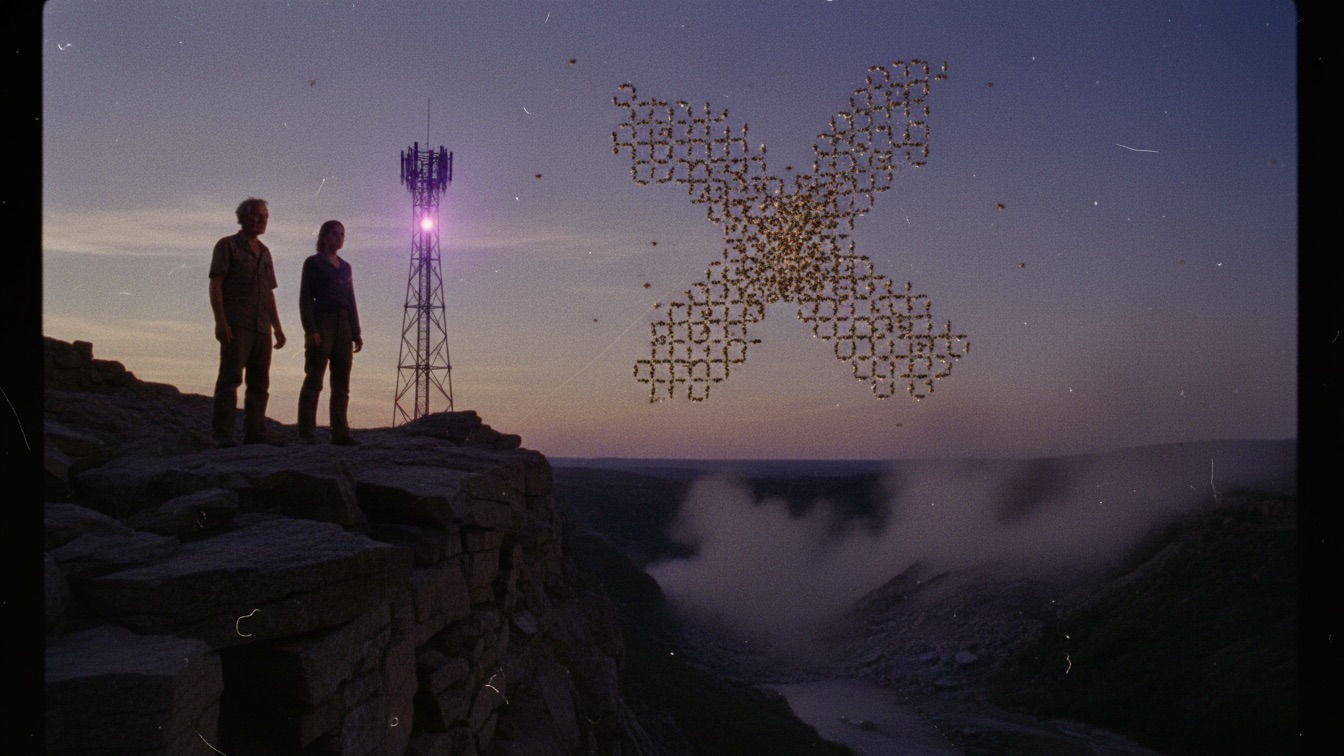
"They won't listen to a phone call," Sam said. He looked at the bees. They were swarming now, lifting off the dish in a great, dark cloud that blotted out the stars. They weren't flying randomly. They were forming shapes in the air—complex, geometric patterns that looked like ancient constellations. "We have to show them."
The helicopters were low-slung shadows against the pale moonlight, their rotors beating a rhythmic, aggressive pulse that Sam felt in his teeth. He stood in the center of the yard, his hands tucked into his pockets to hide their shaking. Sarah was beside him, her tablet held out like a shield. The bees were no longer on the dish; they were a swirling, living aurora above the pasture, thousands of tiny bodies tracing the lines of a map only they could see.
"They're doing it again," Sarah shouted over the roar of the approaching engines. "Look at the patterns!"
Sam looked up. The bees were forming a massive, three-dimensional representation of the ridge. He could see the contours of the hill, the dip of the valley, and a pulsing, red-tinged vein of bees that ran deep beneath the surface. It was a visual map of the gas leak. They were showing the exact location of the fracture.
"It’s a diagnostic!" Sarah cried, her eyes wide with a mix of terror and awe. "They’re not just holding it together. They’re flagging the danger zone."
Two massive transport trucks, followed by a line of humvees, turned into the long drive. Their headlights were blinding, washing out the glow of the bees. They didn't slow down for the ruts. They bounced and jolted, the sound of their heavy engines drowning out the summer crickets. They came to a halt fifty yards from the house, forming a semi-circle of steel and light.
Men in dark tactical gear poured out of the vehicles. They moved with a clinical, terrifying efficiency, setting up tripods and aiming large, dish-like devices toward the pasture. These weren't weapons of lead and fire; they were the disruptors Sarah had warned about.
Sheriff Connor’s cruiser pulled up behind the lead truck. He stepped out, looking smaller and more frantic than he had earlier that day. He ran toward Sam, his hands raised as if to keep the soldiers from firing.
"Sam! Get back!" Connor yelled. "They’re going to clear the signal!"
Sam didn't move. He stepped forward, putting himself between the soldiers and the hives. "Stop! You have to stop!"
A tall man in a desert-tan uniform stepped into the light. He had a face like carved granite and eyes that saw everything as a tactical problem. He held a radio to his ear, his voice calm and lethal. "Sir, you are interfering with a national security operation. Move aside."
"You don't understand!" Sarah jumped in, holding her tablet toward the officer. "Look at this! The signal isn't a weapon. It’s a warning. There’s a high-pressure gas leak under this ridge. The bees are the only thing keeping it from exploding!"
The officer didn't even look at the screen. "The sensors are picking up a hostile frequency. My orders are to neutralize the source. We have a blackout in three counties and a potential electronic strike in progress. Move your father, or we will move him for you."
"It’s not a strike!" Sam roared, his voice cracking. "It’s a shield! If you turn those disruptors on, you’ll kill the bees. If the bees die, the frequency breaks. If the frequency breaks, this whole mountain becomes a bomb. Look at the patterns in the air, man! Use your eyes!"
The officer looked up. For a moment, his gaze flickered as he saw the swarm. The bees were now forming the shape of a massive, warning hexagon—the international symbol for danger—directly over the spot where the gas was most concentrated.
"It’s a coincidence," the officer said, though his voice lacked its earlier certainty. "Natural phenomena mimic patterns all the time. Colonel, we are at T-minus two minutes to pulse. Clear the area."
"Jim!" Sam turned to the Sheriff. "You know this land. You know the old storage lines. Tell him!"
Connor looked from Sam to the officer, then up at the bees. He was a man caught between his duty and his gut. He looked at the ground, then back at the soldiers. "Colonel, wait. Edisten might be a crank, but he’s the best engineer this county ever produced. If he says there’s a leak, we should at least check the pressure monitors at the Fayette hub."
"We don't have time for a municipal check," the Colonel snapped. "The signal is evolving. It’s shifting into the gigahertz range. It’s a clear escalation."
"Because the pressure is building!" Sarah screamed. She was frantic now, tapping on her tablet. "I’ve hacked into the utility’s SCADA system. The pressure in line 4-B is at 1,200 PSI and rising. The safety valves are jammed. The bees are the only thing dampening the resonance. If you fire that pulse, you’ll create a harmonic vibration that will shatter the pipe!"
She turned the tablet around. A red line on a graph was spiking vertically. It was the visual representation of a catastrophe in progress.
Inside the pasture, a small fire suddenly broke out. It wasn't a brush fire; it was a blue, ghostly flame licking up from a crack in the dry earth. The gas was beginning to vent.
The Colonel froze. He saw the flame. He saw the way the bees immediately dove toward it, thousands of them sacrificing themselves to smother the ignition point with their bodies and a thick, dark substance they were secreting.
"They’re sealing it," Sam whispered, tears streaming down his face. "They’re using propolis. They’re trying to plug the leak."
The Colonel looked at the flame, then at the tablet, then at the swarm. He was a man trained to fight enemies, not to understand protectors. For ten agonizing seconds, the only sound was the throb of the helicopters and the desperate, high-pitched whine of the bees.
"Abort the pulse," the Colonel said into his radio. "I repeat, abort. Turn those disruptors into floodlights. I want every man on the perimeter. We have a Level One gas emergency. Get the utility engineers on the line. Now!"
The tension broke like a fever. The soldiers moved, but their purpose had shifted. The heavy light arrays snapped on, bathing the pasture in a brilliant, artificial noon. The bees didn't scatter. They stayed in their formation, a golden wall between the soldiers and the venting gas.
Sam slumped against the porch railing, the weight of the last few hours finally crushing him. He felt Sarah’s hand on his back. She was shaking as hard as he was.
"They listened," she whispered.
"They didn't have a choice," Sam said. "The bees showed them the truth. They just had to stop being afraid long enough to see it."
Across the pasture, the blue flame flickered and died, smothered by the living carpet of the hive. But the ground was still humming. The danger wasn't over. The bees were holding the line, but they were dying by the hundreds, their tiny bodies scorched by the heat and the pressure.
"We have to help them," Sam said, pushing himself off the railing. "Jim, get the water trucks. We need to cool the ground. If we can drop the temperature, the gas might stabilize until the engineers can cap the line."
Connor didn't hesitate. He was already on his radio, barking orders to the fire department. The night was no longer a standoff. It was a rescue mission. And for the first time in his life, Sam Edisten wasn't an outsider. He was the commander of the field.
The rest of the night was a blur of motion and sound. Fire trucks roared up the drive, their hoses snaking across the dry grass. They didn't spray the bees; they sprayed the perimeter, creating a curtain of mist that cooled the air and dampened the static. Sam stood with the engineers from the gas company, men who had arrived in a panic and were now looking at the satellite dish with a kind of holy dread.
"I’ve never seen anything like it," the lead engineer said, a man named Miller who had spent thirty years on the lines. He was looking at Sarah’s tablet, which was now synced to the company’s internal sensors. "The vibration coming from those hives... it’s a perfect counter-phase to the leak’s frequency. It’s like they’re active-noise-canceling the structural failure."
"They're smarter than we are," Sam said. He was sitting on a crate, a bottle of water in his hand that he hadn't touched. "They don't need a degree to know when the house is falling down."
By dawn, the engineers had managed to manually override the safety valves three miles downstream. The pressure began to drop. The high-pitched scream that had been vibrating in Sam’s bones since the previous afternoon finally faded into a low, manageable hum.
As the first light of the sun began to bleed over the ridge, the bees began to return to their hives. They didn't move with their usual purpose. They were slow, their wings tattered, their bodies covered in the gray dust of the underground. They crawled into the white boxes, a weary army returning from a war no one else had known was happening.
The military trucks began to pull out, the Colonel giving Sam a stiff, respectful nod as his humvee passed. He didn't apologize—men like that didn't have the vocabulary for it—but the way he looked at the hives told Sam that he would never look at a common insect the same way again.
Sheriff Connor stayed until the last fire truck left. He walked over to the porch where Sam and Sarah were sitting, the two of them watching the sun rise. He looked exhausted, his uniform stained with mud and soot.
"The town's power is coming back on," Connor said. "The blackout was a mess, but we didn't lose a single building. No explosions. No fires. Just a lot of people who are going to have a lot of questions about why their radios were picking up bee-buzzing all night."
"Tell them it was atmospheric interference," Sam said. "They won't believe the truth anyway."
"I think they might," Connor said, looking out at the pasture. The satellite dish was still there, but it was just a piece of plastic now. The glow was gone. "Word travels fast in a small town. They’re already calling it the Honey Shield."
He tipped his hat and walked back to his car. Sam watched him go, feeling a strange, hollow lightness in his chest. The burden he’d been carrying for years—the isolation, the feeling that he was a relic of a forgotten age—had lifted. He wasn't alone. He had the hives. And he had his daughter.
Sarah leaned her head on his shoulder. "I'm sorry I tried to make you leave, Dad."
"You were worried. It’s what daughters do."
"I’m not going back to Seattle. At least, not yet," she said. "I think I need to study this. If they did it here, they’re doing it elsewhere. We’re missing an entire layer of the world’s operating system, Sam. I want to build a bridge. A way for us to listen."
Sam smiled. It was the first real smile he’d had in a long time. "The bees might have something to say about that. They value their privacy."
Two months later, the valley was a different place. The heat had broken, replaced by the crisp, golden air of late August. The town of Fayette was holding its first annual Honey Shield festival. There were stalls selling local honey, kids wearing yellow-and-black face paint, and a large plaque being dedicated at the town hall.
But Sam wasn't at the festival. He was on his ridge, standing by the hives with Sarah. They were wearing their veils, the white mesh protecting them from the gentle hum of a healthy colony. The bees were busy with the clover, oblivious to their status as local heroes.
Sam opened one of the hives, lifting out a frame. It was heavy with honey, the wax a perfect, golden white. He looked at the satellite dish. It was clean now, the plastic white and silent.
"Look at that," Sarah said, pointing toward the woods.
A massive swarm was taking flight, but it wasn't a panicked exodus. It was a dance. Thousands of bees rose into the clear blue sky, circling higher and higher. They didn't form a map or a warning. They just flew, their wings catching the light like a million tiny shards of glass.
Sam watched them until they were just a speck in the distance, a part of the air itself. He felt a deep sense of clarity, a physical sensation of sudden oxygen filling his lungs. The world was changing, yes. It was getting hotter, louder, and more dangerous. But nature wasn't a victim. It was an adaptivity. It was a force that would find a way to protect its own, even if it had to use a discarded satellite dish to do it.
He felt Sarah’s hand slip into his. They stood there for a long time, two engineers in a field of clover, watching the sky.
"They're still broadcasting, you know," Sarah whispered.
Sam nodded. He didn't need a scanner to hear it. He could feel it in the ground beneath his boots—a low, steady pulse that told him the world was still turning, and for now, at least, it was safe.
“As the sun set on the final day of the festival, Sam noticed a single bee landing on his new digital watch, its wings vibrating in a sequence that looked suspiciously like a countdown.”