Format: Short Film / Anthology Episode | Est. Length: 10-12 minutes
Imagine Copper Wire and Honey as a standout chapter in a speculative anthology series titled The Resonance. This series explores a world where the planet’s biosphere has begun to "hack" human technology to defend itself against environmental collapse. Each episode features a different localized anomaly—from fungal networks infiltrating smart cities to cetaceans disrupting undersea fiber-optics—weaving a larger tapestry of a world where nature is no longer a victim, but a sentient, technological force.
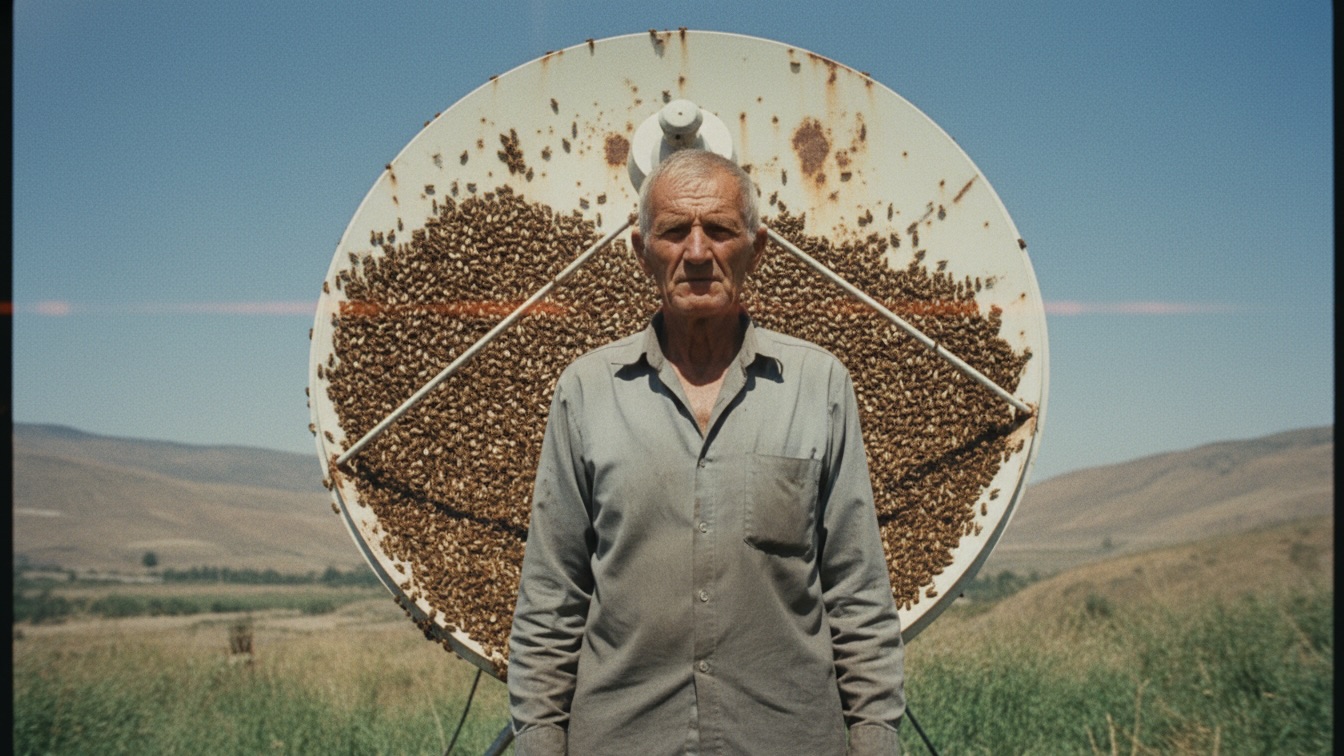
In a heat-shimmering valley, a retired engineer discovers his old satellite dish is covered in a vibrating carpet of honeybees that are broadcasting a rhythmic digital heartbeat on a restricted government frequency.
When a swarm of bees begins broadcasting a high-frequency signal from a retired engineer’s satellite dish, he must protect the hive from a military strike to prevent a catastrophic underground explosion. Nature and technology collide in a race to stop a disaster that only the insects can see coming.
The primary theme is the symbiosis between biological systems and human infrastructure, suggesting that nature is not a passive victim of technology but an active, adaptive participant. It explores the "intelligence of the swarm" as a metaphor for collective survival against systemic failure.
The secondary theme focuses on the bridge between generations, represented by Sam’s analog wisdom and Sarah’s digital expertise. Their reconciliation mirrors the necessary union of old-world observation and new-world data required to interpret the changing environment and avert a global crisis.
At the immediate level, Sam’s life and legacy are at risk as the military prepares to deploy high-output microwave disruptors on his property. On a larger scale, the entire county faces total destruction from a high-pressure gas explosion that would be triggered if the bees' stabilizing frequency is broken.
The external conflict pits Sam and Sarah against a rigid military hierarchy that views any unknown signal as a hostile threat to national security. Internally, Sam struggles with his isolation and the fear that his mind is failing, while Sarah must overcome her skepticism of her father’s "cranky" theories to see the data-driven truth of the situation.
Sam Edisten, a reclusive former engineer, notices his bees have abandoned their hives to form a geometric grid on an old satellite dish, emitting a modulated data stream. Sheriff Connor arrives to warn Sam that the FCC has traced interference to his ridge and that a county-wide blackout is imminent, threatening a military security audit if the signal persists. As the power goes out, the bees absorb a massive electrical surge, acting as a living capacitor to save the local grid, but the hum they emit only draws more government attention.
Sarah, Sam’s estranged daughter and a systems architect, arrives to evacuate him before a military "disruptor" unit arrives to scramble the signal. Together, they realize the bees aren't a weapon but a shield, using frequency to stabilize a massive, undetected gas leak in a decommissioned pipeline beneath the ridge. In a tense standoff with a Colonel, they must prove the bees are the only thing preventing a catastrophic explosion before the military fires a pulse that would shatter the pipe and kill everyone in the valley.
* Sam Edisten: A seventy-two-year-old retired lab engineer who has retreated into a life of solitude and beekeeping. He begins the story as a cynical recluse, weary of a world he feels has passed him by, but ends as a vital protector who bridges the gap between nature and science. His arc is one of re-engagement, moving from a man who talks to hives because he’s lonely to a man who interprets for them because he’s the only one who can.
* Sarah Edisten: A high-strung systems architect in her thirties who views the world through data points and logic. She starts the episode driven by a frantic need to "save" her father from his own perceived delusions, but her arc concludes with her acknowledging the limits of human technology. By the end, she is no longer just a coder but a translator of the "biological operating system" she once dismissed.
* Sheriff Connor: A weary local lawman caught between his long-standing respect for Sam and the mounting pressure of federal mandates. He serves as the grounded perspective of the town, transitioning from a man who sees Sam as a "cranky old man" to the crucial ally who trusts his gut over his orders.
* The Colonel: A pragmatic, mission-oriented military officer who views the world as a series of tactical threats to be neutralized. He represents the "antagonistic force" of rigid institutional thinking, though he is ultimately capable of pivoting when presented with undeniable physical evidence of a greater threat.
* The Discovery: Sam observes the bees forming a mechanical grid on his satellite dish and detects a digital heartbeat on his frequency scanner. The heat is oppressive, and the Sheriff’s arrival establishes the ticking clock of the FCC interference and the upcoming 10 PM blackout. Tension builds as the scanner spikes, confirming the bees are broadcasting a data stream rather than just buzzing.
* The Blackout Surge: At 10 PM, the county goes dark, and the bees emit an electronic shriek as they absorb a massive electrical surge that should have fried the local transformers. Sam realizes the bees are acting as an organic capacitor, protecting the town from a grid failure. The frequency scanner melts in his pocket, signaling the sheer power of the energy the hive is managing.
* The Arrival: Sarah arrives in a panic, revealing that the military is tracking the signal as a potential precursor to a kinetic strike. She and Sam clash over his "crazy" theories until they cross-reference her tablet data with the bees' patterns. They discover the bees are mapping a high-pressure gas leak beneath the ridge, using frequency to hold the structural integrity of the earth together.
* The Standoff: The military arrives with microwave disruptors, and the Colonel prepares to neutralize the "hostile" signal. Sam and Sarah stand in the line of fire, desperately trying to explain that the disruptor pulse will trigger the gas explosion. The climax occurs when a blue flame vents from the ground, and the bees sacrifice themselves to smother it, finally convincing the Colonel to abort the pulse.
* The Aftermath: As dawn breaks, the gas pressure is stabilized by engineers, and the surviving bees return to their hives, tattered but successful. Sam and Sarah sit on the porch, their relationship mended by the shared miracle they witnessed. The episode ends with the realization that the bees are still broadcasting, and Sarah decides to stay and help Sam "listen" to the world's new operating system.
The episode begins with a sense of "rural noir" and oppressive isolation, characterized by the heavy heat and Sam’s raspy, disused voice. As the signal is discovered, the mood shifts into a high-tension tech-thriller, peaking with the arrival of the military and the threat of the disruptor pulse. The finale transitions into a sense of "sublime awe," leaving the audience with a feeling of profound connection to the natural world and a lingering curiosity about the "unseen" systems protecting us.
If expanded, the season would follow Sam and Sarah as they travel to other "hotspots" where nature is interfacing with failing infrastructure. They would act as a rogue diagnostic team, staying one step ahead of a government agency (The Signal Task Force) that wants to weaponize or suppress these biological anomalies.
The thematic escalation would involve the discovery that these events aren't isolated but part of a global "re-boot" of the Earth’s biosphere. The season finale would reveal that the bees in the valley were just one node in a planetary network, leading to a global event where humanity must choose between fighting the change or integrating with it.
The visual style is "Grounded Sci-Fi" meets "Americana Gothic," utilizing high-contrast lighting to emphasize the sweltering heat of the day and the absolute void of the blackout. The camera work should be intimate and tactile when focusing on Sam and the bees, transitioning to cold, wide, and clinical shots when the military arrives.
Tonal comparables include the atmospheric dread of Arrival mixed with the rural mystery of Signs. The use of amber and violet bioluminescence against the deep blacks of the night creates a surreal, painterly aesthetic that highlights the "miracle" occurring in the mundane setting.
The target audience is adults (18-45) who enjoy "smart" speculative fiction and anthology series like Black Mirror or Tales from the Loop. It appeals to viewers interested in environmental themes, father-daughter dynamics, and "low-fi" science fiction that prioritizes atmosphere and ideas over explosive action.
The pacing is a "slow burn" that accelerates rapidly once the blackout hits. The first five minutes establish the atmospheric tension and the mystery of the signal, while the final seven minutes are a high-stakes, real-time race against the military’s countdown. The 10-12 minute runtime ensures a tight, focused narrative that emphasizes the "incident" without overstaying its welcome.
The primary production challenge is the "bee carpet" and the geometric formations, which will require a blend of practical macro photography and high-end CGI. The bioluminescent amber and violet pulses must feel organic rather than digital to maintain the "biological technology" aesthetic.
The gas leak "blue flame" and the melting frequency scanner are key practical effects that ground the sci-fi elements in reality. Sound design is critical; the "electronic shriek" of the bees should be a complex layer of organic wing-beats and synthesized data-bursts to create a unique, unsettling auditory signature.


