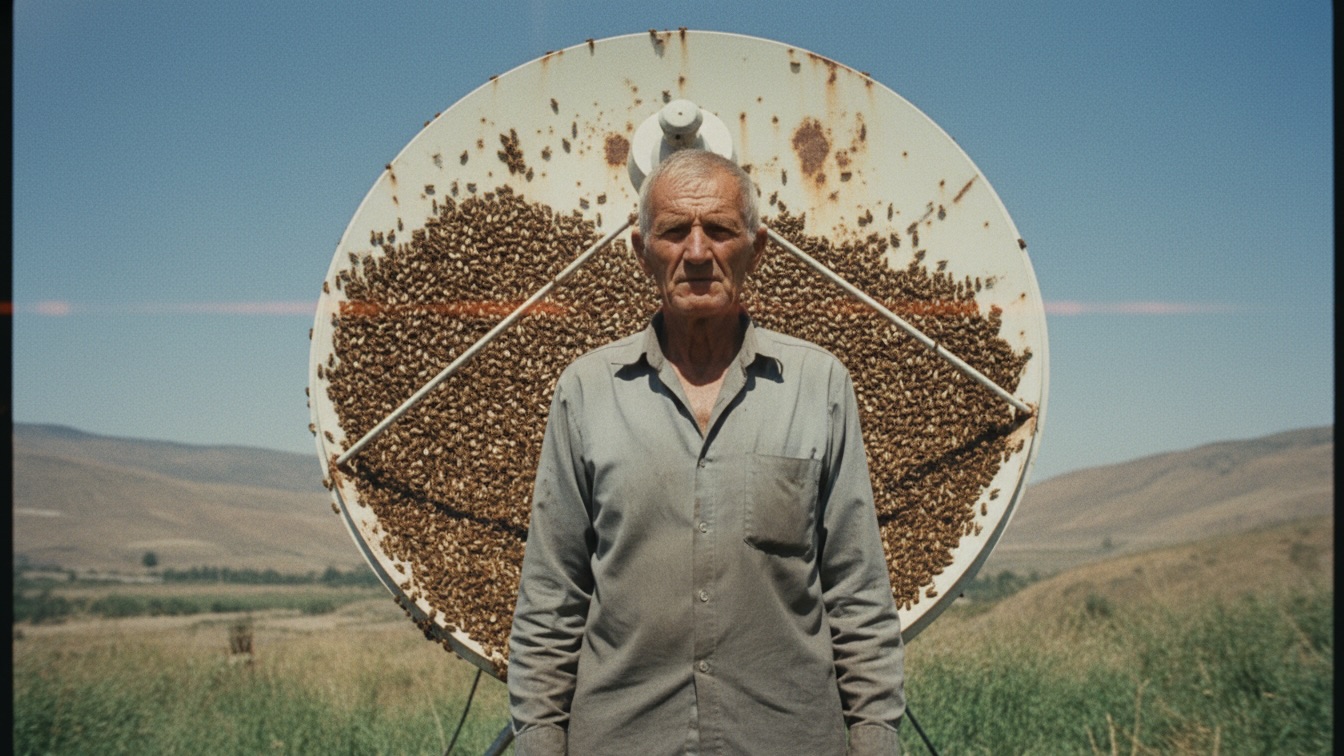
The story follows Sam Edisten, a seventy-two-year-old retired lab engineer living a reclusive life in a heat-stricken valley. He discovers that a massive swarm of honeybees has colonized an old, disconnected satellite dish, forming a complex geometric pattern that emits a rhythmic digital pulse. When Sheriff Connor arrives to investigate reports of signal interference, Sam realizes that the bees are not merely swarming but are acting as a sophisticated organic antenna.
As a scheduled county-wide blackout occurs, the bees absorb a massive electrical surge that would have otherwise destroyed the local power grid. Sam’s daughter, Sarah, a systems architect, arrives and helps him decode the true purpose of the bees' behavior. They discover a catastrophic gas leak in a decommissioned pipeline beneath the property, which the bees are dampening through harmonic vibration.
When the military arrives intending to neutralize the "hostile" signal with electronic disruptors, Sam and Sarah must convince the commanding officer of the danger. By demonstrating that the bees are actually sealing the leak and preventing a massive explosion, they manage to halt the military intervention. The story concludes with the town celebrating the "Honey Shield" while Sam and Sarah remain on the ridge, having bridged their personal estrangement through a shared understanding of nature's hidden complexities.
The central theme of the narrative is the symbiosis between organic life and human technology. Rather than presenting nature and machine as opposing forces, the story suggests that biology is capable of co-opting discarded technology to serve a greater ecological purpose. The bees do not merely inhabit the satellite dish; they integrate with it, turning a relic of human communication into a tool for environmental stabilization. This reflects a psychological shift in how the protagonist perceives his own relevance in a rapidly changing world.
Another prominent theme is the danger of misinterpretation in the face of the unknown. The military and the FCC view the bees' signal as a kinetic threat or a hostile beacon because their frameworks for understanding are limited to conflict and security. This mirrors the psychological concept of "projection," where the authorities project their own fears and systemic rigidities onto a phenomenon that is actually protective. The resolution of the conflict requires a shift from a defensive posture to one of observation and empathy.
The story also explores the theme of legacy and the bridging of generational divides. Sam and Sarah represent two different eras of engineering—the physical, tactile world of old schematics and the digital, data-driven world of modern networks. Their reconciliation is facilitated by the bees, which require both Sam’s intuitive, long-term observation and Sarah’s high-tech diagnostic capabilities to be understood. Their collaboration suggests that human progress is most effective when it respects the wisdom of the past while utilizing the tools of the future.
Finally, the narrative touches upon the resilience of nature in the Anthropocene. The bees are described as an "adaptivity," a force that is actively correcting the environmental hazards created by human negligence, such as the forgotten gas pipeline. This provides a hopeful psychological counter-narrative to environmental despair. It suggests that while the world is "fraying at the edges," there are hidden systems of repair working beneath the surface of human perception.
Sam is a man defined by his transition from a high-functioning professional life to a state of self-imposed isolation. At seventy-two, he views the world through the lens of a weary engineer, seeing his own aging body and his old equipment as failing machines. His raspy voice and "disuse" of social interaction suggest a psychological withdrawal, likely a defense mechanism against a world that he feels has passed him by. The bees provide him with a renewed sense of agency, transforming him from a "cranky old man" into a vital guardian of the valley.
His internal conflict stems from his fear of the "outside" world, which he perceives as increasingly twitchy and aggressive. He clings to the bees because they represent a logic that he can still decode, unlike the bureaucratic and military forces that threaten his peace. By the end of the story, Sam experiences an existential expansion. He moves from being a relic of the past to a pioneer of a new kind of understanding, finding a "physical sensation of sudden oxygen" that signals his psychological rebirth.
Sarah serves as the narrative’s bridge between the reclusive world of the ridge and the high-stakes environment of modern technology. As a systems architect, her initial reaction to the crisis is one of frantic data-gathering and a desire to "rescue" her father from what she perceives as his delusions. Her character represents the anxiety of the modern professional, driven by a need to control and categorize information. However, her scientific curiosity eventually overcomes her fear, allowing her to see the bees as a complex operating system.
Her relationship with her father is marked by years of unspoken arguments and distance, yet her return to the ridge is a clear indication of her underlying loyalty. She undergoes a significant shift in perspective, moving from a desire to flee to a commitment to stay and "build a bridge" to understand the natural world. This reflects a psychological maturation, as she learns to value her father's intuitive wisdom alongside her own technical expertise. She finds a new purpose that transcends the corporate world of Seattle.
Sheriff Connor is the embodiment of the "everyman" caught between institutional duty and local reality. He is characterized by exhaustion and the "dark circles under his eyes," suggesting a man burdened by the social decay he witnesses in the town. Psychologically, he is a man living on the edge of burnout, yet he retains a sense of "gut" instinct that allows him to trust Sam when it matters most. He acts as a crucial mediator, ultimately choosing the word of a neighbor over the orders of a colonel.
The Colonel represents the psychological rigidity of the military-industrial complex. He views the world as a series of tactical problems to be neutralized, and his refusal to look at Sarah’s tablet initially marks him as the story's antagonist. His transformation is brief but significant; he is a man of "carved granite" who is forced to acknowledge a power greater than his own weaponry. His decision to abort the pulse demonstrates that even the most rigid systems can adapt when faced with undeniable, life-saving evidence.
The pacing of the story is masterfully handled, beginning with a slow, oppressive heat that mirrors Sam’s stagnant life. This lethargy is gradually replaced by a sense of high-frequency tension as the "digital heartbeat" of the bees begins to sync with the arrival of outside threats. The narrative voice uses technical jargon—such as "440 megahertz," "SCADA system," and "Fourier transform"—to ground the fantastical elements of the plot in a believable scientific reality. This creates a tone of "grounded sci-fi" that makes the miracle of the bees feel like a discovery rather than a magic trick.
Sensory details are used to heighten the emotional stakes, particularly the contrast between the "amber rhythm" of the bees and the "blinding" headlights of the military trucks. The author frequently uses mechanical metaphors to describe biological functions, such as the bees moving with "mechanical precision" or the "electronic shriek" of the swarm. This stylistic choice reinforces the theme of symbiosis, blurring the lines between the natural and the artificial. The soundscape of the story is especially vivid, moving from the silence of the forest to the "purely electronic shriek" that signals the climax.
The narrative voice is one of observant gravity, reflecting Sam’s own internal state. It avoids sentimentality, even during the reunion between father and daughter, focusing instead on their shared intellectual labor. This restraint makes the final scene, where the bees rise like "a million tiny shards of glass," feel earned and profoundly moving. The use of the "Honey Shield" as a recurring motif provides a satisfying symbolic arc, evolving from a literal physical barrier to a local legend that represents the town's collective survival.


