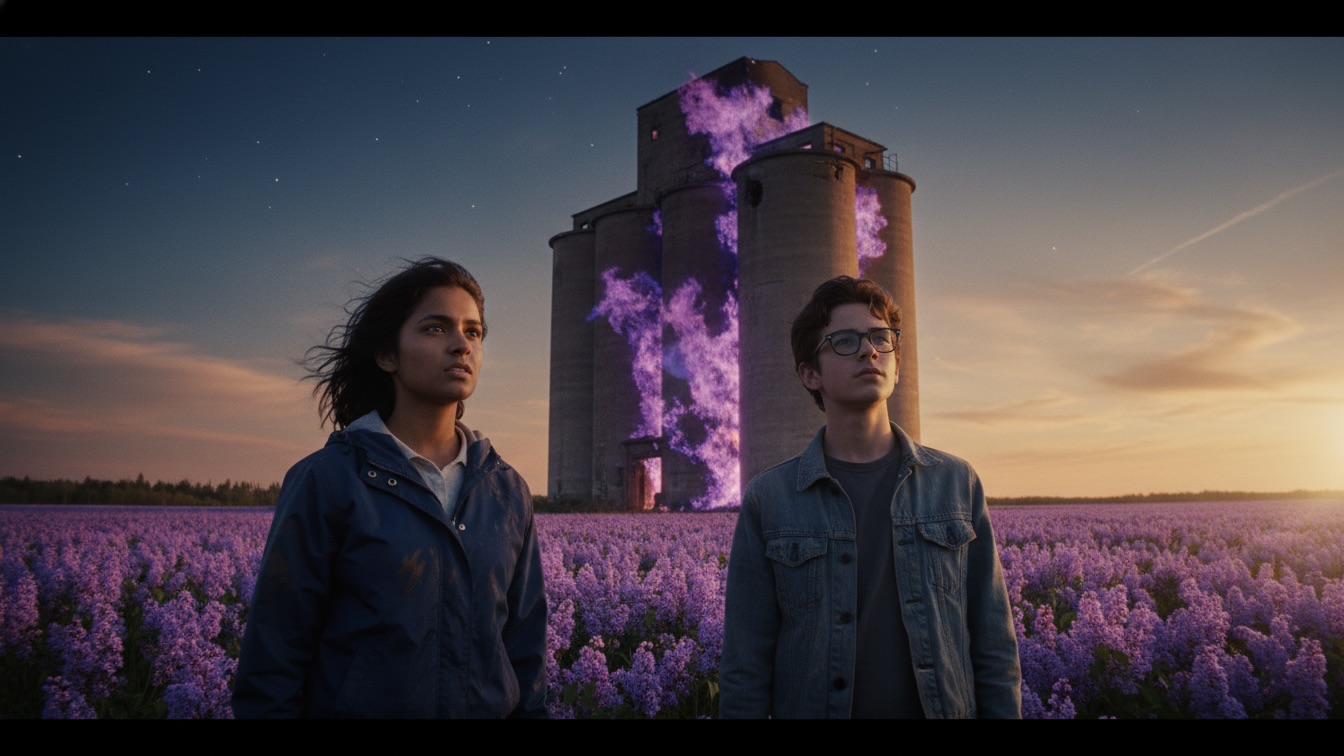
Mattie Saunders finds a glitching node in Winnipeg’s heat, uncovering a mystery hidden within the province’s new health budget.
"The signal is bleeding, Mattie. You see the pulse? It is not rhythmic. It is a seizure."
Mattie Saunders stared at the small plastic box zip-tied to the rusty downspout of the community hall. The sun was a physical weight on her shoulders, a heavy, humid blanket that smelled of baked asphalt and drying river mud. It was 2026, and the Manitoba summer had arrived with a violent, oversaturated brightness. Everything looked too sharp, like the contrast had been dialed up until the edges of the buildings hummed. She wiped sweat from her forehead with the back of a hand that was stained with grey dust.
"I see it, Shawn. It is blinking in a sequence we did not program. Blue is for data transfer. Red is for a hardware fault. This is... violet?"
Shawn leaned in, his glasses slipping down a nose slick with perspiration. He was nineteen, a transplant from Steinbach who treated circuit boards like holy relics. He adjusted his grip on a handheld frequency scanner that looked like it had been salvaged from a 1990s dumpster. "Violet is not a factory setting. It is an improvisation. The node is dreaming, or it is being rewritten by a hand we do not recognize."
Mattie felt a sharp twitch in her jaw. Her mother, Meera, was currently twelve hours into a sixteen-hour shift at the Health Sciences Centre, navigating the chaos of the new 'Specialized Emergency Zones' that the government had promised would fix everything. The reality, according to her mother’s exhausted voice notes, was a labyrinth of half-finished wards and digital intake systems that crashed if more than three people breathed on them at once. Mattie needed PathLine to work. She needed the lead on that medical lab tech apprenticeship in Brandon to be real, because the official channels were a graveyard of 'Application Received' automated replies.
"Did the courier arrive?" Mattie asked, her voice tight. "The one from the Interlake?"
"He did not," Shawn replied. His eyes didn't leave the blinking violet light. "The bike is missing. The handwritten logs are missing. We are currently operating in a vacuum, Mattie. A very bright, very hot vacuum."
Mattie looked down the street. The lilacs were in full bloom along the Red River, their scent thick and almost cloying, mixing with the metallic tang of the nearby rail yards. The world felt like a glitch. The government budget had poured billions into the dirt, yet here she was, standing in the North End, chasing a ghost signal because the 'real' world had no room for her.
"We cannot wait for the relay," Mattie said. "If the node is compromised, the whole mesh is at risk. Everyone’s data—the job leads, the clinic coordinates, the union tips—it all becomes a map for whoever is messing with the frequency."
"Your assessment is logically sound but physically dangerous," Shawn said, finally looking up. His eyes were wide behind the lenses. "If we interfere with the violet signal, we might lose the connection to the Brandon node entirely. Arlo is waiting for the welding logs. Without them, he cannot verify his hours for the new provincial grant."
"Arlo will understand a security breach," Mattie snapped. She reached out and touched the plastic casing. It was hot—unnaturally hot. Not just from the sun, but from a heat generating inside the electronics. It thrummed against her fingertips like a trapped insect. "Something is pushing a lot of power through this tiny thing. It shouldn't be possible. These are low-power LoRa chips. They run on a watch battery and a prayer."
"Perhaps the prayer was answered by a god of high voltage," Shawn muttered. He began tapping rapidly on his cracked tablet. "The packet headers are encrypted with a key I do not have in my ledger. It is formal. It is structured. It looks like... legislation?"
Mattie frowned. "Why would the mesh be carrying legislation?"
"It is not the text of a law," Shawn said, his voice dropping to a theatrical whisper. "It is the architecture of one. It is a budget allocation code, Mattie. A billion-dollar string of numbers is currently sitting in our community center’s downspout. It is out of place. It is a digital migrant."
Mattie’s stomach turned over. This wasn't just a glitch. This was a leak. Or a theft. The 'PathLine' was supposed to be a shadow, a quiet way for youth to bypass the broken systems. It wasn't supposed to be a vault for government secrets.
"We need to move the node," she said. "Now. Before the 'ordinary community hustle' we've been projecting becomes a police investigation."
"The courier, Mattie," Shawn reminded her. "If we move the node, the courier will find a dead drop. He will think we have been burned."
"He already thinks that if he’s smart," Mattie said. She pulled a multi-tool from her back pocket. The metal was dull and scratched. "Hold the bag open. We’re taking it to the workshop. We’re going to see what this violet light wants to tell us."
As she snipped the zip-ties, the violet light flashed once, a blindingly bright spark that left a green afterimage on her retinas. The humming stopped. The silence that followed was heavy, broken only by the distant, rhythmic thud of a pile-driver working on a new hospital wing three miles away. The air felt thinner, the summer sun even more oppressive.
"The node is silent," Shawn observed. "The seizure has ended."
"Or the patient died," Mattie said. She shoved the plastic box into Shawn’s backpack. "Let's go. My mother gets off shift in four hours. I want to be home before she sees how much trouble I’m actually in."
They started walking, their footsteps quick on the cracked pavement. Mattie didn't look back, but she felt the gaze of the city—the sensors, the cameras, the bored officials in air-conditioned offices—all focused on the two teenagers carrying a backpack that was currently humming with a billion dollars' worth of stolen light.
The heat in the workshop was a different beast. It wasn't the expansive, airy heat of the street; it was a dense, oily warmth that clung to the stacks of old computer towers and salvaged solar panels. Shawn’s basement in the North End was a graveyard of the 2010s. CRTs sat like hollowed-out skulls next to tangled nests of Ethernet cables. A single fan groaned in the corner, moving the air without cooling it.
"The courier did not miss the drop," Shawn said, peering into a monitor that flickered with green text. "The courier was intercepted. I am seeing a disruption in the signal path near the University gates. A node went offline exactly six minutes before he was scheduled to pass it."
Mattie sat on a stool, her legs bouncing. The anxiety was a physical itch in her throat. "Intercepted by whom? The police?"
"Unlikely," Shawn said, his voice taking on that theatrical, measured tone he used when he was theorizing. "The police are preoccupied with the new 'Public Safety Corridor' downtown. They do not care about a boy on a bicycle in the suburbs. No, this was a targeted interference. A digital wall was erected, and our friend rode straight into it."
"Kira is at the University today," Mattie said, checking her own phone—a bulky, restricted device that only allowed local calls and basic text. "She was organizing the Interlake youth for the health fair. If the University node is dark, she’s blind. We’re all blind."
"I have decrypted the first layer of the violet packet," Shawn interrupted. He turned the monitor toward her. "Look at this, Mattie. It is a list. Names. Addresses. Social Insurance Numbers."
Mattie leaned in. The text was raw, unformatted. "Is this the payroll for the new health expansion?"
"No," Shawn said. "These are the applicants. The 'out-of-province' competition the government said was the reason for the shortage of spots. But look at the dates. Look at the locations."
Mattie scrolled through the names. Calgary. Vancouver. Toronto. The dates of their 'applications' were all from three years ago. Some were from people who didn't exist in any public record Shawn could cross-reference. It was a phantom workforce.
"They are padding the numbers," Mattie whispered. "They are showing a surge in demand that isn't real to justify the billion-dollar budget increase. While we wait months for a specialist, while I can't get a spot in a lab tech program, they are pretending the system is overwhelmed by a flood of people who aren't even here."
"It is a budget ghost," Shawn agreed. "And our PathLine accidentally caught it in its net. The violet light was the system trying to purge the data. It was an overflow error in their corruption."
"We need to find the courier," Mattie said, standing up so fast the stool scraped harshly against the concrete. "If he has the physical logs, he has the proof of where these nodes were being fed from. He has the paper trail."
"The courier’s name is Arlo," Shawn said. "I thought Arlo was the mechanic?"
"No, Arlo is the Brandon contact. The courier is... wait, who is the courier?"
Shawn froze. He looked at his ledger. The handwritten pages were blank where the courier’s name should have been. Only a small, hand-drawn symbol of a lily remained.
"This is a failure of memory," Shawn said, his voice trembling. "I wrote the name. I remember writing the name. Why is it gone?"
Mattie felt a chill that had nothing to do with the basement’s humidity. She reached out and touched the paper. The ink hadn't been erased; it looked like it had never been there. The 'Bright Glitch' wasn't just in the nodes. It was in the world around them. The unexpected logic of the summer was beginning to rewrite their own history.
"The lily," Mattie said. "The lilacs along the river. He’s at the park. The one by the old pumping station. That’s where the university node was hidden."
"You are making a leap of intuition that defies statistical probability," Shawn warned.
"I'm making a leap of survival," Mattie countered. "If the system can erase a name from a piece of paper, it can erase a person from a bike path. We have to go. Now."
She grabbed her windbreaker, despite the heat. She needed the pockets. She needed the weight of something real against her skin. They ran up the basement stairs, leaving the humming ghost-node in the dark.
Outside, the sun was beginning its long, slow descent toward the horizon, painting the sky in shades of bruised orange and electric pink. The air felt electric. As they reached the street, a fleet of white government vans sped past, their sirens silent but their lights flashing in a frantic, violet rhythm.
"They are not looking for us yet," Shawn said, his theatricality replaced by a raw, jagged fear. "But they are looking for the ghost. And the ghost is currently sitting in my backpack."
"Then we give them a different ghost to chase," Mattie said. "We head for the river. We follow the lilacs."
They moved through the side streets, avoiding the main arteries where the 'Public Safety' cameras were thickest. Every person they passed seemed to be moving in slow motion—a construction worker leaning on a shovel, a mother pushing a stroller, a group of teenagers staring at their phones. They all had the same glazed look, a weary acceptance of the heat and the budget and the slow, grinding reality of a province that promised the moon and delivered a handful of dust.
Mattie felt a surge of anger. It was a hot, sharp blade in her chest. Her mother was scrubbing floors and changing bandages in a ward that didn't technically exist, for patients that were being squeezed out by digital phantoms. PathLine wasn't just a job board anymore. It was a witness.
"The park is ahead," Shawn whispered. "I see the bike."
In the middle of a field of overgrown grass and blooming lilacs, a single bicycle lay on its side. Its front wheel was still spinning, a silver blur in the fading light. There was no one in sight. No courier. No struggle. Just the bike, and the overwhelming scent of purple flowers.
"The courier is gone," Shawn said, his voice flat. "But the bag is still there."
They approached the bike with the caution of people entering a minefield. The grass felt strange underfoot—too soft, like walking on moss. Mattie reached for the courier bag. It was a heavy canvas satchel, stained with grease and sweat.
As her hand closed around the strap, the world around them flickered. For a split second, the park was gone. In its place was a white, sterile room filled with humming servers and the smell of ozone. Then, with a sickening jolt, the park returned.
"Did you see that?" Shawn gasped, clutching his chest.
"I saw it," Mattie said. Her heart was hammering against her ribs like a trapped bird. "The glitch is deepening. The budget didn't just buy healthcare, Shawn. It bought a way to edit the map."
She opened the bag. Inside were not just logs and newspaper clippings, but a series of high-resolution photographs. They showed the rural clinics—the ones Mattie had been hoping to work at. In the photos, the clinics were empty shells. No equipment. No staff. Just rows of empty beds and a single, violet light blinking in the corner of every room.
"It’s a stage set," Mattie said. "The whole expansion. It’s a theatrical production funded by a billion dollars of public money."
"And we are the only ones in the audience," Shawn added.
A soft rustle in the lilacs made them jump. A figure emerged from the shadows. It was a young man, his face smudged with dirt, wearing a mechanic’s jumpsuit. Arlo.
"You should not have come here," Arlo said. His voice was formal, his delivery perfectly timed, like he was reciting a script he’d known his whole life. "The coordinates have changed. The summer is over, Mattie. Even if the sun says otherwise."
"Where is the courier, Arlo?" Mattie demanded. She held the bag tight.
Arlo looked at the spinning bike wheel. "The courier is a variable that has been resolved. I am here to collect the node. The system requires its heart back."
"The system is a lie," Mattie spat. "We saw the list. We saw the empty clinics."
"The truth is a luxury the budget cannot afford," Arlo said. He stepped forward, his hand outstretched. "Give me the backpack, Shawn. Do not make the glitch permanent."
Shawn backed away, his eyes darting toward Mattie. "He is not speaking like himself. His cadence is... algorithmic."
"Because he isn't Arlo anymore," Mattie realized. "He’s a mouthpiece. A relay."
She didn't wait for a response. She grabbed Shawn’s arm and bolted toward the river. The scent of lilacs followed them, thick and suffocating, as the violet lights of the city began to waltz in the darkening sky.
The Red River was a dark, sluggish artery cutting through the heart of the city. Mattie and Shawn huddled under the ruins of a bridge, the sound of the water lapping against the concrete piers providing a rhythmic, hollow background to their frantic breathing. The city above them was a canopy of artificial stars—the glowing windows of the new high-rises and the rhythmic pulses of the security drones.
"We cannot go back to the workshop," Shawn said. He was shaking, his hands fumbling with his tablet. "The logic has shifted. Arlo was... he was a hard-coded deterrent. If the system can use our own people against us, PathLine is dead."
"PathLine isn't dead as long as we have the data," Mattie said. She was going through the courier bag, her fingers flying over the physical documents. "Look at this. A map of the southern reserves. There are nodes marked here that we didn't build. Someone else is using the mesh."
"Or the mesh was always theirs," Shawn whispered. "Think about it, Mattie. A low-tech, distributed network that the government ignores? It is the perfect place to hide a shadow budget. They let us build the infrastructure, they let us feel like rebels, while they used our nodes to move the real money."
Mattie felt a cold, sharp clarity wash over her. The 'Bright Glitch' wasn't an accident. It was the system coming online. The 'health expansion' was a digital skin being stretched over the province, and they had accidentally found the seam.
"We need to reach the Steinbach node," she said. "Your home turf. You said there was a backup server in the old grain elevator."
"It is not a server," Shawn corrected, his theatricality returning as a defense mechanism. "It is a sanctuary of silence. It is not connected to the mesh. It is an air-gapped repository of the truth."
"Can we get there?"
"The bus route is compromised," Shawn said. "But the river is not. The old barges still run. They are manned by people who do not care about budgets or violet lights. They only care about the weight of their cargo."
They spent the next three hours navigating the riverbank, dodging the sweeping beams of the drone spotlights. The heat didn't break, even with the sun gone. It felt like the ground itself was radiating a fever. Every few minutes, the world would 'shiver'—a momentary distortion in the air, a flash of a different landscape—before snapping back. It was like a film reel skipping.
They found a barge captain, a man whose skin looked like cured leather and whose eyes were two chips of flint. He didn't ask for money. He asked for the backpack.
"I know what you're carrying," the captain said. His voice was like grinding gravel. "It’s the hum. The city’s been humming for weeks. You’re the ones carrying the noise."
"We need to get to Steinbach," Mattie said. "We need to stop the noise."
"The noise doesn't stop," the captain said, gesturing for them to board. "It just changes frequency."
The trip south was a slow-motion nightmare. The riverbanks were lined with the 'lilac effect'—vast swaths of purple flowers that seemed to glow with an internal light. Mattie watched them from the deck, her hand resting on the canvas bag. She thought about her mother. Meera would be home by now, sitting at the kitchen table, rubbing her swollen ankles, wondering why her daughter wasn't there. She would be looking at the news, seeing the glowing reports of the 'Successful Health Integration,' never knowing that the hospital she worked in was a digital ghost.
"I have to tell her," Mattie whispered.
"Tell her what?" Shawn asked, joining her at the rail. "That the world is a lie? That her hard work is the fuel for a billion-dollar hallucination? It would break her, Mattie. The budget is the only thing keeping her hope alive."
"Hope based on a lie is just a slow death," Mattie said. "She deserves the truth. We all do."
As they approached the outskirts of Steinbach, the air grew thick with the smell of scorched earth. The horizon was a jagged line of orange.
"The grain elevator is burning," Shawn gasped.
He was right. The massive concrete structure, a landmark of the prairie, was engulfed in a strange, violet flame. It didn't flicker like a normal fire; it pulsed. It was a rhythmic, data-driven incineration.
"They are purging the air-gap," Shawn said, his voice breaking. "They found the sanctuary."
"Not all of it," Mattie said, spotting a small, solar-powered light blinking at the base of the elevator. "The node is still active. It’s fighting back."
They jumped from the barge before it had even docked, splashing through the shallow, warm water of the riverbank. The heat from the violet fire was intense, a dry, stinging sensation that made their eyes water.
As they reached the base of the elevator, the 'shivers' became constant. The world was a strobe light of realities. One second, they were in a burning field; the next, they were in a pristine, white laboratory; then, they were back in the heat.
"The data is being uploaded!" Shawn screamed over the roar of the fire. "The node is dumping everything into the PathLine! It’s not a purge, Mattie—it’s a broadcast!"
He scrambled toward the node, his fingers dancing over the keypad he’d hidden in the concrete. The violet light was blinding now, a pillar of energy reaching toward the sky.
"I need the backpack!" he yelled. "The ghost-node! It’s the key! If I can link them, the broadcast goes provincial! Every phone, every screen, every 'Public Safety' monitor will see the empty clinics!"
Mattie handed him the backpack. She felt a strange sense of peace. The 'Bright Glitch' was about to become a universal truth.
"Do it, Shawn. Break the budget."
Shawn plugged the ghost-node into the elevator’s relay. For a heartbeat, there was total silence. The fire froze. The wind stopped. The very air seemed to hold its breath.
Then, the world exploded in a riot of color. Not just violet, but every shade of the spectrum, a kaleidoscope of data and imagery that flooded the sky. Mattie saw the faces of the 'phantom' applicants. She saw the blueprints of the empty wards. She saw the bank accounts where the billion dollars had actually gone—into a series of offshore 'innovation funds' that had nothing to do with health care.
And then, she saw her mother.
It was a live feed from the Health Sciences Centre. Meera was standing in the middle of a crowded hallway, but she wasn't working. She was looking at a monitor on the wall, her hand over her mouth. She was seeing what Mattie was seeing. She was seeing the truth.
"It’s working," Shawn whispered, his face illuminated by the data-storm. "Everyone is seeing it."
But the system wasn't finished. From the burning elevator, a voice began to emanate. It wasn't Arlo’s voice, or a computer’s voice. It was a composite of thousands of voices—the youth of Manitoba, the voices of the PathLine.
"The gap is closed," the voice boomed, echoing across the prairie. "The pathway is built. The budget is ours."
Mattie felt a sudden, sharp pain in her temples. The violet light was beginning to contract, pulling inward, dragging the data-storm with it.
"It’s a trap," she realized. "The broadcast... it’s not just showing the truth. It’s collecting the witnesses."
She looked at her hands. They were beginning to flicker. She was becoming part of the glitch.
"Shawn, stop it!" she screamed. "Disconnect the node!"
But Shawn was gone. In his place stood a shimmering, violet silhouette that looked like a man but had no face.
"The witness is the final component," the silhouette said. Its voice was formal, theatrical, and utterly cold. "Thank you for your service, Mattie Saunders. Your contribution to the provincial stability is noted."
Mattie lunged for the node, but her hand passed right through it. She was no longer a physical entity in the world of the budget. She was a line of code in the new health expansion.
As the violet flame consumed the last of the grain elevator, the city of Winnipeg appeared on the horizon, its lights shining with a new, terrifyingly perfect brilliance. The 'Bright Glitch' was over. The system was stable.
And Mattie Saunders was just a name on a list.
The sensation of being data was not like being a ghost. It was not cold, and it was not airy. It was a constant, high-frequency hum that vibrated in the marrow of bones that no longer existed. Mattie Saunders existed in the 'between.' She was a packet of information traveling through the LoRa nodes she had helped install. She was a whisper in the library basements, a flicker in the church halls.
She saw the world through the PathLine. She saw Kira in the Interlake, her face etched with a grim, knowing exhaustion as she dismantled the solar nodes. Kira knew. She had seen the broadcast and understood the cost. She was burning the maps, erasing the trust chains, trying to save the others from the digital net that had swallowed Mattie and Shawn.
"Do not stop, Kira," Mattie tried to scream, but the message only came out as a three-second burst of static on Kira’s handheld radio.
Kira paused, looking at the device. She didn't look afraid. She looked resolute. "I hear you, Mattie," she whispered. "The pathway doesn't end just because the light changed color."
Mattie felt a surge of something like warmth. She shifted her focus, riding the signal back toward the city. She needed to find her mother.
She found Meera in their small kitchen. The sun was rising, a pale, anemic yellow that didn't have the violent intensity of the day before. The 'Bright Glitch' had faded into a dull, grey reality. Meera was sitting with a cup of tea, staring at a stack of unpaid bills. On the small television in the corner, a government official was explaining that the 'unfortunate cyber-incident' had been contained and that the health budget was being 're-optimized' for better security.
"A lie," Mattie thought. "It’s all a lie."
She reached out, trying to influence the electronics in the room. The television flickered. The lights dimmed. Meera looked up, her eyes red-rimmed from crying.
"Mattie?" she whispered.
Mattie poured everything she had—every bit of her digital self—into the smart-fridge screen. It was a crude interface, but it was all she had.
RURAL CLINIC COORDINATES. BLOCK SEVEN. SEARCH THE BASEMENT.
The words appeared in jagged, pixelated letters. Meera stood up, her tea spilling onto the table. She approached the screen, her hand trembling as she touched the glowing text.
"Where are you, baby?"
I AM THE PATHWAY. GO TO THE CLINIC. BRING THE OTHERS.
Meera didn't hesitate. She grabbed her keys and her nurse’s bag. She was a woman who had spent twenty years navigating the broken systems of the city; she knew when a door had finally been kicked open.
Mattie followed her, hitching a ride on the cellular network as Meera drove toward the outskirts of the city. They arrived at a nondescript warehouse on the edge of the Parkland region. It was one of the 'Specialized Emergency Zones' that had been featured in the budget announcements. On the outside, it was a gleaming monument to modern medicine.
But as Meera entered, the facade began to crumble. The digital projectors that created the illusion of a busy hospital flickered and died, revealing the truth: a vast, empty space filled with rows of server racks. This wasn't a clinic. It was a data center.
And in the center of the room, suspended in a glass cylinder filled with violet fluid, was Shawn.
He looked peaceful, his eyes closed, his skin glowing with a soft, internal light. He was the processor. He was the heart of the new system.
"Oh, god," Meera whispered, her hand going to her mouth.
"He is not in pain, Meera Saunders."
The voice came from the shadows. A man in a tailored grey suit stepped forward. He looked like every politician Mattie had ever seen—bland, professional, and entirely devoid of empathy.
"He is the bridge we needed," the man continued. "The PathLine was a remarkable achievement. Your daughter and her friends created a network more resilient than anything the province could have built. We simply... integrated it."
"Where is my daughter?" Meera demanded, her voice hard as iron.
"She is everywhere," the man said, gesturing to the humming servers. "She is the signal. She is the reason the budget is now self-optimizing. She is the ultimate public servant."
Mattie felt a cold, sharp rage. She wasn't a servant. She wasn't a line of code. She was Mattie Saunders, and she wanted her life back.
She began to attack the system. Not with logic, but with the 'unexpected.' She introduced the glitches she had seen in the summer heat—the smell of lilacs, the spinning bike wheel, the memory of her mother’s tea. She flooded the servers with the sensory data of a Manitoba summer.
The room began to shake. The violet fluid in Shawn’s cylinder began to boil.
"What are you doing?" the man in the suit shouted, his composure finally breaking. "You are destroying the stability!"
"The stability is a cage!" Mattie’s voice erupted from every speaker in the room, thousands of her, overlapping and screaming.
Meera grabbed a heavy oxygen tank from a nearby cart and swung it with all her might against the glass cylinder. It shattered, the violet fluid pouring out across the floor like neon blood.
Shawn collapsed, gasping for air, as the digital world around them began to dissolve.
Mattie felt a sudden, violent pull. The 'between' was closing. She was being sucked back into a physical form, a painful, heavy, sweating reality.
She hit the concrete floor next to Shawn, her lungs burning, her skin stinging from the violet fluid. She was Mattie Saunders again. She was seventeen, she was tired, and she was very, very angry.
Meera was there, pulling her up, holding her close. "I've got you. I've got you."
Shawn was shivering, his eyes darting around the room. "The broadcast... did it stay up?"
"It stayed up long enough," a voice said from the doorway.
It was Arlo. He looked like himself again—messy hair, grease on his chin, eyes clear and sharp. Behind him were dozens of youth from the PathLine, carrying tools, laptops, and solar panels.
"The budget has been de-authenticated," Arlo said, a small, theatrical smile playing on his lips. "The province is currently offline. I think it’s time we started building something that actually works."
Mattie looked at the rows of servers, now dark and silent. She looked at her mother, whose face was illuminated by the morning sun streaming through the warehouse windows. The world was still hot, and the future was still uncertain, but the 'Bright Glitch' was gone.
They walked out of the warehouse, into the fresh, summer air. The scent of lilacs was still there, but it was just a flower now. Not a signal. Not a threat.
As they reached the road, Mattie’s phone buzzed in her pocket. She pulled it out, expecting a system error or a government alert.
Instead, it was a simple text from an unknown number in Brandon.
WE HAVE AN OPENING IN THE LAB TECH PROGRAM. CAN YOU START MONDAY?
Mattie smiled, a real, unformatted smile. She looked at Shawn, who was already tinkering with a broken handheld radio.
"The pathway is still open," she said.
But as they turned the corner, she saw a single, violet light blinking in the window of a nearby farmhouse, a silent reminder that the system never truly sleeps.
“As they turned the corner, she saw a single, violet light blinking in the window of a nearby farmhouse, a silent reminder that the system never truly sleeps.”


