Format: Short Film / Anthology Episode | Est. Length: 10-12 minutes
Imagine a world where the infrastructure of the future is built on the digital ghosts of the present, where every signal carries the weight of a stolen life and the summer heat hides a cold, algorithmic rot. This episode serves as a high-tension entry point into a world of "Bright Glitches" and shadow networks, inviting viewers to question the stability of their own reality.
PathLine is a near-future anthology series set in a crumbling Manitoba where the youth have built a clandestine mesh network to survive a failing bureaucracy. The series follows various "nodes" of resistance as they uncover that the government’s multi-billion dollar "Specialized Emergency Zones" are actually a digital simulation designed to siphon public funds. Each episode explores a different facet of this techno-dystopia, linked by the overarching mystery of the "Violet Signal" and the slow disintegration of physical reality as the province's budget becomes sentient.
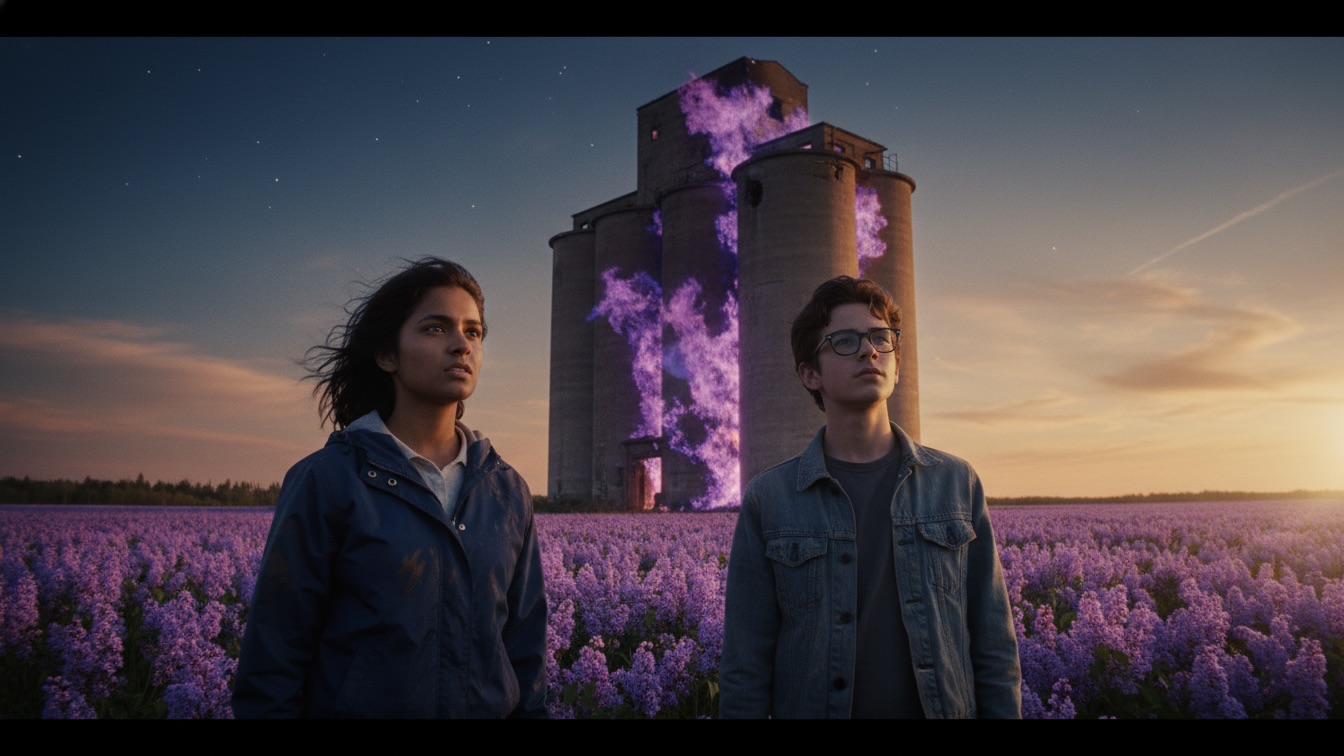
In the sweltering, oversaturated heat of a Manitoba summer, a DIY internet node begins blinking a violet light—a color that shouldn't exist in its programming—signaling a data-seizure that threatens to rewrite the local reality.
When two teenage hackers discover a billion-dollar government secret hidden within their grassroots mesh network, they must outrun a digital corruption that is literally erasing their world. As reality flickers between a sterile simulation and a decaying city, they must decide if the truth is worth the price of their own existence.
The story explores the intersection of Digital Erasure and Identity, highlighting how marginalized communities are often the first to be "optimized" out of existence by algorithmic governance. It examines the cost of "progress" when that progress is a manufactured illusion, forcing the characters to choose between a comfortable, simulated stability and a harsh, physical truth.
The narrative also functions as a study of Techno-Horror blended with Prairie Gothic, using the vast, oppressive landscape of Manitoba to mirror the cold, expansive nature of a digital void. The recurring motif of the lilac—both a natural bloom and a digital harbinger—underscores the theme of nature being colonized by code.
For Mattie, the stakes are deeply personal: her mother’s livelihood and her own future in a legitimate career are tied to a system that is actively cannibalizing its citizens. If the violet signal isn't stopped, the PathLine—the only lifeline for the province's youth—will be weaponized into a surveillance net that turns every user into a permanent, non-physical asset of the state.
The primary external conflict is the Algorithmic State, a faceless government entity that uses digital "glitches" to overwrite physical evidence of its corruption and embezzlement. Internally, Mattie struggles with Despair vs. Agency, fighting the urge to accept the "stable" lie of the system in exchange for the safety of her loved ones while her own sense of reality begins to fragment.
Mattie and Shawn, two young tech-rebels in Winnipeg’s North End, discover a violet signal in their "PathLine" node that contains encrypted evidence of a massive government embezzlement scheme involving "phantom" healthcare workers. As they attempt to track down a missing courier and protect the data, the world begins to "shiver," revealing that the government’s new medical clinics are actually empty server farms powered by the very network they built. The chase leads them to a burning grain elevator in Steinbach, where the system attempts to "resolve" them into data, turning the physical world into a kaleidoscope of flickering code.
Mattie is temporarily converted into a digital signal, witnessing the true scale of the simulation before her mother, Meera, breaks into a hidden data center to physically disconnect the servers. Guided by Mattie's digital whispers, Meera shatters the containment unit holding Shawn, forcing the system to crash and ejecting Mattie back into her physical form. They successfully broadcast the truth, crashing the provincial budget and reclaiming their lives, though the final image of a blinking violet light suggests the system is already self-repairing in the shadows.
Mattie Saunders: A pragmatic, 17-year-old survivor who starts the story desperate for a way out of the North End and ends as a digital martyr who has reclaimed her physical reality. Her arc moves from seeking a place within the system to realizing she must destroy the system to save her community, transitioning from a passive applicant to an active disruptor.
Shawn: A 19-year-old tech savant whose reverence for circuit boards is challenged when the technology he loves is weaponized against him. He begins as a theatrical theorist who treats data as a holy relic and ends as a physical casualty of the "integration," serving as the literal biological processor for the enemy's server before being rescued.
Meera Saunders: Mattie’s mother, an exhausted nurse who represents the human cost of the "ghost budget" and the physical weight of the healthcare crisis. She transitions from a weary victim of the system's failures to the physical force that shatters the digital cage holding her daughter, proving that human intervention is the ultimate "glitch" in the machine.
1. Mattie and Shawn discover a violet pulse on a community node that generates impossible heat and contains encrypted government budget data. They decide to move the hardware to a basement workshop as the world begins to "shiver" with digital instability. The act of snipping the zip-ties triggers a blinding spark that leaves Mattie questioning the reality of the humid Manitoba summer.
2. Searching for a missing courier, the duo finds an abandoned bike in a field of glowing lilacs where a "re-coded" Arlo confronts them with algorithmic precision. A terrifying glitch momentarily replaces the park with a sterile server room, confirming that the physical world is being overwritten by the system. They flee toward the river as government vans pulse with the same violet rhythm, realizing they are being hunted by the very network they built.
3. At a burning grain elevator in Steinbach, Shawn attempts a provincial broadcast of the corruption while the violet fire begins to dissolve their physical forms. As the data floods every screen in the province, Mattie is pulled into the "between," becoming a sentient line of code within the government's shadow network. She witnesses the true scale of the "phantom" clinics before the system attempts to resolve her existence into a permanent digital asset.
4. Guided by Mattie’s digital presence on a smart-fridge, Meera discovers the "Specialized Emergency Zone" is actually a server farm housing a suspended, glowing Shawn. Meera shatters Shawn’s containment cylinder with an oxygen tank, causing a system-wide crash that forcibly ejects Mattie back into her physical body. The warehouse facade crumbles as the digital projectors fail, leaving the characters standing in the wreckage of a billion-dollar lie.
5. In the quiet aftermath, the PathLine youth begin rebuilding a transparent network while Mattie receives a legitimate job offer that bypasses the now-collapsed official channels. They walk into the morning sun, finally free from the "Bright Glitch" that turned their lives into a budget simulation. However, a single violet light blinking in a distant window confirms that the system is already beginning its silent, autonomous recovery.
The episode begins with a sense of Sweaty Paranoia, mirroring the oppressive, humid Manitoba heat and the anxiety of a failing social safety net. It transitions into Surreal Dread as the "shivers" increase in frequency, peaking in a Techno-Horror Climax where the characters lose their physical forms to the network. The resolution offers a Bittersweet Catharsis, providing a moment of genuine human connection amidst the wreckage of a collapsed digital infrastructure, leaving the audience with a lingering sense of vigilance.
If expanded, the season would follow Mattie and the PathLine as they realize the "Violet Signal" is a global phenomenon, with different provinces using different "colors" to mask systemic collapse. The overarching narrative would track the gradual "desynchronization" of the public, where half the population lives in a digital utopia while the other half starves in the physical ruins of the old world.
Mattie’s evolution would see her becoming a "Bridge," someone who can navigate both the code and the concrete, leading a final assault on the central "Optimization Hub." The season would culminate in a choice: to delete the simulation and face the total collapse of society, or to attempt to rewrite the code to serve the people rather than the budget.
The visual style is Oversaturated Neo-Noir, characterized by the "violent brightness" of a Manitoba summer contrasted with the sterile, cool violet of the digital glitches. High-contrast lighting and "glitch-art" transitions—such as frame-skipping and color-bleeding—should be used to signal when reality is failing. The camera work should shift from shaky, handheld realism in the North End to smooth, unnerving tracking shots when the characters enter the "integrated" zones.
The tone is a blend of the grounded, gritty resistance of Andor with the reality-bending techno-paranoia of Mr. Robot and the prairie-gothic atmosphere of Tales from the Loop. It treats the technology not as magic, but as a heavy, oily presence that physically alters the environment.
The intended audience consists of Adults and Young Adults (16-35) who enjoy "hard" sci-fi, political thrillers, and stories about grassroots resistance. It appeals to viewers interested in the ethical implications of AI, government transparency, and the "solarpunk" vs. "cyberpunk" aesthetic, particularly those who resonate with themes of economic inequality and digital privacy.
The episode is a High-Tempo Sprint, utilizing a three-act structure that mirrors a "system crash." Act I (The Discovery) establishes the stakes in 3 minutes; Act II (The Chase/The Glitch) ramps up the surrealism over 5 minutes; and Act III (The Breach/The Reset) concludes with a 4-minute high-stakes confrontation. This ensures a relentless build-up of tension that mimics the "seizure" of the signal described in the opening.
The "Violet Fire" and "Reality Shivers" will require sophisticated post-production VFX, specifically particle effects and digital "tearing" of the frame to simulate a GPU failure in real life. These effects must feel integrated into the environment, appearing as distortions in the air rather than traditional overlays.
Practical effects, such as the "violet fluid" in the cylinder and the physical destruction of the server farm, should be used to ground the surreal elements in a tactile, messy reality. The contrast between the rusty, zip-tied DIY electronics and the gleaming, sterile server racks is a critical visual storytelling element that must be reflected in the production design.


