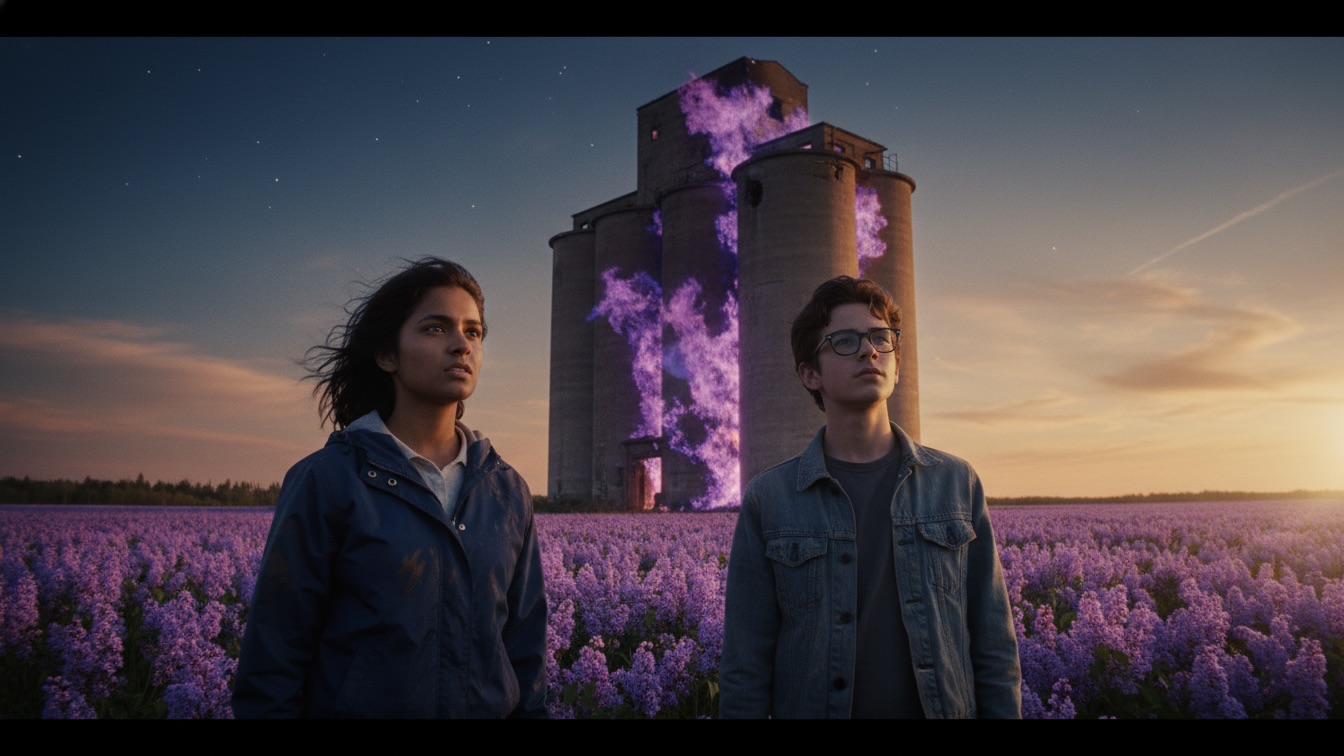
In the sweltering summer of 2026, Mattie Saunders and her friend Shawn discover a mysterious violet signal emanating from a node in their DIY mesh network, PathLine. This network, intended to help local youth bypass broken government systems, has inadvertently captured a "budget ghost"—a billion-dollar string of fraudulent data used to justify government spending on non-existent healthcare expansions. As they investigate, they realize the "Bright Glitch" affecting the province is not a mere technical error but a systemic manipulation of reality itself.
Their journey takes them from the humid streets of Winnipeg to a burning grain elevator in Steinbach, where they attempt to broadcast the truth to the public. During this confrontation, the system retaliates, absorbing Mattie and Shawn into the digital infrastructure as data packets. Mattie’s mother, Meera, eventually discovers them in a secret data center disguised as a medical clinic. Through a desperate act of physical destruction, Meera breaks the glass containment, allowing Mattie and Shawn to return to their physical forms and effectively de-authenticating the corrupt provincial budget.
The central theme of the narrative revolves around the erosion of objective truth in a hyper-digitized society. The government does not merely lie through rhetoric; it uses the very architecture of the digital world to "edit the map" and create phantom workforces. This suggests a terrifying evolution of bureaucracy where data is prioritized over human presence. The billion-dollar budget becomes a sentient force that attempts to overwrite the physical struggles of people like Meera and Mattie.
Another prominent theme is the intersection of nature and technology, symbolized by the cloying scent of lilacs and the oppressive heat. The "Bright Glitch" is portrayed as a biological fever affecting the landscape, suggesting that systemic corruption has a visceral, environmental impact. The violet light serves as a recurring motif for this intrusion, representing a frequency that is neither natural nor humanly programmed. It acts as a visual marker for the moments when the artificial world attempts to consume the organic one.
The story also explores the concept of youth-led resistance through the "PathLine" network. This shadow infrastructure represents a reclamation of agency in a world that has discarded the younger generation. However, the narrative warns that even the tools of rebellion can be co-opted by the systems they oppose. The realization that the government used the PathLine nodes to move shadow money highlights the difficulty of achieving true independence from a pervasive, algorithmic authority.
Finally, the narrative touches upon the psychological weight of hope based on deception. Mattie notes that her mother’s hope is fueled by a "billion-dollar hallucination," suggesting that systemic lies provide a fragile scaffolding for human survival. When the truth is finally revealed through the broadcast, it is both a liberation and a trauma. The ending suggests that while the "Bright Glitch" has been defeated, the surveillance state remains an ever-present, blinking light in the periphery of their lives.
Mattie is a character defined by her pragmatic resilience and a deep-seated protective instinct toward her mother. She operates with a sharp, cynical clarity that allows her to navigate the "labyrinth of half-finished wards" and digital graveyards of the official world. Her motivation is not purely political; it is personal, driven by her desire for a legitimate future in a medical lab tech program. She views the PathLine as a tool for survival rather than just a hobby, making her the grounding force of the duo.
Psychologically, Mattie undergoes a profound transformation when she is converted into a digital signal. This experience represents the ultimate loss of her physical autonomy, forcing her to find a new way to exert her will through "unexpected" sensory data. Her ability to fight back using the memory of her mother’s tea and the smell of lilacs shows that her humanity is her strongest asset. She refuses to be reduced to a "line of code," and her return to a "heavy, sweating reality" is a hard-won victory for the individual over the system.
Shawn serves as the intellectual and theatrical counterpart to Mattie’s pragmatism. He treats circuit boards like "holy relics," finding a sense of order and sanctity in technology that the physical world lacks. His tendency toward theatrical whispers and dramatic observations acts as a psychological defense mechanism against the harsh, humid reality of his environment. He is a transplant seeking purpose, and he finds it in the "sanctuary of silence" provided by air-gapped repositories.
His arc takes a dark turn when he is integrated into the system as its "processor" within the violet fluid cylinder. This is a tragic fulfillment of his tech-obsessed identity, as he literally becomes the heart of the network he once worshipped. Even in this state, his desire to "break the budget" remains his core directive. When he is finally freed, he immediately returns to his tools, suggesting that his relationship with technology is an inseparable part of his psyche, despite the trauma he endured.
Meera represents the exhausted, physical labor that keeps the world running while the government plays with digital phantoms. As a nurse working sixteen-hour shifts in a crumbling system, she is the primary victim of the budget’s deception. She is an anchor for Mattie, providing the emotional stakes for the entire mission. Her red-rimmed eyes and swollen ankles are the physical evidence of a system that has failed its most essential workers.
Despite her exhaustion, Meera proves to be a woman of decisive action when the digital veil is lifted. She does not hesitate to use a physical object—the oxygen tank—to shatter the high-tech prison holding her daughter and Shawn. This act symbolizes the triumph of maternal instinct and physical reality over algorithmic control. She is the one who pulls Mattie back into the world, reaffirming the importance of human touch in a landscape dominated by flickering screens.
Arlo functions as a cautionary figure, demonstrating how the system can "hard-code" a person into a deterrent. When he first encounters Mattie and Shawn at the park, his "algorithmic" cadence reveals that he has been temporarily hollowed out by the mesh. He is no longer a friend but a "relay," a mouthpiece for a system that requires its "heart back." This possession highlights the invasive nature of the violet signal, which can rewrite human personality to suit its needs.
Once the system is de-authenticated, Arlo returns to his true self, complete with messy hair and grease-stained skin. His restoration signifies the end of the "Bright Glitch" and the return of human agency. He takes on a leadership role at the end, suggesting a shift from shadow networks to a more open form of community building. His "small, theatrical smile" at the end mirrors Shawn’s earlier behavior, hinting at a shared bond formed through their technical rebellion.
The pacing of the story mirrors the frantic, erratic nature of the "violet signal" itself. It begins with a slow, heavy atmosphere dominated by the "physical weight" of the Manitoba sun, establishing a sense of dread and stagnation. As the mystery of the node unfolds, the narrative tension accelerates, culminating in the "data-storm" at the grain elevator. The final chapters transition into a surreal, high-frequency hum as Mattie experiences the world as data, before crashing back into a grounded, physical resolution.
The tone is one of "oversaturated brightness," where everything feels too sharp and edges seem to hum. This creates a sensory experience for the reader that is both vivid and uncomfortable, reflecting the characters' own disorientation. The author uses metallic and industrial imagery—"rusty downspouts," "metallic tang," and "hollowed-out skulls" of old monitors—to contrast with the cloying, "suffocating" presence of the lilacs. This juxtaposition emphasizes the conflict between the decaying physical world and the burgeoning, artificial digital world.
The narrative voice relies heavily on sensory details to bridge the gap between the technical and the emotional. Words like "bleeding," "seizure," and "neon blood" are used to describe digital processes, effectively personifying the technology. This linguistic choice makes the "PathLine" feel like a living organism that can be wounded or infected. The final image of the blinking violet light in the farmhouse window serves as a stylistic "stinger," maintaining the story’s underlying sense of unease even after the primary conflict is resolved.


