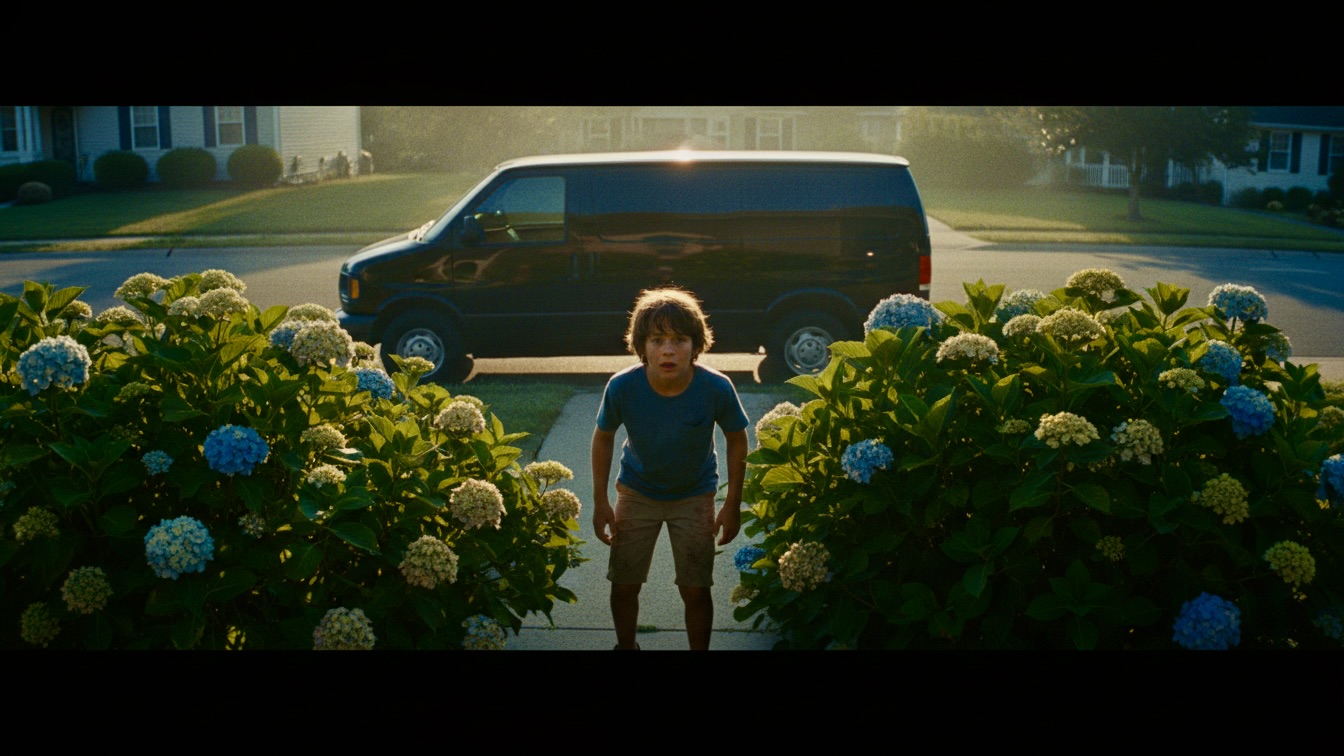
Leo notices his father’s growing fear as a mysterious device appears on their router during a blistering summer heatwave.
The sun was already a hammer at eight in the morning. It beat against the kitchen window, turning the glass into a heater. I sat at the table, my cereal turning into a soggy mush of sugar and milk. My dad, David, was doing his usual thing. He had the newspaper spread out, but he wasn't really reading it. He was folding it. Over and over. He’d make a crease, smooth it with his thumb, then unfold it and start again. His hands were shaking just a little bit. Not like he was cold—it was ninety degrees—but like he was holding onto a vibrating phone that wouldn't stop buzzing. My mom was on her tablet, her thumb flicking fast across the screen. Her face was tight, the way it gets when she’s trying to solve a puzzle that’s missing three pieces.
"The government wants more access," Dad said. He didn't look up. He just kept folding that paper. "Timely access. That’s what they call it. Like it’s a pizza delivery or something. Just a quick peek at everything you do online, for your own safety."
Mom didn't look up either. "They’re appealing the ruling on the Emergencies Act, David. They think they were right to do it. They’ll always think they were right."
I watched a fly buzz against the window screen. It was desperate to get out into the heat, which seemed crazy to me. Inside was air conditioning. Outside was a furnace. But the fly didn't care. It just wanted to be somewhere else. I felt a bit like that fly. The kitchen felt small. The whole house felt small. It was like the walls were leaning in, trying to hear what we were saying. I looked at my tablet lying next to my bowl. The little green light at the top—the one that says the camera is off—flickered. Just for a second. It turned red, then back to green. My stomach did a slow roll, like a gymnast who forgot how to land.
"Dad?" I said. My voice sounded thin in the quiet room.
"Yeah, Leo?" He finally stopped folding the paper. He looked at me, but his eyes were focusing on something behind me, like he was checking the shadows in the hallway.
"You always say you voted for stability," I said. I’d heard him say it a thousand times to the neighbors, to my uncles, to the guy who fixes the furnace. "But if they can just freeze people’s bank accounts because they’re protesting... what happens when they don't like what we say? Like, what if we complain about how much the rent is? Or how long it takes to see a doctor? Do they just turn off our money then too?"
Dad didn't answer right away. He looked at Mom. She stopped flicking her screen. The only sound was the hum of the fridge, which sounded louder than usual, like it was a jet engine getting ready for takeoff. Dad reached out and touched my hand. His palm was sweaty. He looked at my tablet, then at the smart speaker sitting on the counter. He leaned in closer, lowering his voice until it was barely a whisper.
"I don't know, Leo," he said. "I really don't know anymore. I thought there were rules. I thought the social contract meant we all agreed on the boundaries. But the boundaries keep moving. It’s like playing soccer and someone keeps picking up the goals and running away with them."
"That’s cheating," I said.
"It’s not cheating if you’re the one who writes the rulebook," he replied. He stood up abruptly, his chair screeching against the linoleum. The sound made me jump. He walked over to the sink and poured his coffee out. It was a full cup. He hadn't even taken a sip. He stood there staring at the drain, watching the brown liquid swirl away. Outside, a black van crawled down our street. It was moving so slowly that it barely made a sound. It didn't have any markings on it. No 'Joe’s Plumbing' or 'Super Fast Internet.' Just shiny black paint that reflected the summer sun like a mirror.
I watched it through the gap in the curtains. My heart started thumping against my ribs, a fast, frantic rhythm. The van stopped in front of the Miller’s house across the street, then crawled another ten feet and stopped again. It was right in front of our driveway now. The windows were tinted so dark you couldn't see who was inside. It just sat there, idling. A thin wisp of exhaust rose into the shimmering air.
"Dad, there’s a van," I whispered.
He didn't move for a second. Then, he slowly turned his head. He didn't walk to the window. He stayed by the sink, but I could see his reflection in the toaster. He looked scared. My dad, who isn't scared of spiders or thunderstorms or the weird noises the basement makes at night, looked like he wanted to hide under the table.
"Probably just Amazon," Mom said, though she didn't sound like she believed it. She was looking at the van now too, her tablet forgotten on the placemat. "They’re always delivering stuff."
"At eight a.m. on a Saturday?" I asked. "In a van with no logo?"
"Don't point, Leo," Dad said sharply. "Just... come away from the window. Go play in the basement. It’s cooler down there."
"I want to see what they’re doing," I said. I felt a surge of that weird energy you get right before a race. My legs wanted to run, but my brain wanted to stay and solve the mystery. Why was my dad acting like the secret police were outside? This was Ottawa. This was the suburbs. We had a lawn that needed mowing and a mailbox that only ever had bills and pizza coupons in it.
I backed away from the window anyway. I picked up my tablet. The light was green again. Solid green. But I didn't trust it. I put a piece of blue painter’s tape over the lens. If they were watching, they were going to see a lot of blue and nothing else. I headed for the basement door, my socks sliding on the wood floor. I could hear my parents starting to argue in low, hissed voices behind me. It wasn't a mean argument. It was a worried one. The kind where they’re both on the same side but they don't know what the side is anymore.
The basement was a different world. It smelled like laundry detergent and old cardboard. It was at least ten degrees cooler, but it didn't feel better. It felt heavy. I walked past the big chest freezer and the shelves full of emergency water jugs Dad started buying last month. I went to the corner where the router lived. It’s a messy tangle of black wires and glowing lights that usually looks like a sleeping robot. But today, something was different. There was a new box. It was small, no bigger than a pack of cards, and it was plugged directly into the back of our internet router. It didn't have a brand name on it. It just had one single, tiny red light that pulsed like a heartbeat.
I knelt down on the cold concrete. My knees hurt, but I didn't care. I traced the wire from the little box to the router. It was a professional job. The wire was zip-tied to the others, hidden behind the main power cord. I didn't remember the internet guy coming over. I didn't remember Dad saying anything about an upgrade. I reached out a finger to touch it. The plastic was warm. Not hot, but warm enough to know it was working hard. It hummed. A very low frequency that you could feel in your teeth more than you could hear with your ears.
"What are you doing?" a voice jumped out of the dark.
I screamed and fell over, hitting my elbow on a box of Christmas decorations. My sister, Maya, was standing by the laundry machine. She’s fourteen and thinks she’s a ninja. She was wearing her oversized hoodie even though it was a billion degrees outside. She had her phone out, recording me.
"Shut up, Maya!" I hissed, rubbing my elbow. "You almost gave me a heart attack."
"You’re being weird," she said, lowering her phone. "Why are you sniffing the router?"
"I’m not sniffing it. Look at this." I pointed to the little black box. "Did Dad put this here?"
Maya leaned over, her long hair falling over her shoulder. She squinted at the pulsing red light. "I don't think so. Dad can barely figure out how to reset the Netflix password. He wouldn't know how to bridge a connection like that."
"Then who did?" I asked. "The black van is outside."
Maya’s face went pale. She stopped acting like a cool teenager and started looking like a kid who just realized the floor is actually lava. "The van? The one from the news?"
"What news?" I scrambled up. "I haven't seen anything on the news."
"They’re calling it 'Data Integration'," Maya whispered. She sat down on a pile of folded towels. "They’re putting these nodes in houses in 'high-interest' neighborhoods. It’s supposed to help prevent cyber-attacks or something. But some people say it’s just a way to mirror everything on the local network before it even gets encrypted."
"Mirror it?" I felt a chill that had nothing to do with the air conditioning. "You mean they’re seeing my texts? And Dad’s spreadsheets? And your TikToks?"
"Everything," Maya said. "If it’s on the Wi-Fi, it goes through that box. And if that box is plugged into the main line, it’s like having a spy sitting in our living room."
I looked at the red light. It blinked. Blip. Blip. Blip. It felt like it was mocking me. I reached for the wire, my fingers inches away from pulling it out. If I unplugged it, maybe the spy would go blind. Maybe the van would drive away. Maybe Dad would stop shaking.
"Don't!" Maya grabbed my wrist. Her grip was surprisingly strong. "If you unplug it, an alert goes off. That’s what the forums say. They’ll know we tampered with it. They’ll come to the door, Leo. Do you want them coming to the door?"
I looked at her. Her eyes were wide and full of a kind of fear I’d never seen in her. Maya was the one who climbed the big oak tree in the park. Maya was the one who stood up to the eighth-grade bullies. If she was scared of a little black box, I should be terrified.
"We have to tell Dad," I said.
"He knows," Maya whispered. "I saw him looking at the router last night. He was just standing here in the dark, staring at that red light. He didn't touch it. He just watched it. He looked like he was at a funeral."
I thought about Dad folding the newspaper. The stability he wanted was gone. It had been replaced by a pulsing red light in our basement. The silence in the house suddenly felt heavy, like we were underwater. I could hear the washing machine starting its spin cycle upstairs, the vibration traveling through the floorboards. It felt like the house was trying to shake itself apart.
"We have to find out what it’s sending," I said. I felt a spark of something—not just fear, but a need to do something. I was twelve. I was fast. I knew how to use a computer better than most adults. "If it’s a mirror, there’s a destination. An IP address. We can track it."
"Leo, don't be a hero," Maya said. "This isn't a movie. This is real life. Real life is when people get their accounts frozen and can't buy groceries."
"I’m not being a hero," I said, even though my heart was racing. "I’m being a detective. There’s a difference. Heroes get medals. Detectives get answers."
I sat down at the old desktop computer we keep in the basement for homework. It was slow, and the monitor had a scratch across the middle, but it was hard-wired to the router. It didn't use the Wi-Fi. It was the only thing that might be invisible to the little black box. I hit the power button and waited for the long, agonizing groan of the hard drive spinning up. I had to know. I had to know why my dad was losing his mind and why a black van was parked in our sun-drenched street.
The computer screen flickered to life, casting a ghostly blue glow over the basement. I opened a terminal window, my fingers flying over the keys. I wasn't an expert, but I’d spent enough time on coding forums to know the basics of a network scan. I typed in the command to list all the devices on our local network. The list popped up, scrolling down the screen in green text. There was my tablet (listed as 'Leo-Tab-Blue-Tape'), Maya’s phone, Mom’s laptop, the smart fridge, and the smart speaker. And then, at the very bottom, a device with no name. Just a string of numbers and letters that looked like a secret code.
"There it is," I whispered. "Device 0x4A-99-BC."
"What’s it doing?" Maya leaned in, her breath smelling like the mint tea she drinks.
"It’s sending packets," I said, watching the data stream. "A lot of them. Every time you move your mouse or I type a letter, it sends a tiny burst of data to an external server."
"Where?"
I ran a trace-route command. I watched as the data hopped from our house to the local exchange, then to a massive server farm downtown, and then... it disappeared. It hit a firewall that was like a brick wall made of titanium. I couldn't go any further. I was stuck outside the gates, looking in.
"I need a better view," I said. "I’m going outside."
"Are you crazy?" Maya hissed. "The van is out there!"
"I’m going out the back," I said. "Through the doggy door."
"We don't have a dog, Leo."
"I know, but the hole is still there from when we moved in. It’s covered by a piece of plywood. I can squeeze through."
I didn't wait for her to argue. I scrambled over to the small utility window near the ceiling of the basement. I pushed it open. It groaned, a sound that felt like a siren in the quiet house. I pulled myself up, my sneakers kicking against the concrete wall, and wriggled through the narrow gap. I landed in the dirt behind the hydrangea bushes. The heat hit me like a physical punch. The air was thick and tasted like dry grass and car exhaust.
I stayed low, crawling through the mulch. My hands got stained dark brown, and a spider scurried over my knuckles, but I didn't make a sound. I reached the edge of the house and peeked around the corner. The black van was still there. It hadn't moved an inch. But now, the driver’s side window was cracked open just a tiny bit. I could see the glint of a lens. Someone was taking pictures of our house. Not just the house—they were focusing on the front door.
I looked over at the neighbor’s yard. Mrs. Gable, who is ninety years old and has about fifty cats, was sitting on her porch. She had her big bird-watching binoculars out. She wasn't looking at birds. She was looking at the van. Her face was twisted into a scowl that could peel paint. She saw me peeking from behind the hydrangeas and waved me over with a frantic, jerky motion.
I stayed low and sprinted across the gap between our houses, diving behind her porch swing. I was sweating so much my shirt was sticking to my back.
"Mrs. Gable?" I whispered.
"They’ve been there for three hours," she croaked. She didn't look at me; she kept her binoculars glued to the van. "They think they’re being subtle. They’re about as subtle as a neon sign in a graveyard."
"Who are they?" I asked.
"The ones who want to know everything," she said. "I remember them from when I was a girl, back in the old country. They start with the lists. Then they start with the questions. Then the vans show up. It always starts with a 'crisis'."
"But this is Canada," I said. It felt like a weak argument.
"Geography doesn't change human nature, Leo," she said, finally lowering the binoculars. Her eyes were sharp and bright, like two polished stones. "They’re looking for your father. They’ve been flagging his searches. He’s been looking up things he shouldn't."
"Like what? He’s an accountant! He looks up tax codes and the price of gas!"
"He’s been looking up the law," Mrs. Gable said. "He’s been looking up how to protect his savings. He’s been looking up what his rights are if the 'stability' he loves so much decides he’s no longer stable enough. To them, that’s a red flag. A person who knows their rights is a person who is hard to manage."
My stomach dropped. Dad wasn't just being paranoid. He was being targeted. For being a regular guy who was starting to ask questions. I looked back at our house. It looked so normal. The white siding, the flower pots Mom spent all spring planting, the basketball hoop with the frayed net. It looked like a happy home. But inside, there was a red light blinking in the basement, and outside, there was a man with a camera in a black van.
"What do I do?" I asked.
Mrs. Gable reached into her pocket and pulled out a small, silver thumb drive. It was scratched and old, but she held it like it was made of gold. "Take this. It has a program on it. It’s a ghost. If you plug it into that little box in your basement, it will feed them junk data. It will make them think your father is searching for recipes for apple pie and watching videos of kittens for the next ten years. It won't stop them forever, but it will buy you time."
"Why do you have this?" I asked, staring at the drive.
"Because I’m a bird-watcher," she said with a tiny, sharp smile. "And sometimes, you have to know how to hide the nest."
I took the drive. It felt heavy in my palm. "Thank you, Mrs. Gable."
"Go," she whispered. "And tell your father to stop folding the paper. It’s a dead giveaway that he’s nervous. Tell him to start acting like a man who has nothing to hide, even if he’s hiding the truth."
I nodded and crawled back toward my house. The heat was shimmering off the pavement now, making the black van look like a ghost. I felt like I was in a movie, but there was no music, and my heart was beating too fast for a hero. I was just a kid in a sweaty T-shirt trying to save his dad from a red light.
I scrambled back through the utility window, my heart hammering against my ribs like a trapped bird. I didn't care about the dirt on my knees or the spider web in my hair. I had the drive. I had the 'ghost'. I dropped onto the basement floor and saw Maya still sitting by the computer. She looked like she’d aged five years in the ten minutes I’d been gone.
"Leo!" she gasped. "Dad’s coming down. He’s looking for you."
"I have it," I whispered, showing her the thumb drive. "Mrs. Gable gave it to me. It’s a ghost program."
Maya’s eyes went wide. "Mrs. Gable? The cat lady?"
"She’s more than a cat lady, Maya. Trust me."
I ran to the router. The red light was still pulsing. Blip. Blip. Blip. It felt like it was counting down to something. I looked at the little black box. There was a tiny USB port on the side, hidden under a rubber flap. My hands were shaking so hard I almost dropped the drive. I took a deep breath, trying to steady myself. I could hear Dad’s footsteps on the stairs. He was moving slowly, his heavy boots thudding on the wood.
"Leo? Maya? Are you down there?" his voice called out. He sounded tired. Exhausted. Like he’d been carrying a mountain on his back all morning.
"We’re here, Dad!" I yelled back, trying to sound normal. My voice cracked.
I jammed the thumb drive into the port. For a second, nothing happened. Then, the red light turned orange. It flickered rapidly, a frantic strobe effect that made the shadows in the basement dance. On the computer screen, the data stream suddenly went crazy. The green text was replaced by a flood of nonsense. It looked like a cat had walked across a keyboard made of light.
"What did you do?" Maya whispered, leaning over the monitor.
"I fed it the ghost," I said.
Suddenly, the screen changed. A window popped up. It wasn't the data stream anymore. It was a bank statement. My dad’s bank statement. I saw the numbers—the mortgage payment, the grocery bill, the savings for my college. And then, at the very bottom, in bright red letters, it said: ACCOUNT STATUS: PENDING REVIEW. FLAG: CIVIC DISILLUSIONMENT.
My breath caught in my throat. They were already doing it. They were getting ready to freeze his money because he was 'disillusioned'. Because he wasn't happy with the way things were going.
"Pending review?" Maya breathed. "That means they can just... stop it?"
"Not if the data is junk," I said. I watched the program Mrs. Gable gave me work its magic. The 'Pending' status started to flicker. The words shifted and changed. The flag disappeared. In its place, the screen showed a series of mundane searches: 'How to bake a pie', 'Best lawn mowers 2026', 'Ottawa Senators schedule'.
Dad stepped into the basement. He looked at us, then at the computer. He saw the bank statement before I could close the window. He froze. The color drained from his face until he looked like a statue made of salt. He walked over, his eyes fixed on the screen.
"Leo..." he said softly. "What is this?"
"It’s okay, Dad," I said, standing up. I felt taller than I did ten minutes ago. "The ghost is in the machine. Mrs. Gable helped."
Dad looked at the little black box with the orange light. He looked at the bank statement, which now showed he was just a guy interested in hockey and pies. He sat down in the old office chair and put his head in his hands. He didn't say anything for a long time. The only sound was the hum of the 'ghost' working.
"I just wanted stability," he whispered into his palms. "That’s all. I just wanted a world that made sense."
"The world doesn't make sense anymore, Dad," Maya said, sitting on the arm of his chair. "But we’re still here. And we’re faster than they are."
Dad looked up. He looked at me, then at Maya. For the first time all day, the shaking in his hands stopped. He reached out and touched the computer screen, his finger tracing the words 'Account Status: Active'.
"You kids," he said, a tiny smile tugging at the corner of his mouth. "You’re going to get us into a lot of trouble."
"Or we’re going to get us out of it," I said.
Outside, I heard the sound of an engine starting. I ran to the utility window and peeked out. The black van was pulling away. It drove slowly, just like before, but this time it didn't stop. It turned the corner and disappeared. The street was empty again, just the shimmering heat and the sound of a lawn mower in the distance.
"It’s gone," I said, turning back to the room.
But I knew it wasn't really gone. There would be other vans. There would be other red lights. The social contract was frayed, and the pieces were falling on the floor. I looked at the thumb drive still plugged into the box. It was a small victory, but it felt like a start.
"Dad?" I asked.
"Yes, Leo?"
"What are we going to do now?"
Dad stood up. He looked around the basement, then up at the ceiling, toward the rest of the house. He looked like he was seeing it for the first time—not as a fortress, but as a place that needed to be protected.
"First," he said, his voice firm and clear. "We’re going to have breakfast. Real breakfast. No more burnt toast. And then... we’re going to talk. Really talk. Without the phones. Without the tablets. Just us."
"And then?" Maya asked.
Dad looked at the router one last time. "And then, I think I need to go visit Mrs. Gable. I have a feeling she knows a lot more than just how to watch birds."
I smiled. The summer heat was still there, and the world was still a confusing, scary place, but for the first time in a long time, I didn't feel like a fly hitting a window. I felt like I was finally outside.
I reached for the computer mouse, but then I stopped. I didn't need the screen. I needed to be with my family. We walked upstairs together, the three of us, leaving the little orange light to keep its secret in the dark.
“As we sat down to eat, I noticed the smart speaker’s light blink once, twice, and then turn a solid, unblinking blue.”


