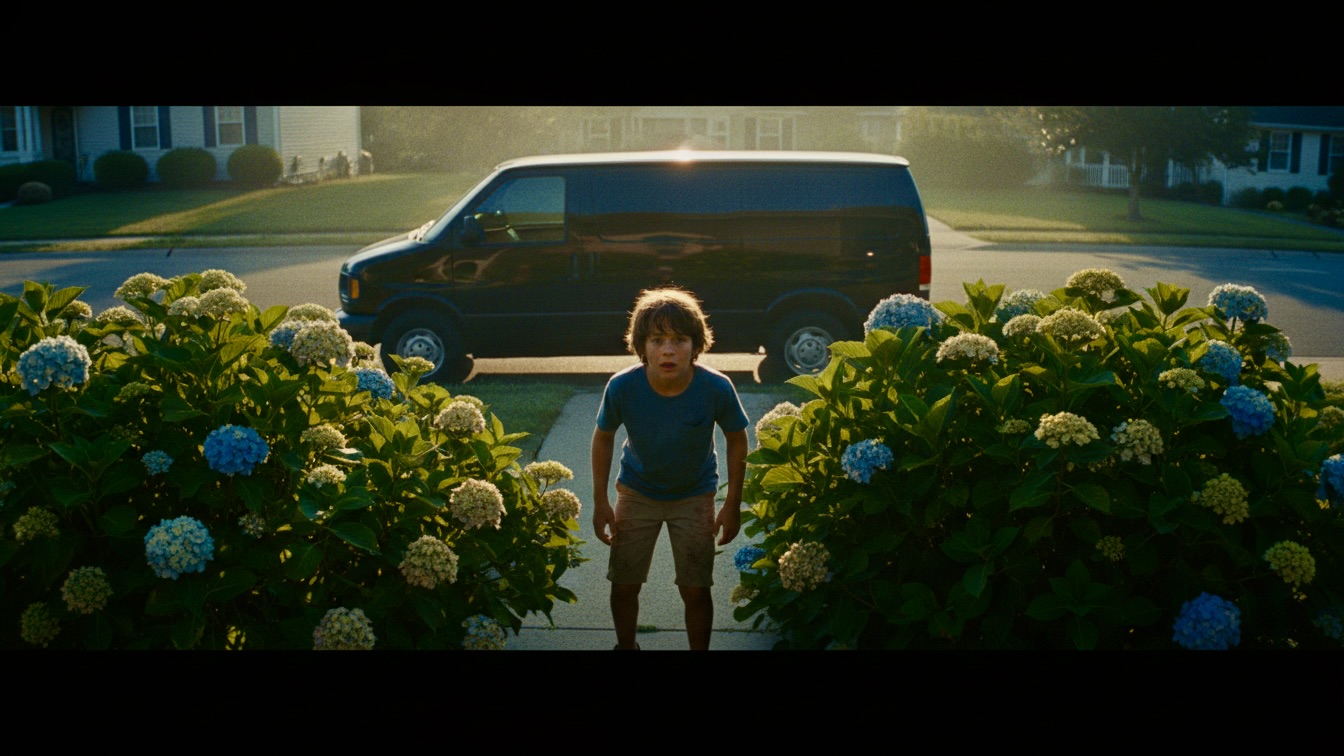
The story opens in a tension-filled kitchen where the oppressive summer heat serves as a metaphor for the mounting political pressure felt by the family. Leo, a twelve-year-old boy, observes his father, David, exhibiting signs of extreme anxiety as they discuss the government’s increasing encroachment on privacy and the freezing of bank accounts. This domestic unease escalates when Leo notices a black, unmarked van idling outside their home and discovers a mysterious surveillance "node" attached to their router in the basement.
Accompanied by his older sister, Maya, Leo learns that the device is part of a "Data Integration" program designed to monitor all household internet traffic. Driven by a need for answers, Leo sneaks out of the house to speak with their elderly neighbor, Mrs. Gable, who reveals she has seen such patterns of surveillance before in her youth. She provides Leo with a "ghost" thumb drive designed to feed the surveillance device junk data, masking his father's activities.
Leo successfully installs the drive just as his father enters the basement, discovering that his bank account has already been flagged for "civic disillusionment." The "ghost" program successfully clears the flag by replacing David's search history with mundane topics, causing the surveillance van to depart. The chapter concludes with a shift in the family dynamic, as David decides to abandon his fearful silence in favor of open, honest communication with his children.
The central theme of the narrative is the erosion of the social contract and the subsequent psychological impact of state surveillance. David’s repeated folding of the newspaper symbolizes his desperate attempt to find order in a world where the "boundaries keep moving." The story suggests that when the state breaks its promise of stability, the domestic sphere becomes a site of both trauma and resistance. The "red light" serves as a digital panopticon, a constant reminder that the private thoughts and actions of the citizenry are being judged by an unseen authority.
Another prominent theme is the generational shift in digital literacy and its role in modern resistance. While David is paralyzed by the loss of the world he once understood, his children, Leo and Maya, possess the technical skills to navigate and subvert the systems of control. This highlights a power inversion where the youth become the protectors of the household. Mrs. Gable bridges these generations, offering historical context that suggests surveillance is an old human impulse merely wearing new technological clothes.
The narrative also explores the psychological concept of "civic disillusionment" as a punishable offense. The government in the story does not just monitor illegal acts but tracks the emotional and intellectual state of its citizens. By flagging David for his loss of faith in the system, the state attempts to mandate loyalty through economic coercion. The story posits that in such an environment, the act of maintaining a private internal life becomes a radical form of rebellion.
Leo serves as the perceptive protagonist whose transition from a passive observer to an active agent of resistance drives the plot. Initially, he compares himself to a fly trapped against a screen, illustrating his feeling of helplessness and his desire to escape the stifling atmosphere of his home. His psychological response to the surveillance is one of intense curiosity fueled by a need to regain a sense of safety. Unlike his father, who is frozen by fear, Leo translates his anxiety into a "detective" mindset, using his technological fluency to reclaim power over his environment.
David represents the psychological toll of a collapsing worldview. As an accountant who values "stability," he is suffering from profound cognitive dissonance as the government he once supported begins to treat him as an enemy. His nervous tic of folding the newspaper and his inability to drink his coffee reflect a state of hyper-vigilance and a loss of agency. He is a man who played by the rules only to find that the rules were designed to trap him, leading to a state of "civic disillusionment" that is both a political and a psychological crisis.
Maya acts as the pragmatic realist of the sibling duo, providing the necessary exposition that anchors Leo’s suspicions in a terrifying reality. While she adopts a "ninja" persona to mask her vulnerability, her fear is evident when she realizes the true implications of the "Data Integration" nodes. She serves as a vital collaborator for Leo, offering the caution he lacks while supporting his efforts to subvert the surveillance. Her character highlights the loss of innocence forced upon children who must learn to hide their digital footprints to survive.
Mrs. Gable functions as the "wise elder" archetype, possessing a historical perspective that the other characters lack. Her character suggests that the current technological crisis is a repetition of historical cycles of authoritarianism. She is psychologically resilient, having learned how to "hide the nest" from her past experiences in the "old country." By providing Leo with the "ghost" drive, she passes on the tools of survival, proving that vigilance and wisdom are the most effective counters to state intrusion.
The author employs a heavy, claustrophobic tone that mirrors the sweltering heat of the Ottawa summer. Phrases like "the sun was already a hammer" and the description of the air as a "furnace" create a sensory experience of being trapped. This environmental pressure heightens the psychological tension, making the arrival of the black van feel like an inevitable extension of the weather. The pacing begins as a slow, domestic simmer and accelerates into a high-stakes techno-thriller as Leo moves into the basement and then outside.
The narrative voice is grounded in Leo’s twelve-year-old perspective, which allows for a blend of innocent observation and technical jargon. The use of metaphors, such as comparing the government’s actions to a soccer game where the goals are being moved, makes complex political concepts accessible and emotionally resonant. Sensory details are used effectively to signal danger, particularly the "low frequency" hum of the surveillance box that Leo can feel in his teeth. This detail emphasizes that the surveillance is not just a digital threat but a physical intrusion into the family's space.
The contrast between the "green light" of perceived safety and the "red light" of active monitoring serves as a recurring visual motif. This binary reflects the precarious nature of the characters' lives, where their status can change from "Active" to "Pending Review" in an instant. The story concludes with a shift in imagery, moving from the artificial glow of screens to the prospect of a "real breakfast" and face-to-face conversation. This stylistic choice underscores the narrative’s ultimate message: that human connection and honesty are the only true shields against a system built on observation and control.


