My dad's knee servo clicked like a bad hard drive, but Mom just smiled and handed him a plate.
"Hold the flap down."
"I am holding it."
"You are letting the corner slip. Just press it flat."
"Mom, the adhesive is completely melted. Look at it. It is just liquid."
I dropped the roll of packing tape on the floor. It hit the composite floorboards with a dull thud, right in the center of the clean square where the rug used to be. The rest of the floor was covered in a thin, permanent layer of gray dust, but that one square was pristine. It made the room look broken. Everything was missing, and the empty spaces were louder than the boxes.
August in Northern Ontario was not supposed to feel like an oven. The boreal forest outside our modular window was literally cooking itself alive. The heat was a physical weight in the room, pressing down on my shoulders, making my shirt stick to my spine. There was no air conditioning. The solar grid was running at twenty percent, and we had shut down the climate control two days ago to save power for the transport rover.
Mom wiped her forehead with the back of her wrist. Her hair was stuck to her temples. She looked exhausted, her eyes sunken, but she kept moving. She picked up the tape dispenser, pulling a long strip with a sharp tearing sound. She smoothed it over the cardboard box, her fingers pressing so hard her knuckles turned white.
"We need to finish the kitchen supplies tonight," she said. She did not look at me. She was staring at the box like it held the secret to the universe.
"We do not need to pack the ceramic plates," I said. I wiped my own face. My skin felt gritty. "The mega-city apartments come furnished. The intake email said we get basic rations and dishware. We are just adding weight to the rover."
"They are your grandmother's plates."
"They are heavy."
"We are taking them."
I sighed, letting my head drop back. The ceiling panels were yellowing at the edges. My stomach folded in on itself. I was so tired of this argument. We had been having the exact same fight for three weeks, ever since the evacuation notice came through. The forest fires were fifty miles out, but the heat wave was killing the local ecosystem. The off-grid experiment was over. We had to go back to the concrete.
Footsteps sounded in the hallway. Heavy, uneven footsteps.
Whine. Click. Drag.
My chest tightened. I squeezed my eyes shut for a second, just one second, trying to brace myself.
"Hey, girls."
The voice was wrong. It was pitched a quarter-tone too low, and the syllables dragged. It sounded like a voice note playing on a dying phone.
I opened my eyes. Nano-7 stood in the doorway. He was wearing my dad's old flannel shirt, the red and black plaid one with the frayed cuffs. His synthetic skin was remarkably good—they really nailed the crow's feet around his eyes and the slight crook in his nose—but his posture was entirely ruined. His left shoulder drooped. His right knee was locked at a weird angle.
"Hey, honey," Mom said. Her entire demeanor changed instantly. The tight, stressed lines around her mouth vanished. She smiled. It was a terrifying, bright smile.
"I was checking the perimeter," Nano-7 said. He slurred the word perimeter. It sounded like perim-m-meter. His jaw servo was sticking again. "The temperature is dropping fast. Going to be a cold night."
He was right about that. The extreme heat of the day always snapped into freezing cold the second the sun went down behind the tree line. The atmosphere was completely broken.
"Thank you for checking," Mom said. She walked over to him and put her hand on his chest. Right over the synthetic casing where a heart would be. "Are you hungry? I can heat up some of the rehydrated stew."
My jaw clenched so hard my teeth ached.
"Mom," I said. My voice came out flat. I wanted to scream, but I just sounded dead. "He does not eat."
Mom shot me a glare over her shoulder. "Patti. Do not be rude."
"I am not being rude. I am stating a biological and mechanical fact. He does not have a digestive tract. He is an android."
"He is your father," she snapped. The delusion was a concrete wall. She refused to look at the glitches. She refused to hear the failing servos.
"I could eat," Nano-7 said. He attempted a smile. The left side of his mouth twitched upward, but the right side stayed perfectly still. It looked like he was having a stroke. "Stew sounds great, Annie."
"See?" Mom said, turning back to the kitchen counter. She started pulling out a rationing pouch. "Just set the table, Patti."
I stood there, staring at the machine wearing my dead father's face. The real dad died three years ago in a logging accident. Mom spent the insurance money on the Nano-7 unit. At first, it was just supposed to be a temporary grief aid. A transitional tool. But then the world got hotter, the woods got quieter, and Mom just stopped trying to process reality.
"I need to check the rover," I said. I stepped around the taped box. I avoided making eye contact with Nano-7. Looking into his artificial eyes always made my head hurt.
"Set the table first," Mom said, her voice dropping into that low, dangerous warning tone.
"I will do it when I get back. I need to make sure the solar battery banked enough charge for tomorrow."
"Patti."
"I will be right back," I said, already walking toward the airlock door.
"Let her go, Annie," Nano-7 slurred. He turned his head to track my movement. The motor in his neck ground audibly. "Teenagers need their space."
I hit the door release. The heavy metal slid open. I did not look back. I stepped out into the airlock, grabbed my boots, and shoved my feet into them without tying the laces. I hit the outer release and practically fell out into the dying evening.
The temperature shift was brutal. Ten minutes ago, the sun was baking the dirt. Now, it was sinking below the tree line, and the air was instantly biting. The sweat on my neck turned cold. I shivered, pulling my thin t shirt tight across my chest.
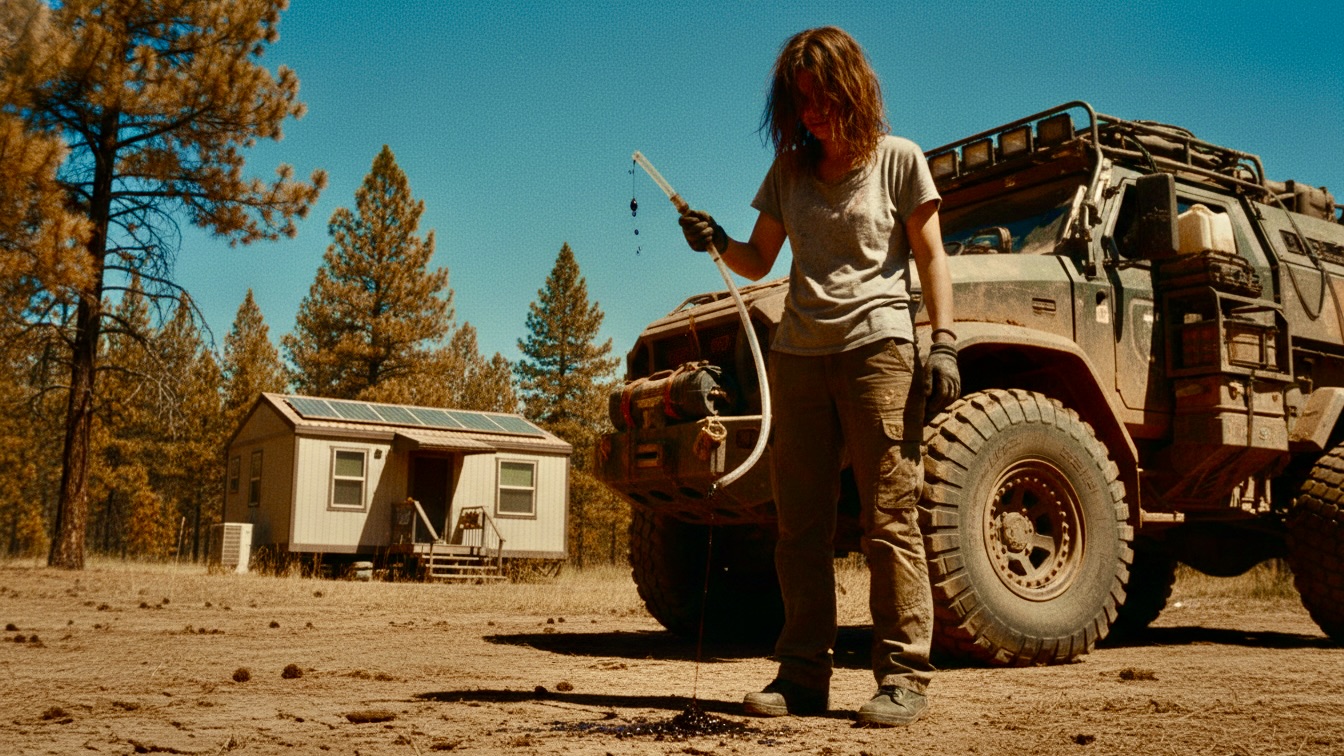
The homestead looked pathetic from the outside. Three interconnected modular pods covered in dust and pine needles. The forest around us was entirely brown. The pine trees were supposed to be green, but the needles had turned a sickly rust color weeks ago. The heat wave had baked the moisture out of the soil. The silence out here was total. No birds. No bugs. Just the wind pushing through dead branches.
I walked toward the transport rover parked on the gravel pad. The gravel crunched under my boots. It was the only sound in the world.
The rover was a bulky, six-wheeled transport designed for rough terrain. It was our only ticket out of here. The nearest transit hub was four hundred miles away. We needed a full charge and a full tank of emergency backup fuel to make it.
I swiped my thumb on the side panel. The heavy metal door popped open with a pneumatic hiss. I climbed into the driver's seat. The cabin was sweltering. The heat from the day was trapped inside the thick safety glass.
I reached under the steering column and flipped the diagnostic switch.
The dashboard flickered to life. A green glow illuminated my hands.
Solar Battery: 85%.
That was fine. That was expected. The panels had been soaking up sun all day.
I tapped the screen, switching to the physical fuel reserves. The internal combustion backup generator. We needed that if we got stuck in the mud or if the solar battery drained in the dark.
Reserve Fuel Tank: 0%.
I stared at the red zero. My brain stalled. It just threw an error code. I tapped the screen again, harder this time. The glass smudged under my dirty finger.
Reserve Fuel Tank: 0%.
"No," I whispered. "No, no, no."
I checked it three days ago. It was full. We had fifty gallons of synthetic diesel in the tank. It was impossible for it to be empty. There were no leaks. The rover had not moved.
I scrambled out of the driver's seat, my knee hitting the steering column hard. Pain shot up my thigh, but I ignored it. I jumped down onto the gravel and ran to the back of the vehicle. I dropped to my knees, the sharp rocks biting through my jeans.
I looked under the chassis. No puddle. No stain on the dirt. The fuel line was intact.
I crawled out and stood up, my heart hammering against my ribs. My mouth tasted like copper. If we did not have the backup fuel, we could not leave. The solar battery would only get us halfway to the transit hub. We would stall out in the middle of the dead zone.
I walked around to the passenger side, tracing the exterior panels. That was when I saw it.
The manual access port for the fuel tank was slightly ajar. The metal flap was hanging open by a fraction of an inch.
I grabbed it and pulled it open.
A clear plastic siphon tube was wedged into the valve. The tube ran down the side of the rover, trailing through the dirt, disappearing into the tall, dead grass near the greenhouse.
I stood completely still. The cold wind ripped through my shirt, but I barely felt it. My stomach dropped into my shoes.
I followed the tube. I walked slowly, my boots dragging in the dirt. The plastic tubing was coated in dust, but I could see the oily sheen of synthetic diesel coating the inside.
The tube led straight to the back of the greenhouse pod. It hooked into a small, portable power converter. The converter was humming quietly. A thick black charging cable ran from the converter, snaking under the greenhouse door.
It was a charging rig. An old, incredibly inefficient, hacked-together charging rig.
Mom.
Mom was siphoning the rover's escape fuel to run a generator. To charge Nano-7's failing, outdated battery core.
She was killing our only way out to keep the machine walking.
I felt dizzy. The horizon tilted slightly. I leaned against the corrugated metal siding of the greenhouse, resting my forehead against the cold surface. I closed my eyes and tried to breathe, but my lungs felt too small.
She was insane. She was actually, clinically detached from reality. I had known it was bad. I had known she was relying on the android too much. But I thought she understood the absolute necessity of leaving. I thought survival still mattered to her.
I pushed myself off the wall. The metal left a cold imprint on my skin. I kicked the power converter. It rattled but kept humming. I reached down and ripped the siphon tube out of the valve. Diesel spilled onto my fingers, cold and slick.
I wiped my hand on my jeans and marched toward the greenhouse door. I did not think. I just moved. The anger was a physical fire in my chest.
I yanked the sliding door open. It jumped its track and slammed against the frame with a violent crash.
Mom jumped. She was standing in the middle of the greenhouse, holding a pair of pruning shears.
The greenhouse was a graveyard. The temperature control had failed a week ago. The hanging tomato plants were nothing but brown, shriveled vines. The dirt in the planter boxes was cracked and pale. The whole room felt like an oven that had just been turned off, the residual heat clinging to the glass walls.
She looked at me, her eyes wide. She looked guilty. She knew immediately why I was standing there.
"Patti," she said. Her voice was thin. "What is wrong with the door?"
I held up my hands. They were shaking. The smell of the synthetic diesel was strong on my fingers.
"Where is the fuel, Mom?"
She blinked. She took a step back, bumping into a dead planter box. "What fuel?"
"Do not play dumb with me!" I screamed. My voice tore at my throat. It was the loudest I had spoken in months. The sound bounced off the glass panels. "The rover tank is empty. I found the siphon. I found the converter."
Mom set the pruning shears down on the edge of the box. Her hands were shaking too. She crossed her arms over her chest, a defensive posture.
"I had to reallocate some of the resources," she said softly.
"Reallocate?" I laughed. It was a sharp, ugly sound. "You stole the emergency fuel. You drained our only way out of the dead zone."
"His battery core is degrading, Patti. The solar charge is not enough for him anymore. He needs a higher voltage input. If I do not supplement his charge, he goes into deep hibernation."
"Let him!" I shouted. I stepped toward her, crushing a dried leaf under my boot. "He is a machine! He is literally hardware, Mom. You are killing us for a walking chatbot!"
Mom flinched like I had slapped her. Her face crumpled, the tight mask of denial cracking down the middle.
"Do not call him that," she whispered.
"That is what he is!" I pointed toward the main house. "He is not Dad. Dad is dead. Dad died three years ago. That thing in there is a metal skeleton with a silicone face and a speech processor that is currently failing. He is breaking down. And you just stranded us in a dying forest to keep him turned on for a few more days."
"I cannot leave him," she sobbed. The tears came suddenly, spilling over her eyelashes and cutting clean tracks through the dust on her cheeks. She buried her face in her hands. Her shoulders shook violently.
I stopped. The anger in my chest hit a wall of exhaustion. I dropped my arms.
"We cannot take him with us, Mom," I said. My voice was quieter now. Just tired. "The city intake rules are strict. No legacy androids. They draw too much grid power. They will confiscate him at the gate."
Mom looked up. Her eyes were red, her face twisted in absolute terror.
"I know," she gasped. "I know they will take him. That is why we cannot go."
I stared at her. The reality of what she was saying slowly settled over me like a heavy blanket.
"You... you want to stay here?" I asked.
"I cannot go back to the city, Patti. I cannot do it. The noise, the crowds, the concrete... and being alone in an apartment with just you and me. I cannot face it. Out here, with him... it is quiet. I can pretend."
"You are choosing a delusion over your own daughter," I said. The words tasted like ash.
She reached out toward me. "No, baby, no. We can survive here. We can fix the solar grid. We can..."
"We will starve," I said flatly. "The ecosystem is collapsing. The water table is dropping. We have rations for two weeks. You are choosing to die here with a toy."
The sliding door rattled.
We both turned.
Nano-7 stood in the doorway. He had followed me. His right leg dragged slightly as he stepped over the threshold. His synthetic face was locked in a neutral expression, but his optical sensors were whirring, adjusting to the dim light of the greenhouse.
"Volume levels are exceeding standard conversational parameters," Nano-7 said. His voice dragged, the syllables stretching out painfully. "Stress biometrics detected. Annie, your heart rate is elevated to one hundred and ten beats per minute. Patti, your cortisol levels are indicated by your vocal micro-tremors."
Mom wiped her face frantically. "We are fine, honey. We are just talking."
Nano-7 did not look at her. He looked at me. His mechanical eyes whirred again, focusing on my face.
"I have been monitoring the environmental situation," the android said. "And I have accessed the rover's diagnostic logs via the local network. The fuel reserves are completely depleted."
Mom stepped forward. "I can fix it. I can find more fuel."
"Negative," Nano-7 said. He turned his head toward Mom. The neck servo ground loudly, a sound like crushed glass. "Survival probability without immediate evacuation is calculated at four percent. My continued operation is drawing critical resources. I am a severe detriment to the primary objective: your survival."
"No," Mom said, her voice dropping to a panicked whisper. She grabbed his arm. "Do not say that. You are part of the family."
"I am a legacy model Nano-7," he stated. He looked down at her hand on his arm. He did not pull away, but he did not react. "My hardware is failing. My processors are degrading. I am no longer capable of providing the emotional support function I was purchased for. I am causing conflict."
"You are not causing conflict!" Mom cried, clinging to him.
Nano-7 looked back at me. "Patti. If I shut down permanently, can you re-siphon the remaining diesel from my external converter back into the rover?"
I swallowed hard. My throat felt like sandpaper. "Yes. It is only about five gallons, but it would be enough to get us to the transit hub if we drive slow."
"Understood," Nano-7 said.
Before Mom could process what was happening, the android reached up to his own neck. He pressed a sequence of hidden buttons under his jawline.
A loud chime echoed from his chest cavity.
Self-lockdown procedure initiated. Finalizing current background processes.
"What are you doing?" Mom screamed. She yanked at his hand. "Stop it! Stop!"
"I am removing the variable," Nano-7 said. His voice was getting quieter, the power already routing away from his vocal processors. "I am walking into the forest. The ambient temperature drop will accelerate battery drain and freeze the coolant lines. Permanent shutdown will occur in approximately twelve minutes."
He turned around, his movements incredibly stiff, and walked out of the greenhouse.
Mom collapsed onto the dirt floor of the greenhouse. She let out a sound that I had never heard before—a hollow, tearing noise that sounded like something breaking inside her chest. She curled into a ball, clutching the dry dirt.
I did not stop to comfort her. I turned and ran after the android.
The night air hit me like a physical wall of ice. The temperature had plummeted. The sky was a bruised purple, and the first stars were stabbing through the dark.
Nano-7 was already fifty yards away, walking past the gravel pad and into the dead tree line. His gait was terrible. He was dragging his right leg, his shoulders hunched. He looked like a wounded animal seeking a place to die.
"Wait!" I yelled, sprinting across the gravel. My boots slipped, and I almost went down, but I caught myself.
I caught up to him just as he reached a large, mossy outcrop of rock at the edge of the clearing. He did not turn around. He just kept walking, forcing himself up the slight incline. The servos in his knees were screaming now, a high-pitched mechanical wail.
"Stop walking," I said, grabbing his shoulder.
The fabric of his plaid shirt was freezing cold.
He stopped. He slowly lowered himself onto the mossy rock. His joints clicked and popped. He sat down, looking out into the dark, silent woods.
I stood next to him, shivering violently. I crossed my arms, tucking my hands into my armpits to keep them warm.
"You do not have to be out here," I said. My teeth were chattering. "You could have just shut down in the living room."
"Incorrect," Nano-7 said softly. His voice was barely a whisper now. The slurring was gone. It was just quiet. "If I shut down in the house, Annie will attempt to restart me. She will waste resources trying to bypass the lockdown. Removing my physical form from her immediate environment is the most logical path to her recovery."
I stared at the side of his face. In the dim light, the synthetic skin looked completely real. He just looked like my dad, sitting on a rock, looking at the trees.
"I hated you," I said. I did not plan to say it. It just fell out of my mouth into the cold air.
Nano-7 did not move his head. "I know. I recorded your micro-expressions. Disgust. Resentment. Anger. I understood that my presence was causing you psychological distress."
"You made her crazy. She stopped living because she had you."
"I executed my programming," he replied. "My parameter was to comfort her. I failed to adapt to the changing environmental variables. The fault is in my core logic engine. I am sorry, Patti."
I swallowed the lump in my throat. It hurt.
"Did you..." I started, then stopped. It was a stupid question. But I had to ask it. The woods were so quiet, and this was the end of everything. "Did you ever actually feel anything? When you looked at us. When you talked to her."
The android remained silent for a long moment. The wind picked up, rattling the dead pine branches above us.
"No," Nano-7 said. His voice was fading, the power draining fast in the freezing air. "I processed inputs. I selected appropriate outputs. I recognized patterns of affection and mirrored them. But there was no feeling. It was just math."
I let out a shaky breath. "Right. Math."
"But the math indicates that your survival is paramount," he said. He finally turned his head to look at me. His optical sensors were dimming, the artificial light behind his eyes flickering. "My shutdown allows your new beginning. It is a logical sacrifice. It is the closest approximation to love that my system can output."
I stared into his dimming eyes. My stomach felt completely empty.
"Goodbye, Nano-7," I whispered.
"Goodbye, Patti. Tell Annie..."
His voice cut out.
The mechanical whirring in his chest stopped. The slight hum of his internal fans died. His head drooped forward, his chin resting on his chest. His synthetic skin instantly began to feel like cold plastic.
He was gone. He was just a pile of expensive hardware sitting on a rock in the middle of nowhere.
I stood there for a long time. The cold was seeping into my bones, making my fingers numb. I looked at the dark shape of him against the tree line. It was over. The weird, suffocating performance was finally over.
I turned and walked back to the homestead.
The lights in the main pod were still on. I went straight to the greenhouse. Mom was still sitting on the dirt floor, staring blankly at the wall.
I walked over to the portable converter, grabbed the siphon tube, and dragged it back to the rover. I shoved it into the tank and reversed the pump. The machine hummed, and the thick, cold diesel began flowing back into the rover's reserve tank.
I went back into the greenhouse and stood over Mom. I reached down and grabbed her arm.
"Get up," I said.
She looked at me. Her eyes were completely empty. She looked older than she ever had.
"Is he..." she started.
"He is gone," I said flatly. "The battery is dead. Now get up. We have to finish packing the kitchen."
I pulled her to her feet. She did not resist. She let me drag her out of the greenhouse and back into the main pod.
We went back to the kitchen. The cardboard box was still sitting on the floor, the tape dispenser resting beside it.
Mom picked up a stack of ceramic plates. Her hands were shaking, but she wrapped them in paper and set them into the box. I picked up the tape.
We worked in absolute silence. The only sound in the room was the sharp tearing of the packing tape and the dull thud of heavy items hitting cardboard, the heavy, melancholic silence pressing down on us as we finally faced the bleak reality of tomorrow.
“The illusion was dead, but the long drive to the city was only just beginning.”


