Ken dragged his sleeve across his forehead, smearing black grease over a fresh cut.
Ken stared at the heavy iron wrench in his hand. The grip was worn smooth. It used to have a rubber sleeve, but that rotted away four years ago. Now it was just cold metal, slick with his own sweat. He wiped his palm on his thigh. His pants were stiff with weeks of accumulated grime. He needed the ten-millimeter socket. He reached for the tool belt hanging off the access ladder. His fingers brushed empty canvas. The socket was missing. He looked down into the dark, narrow shaft below him. Nothing. It probably fell into the primary water reclamation tank months ago.
He sighed. The sound was flat in the cramped space. He grabbed the adjustable crescent wrench instead. It was a terrible tool for this job. The jaws were loose. He fitted it over the rusted bolt holding the primary oxygen filter in place. Sector 4 depended on this filter. Without it, the air turned sour in two days. People would start getting headaches. Then the coughing would start.
He applied pressure. The wrench slipped. The heavy steel jaws slammed into his knuckles.
Ken hissed. He pulled his hand back. Blood welled up from a jagged tear over his index finger. He didn't swear. He just watched the red bead swell and drip onto the grated floor. It mixed with a puddle of dark machine oil. He ripped a strip of cloth from the hem of his undershirt, wrapped it tight around the knuckle, and tied it off with his teeth.
Above his head, the massive public display screens flickered to life. The scheduled broadcast. The sudden influx of bright light made Ken squint. The screen filled with a vibrant, blinding yellow sun. High grass swaying in a warm breeze. Blue water. A perfect, endless summer. A synthetic voice, smooth and rich, echoed through the maintenance bay.
"Eden awaits. The journey is long, but the destination is paradise. Rest. Conserve your energy. We are arriving soon."
Ken ignored it. He hated the broadcast. He hated the fake sun. The ship itself was sweltering. The cooling systems in Sector 4 had failed a decade ago. It felt like standing in the mouth of a furnace. The heat was a physical weight on his shoulders. He leaned back in, fitting the loose wrench over the bolt again. He pressed his chest against the vibrating pipe. He used his body weight.
The bolt shrieked. It gave way with a sickening crunch of oxidized metal. Ken twisted it out with his fingers and tossed it onto the grate. It clattered against the iron. He grabbed the handle of the carbon filter and pulled.
It didn't budge.
He braced his boots against the bulkhead. He pulled again. The muscles in his forearms burned. He felt a sharp pull in his lower back. The filter slid out two inches, then jammed. Black dust puffed into the air. Ken coughed, turning his head away. The dust smelled like burnt hair and old copper. He shoved his fingers into the gap, ignoring the sharp edges of the casing, and yanked.
The filter came free. It weighed forty pounds. Ken dropped it heavily onto the floor.
The housing was empty. A dark, rectangular hole. Ken picked up his portable work light. He clicked it on and shined it inside. The inner mesh was completely coated in a thick, gray sludge. It was supposed to be dry. Condensation from the failing humidity regulators was mixing with the carbon dust. It was turning into cement.
He needed a scraper. He reached for his belt again. The scraper was there. He pulled it out and started hacking at the sludge. Flakes of gray matter fell into his lap. He worked in silence. The only sound was the scrape of metal on metal, and the endless, cheerful drone of the Eden broadcast overhead.
"Think of the warmth on your skin," the voice said. "Think of the open sky. The Vanguard Council thanks you for your patience."
Ken stopped scraping. He looked up at the screen. A family was running through a field of tall, green plants. They were laughing. Their clothes were perfectly white. No grease. No sweat. No blood.
He looked around the maintenance bay. It was empty. There used to be three people assigned to this junction. Now it was just him. The others had either been reassigned to the upper decks, or they had just stopped showing up. People were tired. The broadcasts told them to rest. Told them the work was almost done. So they sat in their cramped bunks, plugged into the local net, and waited for a sun they had never seen.
Ken went back to scraping. He cleared the bottom track. He grabbed the new filter. It wasn't new. It was a refurbished unit from Sector 12. He had traded three weeks of his synthetic protein rations to a scrapper for it. It was dented on one side, but the carbon inside was dry.
He lifted it. His back flared with pain. He shoved it into the housing. It stuck halfway. He hit it with the heel of his hand. Once. Twice. It slid home with a heavy thud.
He picked up the rusted bolt. The threads were stripped. He couldn't put it back in. He reached into his pocket and pulled out a handful of mismatched screws and bolts. He found one that looked close enough. He jammed it into the hole and tightened it down with the loose wrench. It held. Barely.
He leaned back against the wall, chest heaving. Sweat dripped off his chin. He wiped his face with the back of his clean hand. The air flowing out of the vent already tasted slightly less metallic. It was a small victory. A tiny, insignificant victory that would keep Sector 4 breathing for another month. Maybe two.
He packed up his tools. The broadcast switched to a shot of a sparkling ocean. The fake waves crashed silently on the screen. Ken turned his back on it. He walked toward the diagnostic terminal at the end of the hall. He needed to log the repair and check the pressure readouts.
The terminal was built into the wall. The screen was cracked diagonally. The keyboard was missing three keys. Ken punched in his access code. The screen flickered, struggling to render the simple text interface.
He opened the sub-routine for the ventilation manifold. The pressure numbers scrolled past. Sector 4 was stable. Barely in the green, but stable. He went to close the terminal, but his finger slipped on the cracked glass. He hit the directory key instead.
The screen flashed. A new menu appeared. It was a low-level diagnostic overlay. Ken had seen it before, but usually it was locked out. Today, for some reason, the security handshake failed. The system was decaying just as fast as the physical ship.
He stared at the menu. One of the options was labeled 'Navigational Telemetry - Raw'.
Ken hesitated. The Vanguard Council strictly forbade lower-deck access to navigational data. They said it was to prevent 'unnecessary anxiety' among the population. The daily broadcasts provided all the updates they needed. "We are on course. We are making good time."
He looked over his shoulder. The corridor was empty. He pressed the button.
The screen went black for a long time. Ken thought he had crashed the terminal. He reached out to reboot it.
Text began to populate. Long strings of coordinates. Velocity vectors. Trajectory models.
Ken leaned in. He wasn't a pilot. He was a mechanic. But he knew basic physics. He knew how to read a speed gauge. He found the line labeled 'Current Forward Velocity'.
He stared at the number. He blinked hard, thinking the sweat in his eyes was blurring his vision. He wiped his eyes and looked again.
The number was zero.
Ken frowned. He tapped the screen. The number didn't change. He scrolled down. He found the engine output logs. The massive fusion drives at the rear of the ship. The logs showed they were running at eighty percent capacity.
How could the engines be running if the velocity was zero?
He kept scrolling. He found the exhaust vectoring data. The engines weren't pushing the ship forward. The thrust baffles were locked in a completely reversed position. The ship was pushing against itself. It was burning fuel, generating massive amounts of heat, but going absolutely nowhere.
Ken felt a cold knot form in his stomach. The sweltering heat of the hallway suddenly felt very far away. He opened another file. 'External Sensor Array - Visual'.
The screen split. On the left side, the broadcast feed of Eden. The bright sun. The blue sky.
On the right side, the raw optical feed from the ship's nose cameras.
It was pitch black. Ken adjusted the contrast on the terminal. Slowly, a shape emerged from the darkness. It was a massive, jagged sphere of rock and ice. There was no light coming from it. No warmth. It was a dead star, collapsed and frozen.
The ship wasn't flying toward Eden. It was caught in a stationary, decaying orbit around a piece of dead space debris.
Ken looked at the timestamp on the orbital lock.
One hundred and fourteen years.
They had been parked here for over a century. Long before Ken was born. Long before his parents were born. The entire journey was a lie. The broadcasts. The promises. The waiting. It was all a trap. A way to keep the lower decks quiet, docile, and waiting for a salvation that did not exist.
He backed away from the terminal. His breathing was shallow. He looked at his hands. The grease. The blood. The fresh blister forming on his palm. He had spent his entire life keeping this rusted metal box breathing, believing that every turned wrench brought them one inch closer to the sun.
He turned and ran down the corridor.
Ken's boots hit the metal grating hard. He didn't care about the noise. He bypassed the main elevator banks—they were too slow—and took the maintenance stairs down to Level 42. He skipped steps, his hand sliding down the rusted handrail. The air grew thicker, heavier, the deeper he went into the residential blocks.
He burst through the heavy fire door into Corridor B. The lights here were dim, running on emergency power. Water dripped from a cracked pipe overhead, pooling on the floor. He stepped over a pile of discarded food wrappers. The doors lining the hall were solid gray metal, dented and scarred.
He stopped at door 42-11. He slammed his palm against the release pad. The door slid open with a painful screech.
The room was small. Two bunks, a metal table, a tiny sink. The air smelled stale, like unwashed clothes and old ozone.
Nia was lying on the bottom bunk. She was wearing a bulky, silver headset that covered her eyes and ears. A thick black cable ran from the headset to a jack in the wall. Her mouth was slightly open. She was smiling.
"Nia," Ken said. His voice was rough.
She didn't move. She couldn't hear him. She was plugged directly into the main feed. The Vanguard Council pumped the highest fidelity version of the Eden simulation straight into the residential blocks.
Ken walked over to the bed. He reached down and grabbed the headset.
He pulled it off her face.
Nia gasped. Her eyes snapped open. The pupils were dilated. She blinked rapidly, her hands flying up to cover her face as the dim light of the room hit her.
"What are you doing?" she yelled. Her voice was shrill. She sat up, reaching for the headset. "Give it back!"
Ken held it out of her reach. "Look at me."
"I was in the middle of a sun cycle!" Nia said, her face twisting in anger. She rubbed her eyes. "The sky was just changing colors. Put it back, Ken. Now."
"There is no sky," Ken said. He dropped the headset onto the floor. It clattered against the metal deck. The cable snapped taut.
Nia stared at the headset, then looked up at him. "Are you crazy? You know how many ration chits that cost?"
"It does not matter," Ken said. He took a step closer to the bed. "Listen to me. The ship is not moving. We are not going anywhere."
Nia rolled her eyes. She leaned over the side of the bunk and grabbed the headset. "You have been working too long. You are breathing too much rust. Let me go back in."
Ken grabbed her wrist. His grip was tight. The grease from his hand smeared onto her pale skin.
"Stop," he said. "Look around this room. Look at the water on the floor. Look at the rust on the walls. This is it, Nia. This is all there is."
Nia yanked her arm away. She looked at the grease stain on her wrist with disgust. "Don't touch me with those hands. You are always dirty. You just don't understand. The Council said we are entering the final approach phase. We just have to wait. We just have to be patient."
"I saw the raw telemetry," Ken said. He kept his voice low, intense. "I bypassed the terminal lock in the ventilation bay. The forward velocity is zero. We are parked. We have been parked for a hundred years in front of a dead rock. They are running the engines in reverse just to burn fuel and keep us thinking we are moving."
Nia stared at him. For a second, the anger left her face, replaced by a flicker of confusion. Then the wall came back down. She shook her head.
"You do not know how to read those screens," she said. "You fix pipes. You are not a navigator."
"I know what zero means," Ken said. "It is a lie. The whole thing. They just want us to sit here with these things on our heads while the ship rots around us. They are hoarding the resources on the upper decks."
"Stop it," Nia said. She covered her ears. "I don't want to hear this. You are always so negative. You just want to drag me down here into the dirt with you. I am going to Eden. I am going to walk on real grass."
"You are going to suffocate in a metal box," Ken said. He stepped back. He felt a sudden, crushing exhaustion. He looked at his sister. She was nineteen. She had never known anything but this room, the stale air, and the fake sun in the headset. She didn't want the truth. The truth was ugly and required work. The lie was beautiful and required nothing.
Before he could speak again, the lights in the room went completely dark.
Ken froze.
A second later, the red emergency strobes flared to life. They pulsed in the corners of the ceiling, casting harsh, moving shadows across the walls.
Then came the sound. A low, mechanical groan that vibrated through the floorboards. It was the sound of massive hydraulic pistons firing.
"What is that?" Nia asked. Her voice was small now. The anger was gone.
"The blast doors," Ken said. He turned toward the hallway.
A deafening siren began to wail. It was the general alarm for Sector 4. Ken stepped out of the room and looked down the corridor. At the far end, the massive steel bulkheads were slowly descending from the ceiling. They ground against their tracks, throwing sparks into the dim air.
People were stepping out of their rooms. Confused faces. Shouting.
Ken looked at the air vent above Nia's door. The small ribbon of cloth he had tied there to monitor the airflow was hanging perfectly still.
The fans had stopped.
He pulled his diagnostic pad from his pocket. The screen was flashing red.
`SYSTEM FAILURE: SECTOR 4 PRIMARY LIFE SUPPORT. CRITICAL PRESSURE DROP.`
`RESPONSE PROTOCOL: QUARANTINE. SECTOR SEALED. REDIRECTING REMAINING RESOURCES TO UPPER DECKS.`
Ken stared at the screen. The Vanguard Council wasn't even trying to fix it. The moment the system buckled, they cut Sector 4 loose. They were sealing them in to preserve the air for the elite.
"Ken?" Nia stood in the doorway. She wasn't holding the headset anymore. "Why did the air stop?"
"They locked us out," Ken said. He shoved the pad back into his pocket. He turned to face her. The red strobe light washed over his face. "The automated systems are dead."
"So what do we do?" she asked. She looked at the vent. She took a short, shallow breath. "Are they sending someone down?"
"No," Ken said. "No one is coming."
He looked down the hall. The heavy steel bulkhead hit the floor with a massive boom that shook the dust from the ceiling. Sector 4 was completely cut off. The air they had right now was all the air they would ever have.
Unless they moved it themselves.
Ken walked past Nia. He grabbed his heavy wrench off the bed.
"Where are you going?" Nia asked, her voice tight with rising panic.
"To the plaza," Ken said. "We have to open the floor grates. If we don't start the manual pumps in twenty minutes, we all die in the dark."
The central plaza of Sector 4 was a large, circular open area. It was originally designed as a communal gathering space, a place for the lower decks to socialize. Now, it was just a concrete floor covered in scuff marks and lit by the relentless, pulsing red of the emergency strobes.
When Ken arrived, the plaza was already filling with people. The panic was thick. It was a physical thing in the air. People were pushing against the sealed elevator doors, hammering on the metal with their fists. A woman was screaming at a dead intercom panel. Children were crying.
The air was already changing. The stale smell was getting sharper. The humidity was rising rapidly as hundreds of breathing bodies trapped in a sealed box began to heat up the room.
Ken pushed his way through the crowd. He didn't waste time trying to calm anyone down. Words were useless right now.
He spotted old man Miller sitting on a crate, staring at the floor. Miller used to work the water reclamation vats before his knees gave out.
"Miller," Ken shouted over the noise. "Get up."
Miller looked up slowly. His eyes were watering. "The doors are down, Ken. We're done."
"Get up," Ken repeated. He grabbed Miller by the shoulder and hauled him to his feet. He looked around and saw Sarah, one of the shift leads from the algae farms. She was tall, broad-shouldered, and had hands like shovels. She was trying to keep a group of teenagers from fighting over a sealed water dispenser.
"Sarah!" Ken yelled.
She turned. He waved her over. She pushed through the crowd, her face hard.
"What is the plan, Ken?" she asked. "The vents are dead."
"We use the manual overrides," Ken said. He pointed to the center of the plaza. There was a massive, circular iron grate bolted into the floor. It was twenty feet across. Underneath it was the manual pneumatic pump system. It was an archaic failsafe, built into the ship's original design and untouched for decades.
"Those pumps take four people just to move one lever," Miller said. "And they're probably rusted solid."
"Then we break the rust," Ken said. He walked to the edge of the grate. He dropped to his knees and wedged the loose jaws of his crescent wrench under the heavy iron rim. "Help me lift."
Sarah didn't hesitate. She dropped down next to him, wedging her thick fingers into the gap. Miller grabbed the other side.
"On three," Ken said. "One. Two. Three."
They heaved. The iron grate groaned. It didn't move.
"Again," Ken barked. Sweat was pouring down his face. The heat in the room was climbing. "Three."
They pulled. Ken felt a muscle in his shoulder tear. The grate shifted a fraction of an inch. A harsh scraping sound echoed over the crowd.
People stopped screaming and turned to look.
"Don't just stand there!" Sarah roared at the crowd. "Get over here and pull!"
Half a dozen men and women rushed forward. They grabbed the edges of the grate.
"Pull!" Ken yelled.
With a massive crunch of breaking rust, the heavy iron circle lifted. They flipped it over. It crashed onto the concrete floor, sending a shockwave through the plaza.
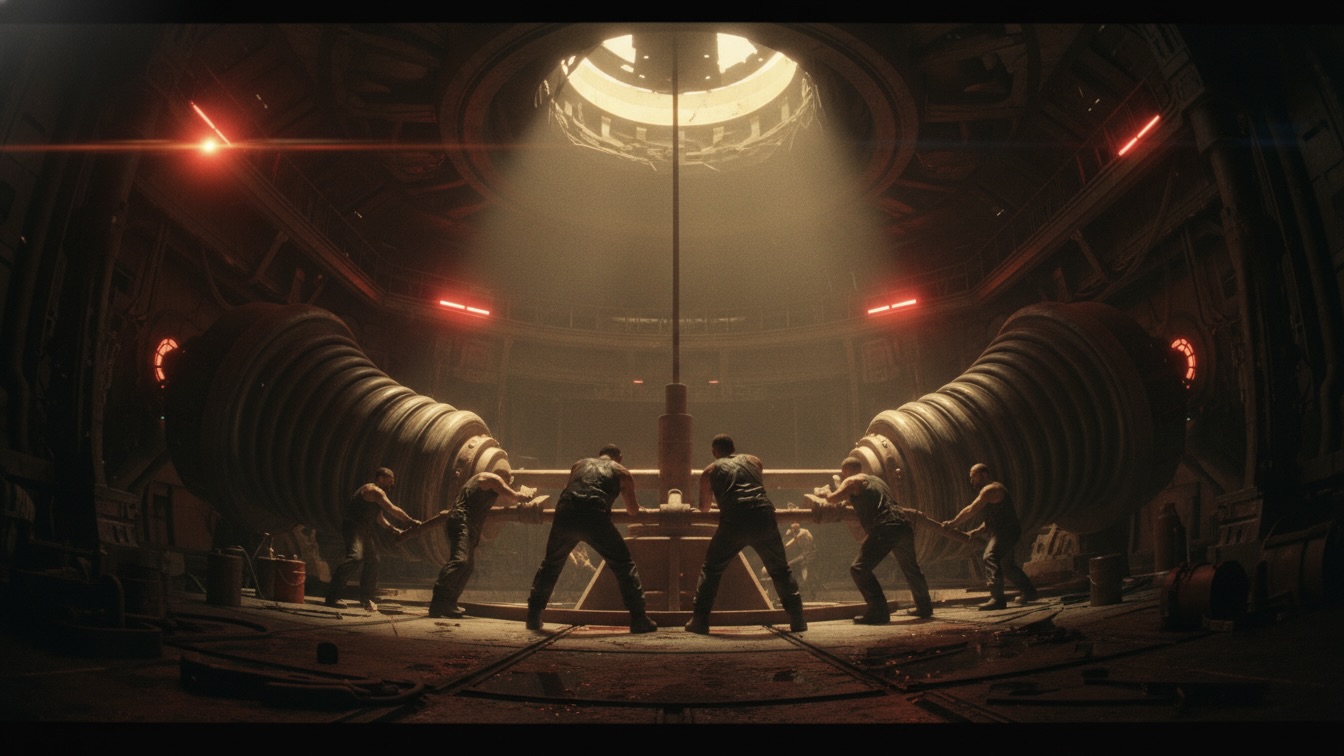
Below them was a dark, circular pit. Four massive iron levers protruded from the central column, connected to thick rubber bellows the size of small cars. The smell coming out of the pit was pure stagnant rot.
"Down," Ken said. He jumped into the pit. The drop was only four feet. He landed on the metal catwalk surrounding the bellows.
Sarah and Miller followed, along with a dozen others.
"Four to a lever," Ken ordered. He grabbed the end of the nearest iron bar. The metal was cold and rough. "Push down. Then pull up. You do not stop until you pass out. When you pass out, someone else takes your spot."
Sarah organized the other three levers. Ken looked at the people grabbing the bar with him. A young kid from hydroponics. An older woman with a severe cough. A mechanic with a missing finger.
"Push," Ken said.
They leaned their weight onto the heavy iron bar. It didn't move.
"Push harder," Ken grunted. He planted his boots and drove his entire body weight forward.
There was a loud crack. The iron lever suddenly gave way, dropping two feet. A massive whoosh of air erupted from the bellows below them. Dust blew up into their faces.
"Pull up!" Ken yelled.
They hauled the heavy bar back up. It was exhausting. The resistance of the thick rubber bellows was immense.
Down. Up. Down. Up.
Slowly, a rhythm formed. The four levers moved in sequence. The massive rubber bellows compressed and expanded. Above them, in the plaza, someone shouted.
"Air! I feel air!"
Ken didn't stop. He couldn't. His hands were cramping. The blister on his palm tore open, bleeding onto the iron bar. He ignored it. He focused entirely on the movement. Down. Up.
Ten minutes passed. Then twenty. Ken's arms felt like lead. The teenager next to him stumbled, gasping for breath. Ken grabbed him by the collar and shoved him back toward the ladder.
"Next!" Ken yelled.
A man jumped down and took the kid's place. They kept pumping.
It was brutal, ugly work. There was no glory in it. No cinematic music. Just the harsh sound of rasping breath, the clank of iron, and the smell of sweat.
Suddenly, the heavy metal door at the far end of the maintenance pit slammed open.
Ken looked up, wiping sweat from his eyes.
A figure stood in the doorway. He was tall, dressed in the clean, black uniform of the Vanguard Enforcers. His left arm was completely mechanical, gleaming silver in the red strobe light.
Elder Reyes.
The crowd on the levers faltered. The rhythm broke. The massive bellows slowed.
"Keep pumping!" Ken roared at them. He let go of his lever and stepped forward on the catwalk.
Reyes walked slowly down the metal stairs into the pit. He looked at the sweating, dirty people working the pumps with an expression of absolute disgust.
"Stop this immediately," Reyes said. His voice was calm, amplified by a small speaker on his collar. "Sector 4 is under quarantine protocols. Manual overrides are a violation of Vanguard directive 4-A."
"We are breathing," Ken said. He picked up his crescent wrench from the catwalk.
"You are stealing pressure from the main lines," Reyes said. He stopped ten feet away from Ken. The mechanical arm hummed quietly. "The atmospheric balance of the ship must be maintained for the survival of the primary crew. Your sector is designated as a loss. Stand down."
"No," Ken said.
Reyes sighed. It was a tired, bureaucratic sound. "I was dispatched to ensure the quarantine was absolute. Your access to the terminal was flagged. You saw the telemetry."
"I saw the dead star," Ken said. He gripped the wrench tighter.
"A necessary fiction," Reyes said. "The ship is failing. The resources are limited. The Council must survive to find a real solution. The masses cannot handle the truth. They need the broadcast. They need Eden. And right now, they need to die quietly."
Reyes raised his mechanical arm. The silver fist clenched. "Stop the pumps, or I will break them permanently."
Ken didn't wait. He threw the heavy crescent wrench directly at Reyes's face.
Reyes didn't even flinch. He raised his mechanical arm. The wrench clanged against the silver forearm and spun harmlessly into the dark water below the catwalk.
Ken charged.
He tackled Reyes around the waist. The Enforcer was incredibly heavy. It felt like hitting a concrete pillar. They crashed backward into the heavy steel pipes lining the wall. A valve snapped. High-pressure steam hissed into the air, scalding hot.
Reyes brought his mechanical elbow down on Ken's back.
The impact drove the breath from Ken's lungs. He collapsed onto the metal grating, his vision flashing white. He tasted blood in his mouth. He rolled hard to the right just as Reyes stomped a heavy boot down where his head had been. The metal floor dented under the force.
"Keep the pumps moving!" Ken screamed, his voice ragged.
He scrambled to his feet. He had no weapons. He scanned the dim, steam-filled area. Against the far wall, a heavy lead pipe sat in a pile of debris. Ken dove for it.
Reyes was fast. He grabbed Ken by the back of his shirt and hurled him across the catwalk. Ken slammed into the central iron column housing the pump mechanism. Pain shot up his spine.
Reyes walked toward him, the mechanical arm whirring. "You are extending the suffering. Accept the reality of the situation."
"You first," Ken spat. He grabbed a massive hydro-spanner left near the base of the pump. It weighed at least fifteen pounds. He swung it with both hands.
The heavy steel head connected with Reyes's knee. The joint crunched.
Reyes grunted, dropping to one knee. But his silver arm shot out, grabbing Ken by the throat. The metal fingers tightened with hydraulic force. Ken was lifted off his feet, kicking in the air.
The edges of his vision began to darken. He dropped the hydro-spanner. His hands tore at the metal fingers crushing his windpipe. It was useless. The grip was unbreakable.
Reyes looked up at him, his face blank. "Quiet now."
Ken looked past Reyes. He saw the ceiling of the maintenance pit. He saw the massive, rusted structural bulkhead directly above them. It was the same bulkhead he had reported as failing three months ago. The one the Council refused to allocate repair materials for. It was held up by two heavily oxidized support struts.
Ken stopped pulling at the hand on his throat. He reached to his belt. He had one tool left. A heavy steel pry bar.
He didn't swing at Reyes. He swung backward, over his own head, driving the pointed end of the pry bar directly into the primary release latch of the rusted strut holding the bulkhead.
He hit the latch perfectly.
The rusted strut snapped with a sound like a gunshot.
The massive steel bulkhead, weighing over three tons, tore free from the ceiling.
Reyes looked up just as the ceiling fell.
The impact was deafening. The massive sheet of metal crushed Reyes against the floor grating, pinning his mechanical arm and lower body entirely.
The metal hand holding Ken's throat suddenly lost its hydraulic pressure. The fingers went slack.
Ken fell to the floor, gasping. He rolled away from the twisted metal. He lay on his back, staring at the exposed wiring in the ceiling, sucking down huge, ragged breaths of the stale, steam-filled air.
He forced himself to sit up. Reyes was pinned under the bulkhead. He wasn't moving.
Ken looked toward the pumps. The people had stopped. They were staring at him.
"Don't stop," Ken rasped. He pointed a shaking finger at the levers. "Pump."
They immediately grabbed the bars and resumed the rhythm. Down. Up.
Ken heard footsteps on the metal stairs. He turned his head.
Nia was standing there. She had climbed down into the pit. She wasn't wearing the headset. She looked at the crushed Enforcer. She looked at the blood on Ken's face, the grease smeared across his torn clothes, the brutal, ugly reality of the dark room.
She looked at the people straining on the heavy iron levers.
Ken met her eyes. He couldn't speak. His throat was bruised and swelling. He just watched her. He waited for her to turn away. To run back to her room and close her eyes.
Nia didn't run. She walked past the dead Enforcer. She walked past Ken.
She went to the nearest lever. She put her small, clean hands on the rough iron next to Sarah's calloused ones.
She pushed down.
Ken watched her work. He watched the sweat form on her forehead. He watched the grimace of pain cross her face as the heavy resistance fought back. She didn't stop.
Hours passed. The red emergency strobes continued to pulse. The heat was unbearable. But the air kept moving. They established shifts. When one group collapsed, another stepped in. The entire sector mobilized. People brought down whatever water they had left. They shared it in small, measured sips.
Eventually, Ken sat on the grated floor near the edge of the pit. His shift was over for the next hour. Every muscle in his body felt like it had been shredded and put back together wrong.
Nia sat down next to him. She didn't say anything. She handed him a small, foil packet.
It was a standard synthetic nutrient paste. The beige sludge they ate every day.
Ken ripped the top off with his teeth. He squeezed the paste into his mouth. It was bland, chalky, and tasted vaguely of stale cardboard.
He swallowed it. He looked at Nia. She was eating hers, staring straight ahead at the massive rubber bellows moving up and down in the dark. Her hands were covered in black grease. She had a blister forming on her thumb.
Ken looked down at his own hands. They were trembling slightly. The knuckles were split. The grease was permanently ground into the lines of his palms.
There was no sun coming. There was no green grass. There was no cinematic rescue. They were stuck on a dying ship, orbiting a dead star, and the only thing keeping them alive was the heavy, brutal, endless work of pushing iron levers in the dark.
He closed his fist. The pain in his joints flared, sharp and real. It was the only truth that mattered now.
"Hey," Nia said softly, not looking away from the pumps.
Ken turned his head.
"Pass me the wrench," she said, pointing to a loose bolt on the lever assembly. "The small one."
“As she reached out to tighten the loose iron fitting, the heavy blast doors at the top of the maintenance stairs began to violently shudder under the weight of a massive, synchronized pounding from the other side.”


