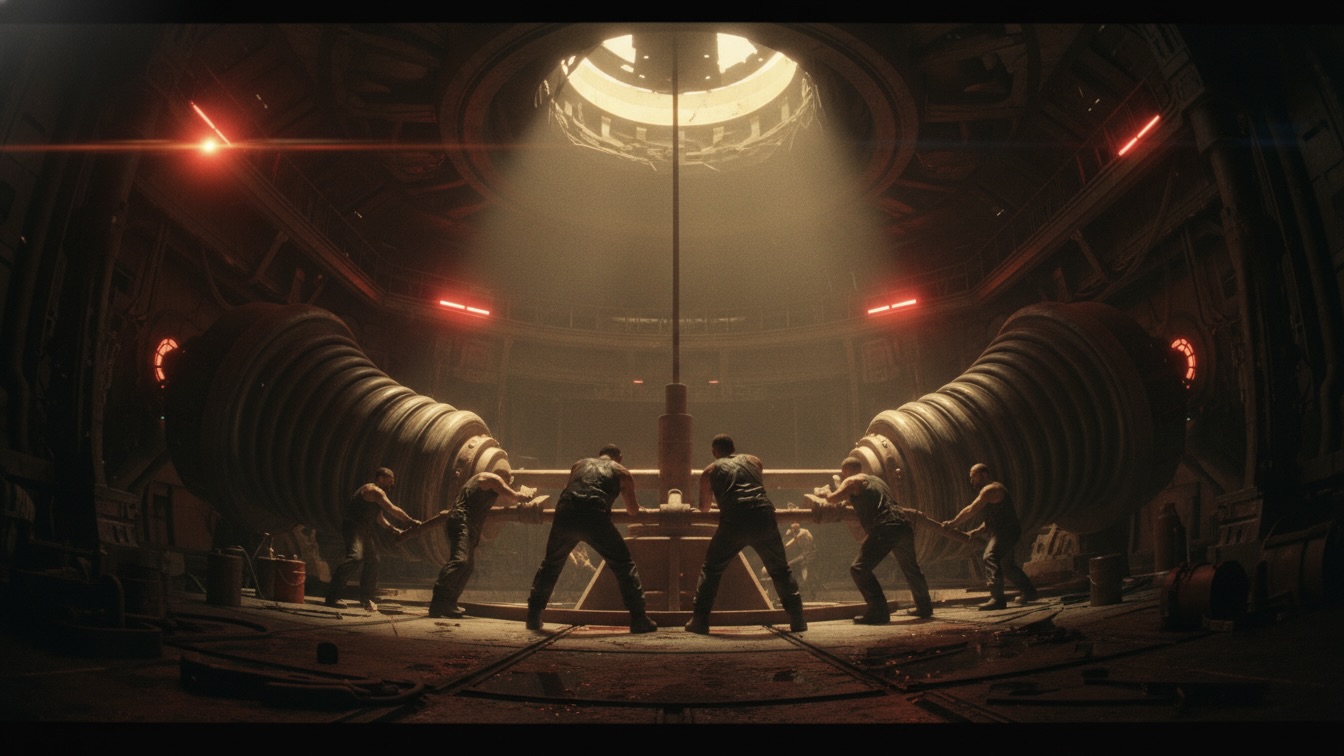
The story follows Ken, a weary mechanic tasked with maintaining the failing life support systems of Sector 4 on a decaying interstellar vessel. While performing a grueling repair on an oxygen filter, he is bombarded by propaganda broadcasts promising a paradise called Eden that seems increasingly unreachable. His routine is shattered when he accidentally accesses restricted navigational data, revealing that the ship has been stationary for over a century, trapped in orbit around a dead star. This discovery exposes the Vanguard Council's narrative as a total fabrication designed to maintain social order through false hope.
When Ken attempts to warn his sister, Nia, the ship’s leadership initiates a quarantine protocol that cuts off life support to the lower decks to preserve resources for the elite. The situation escalates into a desperate struggle for survival as Ken leads the residents of Sector 4 in a manual effort to pump air into their sealed environment. He eventually faces off against Elder Reyes, a cybernetically enhanced enforcer sent to ensure the sector's quiet demise. Through a combination of mechanical knowledge and sheer desperation, Ken defeats Reyes and inspires Nia to abandon her virtual delusions in favor of the harsh, yet honest, labor required to stay alive.
The central theme of the narrative revolves around the tension between a comfortable lie and a devastating truth. The Vanguard Council utilizes the "Eden" simulation as a psychological tool to pacify a population that is slowly rotting away in a failing vessel. This digital opiate serves to prevent the "unnecessary anxiety" that would arise from the knowledge of their true, stagnant position in space. For the inhabitants of the lower decks, the simulation is not just entertainment but a necessary defense mechanism against the grime and heat of their daily existence.
The story also explores the concept of systemic entropy, both physical and moral. The ship is literally falling apart, evidenced by the rusted bolts, stripped threads, and failing humidity regulators that Ken must constantly battle. This physical decay is a direct reflection of the moral collapse of the ship's leadership, who have chosen to hoard resources and sacrifice entire sectors rather than face their failure. The transition from automated systems to manual, muscle-powered pumps symbolizes a regression of civilization, where survival is stripped down to the most basic, visceral level of human effort.
Finally, the narrative highlights the dignity found in manual labor and physical reality. While the elite rely on deception and mechanical enhancement, Ken and the workers of Sector 4 find a grim sort of salvation in the "heavy iron" of their environment. The act of pumping the bellows is a communal rejection of the Council's death sentence. By the end of the story, the grease on Nia’s hands and the blisters on her palms represent a hard-won connection to the real world. This physical pain is presented as superior to the hollow, synthetic joy of the Eden broadcast because it is authentic.
Ken functions as the narrative’s grounding force, a man defined by his relationship with the physical world and his refusal to succumb to the prevailing escapism. Psychologically, he exhibits a high degree of resilience and a pragmatic, almost cynical, worldview that protects him from the Council's propaganda. He views the world through the lens of a mechanic, seeing problems as things to be fixed with sweat and steel rather than prayed away or ignored. His identity is intrinsically tied to his competence, and his "small victory" in fixing the filter provides him with a sense of agency in an otherwise powerless situation.
His discovery of the ship's true status acts as a catalyst that shifts his motivation from simple maintenance to active rebellion. While he initially works to keep the system running, he eventually realizes that the system itself is the enemy. This internal shift is marked by his transition from a solitary worker to a reluctant leader of the people in the plaza. He understands that the truth is a burden, one that his sister is not yet ready to carry, but he forces her to face it because he believes that a painful life is better than a peaceful death in a simulation.
Nia represents the psychological vulnerability of a generation raised entirely within a controlled, artificial environment. Her addiction to the Eden simulation is a classic avoidance strategy, a way to cope with the sensory deprivation and squalor of Level 42. When Ken forcibly removes her headset, her reaction is one of intense withdrawal and anger, illustrating how deeply the Council's "necessary fiction" has integrated into her psyche. She views her brother’s insistence on reality as a personal attack, preferring the vibrant, synthetic sun to the dim, red emergency lights of her actual home.
Her character arc is defined by her eventual transition from a passive consumer of lies to an active participant in her own survival. The moment she steps into the pump pit and places her hands on the iron lever signifies her psychological maturation. She chooses to embrace the "dirt" she once despised, recognizing that her brother's grime is a mark of life while the headset's cleanliness was a mark of the grave. By asking for the wrench at the end of the story, she signals her acceptance of the mechanical reality Ken has lived in his entire life.
Elder Reyes serves as the personification of the Vanguard Council’s cold, utilitarian philosophy. He is a man who has literally and figuratively traded his humanity for the efficiency of the machine, as evidenced by his silver mechanical arm. Psychologically, he operates on a level of detached bureaucracy, viewing the deaths of thousands in Sector 4 as a simple "quarantine protocol" necessary for the survival of the "primary crew." He does not hate the lower-deck inhabitants; he simply views them as obsolete components of a failing system that must be discarded.
His confrontation with Ken highlights the ideological clash between the elite who manage the lie and the workers who endure the reality. Reyes believes that the masses are incapable of handling the truth and that his role is to provide them with a quiet, controlled end. His defeat by a failing structural bulkhead is deeply ironic, as it is the very neglect he championed that ultimately leads to his demise. He is crushed by the literal weight of the ship’s decay, proving that the physical world cannot be indefinitely managed through deception and mechanical force.
The narrative voice of the story is characterized by a gritty, sensory-heavy realism that emphasizes the oppressive atmosphere of the ship. The author uses tactile details—the "cold metal" of the wrench, the "stiff" grime of the pants, and the "burnt hair" smell of the carbon dust—to ground the reader in Ken’s environment. This focus on the visceral and the unpleasant creates a sharp contrast with the "smooth and rich" voice of the Eden broadcast. The language used to describe the ship is often violent and industrial, with words like "shrieked," "crunch," and "slammed" reinforcing the idea that the setting is a hostile, dying organism.
Pacing is used effectively to mirror the rising tension of the plot. The opening scenes are slow and methodical, focusing on the minute details of a single repair to establish the drudgery of Ken’s life. However, once the navigational truth is revealed and the life support failure begins, the pace accelerates into a frantic, high-stakes struggle. The descriptions of the manual pumping are rhythmic and repetitive, mimicking the physical exhaustion of the characters. This creates a sense of claustrophobia, as the reader feels the air getting thinner alongside the residents of Sector 4.
The use of color and light serves as a powerful symbolic motif throughout the text. The "blinding yellow sun" and "blue water" of the simulation are presented as unnatural and intrusive, while the "red emergency strobes" and "pitch black" of the nose cameras represent the harsh reality of their situation. This visual dichotomy reinforces the theme of truth versus illusion. The final scene, bathed in the pulsing red light of the pit, suggests that while their future is grim and devoid of the promised paradise, it is at least visible and real.


