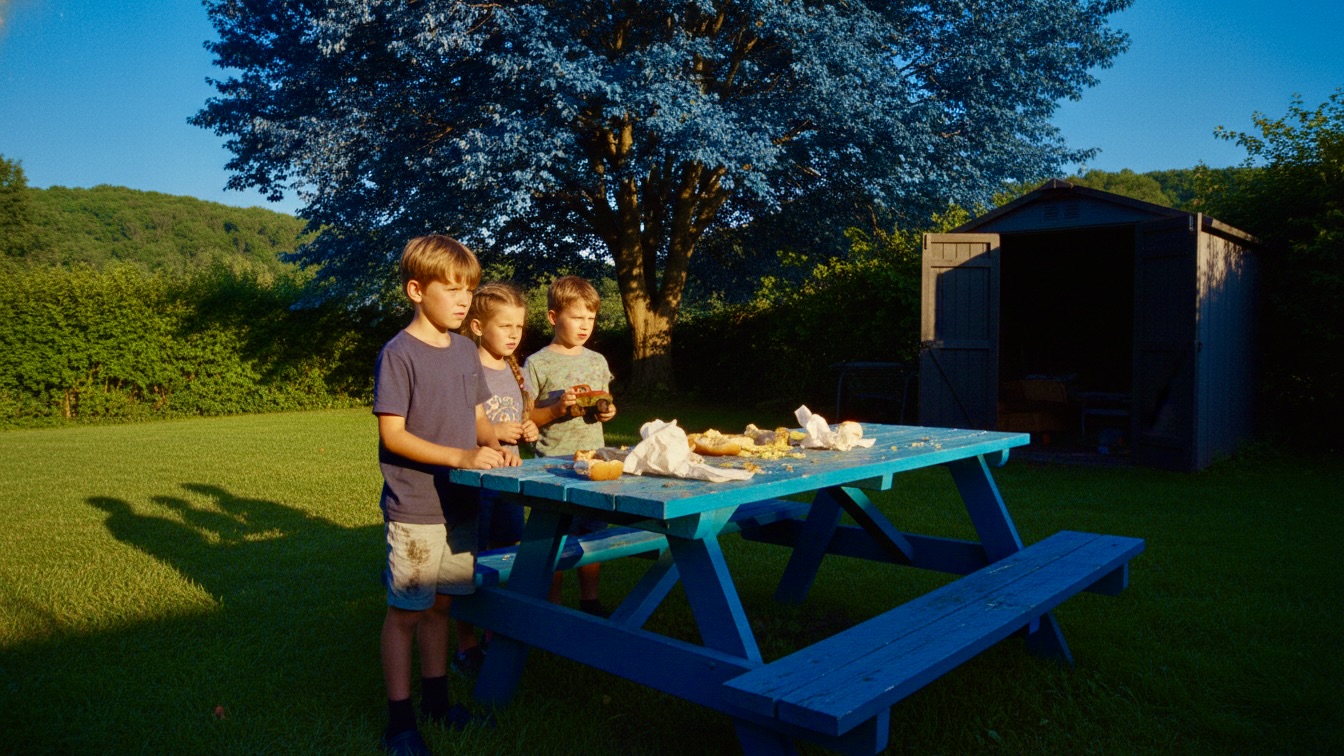
Leo watched the lemonade freeze in mid-pour while the sun turned a sharp, jagged purple over the valley's edge.
The plastic fork snapped. It was a clean, white break, right across the middle tine. I stared at the jagged edge. It looked like a tiny mountain range. The sun was beating down on the back of my neck, hot and heavy, like a warm hand pressing me into the grass. Everything was too bright. The yellow mustard on Toby’s hot dog was practically glowing, a neon stripe that hurt to look at. We were sitting at the blue picnic table, the one with the peeling paint that looked like maps of countries that didn't exist. Grandpa’s chair was empty. His napkin was still there, tucked under the edge of his plate so it wouldn't blow away, but there wasn't any wind. That was the first thing I noticed. The wind had just... quit.
"Leo, stop staring at your plate," Toby said. He was six, and his face was covered in a smear of ketchup that looked like a warrior’s mask. He was kicking his legs under the table. Thump. Thump. Thump. The sound was flat. It didn't echo. It didn't even sound like wood hitting wood. It sounded like someone hitting a pillow.
"I’m not staring," I said. I looked up. The trees at the edge of the yard were still. Not like they were waiting for something, but like they were pictures of trees. Every leaf was frozen. A blue jay was stuck in the air about ten feet above the birdfeeder. It wasn't falling. It wasn't flapping. It was just a blue speck suspended in the bright, white sky. I blinked, thinking maybe I had a headache. Sometimes when I get headaches, things get blurry. But this wasn't blurry. It was too sharp. I could see the individual scales on the blue jay’s legs.
"Where’s Grandpa?" Mia asked. She was sitting across from me, picking the crusts off her peanut butter sandwich. She didn't look up when she asked. She just kept peeling the brown bread away from the white bread with her tiny, dirt-stained fingernails.
"He went to the shed," I said. My voice sounded thin, like it was coming from a radio in another room.
"That was a long time ago," Mia said. She finally looked up. Her eyes were big and brown, and they looked watery. "The lemonade is weird, Leo."
I looked at the pitcher in the center of the table. It was full of ice and lemon slices. But the ice wasn't floating. It was sitting at the bottom, and the liquid on top wasn't moving. I reached out and tipped the pitcher. The lemonade didn't splash. It moved in one big, slow chunk, like yellow gelatin, then it just stopped halfway out of the spout. A single drop hung there, shaped like a diamond, refracting the sun into a million tiny rainbows on the tablecloth.
"Don't touch it," I whispered.
"Why?" Toby asked. He reached for his cup.
"Toby, stop," I said, sharper than I meant to. He pulled his hand back, his lip wobbling. I felt a cold spike in my chest. It wasn't fear, exactly. It was more like the feeling you get when you realize you’ve missed a step on the stairs in the dark. A hollow, dropping sensation. The sun was still hot, but I felt a shiver run down my spine.
I looked toward the shed. It was a small, grey building at the end of the gravel path. The door was hanging open. Grandpa always closed the door. He said the spiders liked to move in if you left it a crack open. But the door was wide, wide open, and inside, it was just black. Not the kind of black where you can see shadows of lawnmowers and rakes. It was a flat, empty black. Like someone had cut a hole in the world with a pair of scissors.
"He’s not in the shed," Toby said. He wasn't kicking the table anymore. He was holding onto the edge of the bench so hard his knuckles were white.
"I’ll go look," I said. I stood up. The grass felt crunchy under my sneakers. It didn't bend. It felt like walking on dried straw, even though it was green and lush this morning. I looked down at my feet. My shadow was gone. The sun was directly overhead, so my shadow should have been a little puddle around my shoes, but there was nothing. Just the green, stiff grass and my blue sneakers.
"Leo?" Mia’s voice was small. "The sun is turning purple."
I looked up. She was right. The edges of the sun were fraying, turning a deep, bruised violet. The light on the grass changed from golden to a weird, sickly lavender. The silence was getting louder. Usually, you can hear the highway from the valley, or the crickets, or the hum of the air conditioner in the big house. Now, there was nothing. It was the kind of silence that makes your ears ring.
"Stay here," I said. I started walking toward the shed. Every step felt heavy. The air felt thick, like I was walking through a swimming pool filled with invisible syrup. I looked back at the table. Mia and Toby were huddling together. They looked small. The blue table looked like a tiny island in a sea of purple grass. I realized then that I was the oldest. Mom and Dad were in the city for the weekend. Grandpa was the one in charge. And Grandpa was gone.
I reached the gravel path. The stones didn't crunch. They were silent. I picked one up. It felt light, like it was made of foam. I squeezed it, and it flattened between my fingers, then stayed that way. It didn't crumble. It didn't break. It just lost its shape. I dropped it, and it didn't make a sound when it hit the ground.
I stopped at the doorway of the shed. The blackness inside was vibrating. It wasn't a sound, but a visual hum, like the heat waves that rise off the asphalt in July. I reached out my hand, just a little bit. The tips of my fingers disappeared into the black. I didn't feel anything. No cold, no heat, no wind. It was just... nothing. I pulled my hand back. My fingernails were glowing with a faint, purple light.
"Grandpa?" I called out. My voice didn't go into the shed. It bounced off the blackness and fell flat at my feet. "Grandpa, the lemonade is stuck."
I waited. I wanted him to walk out, wiping grease off his hands with that red rag he always kept in his back pocket. I wanted him to tell me the sun was just doing something scientific and that I shouldn't worry. But the shed stayed black. The purple light in the yard grew darker. I looked at the house. The windows looked like silver coins. They weren't reflecting the yard anymore. They were reflecting a sky that wasn't there—a sky full of spinning white circles.
I turned around and ran back to the table. I didn't care about the silent gravel or the crunchy grass. I grabbed Mia’s hand and Toby’s arm.
"Inside," I said. "Right now."
"Where’s Grandpa?" Toby asked again. He was crying now, but the tears weren't running down his face. They were sticking to his cheeks in perfect, round spheres.
"He’s just... he’s busy," I said. It was a lie, and Mia knew it. She looked at me, her eyes searching mine, looking for the version of me that knew what to do. I tried to make my face look like a leader’s face. I tried to make my shoulders look wide.
"We’re going to the house," I said, my voice firmer. "We’re going to lock the doors and wait for the sun to turn back to yellow."
We started running. The porch steps were the hardest part. They felt soft, like sponges. Every time I stepped up, the wood sank beneath me. We scrambled through the screen door. It didn't slam. It just clicked, a tiny, plastic sound that felt way too small for how scared I was. Inside, the hallway was long and dark. The pictures of our family on the wall were changing. In the one from last Christmas, Grandpa’s face was just a blur of purple light.
I led them into the kitchen. The clock on the wall had stopped. The second hand was twitching back and forth, stuck between the twelve and the one. It sounded like a heartbeat. Tick-tock. Tick-tock. But it was too fast.
"Leo, the floor is moving," Mia whispered.
I looked down. The linoleum tiles were shifting, sliding over each other like a deck of cards. The yellow squares were moving left, and the white squares were moving right. The kitchen island was slowly sinking into the floor.
"Upstairs," I said. "To the attic."
I didn't know why I said the attic. It just felt like we needed to be as high as possible. Like the ground was no longer a safe place to be. We climbed the stairs, our feet heavy and clumsy. The air was getting colder, but not a nice, breezy cold. It was a still, frozen cold that made my lungs ache.
We reached the attic door. I pushed it open. The attic was full of old trunks and dusty lamps. But the window at the end of the room was the only thing I could see. Outside, the valley was gone. There were no trees, no shed, no blue picnic table. There was only a vast, swirling ocean of purple mist, and in the middle of it, a single, glowing white line that stretched from the ground to the sky.
"Is that where he is?" Mia asked, pointing at the line.
"I don't know," I said. I squeezed her hand. I felt a weird weight in my pocket. I reached in and pulled out the broken plastic fork from the picnic table. It was glowing now, the same purple as the shed.
I looked at my siblings. They were looking at me. Not at the mist, not at the white line, but at me. I realized then that I wasn't just the oldest kid anymore. I was the one who had to decide what happened next. I was the one who had to make sure we didn't turn into purple light too.
"Stay behind me," I said. "I’m going to open the window."
The window frame was swollen. It felt like the wood had spent the last hundred years underwater, even though it was a dry, parched summer. I gripped the latch. It was cold, so cold it felt like it was biting into my palm. I pulled, and the wood groaned, a sound like a giant folding a piece of cardboard. A sliver of the purple mist snaked inside. It didn't drift like smoke. It crawled. It moved along the floorboards, avoiding the shadows, seeking out the patches of violet light that were beginning to pool under the eaves.
"Don't let it touch us," Toby whispered. He was clutching a stuffed rabbit that had lost an eye years ago. The rabbit looked different in this light—its fur seemed to be vibrating, as if it were made of static.
"I won't," I said. I didn't know if I was lying. I felt like a paper boat in a storm, but I had to be a stone wall. I looked at the purple mist. It stopped a few inches from my sneakers. It seemed to be waiting.
I looked back at the kitchen table in my mind. The red plastic cup Toby had been using. I remembered how he’d dropped it right before we ran. Why was I thinking about a cup? Because it was real. It was something solid. I needed something solid. My hand went to my pocket again, feeling the broken fork. It was a tether.
"Mia, get the flashlight from the trunk," I ordered. My voice was cracking, sounding like a teenager's even though I was only eleven.
She scrambled over to a heavy wooden chest. The hinges screamed as she forced it open. She pulled out the big yellow Maglite Grandpa used when the power went out. She clicked it on. The beam was weak, a sickly yellow flicker that struggled against the purple gloom. But it worked. Where the light hit the mist, the mist pulled back. It didn't like the light. It curled away like a worm on hot pavement.
"Keep it on the floor," I said. "Keep it right in front of us."
I stepped toward the window. The white line in the distance was pulsing now. Every time it brightened, the whole attic shook. It wasn't a rumble you could hear; it was a rumble you felt in your teeth. I looked down at the yard again. The blue picnic table was still there, a tiny, defiant speck of color in the sea of violet. And then I saw it. A red plastic cup was rolling across the grass. But there was no wind. The cup was moving with purpose, tumbling toward the shed.
"Look," I pointed.
Toby peered over the sill. "My juice cup!"
"It’s going to the hole," Mia said. Her voice was flat, devoid of the usual kid-whine. She was growing up right in front of me, her face hardening into something sharp and observant.
"Grandpa’s in there," I said. I knew it then. The things that were 'real' were being pulled toward that blackness. The cup, the fork in my pocket, Grandpa. The world was sorting itself out, and we were on the wrong side of the filter.
"We have to go back down," I said.
"No!" Toby cried, hugging his rabbit tighter. "It’s scary down there. The floor is eating things."
"The floor isn't eating things, Toby. It’s just... changing," I said, though I didn't believe myself. "If we stay up here, we’re just waiting for the purple to get us. If we go down, we might find Grandpa. He’ll know how to fix the sun."
I took the flashlight from Mia. I aimed it at the stairs. The wood looked like it was melting. The edges of the steps were rounding off, turning into smooth, grey slopes. I shone the light directly on the first step. The wood solidified. The sharp edges returned. The light was a tool. It wasn't just for seeing; it was for holding things together.
"Okay," I said, a plan forming. "Mia, you hold onto Toby’s belt. Toby, you hold onto my shirt. Do not let go. If you let go, you might float away or turn into a blur. Understand?"
They both nodded. Toby’s eyes were wide, reflecting the yellow beam of the Maglite. We started the descent. Every step was a battle. I had to sweep the light back and forth, 'stitching' the stairs back into reality so we could step on them. If I moved the beam too fast, the step behind us would dissolve into a soft, doughy mess.
We reached the second-floor landing. The bathroom door was open, and the sink was overflowing. But the water wasn't falling to the floor. It was rising toward the ceiling in long, thin threads, like a thousand spiderwebs made of glass. I didn't stop to look. I kept the light on the path to the stairs.
"Don't look in the mirror," I warned as we passed the hallway glass. I had caught a glimpse of myself out of the corner of my eye. My face looked like it was made of pixels, some of them missing, showing the dark hallway behind me through my own forehead.
We reached the kitchen. It was worse now. The kitchen island had vanished completely. There was just a square hole in the floor that led into a bottomless purple void. The fridge was humming a high, screeching note that made my ears bleed. A tiny trickle of red ran down my neck, but I didn't have a hand free to wipe it.
"The door," Mia pointed.
The back door was gone. Not open, not broken, just gone. Where the door should have been, there was only the siding of the house, as if the entrance had never existed.
"The window," I said, pointing to the one over the sink.
I led them to the counter. I had to shine the light on the baseboards to keep the floor from sliding us into the void. I boosted Toby up onto the laminate. It felt like rubber.
"Jump to the grass," I said. "It’s not far. The light will hold the ground together."
I aimed the Maglite out the window, illuminating a patch of the yard. The grass there turned from purple back to green instantly. Toby jumped. He landed with a soft thud.
"I’m okay!" he shouted. His voice was muffled, like he was speaking through a thick blanket.
Mia went next. She didn't hesitate. She was a runner, a soccer player. She coiled her muscles and leaped, clearing the sink and the frame in one smooth motion. She landed next to Toby and immediately started waving her arms, trying to keep her balance on the shifting lawn.
I was alone in the kitchen. The screeching from the fridge was so loud now I couldn't think. I felt the floor under my feet start to tilt. The light in my hand flickered. The batteries were dying.
"Leo! Come on!" Mia’s voice was a tiny needle of sound.
I looked at the stove. A pot of water was still there, the steam frozen in a beautiful, intricate sculpture of white swirls. I grabbed the handle. It was room temperature. I threw the pot toward the void in the center of the room. It didn't fall. It hovered for a second, then began to spin, faster and faster, until it became a silver blur and vanished.
I didn't wait to see what happened next. I climbed onto the counter, the laminate groaning and stretching like a balloon under my weight. I aimed the dying flashlight at the ground one last time and jumped.
I hit the ground hard. The green grass felt like concrete. The impact rattled my brains. I rolled over, gasping for breath. The air was getting thinner. It felt like I was breathing through a straw.
"Where’s the light?" Toby asked.
I looked at my hand. The Maglite was gone. I must have dropped it when I hit the ground. I looked around. The yard was a nightmare of purple and silver. The only green left was the small circle where we stood. And it was shrinking.
"The shed," I said, pointing toward the black hole. "The cup went there. Grandpa is there. We have to go into the dark."
"But it’s the dark," Toby whispered.
"I know," I said. I pulled the broken fork from my pocket. It was glowing bright purple now, almost white. It was the only light we had left. "But it’s the only way out."
I stood up, my knees shaking. I felt a strange sense of calm. The fear was still there, but it was tucked away in a small box in the back of my mind. There was work to do. I was the leader. And a leader doesn't get to be afraid until the job is done.
"Hold on," I said.
We started walking toward the shed, three kids huddled around a broken plastic fork, walking through a world that was being erased around them.
The walk to the shed felt like it took hours. Time wasn't working right. I would take a step, and it felt like I’d been moving for a mile, but when I looked back, the house was still only a few yards away. The sun—or what was left of it—stayed in the same spot in the sky, a jagged purple wound that didn't move. It was perpetually six o'clock, that long-shadow time when the day is supposed to be cooling down, but the heat stayed, thick and airless.
"My feet feel heavy," Toby complained. He was dragging his sneakers. Every time they touched the grass, a little puff of purple dust rose up. It wasn't smoke. It was more like ground-up velvet.
"Just a little further," I said. I was looking at the shed. Up close, the blackness wasn't just a hole. It was a doorway that led to somewhere else. I could see things floating in the dark. A wrench. A garden hose. A single work boot. They were all hovering, slowly rotating in the void.
"Is that the cup?" Mia asked.
She was right. The red plastic cup was there, floating near the top of the doorframe. It looked perfectly normal, out of place in the swirling black. It was a beacon of the mundane.
We stopped a foot away from the entrance. The silence here was different. It wasn't just the absence of sound; it was a pressure against my eardrums, like being at the bottom of a deep pool. I looked at the fork in my hand. The light from it was pulsing in time with the white line in the distance.
"Okay," I said. I turned to face them. "I’m going to go in first. I’ll keep holding the fork. You guys hold onto my other hand. If I feel something pull, I’ll pull back. We stay together. No matter what."
"What if Grandpa isn't there?" Toby asked. He looked so small. His ketchup mask had faded into a dull brown smudge.
"He’s there," I said. I had to believe it. If he wasn't, then there was no one left to fix the world.
I took a deep breath. The air tasted like nothing. Literally nothing. It didn't have the metallic tang of the city or the sweetness of the valley grass. It was just empty. I stepped forward.
Crossing the threshold was like walking through a wall of cold water. My skin tingled, a million tiny electric shocks zapping my arms and legs. For a second, I couldn't see anything. The purple light of the fork was swallowed by the blackness. I felt Toby’s hand tighten on mine, his fingers digging into my palm.
"I’m here!" I shouted, but I couldn't hear my own voice. I could feel the vibration in my throat, but the sound was gone.
Then, the world tilted.
We weren't in a shed anymore. We were standing on a path made of shimmering grey stones that floated in a vast, starry expanse. But the stars weren't stars. They were objects. Thousands of them. I saw a bicycle, a toaster, a stack of newspapers, a lawn chair—all of them glowing with a soft, white light, drifting through the dark.
"Whoa," Mia’s voice whispered in my head. I didn't hear it with my ears; I felt it in my mind.
"Don't let go," I thought back. It worked. We were communicating through the touch of our hands.
We started walking along the floating path. It felt like walking on a trampoline. Every step sent ripples through the stones. I looked down. Below the path, there was nothing but a deep, swirling purple mist, the same stuff that had been crawling through the attic.
"Look!" Toby pointed.
Ahead of us, the path led to a large, circular platform. In the center of the platform was a wooden chair. It was Grandpa’s favorite chair, the one from the porch with the creaky left armrest. And sitting in it was Grandpa.
He looked the same, but different. His flannel shirt was bright and sharp, the red and black checkers looking like they’d been painted with neon. He was holding a small, glowing sphere in his hands, turning it over and over.
"Grandpa!" I thought as hard as I could.
He didn't look up. He was staring at the sphere. His face was set in a look of deep concentration, the kind he got when he was trying to fix the lawnmower engine.
We reached the platform. As soon as my feet hit the wood, the sound came back.
"...just needs a little more tension," Grandpa was muttering. His voice was gravelly and familiar. It was the best sound I’d ever heard.
"Grandpa!" Toby screamed, breaking away from me and throwing himself at the old man’s knees.
Grandpa jumped, nearly dropping the glowing sphere. He looked down, his eyes widening behind his thick glasses. "Toby? Mia? Leo? What in the name of... how did you get here?"
"We followed the cup," I said, stepping forward. My legs felt like jelly.
Grandpa looked at us, then at the blackness beyond the platform. He sighed, a long, heavy sound. "I told your grandmother we needed a better lock on that shed. The seams are fraying, Leo. The whole valley is starting to leak."
"What is this place?" Mia asked, touching the arm of the chair. It felt real. It didn't vibrate or melt.
"This is the Workshop," Grandpa said. He held up the sphere. It looked like a marble, but inside, I could see the whole valley. I saw our house, the blue picnic table, and three tiny figures standing in the yard. "It’s where the world gets put together. But the glue is drying out. I came in here to tighten the screws, but the door locked behind me."
"We can go back," I said. "The door is still open."
Grandpa shook his head. "It’s not that simple, son. Look at the house." He pointed into the sphere.
I looked. The house in the marble was turning purple. The roof was already starting to dissolve into mist.
"The leak is too big now," Grandpa said. "If I leave, the whole thing goes. Someone has to stay here and hold the center."
"No," I said. My voice was small, but steady. "You can't stay here. We need you. Mia and Toby are scared."
"I know they are," Grandpa said, his voice softening. He looked at me, really looked at me. "That’s why you’re here, Leo. I can't do it alone anymore. My hands are too shaky."
He reached out and took my hand. His skin was rough and warm. He placed the glowing sphere in my palm. It felt heavy, like a lead weight, but it was also buzzing with energy.
"You have to hold it," Grandpa said. "You have to keep the image of the house in your mind. If you stop thinking about it, it disappears."
I looked at the sphere. The tiny house was flickering. I thought about the kitchen, the smell of the old wood, the sound of the screen door slamming. The flickering stopped. The image became solid.
"Good," Grandpa whispered. "You’re a natural."
"But I can't stay here forever," I said. "I’m only eleven."
"You won't have to," Grandpa said. "We’re going to move the Workshop. We’re going to take it back to the house. But I need you to lead the way. I’ll carry the heavy stuff, but you have to keep the world from falling apart while we move."
I looked at Mia and Toby. They were watching me. They weren't looking at Grandpa for answers anymore. They were looking at me. The weight in my hand felt even heavier.
"Okay," I said. "What do I do?"
"Hold the sphere," Grandpa said. "And walk toward the white line. Don't look at the things floating in the dark. Just look at the line."
I nodded. I gripped the sphere tight. I could feel the power of it flowing up my arm, making my heart beat in time with the white light.
"Mia, take Toby’s hand," I ordered. "Grandpa, stay behind us. We’re going home."
We turned away from the platform. The path of stones was gone. In its place was a narrow bridge of white light that stretched across the purple void toward the glowing line. It looked thin and fragile, like a strand of silk.
"Is it safe?" Toby whispered.
"It’s as safe as I make it," I said. I stepped onto the light. It was solid. It felt like walking on glass.
We started to walk. The objects in the dark began to crowd around us. I saw a doll with no head, a broken clock, a rusted bicycle wheel. They were spinning faster now, whistling as they cut through the air.
"Keep your eyes on the line!" I shouted.
I felt a sudden pull. The sphere in my hand tried to jump away. The image of the house inside began to blur. I saw the kitchen floor sliding again. I saw the purple mist climbing the stairs.
"No!" I yelled. I squeezed the sphere with both hands. I thought about the blue picnic table. I thought about the way the lemonade looked when it wasn't stuck. I thought about the sound of Grandpa’s radio.
The sphere settled. The bridge of light grew wider.
We were halfway there when the first shadow hit us. It wasn't a physical thing, but a wave of cold that washed over the bridge. It felt like every sad thought I’d ever had was being pushed into my brain at once. I thought about my dog that died last year. I thought about the time I got lost in the mall.
"Leo, I’m scared!" Toby cried. He was slipping. His feet were losing their grip on the light.
I reached back and grabbed his collar. "I’ve got you! Don't listen to the cold! Think about something happy! Think about Christmas!"
"I can't!" Toby wailed.
"Then think about the hot dogs!" I yelled. "The ones with the neon mustard!"
I felt a surge of warmth. The shadow retreated. Toby regained his footing. We kept moving. The white line was close now. It was huge, a pillar of fire that reached into the infinite black.
"Almost there," Grandpa said. His voice sounded tired, but proud.
We reached the edge of the line. It wasn't fire; it was a curtain of pure, white energy. I could see the shed on the other side. I could see the yard, the grass, the trees. It looked like a photograph.
"On three," I said. "One. Two. Three!"
We jumped.
We didn't land in the shed. We landed in the middle of the yard, right next to the big beech tree. The air hit me first—it was hot and thick, but it was real air. I could feel the humidity on my skin. I could hear a cricket chirping somewhere near the porch.
I scrambled to my feet. Grandpa was lying in the grass, breathing hard. Mia and Toby were tangled in a heap, looking dazed but whole.
"Is it over?" Toby asked. He reached up and touched his face. The ketchup was gone.
I looked at the sun. It was yellow. A beautiful, blinding, normal yellow. The purple was gone. The shadows were where they were supposed to be.
"I think so," I said. I looked at my hand. The sphere was gone. My palm was empty, except for a faint, white glow that was already fading.
"Leo," Mia whispered. She was pointing at the beech tree.
I looked up. The tree was different. It was huge, taller than the house, but its bark was silver, and its leaves were a deep, dark blue. It looked like it belonged in a storybook. In the center of the trunk, there was a hollow, and inside the hollow, I could see a faint, purple light.
"The leak," Grandpa said, sitting up slowly. He wiped his glasses on his shirt. "It’s still there. But the tree is holding it now. It’s a seal."
"Will it stay?" I asked.
"As long as someone keeps an eye on it," Grandpa said. He looked at me, and I saw a flicker of something in his eyes. It wasn't just grandfatherly love; it was respect. "I think you’re the one for the job, Leo."
I looked at the tree. I felt a strange connection to it. It was like I could feel the roots digging into the earth, holding the world together. It wasn't a scary feeling anymore. It was a responsibility.
"What about the picnic?" Toby asked, his stomach giving a loud growl.
We all laughed. It was a shaky, nervous laugh, but it felt good. We walked back to the blue picnic table. The lemonade was liquid again. A fly was buzzing around the pitcher. The broken fork was lying on the ground, just a piece of white plastic.
Grandpa sat in his chair. He picked up his napkin and tucked it back under his plate. "Well," he said, looking at the hot dogs. "I think these might be a little cold."
"I don't care," Toby said, taking a huge bite.
We sat there for a long time, eating and watching the sun go down. It was a normal sunset, full of oranges and reds. The purple stayed inside the beech tree, a tiny, contained secret.
I looked at my hands. They were steady now. I didn't feel like a kid anymore. I felt like a guardian. I looked at Mia and Toby. They were arguing over the last bag of chips, their voices loud and bright. They were safe.
"Leo?" Mia said, looking at me. "You want some?"
"Sure," I said.
I took the chip, but I kept my eyes on the tree. The light in the hollow pulsed once, a soft, friendly glow. I knew then that the world would never be exactly the same. The magic was here now, hidden in the shadows and the bark of the trees. But I wasn't afraid. I had the fork—or the memory of it. And I had the weight of the sphere in my mind.
As the stars began to come out, they weren't floating objects anymore. They were just points of light in the sky. But I knew the truth. I knew what was behind the curtain.
Grandpa leaned over and patted my shoulder. "You did good, kid. You did real good."
"Thanks, Grandpa," I said.
I looked up at the moon. It was white and round, like a giant marble. I imagined I could see a tiny house inside it, with a blue picnic table and three kids sitting in the yard. I smiled.
Tomorrow, I’d have to figure out how to explain the blue leaves on the beech tree to Mom and Dad. But for now, the lemonade was sweet, the crickets were singing, and my family was whole.
I stood up and started clearing the plates.
"I’ll get the trash," I said.
"I’ll help!" Toby shouted, jumping up.
"Me too," Mia said.
We walked toward the house together, our shadows long and dark against the cooling grass. The summer night felt perfect. It felt solid. It felt like home.
I looked back one last time at the shed. The door was closed. I’d have to check the lock tomorrow. Just to be sure.
But for tonight, I was just Leo. And that was enough.
I felt the cool breeze on my face, the first one of the evening. It carried no scent, just the sensation of moving air. I closed my eyes for a second, listening to the rhythm of the valley. It was a good song. A steady song.
I was ready for whatever came next.
“But as I turned the key in the back door, I noticed my own reflection in the glass was still missing its left eye.”


