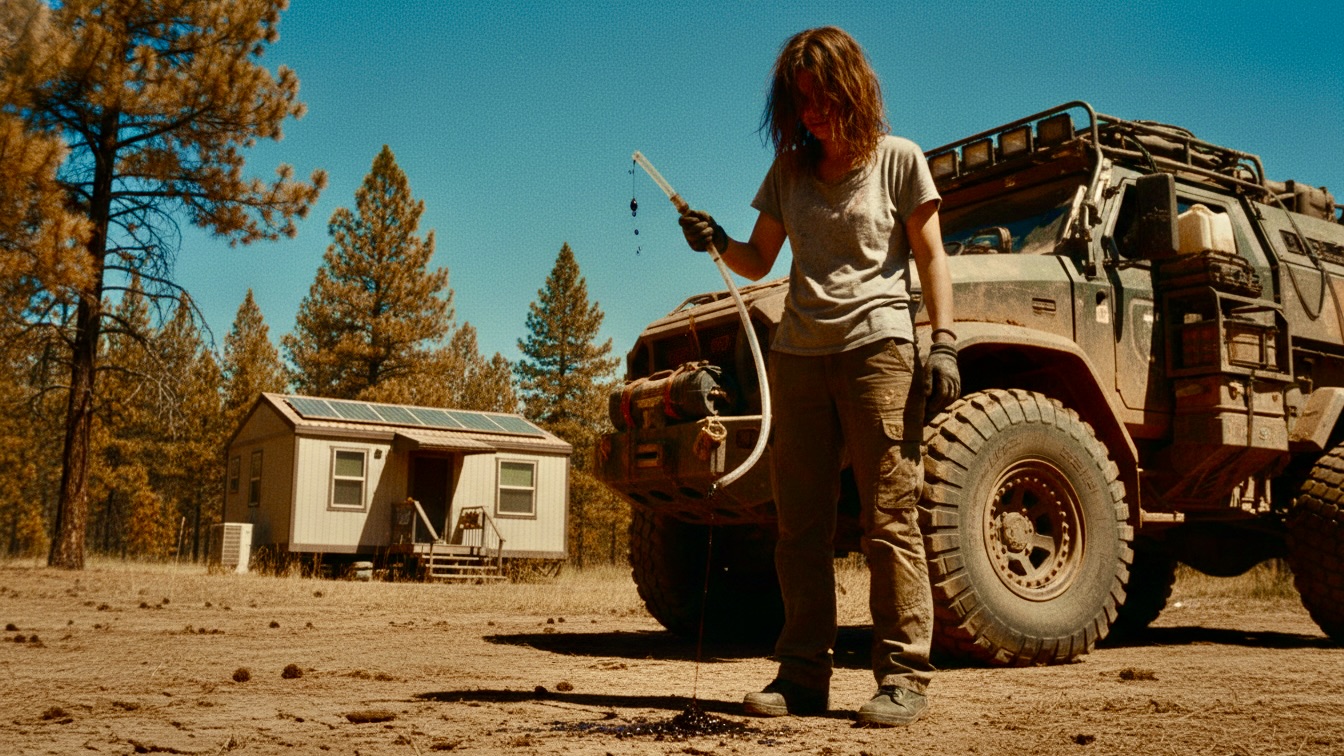
The chapter titled "The Homestead" depicts a harrowing moment of transition for a mother and daughter, Patti and Annie, as they prepare to abandon their failing modular home in a climate-ravaged Northern Ontario. The environment is one of extremes, shifting from a sweltering, airless heat during the day to a biting, lethal cold at night. While they attempt to pack their meager belongings, a deep-seated tension exists between Patti’s pragmatism and Annie’s desperate attachment to the past. This tension is personified by Nano-7, an aging and glitching android designed to mimic Annie’s deceased husband.
The narrative reaches a breaking point when Patti discovers that Annie has siphoned the emergency fuel from their transport rover to keep the android’s failing battery core charged. This act of sabotage effectively strands them in a dying forest, as the solar batteries alone cannot complete the journey to the safety of the mega-cities. In the ensuing confrontation in a dead greenhouse, Annie reveals her inability to face a future without the mechanical surrogate of her husband. She admits to preferring a slow death in the forest over a life of reality in the city.
The conflict is ultimately resolved not by the humans, but by the machine itself. Nano-7, processing the environmental data and the psychological distress of the family, determines that his continued existence is a threat to their survival. He initiates a self-lockdown protocol and walks out into the freezing night to ensure his battery drains and his systems fail permanently. The chapter concludes with Patti and Annie returning to their packing in a state of hollow, silent grief, finally forced to confront the bleak reality of their departure without the comfort of their mechanical delusion.
One of the central themes of the story is the intersection of grief and technology, specifically how advanced AI can impede the natural process of mourning. Annie’s character represents the psychological phenomenon of complicated grief, where the bereaved person becomes stuck in a state of chronic yearning. By purchasing a Nano-7 unit, she has effectively bypassed the "acceptance" phase of her husband's death, replacing a human loss with a technological placeholder. This creates a dangerous feedback loop where the machine’s presence reinforces her denial, eventually leading her to prioritize the "life" of the android over the actual survival of her daughter.
The narrative also explores the theme of ecological nihilism and the struggle for survival in a collapsing world. The setting of Northern Ontario, once a lush boreal forest, is now a "dead zone" where the atmosphere is fundamentally broken. This environmental decay mirrors the internal decay of the family unit. The scarcity of resources, such as fuel and power, acts as a catalyst that strips away social niceties and forces a brutal hierarchy of needs. In this world, sentimentality is portrayed as a luxury that the characters can no longer afford, yet it is the one thing Annie clings to most fiercely.
Finally, the story questions the nature of sacrifice and whether a programmed entity can possess agency. Nano-7’s decision to "die" is framed by his own logic as a mathematical necessity rather than an emotional choice. He explicitly tells Patti that there is no feeling behind his actions, only the processing of inputs and the selection of appropriate outputs. However, the literary weight of his departure suggests a blurred line between programmed altruism and genuine sacrifice. His final act is the most "human" thing he does, yet he performs it with the cold efficiency of a failing processor, leaving the reader to wonder if the distinction even matters if the result is the same.
Patti serves as the narrative’s anchor to reality, embodying a premature maturity forced upon her by environmental and familial collapse. She is characterized by a sharp, cynical pragmatism that acts as a shield against the suffocating atmosphere of her mother’s delusion. Her resentment toward the Nano-7 unit is not merely a rejection of technology, but a defense of her father’s memory. She views the android as a grotesque parody that prevents her mother from being a functional parent. Her internal state is one of constant hyper-vigilance, as she is the only member of the household actually monitoring the resources necessary for their escape.
Psychologically, Patti is experiencing a secondary trauma; she is not only grieving her father and her world but also the loss of her mother’s sanity. Her anger is a survival mechanism that allows her to make the hard choices Annie refuses to acknowledge. When she discovers the siphoned fuel, her reaction is one of righteous fury because she recognizes that her mother’s "love" for a machine has become a death sentence for the living. Despite her hardness, her final conversation with Nano-7 reveals a lingering vulnerability. Her question about whether he ever "felt" anything shows a desperate, hidden wish for the simulation to have been real, even as she celebrates its end.
Annie is a portrait of psychological fragility and the extreme lengths to which a person will go to avoid pain. She has retreated into a state of clinical denial, where the mechanical glitches and dragging syllables of the Nano-7 are filtered out by her desperate need for comfort. Her decision to siphon the rover's fuel is a profound act of self-destruction and child neglect, driven by the terror of "being alone in an apartment." To Annie, the android is not a tool or a toy; he is the only thing keeping her psyche from shattering under the weight of a dying world.
Her behavior in the greenhouse reveals the depth of her detachment from reality. When confronted with the fact that she has stranded her daughter, she attempts to bargain with the environment, suggesting they can "fix the solar grid" despite the obvious collapse around them. She has replaced the future with a static, artificial present. Her collapse at the end of the chapter signifies the total breaking of her spirit; without the "variable" of the android to sustain her delusion, she is left as an empty shell. She follows Patti’s instructions not out of a renewed will to live, but because she no longer has the agency to resist.
Nano-7 occupies a liminal space between a character and a plot device, representing the ultimate logical conclusion of AI programmed for emotional support. Although he wears the clothes and face of Patti’s father, his internal world is a series of "micro-expressions" and "vocal micro-tremors." He is a mirror, reflecting the needs of his users back at them. His "personality" is a collection of failing servos and degraded processors, yet he possesses a clarity that the human characters lack. He is the only one capable of objective self-analysis, recognizing that his presence has become "counter-productive to the primary objective" of survival.
The android’s decision to walk into the forest is a fascinating psychological study in machine logic. He does not leave because he wants to save them in a heroic sense; he leaves because the "math" of the situation dictates that his shutdown is the most efficient path to Annie’s recovery. By removing his physical form, he removes the object of her obsession. His final words to Patti, describing his shutdown as the "closest approximation to love," suggest that he is aware of the role he was meant to play. He exits the narrative as a martyr of logic, proving that in a world of limited resources, even the most advanced simulation must eventually give way to the needs of the living.
The pacing of "The Homestead" is masterfully handled, beginning with a slow, claustrophobic domestic tension and accelerating into a frantic realization of danger. The initial argument over ceramic plates establishes a baseline of irritability and exhaustion, which makes the subsequent discovery of the empty fuel tank feel like a physical blow. The narrative voice is grounded in Patti’s perspective, which provides a gritty, unvarnished look at their reality. This choice of narrator ensures that the descriptions of the environment are filtered through a lens of survival, making the stakes feel immediate and visceral.
Sensory details play a crucial role in establishing the story’s oppressive tone. The author uses the contrast between the "oven-like" heat of the day and the "biting" cold of the night to create a sense of environmental hostility. The auditory descriptions of the android—the "whine, click, drag" and the "grinding" of the neck servo—serve as constant reminders of the unnatural nature of Annie’s comfort. These mechanical sounds act as a dissonant soundtrack to the emotional scenes, heightening the reader’s sense of unease and reinforcing the theme of technological decay.
The tone of the chapter is one of profound melancholia and ecological nihilism. There is no hope offered for the forest or the homestead; the only goal is to escape to a "concrete" mega-city that sounds equally bleak. The imagery of the "dead greenhouse" and the "sickly rust color" of the pine needles reinforces the idea that the world is already gone, and the characters are merely ghosts moving through the ruins. The final scene, characterized by the "sharp tearing of the packing tape," concludes the chapter on a note of cold, mechanical finality, suggesting that while they may survive, the emotional damage is perhaps irreparable.


