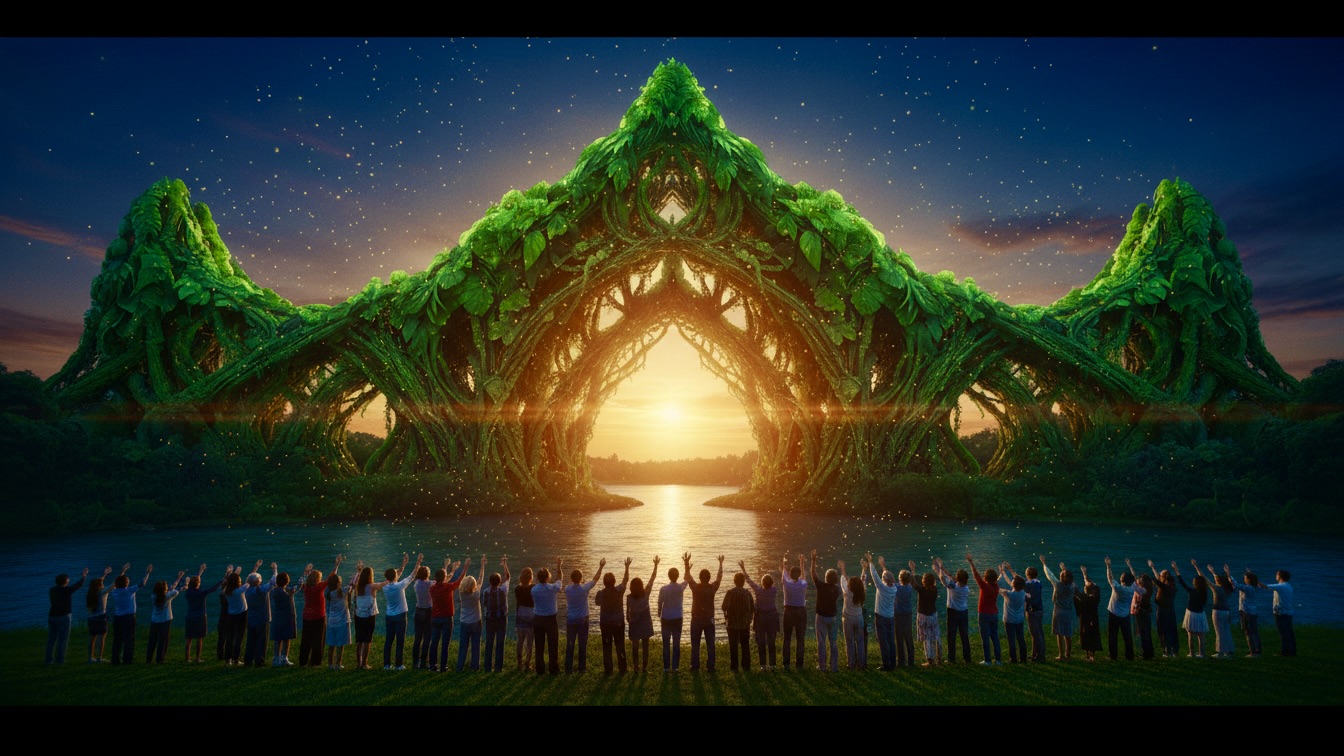
A massive vine network erupts from the Red River, stitching Winnipeg together and ending human isolation through a telepathic link.
The Red River was never supposed to move like that. It was late July, the kind of Winnipeg summer that feels like being trapped inside a damp wool blanket. The humidity was sitting at ninety percent, and the air was thick with the smell of stagnant water and hot asphalt. I was standing on the Osborne Street Bridge, staring down at the brown water, trying to figure out if I could afford the property tax hike. Then, the water didn't just ripple; it buckled. A massive, wet green shape broke the surface. It looked like a cable at first, something the city might have dropped during a construction project. But it was moving against the current. It was a vine, thick as a human torso, covered in leaves that looked like hammered emeralds. It didn't just float. It struck the bridge piling with a sound like a wet punch. Then another one followed. And another. Within seconds, a dozen of these things were climbing the concrete, their thorns digging into the cracks with terrifying precision.
"Mother, do you perceive the structural shift?" Daniel said. He was standing three feet away, his eyes locked on his phone until the vibration of the bridge forced him to look up. He didn't drop his device, but he gripped it so hard his knuckles went white. He was nineteen, a child of the digital static, usually more interested in frame rates than the physical world. But even he couldn't ignore the way the bridge was beginning to groan under the weight of the growth. The vines weren't just climbing; they were weaving. They moved with a purpose that felt calculated, like a 3D printer working in real-time. They crossed the lanes of traffic, wrapping around stalled SUVs and bus stop benches. People were screaming, abandoning their cars, but the vines didn't touch them. They just claimed the metal. They claimed the concrete. They were stitching the city back together, one bridge at a time.
"We need to move, Daniel," I said. My voice felt thin against the low, rhythmic hum that was beginning to rise from the river. It wasn't a sound you heard with your ears; it was a vibration in your teeth. The vines were pulsing. A soft, lime-green light moved through the stalks, timed to the beat of a heart that was much larger than anything human. I grabbed Daniel’s arm, pulling him toward the south end of the bridge. The asphalt was already cracking as smaller shoots erupted through the pavement. They looked like green hands reaching for the light. By the time we reached the end of the block, the Osborne Street Bridge was no longer a piece of civil engineering. It was a living, breathing green tunnel, glowing with a bioluminescent rhythm that made the streetlights look pathetic and dim.
"It is not merely growth," Daniel whispered, his voice shaking with a mix of terror and something that looked dangerously like awe. "It is a network. Look at the way they are interfacing with the power lines. They are not destroying them. They are absorbing them." He was right. The vines had reached the utility poles, wrapping around the transformers. Instead of a short circuit, there was a bright flash of white light, and then the vines began to glow even brighter. The hum grew louder. My phone buzzed in my pocket—a notification that the Wi-Fi signal was at maximum strength, despite the fact that we were standing in the middle of a collapsing intersection. The SSID didn't have a name. It was just a string of symbols that looked like a leaf pattern. The world was changing in seconds, and all I could think about was the fact that I had left the back door unlocked. We ran toward home, our feet slapping against a sidewalk that was rapidly being replaced by a carpet of soft, mossy growth.
When we reached our street, the transformation was already complete. Every house in the neighborhood was encased. It looked like the forest had reclaimed the suburbs in a single afternoon. The vines had climbed the brickwork of our small bungalow, sealing the gaps in the mortar and weaving a thick canopy over the roof. Our front door was barely visible behind a curtain of broad, waxy leaves. I pushed through them, the texture feeling like cold, wet leather against my skin. Inside, the house was dark, but the air was different. It didn't smell like the old wood and dust of a hundred Winnipeg winters. It smelled like a forest after a heavy rain—sharp, clean, and filled with a strange, electric charge that made the hair on my arms stand up. I walked into the living room and stopped. A single vine had punched through the drywall near the ceiling. It wasn't a violent break; the plaster had simply parted to make room. The vine was tracing the line of the crown molding, its tiny tendrils vibrating with that same green light.
"Daniel, stay away from the walls," I warned. I felt a surge of maternal panic, the kind that usually involves stove burners or sharp knives. But this was different. This was the environment itself becoming active. I went to the kitchen to find a knife, some way to hack the thing back, but when I touched the handle of the drawer, a wave of calm washed over me. It wasn't a feeling; it was a directive. The house didn't want me to be afraid. I could feel the house—no, the network—pulsing against the palms of my hands. It was a massive, collective presence. It was the feeling of a thousand people breathing in unison. I dropped my hand, my heart hammering against my ribs. Daniel was already in the corner, his phone discarded on the rug. He was staring at the vine on the wall, his hand hovering just inches from a glowing thorn.
"Mother, the latency is gone," he said. He looked at me, and for the first time in years, he wasn't looking through me. His eyes were focused, bright with a terrifying clarity. "I can feel the signal. It isn't just data. It’s... everything." He reached out and touched the thorn. I screamed his name, but he didn't flinch. He didn't pull away. Instead, his entire body relaxed. A soft green light bled from the vine into his fingertips, tracing the veins in his hand like a map. He closed his eyes, and a small, peaceful smile touched his lips. He looked like he was finally hearing a song he had been trying to remember his entire life. I stood there, paralyzed, watching my son interface with a plant while the city of Winnipeg disappeared under a tide of green fiber.
I woke up the next morning to a room that was bathed in a submarine light. The sun was up, but it couldn't get through the glass. My bedroom window was completely sealed by thick, leafy stalks that had grown over the panes during the night. I sat up, my chest tight. The silence was absolute. No traffic from the nearby expressway, no sirens, no distant hum of the city’s aging electrical grid. Just the soft, rhythmic thumping of the vines. It sounded like a giant cat purring somewhere deep in the foundations of the house. I got out of bed and walked to the window, pressing my hand against the glass. The leaves on the other side moved, responding to my heat. They shifted slightly, allowing a tiny sliver of golden summer light to pierce through. It was hot out there, I could tell by the way the glass felt, but the room stayed a perfect, cool twenty degrees. The vines were acting as a living heat sink.
"Daniel?" I called out, my voice sounding unnervingly loud in the stillness. I walked into the hallway, noting how the vines had progressed. They were no longer just tracing the ceiling; they were integrating. One thick root had grown down the hallway wall, its surface smooth and slightly iridescent. It had pushed aside a framed photo of my wedding—the one I had been meaning to take down for five years—and replaced it with a cluster of small, pale flowers that looked like they were made of glass. I didn't feel the urge to scream this time. The air in the house was so oxygen-rich it felt like drinking cold water. It was impossible to be truly panicked when every breath felt like a shot of pure energy. I found Daniel in the kitchen. He hadn't slept. He was sitting at the table, but he wasn't eating. He was staring at the wall where our kitchen joined with the neighbor’s house.
"The structural integrity of the drywall has been compromised, Mother," Daniel said. He spoke with a formal weight, his usual teenage mumble replaced by a theatrical clarity. "But the biological integrity is superior. Look." I followed his gaze. The wall between our kitchen and the Millers' living room was effectively gone. In its place was a dense, woven screen of vines and broad leaves. It wasn't a hole so much as a transition. I could see the edge of Mrs. Miller’s floral sofa through the gaps. I could hear her breathing. Then, I heard something else. It wasn't a sound, but a thought that arrived in my head with the force of a memory. I wonder if I left the kettle on. It was Mrs. Miller’s voice, clear as a bell, vibrating through the leaves. I jumped back, knocking over a kitchen chair.
"Did you hear that?" I whispered. Daniel nodded slowly. He didn't look surprised. He looked satisfied. "The vines are conductive, Mother. They carry more than just bio-electricity. They carry consciousness. The neighbor is currently experiencing mild anxiety regarding her kitchen appliances. It is quite loud if you focus on it." He reached out and touched the leaf screen. I saw his expression shift, his brow furrowing as he processed a flood of data. "She is also thinking about her late husband’s collection of porcelain birds. She fears they are being crushed by the growth. I should probably inform her that the vines are actually cushioning them. The plant has a high degree of empathy for fragile objects."
Before I could process the fact that my son was now a telepathic plant-human hybrid, the front door burst open. Or rather, the vines covering the front door parted like a stage curtain. Grandma Rose marched in, carrying a heavy canvas tote bag and wearing her gardening gloves. She looked like she had just finished a marathon, but her eyes were sparking with a fierce, vindictive joy. She lived six blocks away, and the fact that she had made it through the green-choked streets at seventy-five was a miracle. She took one look at the kitchen wall and let out a sharp, dry laugh. She dropped her bag on the counter, and I heard the unmistakable clink of preserve jars.
"I told you, Helen," Rose said, stripping off her gloves. "I told you the Earth was going to get tired of our bullshit. We spent a century screaming at each other through plastic boxes and burning everything we could touch. The Green Mind finally had enough. It’s put us all in a timeout." She walked over to the vine on the wall and patted it like it was a prize-winning retriever. The vine pulsed a warm orange in response. "It’s about time we had some peace and quiet. No more internet, no more news cycles, no more politicians barking about growth rates. Just the roots and the soil. It’s honest."
"Grandma, the internet is not gone," Daniel corrected her, his voice carrying that new, resonant tone. "It has merely been upgraded. The vines provide a high-speed bio-link that far exceeds any fiber-optic cable. I can access the collective memory of the entire Red River Valley if I simply hold my breath and concentrate. It is actually fire." Rose rolled her eyes and started unpacking her bag. She pulled out a jar of her homemade pickles and a loaf of sourdough. "Call it whatever you want, kid. All I know is that the power went out three hours ago and my fridge is still cold because the moss wrapped around it is sucking the heat out. Now, sit down. We’re having breakfast. The vines are hungry, and so am I."
As we sat at the table, the reality of our new life began to sink in. We weren't just a family in a house anymore. We were nodes in a massive, living organism. Every time I shifted my weight in my chair, I could feel the ripple of movement through the floorboards as the roots adjusted to support me. I could feel Daniel’s excitement, a bright, buzzing energy in the back of my skull. I could feel Grandma Rose’s stubborn satisfaction, a solid, earthy weight. The privacy of my own mind was leaking out through the walls, and strangely, the terror I expected to feel was absent. There was a profound sense of being held. For the first time since my husband left, the house didn't feel empty. It felt crowded with the lives of everyone on the block, all of us stitched together by a summer growth that didn't care about our fences or our locked doors.
By noon, the concept of a private meal had become an artifact of the past. The vine-screen between our kitchen and the Millers' had thinned even further, until it was more like a beaded curtain than a wall. Mrs. Miller, a woman who had spent the last decade complaining about the height of my grass, stuck her head through a gap in the leaves. Her hair was a mess of gray curls, and she was holding a half-eaten apple. She didn't look angry. She looked dazed. "Helen?" she asked, her voice trembling. "I can hear your thoughts about the property taxes. They’re very loud. Could you perhaps think about something else? I’m trying to focus on my crossword."
I felt a flush of heat creep up my neck. "I’m sorry, Margaret. I’m trying to keep it down, but it’s hard to control the volume." It was the most honest conversation we had ever had. There was no point in pretending; the vines were a literal lie detector. If I felt annoyed, the leaves near her turned a sharp, prickly yellow. If I felt sympathetic, they softened into a deep, velvety blue. We were all being forced into a state of radical authenticity. Daniel, meanwhile, was fascinated by the biology of it. He had found a cluster of small, heavy fruits hanging from the vine near the toaster. They were translucent, the color of a summer sky, and they smelled like nothing I could name. They didn't smell like food; they smelled like an idea of food.
"The network is producing manna-fruit," Daniel announced, plucking one from the stem. He held it up to the light, and I could see a complex network of fibers inside, pulsing with a faint golden glow. "It is a response to the collapse of the supply chain. The plant understands that we can no longer access the grocery stores. It is synthesizing nutrients based on our specific biological needs." He took a bite, and his eyes widened. "It tastes like the steak you used to make on my birthday, Mother. The one with the garlic butter. But the texture is like a ripe peach. It is mathematically perfect sustenance."
Grandma Rose grabbed one and took a massive bite. "Tastes like my mother’s cabbage rolls," she grunted, juice dripping down her chin. "A bit heavy on the dill, but I’m not complaining. It beats the hell out of those meal-prep kits you keep buying, Helen." I took a fruit for myself. As soon as my teeth broke the skin, a rush of flavor hit me. It was the exact taste of the cinnamon toast my father used to make me when I was six and had the flu. It was warm, comforting, and filled with a nutritional density that made my muscles stop aching. The vines weren't just connecting us; they were mothering us. It was a terrifying form of charity. Capitalism hadn't just crashed; it had been made redundant by a plant that grew in the cracks of our floorboards.
But not everyone was ready to accept the green grace. Around two in the afternoon, the sound of heavy machinery broke through the silence of the street. I looked through the leaves of the front window and saw a city truck crawling down the road. It was equipped with a massive sprayer, manned by men in white hazmat suits. I recognized the lead officer—Fredricks, a man who had once given me a ticket for an expired meter. He looked miserable in his plastic suit, sweat fogging his visor. They began to douse the vines with a thick, milky-white herbicide. The smell was horrendous—a chemical, oily stench that made the vines shiver and turn a sickly, bruised purple.
"They are attempting to sever the connection," Daniel said, his voice dropping an octave. He stood up, his hand pressed against the kitchen wall. I could feel his anger through the link; it felt like a hot, sharp needle in my brain. "They do not understand that the herbicide is merely a carbon source. The network will not be denied." As we watched, the vines didn't die. They didn't even wither. They began to drink. The purple hue vanished, replaced by a brilliant, aggressive neon green. The stalks thickened, growing at a visible rate, their thorns elongating into sharp, crystalline points. The vines surged toward the truck, wrapping around the wheels and the sprayer arm. Within minutes, the vehicle was a green mound, and the men in hazmat suits were sprinting back toward the main road.
"The government is a vestigial organ," Daniel remarked, returning to his seat. "It is trying to regulate a forest with a spray bottle. It is an exercise in futility." He looked at me, and for a second, I saw the flicker of the boy I used to know—the one who was afraid of the dark and hated vegetables. But it was gone in an instant, replaced by the calm, terrifying certainty of the Green Mind. "Mother, we cannot stay in this house forever. The network is calling a gathering at the Forks. The spores are ready to release. We need to witness the blossoming."
I looked at Grandma Rose, hoping for a voice of reason, but she was already putting her gloves back on. "He’s right, Helen. You can’t hide in the kitchen while the world turns into a garden. Besides, I want to see what those idiots at City Hall look like now that their offices are full of ferns. I bet the mayor is having a literal heart attack." I realized then that I didn't have a choice. The house was no longer a fortress; it was a cocoon. And the summer was only getting hotter. I grabbed my keys, though I knew they were useless now, and followed my family out into the green-veined streets of Winnipeg. The air outside was humming with the sound of a million leaves vibrating in the wind, a song of a city that was finally learning how to breathe together.
The walk to the Forks was like navigating a dream designed by a structural engineer who had lost their mind. Broadway, once a grey corridor of law offices and government buildings, was a canyon of emerald light. The vines had climbed the stone facades, bridging the gaps between the skyscrapers to create a living ceiling. Beneath it, the air was cool and smelled like damp earth and crushed mint. We weren't alone. Hundreds of people were walking toward the river, their movements synchronized in a way that felt both beautiful and eerie. No one was looking at a screen. There were no phones, no tablets. Everyone was touching the vines as they walked, their fingers trailing along the glowing stalks like they were reading Braille. The silence was heavy, but it wasn't empty; it was full of the collective hum of thousands of minds sharing a single, peaceful frequency.
"Look at the Legislative Building," Rose whispered, pointing toward the dome. The Golden Boy was still there, but he was no longer alone. A massive vine had wrapped around his legs, spiraling up his torso until it reached his torch. From the tip of the torch, a giant, pale flower had bloomed, its petals stretching ten feet across. It looked like a lily made of moonlight. It was beautiful, but it was also a flag of surrender. The old order of laws and borders had been replaced by a biological mandate. We kept moving, our feet sinking into the thick moss that had replaced the asphalt. I saw Officer Fredricks again, standing by a redundant traffic light. He had taken off his hazmat suit. He was sitting on a bench that was being slowly consumed by ivy, his head in his hands. He looked like he was crying, but when I passed him, I felt his mind. It wasn't sorrow; it was relief. The weight of the badge, the weight of the rules—it had all evaporated.
At the Forks, where the Red and Assiniboine rivers meet, the vines had achieved their masterpiece. They had woven a cathedral. A massive, vaulted structure of wood and leaf rose hundreds of feet into the air, spanning the entire meeting point of the waters. It was translucent, allowing the orange light of the setting sun to filter through in long, dusty shafts. Inside, thousands of people were gathered. They were sitting on the grass, standing on the docks, leaning against the living pillars. There was no stage, no leader. Just a shared sense of presence. I saw people who would have never spoken to each other in the old world—businessmen in ruined suits, homeless teenagers, young mothers, elderly veterans—all sitting together in a massive, overlapping circle.
"The connectivity is absolute here," Daniel said, his voice barely a whisper. He walked toward the center of the cathedral, his hand outstretched. I followed him, my heart skipping a beat as we approached a group of people standing near a pile of discarded wood and gasoline cans. These were the Purists—a small, desperate group of men and women who were still holding onto their lighters and their rage. They looked haggard, their eyes red from the pollen in the air. One of them, a man with a thick beard and a jagged scar across his cheek, raised a torch. "It’s a parasite!" he screamed, though his voice lacked conviction. "It’s taking our minds! It’s making us into cattle! We have to burn it out!"
He stepped toward a thick cluster of vines, his hand trembling as he moved the flame closer. The crowd didn't move. No one tried to tackle him. No one shouted. Instead, everyone simply reached out and touched the nearest vine. I felt the collective shift in the atmosphere—a wave of pure, unadulterated empathy that surged through the network. It wasn't a physical force; it was a psychological one. The man with the torch froze. His eyes widened as the empathy-link hit him. He wasn't being attacked; he was being heard. He could feel the peace of the people around him, the lack of hunger, the absence of the crushing loneliness that had defined the digital age. His torch lowered. The fire sputtered and went out. He dropped the can of gasoline and fell to his knees, sobbing. A woman nearby, a stranger, stepped forward and placed a hand on his shoulder. The vines around them glowed a soft, forgiving gold.
"He realizes he doesn't have to fight anymore," Daniel said, looking at the man with a strange, detached pity. "The resistance is a symptom of a localized ego. But the network is a universal truth. There is no 'I' here, Mother. There is only 'Us.'" I looked at my son, and for the first time, I felt a flicker of the old fear. I didn't want to lose him to a hive mind. I didn't want to lose my own messy, complicated self. But then, the vines began to blossom. It happened all at once. Thousands of small, blue flowers opened along the ceiling of the cathedral, and a cloud of shimmering spores began to drift down like summer snow. As the spores touched my skin, the fear vanished. It was replaced by a profound sense of shared history. I could see the city as it was a hundred years ago, and as it would be a hundred years from now. I could feel the river’s memory of the glaciers and the sun’s memory of the stars.
We didn't go home that night. No one did. We found a spot near the water’s edge, where the vines had grown into a soft, cushioned nest of leaves and moss. Grandma Rose curled up at the base of a living pillar, her breathing deep and even. Daniel lay down beside me, his head resting on my shoulder. The city of Winnipeg was glowing green in the summer night, a bioluminescent forest where a metropolis used to be. I looked up through the gaps in the leaf-canopy at the stars, and for the first time in my life, the space between them didn't feel empty. It felt like a distance that could be bridged. I closed my eyes, the rhythmic pulse of the vines matching the beat of my own heart, and I realized that Daniel was right. I didn't want the world to go back to normal. I had never felt less alone in my entire life. The spores continued to fall, a silent, green promise of a world where no one would ever have to scream to be heard again.
“As the spores settled into my lungs, I realized the vines weren't just covering the Earth; they were preparing us for whatever was coming next from the stars.”


