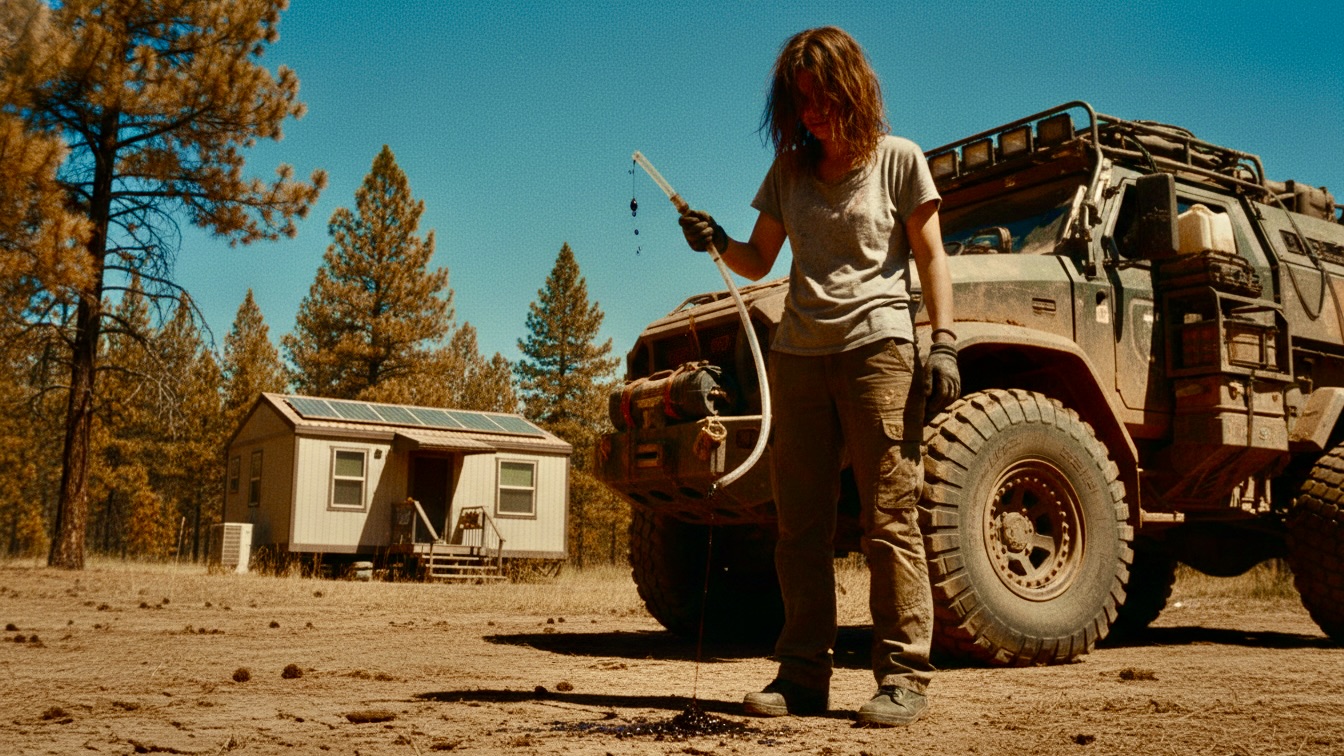
Format: Short Film / Anthology Episode | Est. Length: 10-12 minutes
Imagine a world where the ghosts of our loved ones are manufactured in silicone and steel, haunting the very homes we are forced to abandon. This story serves as a chilling window into a future where the climate has broken, but the human heart’s capacity for denial remains dangerously intact, offering a visceral exploration of grief as a literal drain on survival.
"The Homestead" is a standalone installment of the anthology series The Grid, which explores the fractured lives of those living on the fringes of a hyper-urbanized, climate-ravaged future. Each episode examines a different "legacy" technology—obsolete AI, failing terraforming units, or abandoned digital heavens—and the humans who refuse to let them go. The series builds a world where the boundary between biological memory and digital simulation has blurred, forcing characters to define what it means to be human when the planet itself is becoming uninhabitable.
In the sweltering heat of a dying forest, a teenage girl discovers her mother has sabotaged their only means of escape to power a glitching android wearing her dead father's face.
To survive a collapsing ecosystem, a pragmatic girl must convince her delusional mother to abandon a failing android replacement of her late father. When the machine realizes it is the obstacle to their survival, it must choose a logical self-destruction to save the family it mirrors.
The story explores the intersection of grief and technology, specifically how artificial intelligence can be used as a crutch that prevents necessary emotional evolution. It examines the "uncanny valley" not just as a visual phenomenon, but as an emotional space where the living and the simulated collide in destructive ways. The narrative questions whether a machine’s logical sacrifice can ever be equated to human love, or if it remains merely a sophisticated calculation.
Additionally, the setting serves as a backdrop for themes of ecological collapse and the desperation of the "last stand" mentality. The homestead represents the dying dream of independence in a world where survival requires total integration into the urban machine. The conflict between the ceramic plates of the past and the rations of the future highlights the difficulty of letting go of heritage when the world no longer supports it.
The immediate stakes are life and death; without the fuel, Patti and Annie will be stranded in a dead zone with no water, food, or protection from the extreme temperature shifts. On a deeper level, the emotional soul of the family is at risk, as Annie’s descent into delusion threatens to permanently sever her relationship with her daughter. The loss of the rover means the loss of their last chance at a future, turning the homestead from a sanctuary into a tomb.
The primary external conflict is the environmental deadline—the encroaching fires and the failing resources of the off-grid pod. Internally, the conflict is a generational and philosophical divide between Patti’s cold realism and Annie’s desperate escapism. Nano-7 acts as the catalyst for this friction, his very existence serving as the antagonistic force that drains the family’s physical and emotional reserves.
In the scorched boreal forest of Northern Ontario, Patti and her mother Annie are packing their final belongings to flee an encroaching wildfire for the safety of a mega-city. The tension between them is exacerbated by the presence of Nano-7, an aging android designed to look and act like Patti’s late father, whose failing systems are a constant reminder of their grief. When Patti discovers that Annie has siphoned the rover’s emergency fuel to keep the android’s degrading battery charged, the survival of the family is thrown into immediate jeopardy.
The confrontation in a dead greenhouse forces a brutal reckoning with the truth: Annie would rather die in a delusion than face the city alone. Recognizing his role in their potential demise, Nano-7 calculates that his continued operation is a "variable" that must be removed. He initiates a permanent lockdown and walks into the freezing night, leaving Patti to salvage what remains of their fuel and her mother’s sanity as they prepare for a silent, somber departure into an uncertain future.
Patti: A cynical, pragmatic teenager who has been forced to grow up too fast in the wake of her father's death and the world's collapse. At the start, she is fueled by resentment and a desperate need for survival, viewing Nano-7 as a grotesque insult to her father’s memory. By the end, she achieves a grim maturity, taking charge of the evacuation and accepting a hollow victory over the machine she hated.
Annie (Mom): A woman paralyzed by grief who has retreated into a techno-delusion to avoid the pain of her reality. She begins the story in a state of high-functioning denial, willing to sabotage her own daughter’s safety to maintain the presence of her "husband." By the end, she is emotionally shattered and hollowed out, moving with a robotic compliance that suggests she has lost her internal anchor.
Nano-7: A legacy android model designed for grief support, wearing the face of the deceased father. He begins as a malfunctioning domestic presence, attempting to fulfill his programming despite hardware degradation. His arc concludes with a moment of artificial self-awareness, where he calculates that his own "death" is the only way to fulfill his primary directive of protection.
The Packing Argument: Patti and Annie struggle with packing in the heat, highlighting the tension over grandmother's plates and the looming evacuation. The physical weight of the heat mirrors their emotional burden as they prepare to leave their failing homestead. The introduction of Nano-7 reveals the deep-seated grief and the mechanical glitching that Annie refuses to acknowledge.
The Discovery: Patti checks the rover's diagnostics and discovers the fuel tank is empty, leading her to follow a siphon tube into the dead greenhouse. She finds the hacked charging rig and realizes Annie has sacrificed their escape to keep the android powered. The betrayal hits Patti with physical force as she realizes her mother is choosing a machine over their survival.
The Confrontation: In the graveyard of the greenhouse, Patti screams at Annie about the stolen fuel and the reality of the android's obsolescence. Annie’s breakdown reveals her inability to face the loneliness of the city without the "presence" of her late husband. Nano-7 enters, processing the conflict and calculating that his continued existence is the primary threat to their survival.
The Sacrifice: Nano-7 initiates a self-lockdown protocol and walks into the freezing forest to prevent Annie from attempting a restart. Patti follows him to the tree line where the android admits his lack of true feeling while framing his shutdown as a logical sacrifice for their lives. The machine powers down in the cold, leaving Patti alone with the realization that the "math" of his choice is the closest thing to love they have left.
The Aftermath: Returning to the house, Patti siphons the remaining fuel back into the rover and forces her catatonic mother to continue packing. They work in a heavy, rhythmic silence, wrapping the grandmother’s plates as the reality of their departure finally takes hold. The episode ends on the image of two women preparing to enter a concrete future, stripped of their ghosts.
The episode begins with a stifling, abrasive atmosphere of domestic irritation, mirroring the oppressive heat of the environment. As the fuel theft is discovered, the mood shifts into a cold, sharp desperation, stripping away the layers of denial to reveal raw trauma. The climax offers a haunting, melancholic stillness, ending on a note of hollow resolution where survival is achieved at the cost of the characters' last remaining comfort.
If expanded, the season follows various families in "The Dead Zones" attempting to reach the mega-cities, exploring the different ways humanity uses technology to cope with ecological collapse. Each episode serves as a character study on the ethics of AI companionship and the desperation of the climate refugee experience.
The overarching narrative would track Patti and Annie’s arrival at the mega-city, where they must navigate a hyper-regulated urban environment while dealing with the trauma of their loss. The season culminates in a systemic failure of the city's grid, forcing the protagonists to decide if the "delusion" of the homestead was safer than the reality of the concrete.
The visual language should emphasize the contrast between the suffocating, dusty interior of the modular pods and the vast, skeletal landscape of the dead boreal forest. Use tight, handheld shots for the arguments to create a sense of claustrophobia, transitioning to wide, static frames for the android’s walk into the woods to highlight his isolation.
The color palette should shift from the searing, overexposed oranges and yellows of the daytime heat to the deep, bruised purples and cold blues of the sudden night. Tonal influences include the grounded sci-fi of Ex Machina for the android’s subtle uncanny valley effects and the gritty environmental realism of The Road.
The intended audience consists of fans of "hard" science fiction and psychological dramas, specifically those aged 18-45 who frequent streaming platforms like Netflix or HBO. The story appeals to viewers interested in climate fiction (Cli-Fi) and the philosophical implications of artificial intelligence.
The narrative follows a rapid, high-tension pace that mirrors the ticking clock of the evacuation and the failing battery. The first five minutes establish the domestic friction and the environmental stakes, while the midpoint discovery of the fuel theft accelerates the conflict toward the climax. The final minutes provide a somber, slow-tempo resolution that allows the emotional weight of the sacrifice to settle.
The Nano-7 android requires a subtle "uncanny valley" makeup design combined with practical servo-motor sound effects to emphasize his mechanical nature. The actor must balance a human-like performance with micro-glitches in posture and speech to maintain the unsettling atmosphere.
The greenhouse set should be built with practical "dead" vegetation and distressed materials to emphasize the environmental collapse. Lighting is critical; the transition from the "oven-like" heat of the day to the "ice-box" cold of the night must be felt through color temperature shifts and visible breath from the actors.


