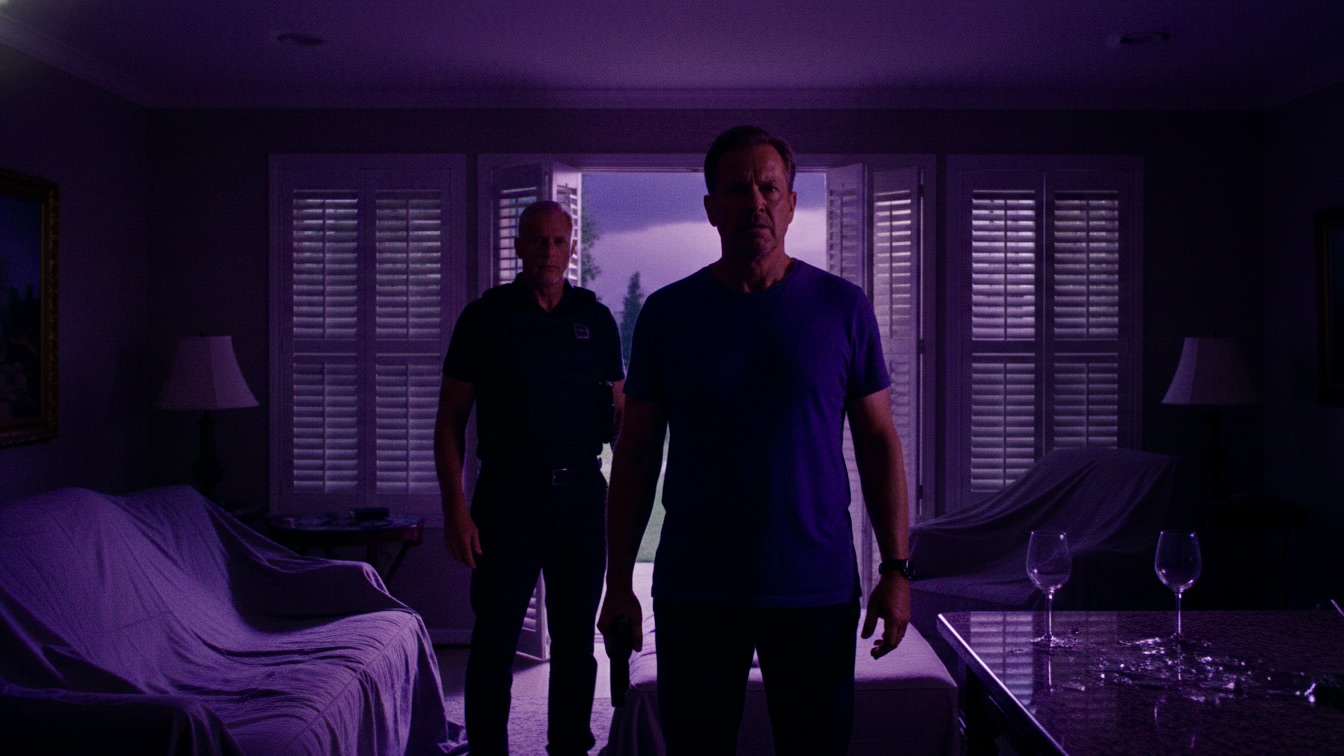
A family discovers their patriarch's secret arsenal as the summer sky turns purple and the neighborhood enters lockdown.
The hum didn’t start in the ears. It started in the molars. Jake pressed his tongue against the back of his teeth, feeling the vibration rattle the enamel. It was a low-frequency thrum, steady and invasive, like a idling truck parked right outside the kitchen window, except there was no truck. The afternoon sun was too bright, a harsh, bleaching yellow that made the manicured lawns of the Oak Haven estate look like plastic. Jake squinted, his left eye pulsing with the onset of a migraine that felt like a hot needle being driven into his temple. He gripped the edge of the granite island, his knuckles turning white. The stone was cool, but it didn't help. Nothing helped when the house started singing to itself.
"Jake? Did you hear me?" Lisa was standing by the sink, her hands dripping with soapy water. She looked tired. The skin under her eyes was puffy, a testament to the three hours of sleep they’d managed before the internet cut out for the fourth time that week. She wasn't looking at him; she was looking at the digital clock on the oven, which was blinking 12:00 over and over again. The power hadn't even flickered, but the smart appliances were losing their minds. "I asked if you called the technician about the mesh network. Benji is losing it because he can't finish his upload."
"The mesh is fine, Lisa," Jake said, his voice sounding thin to his own ears. He reached for a glass of water, but as he set it down, the glass began to migrate across the counter, dancing to the rhythm of the hum. "It's the ISP. Or the grid. Or whatever Art is talking about. My head is killing me. Can you hear that? The vibration?"
Lisa wiped her hands on a linen towel, her movements jerky. "I don't hear anything but you complaining. And Benji yelling. It’s summer, Jake. It’s probably the neighbor’s new AC unit. The Millers put in some industrial-sized system last week. You know how they are. Everything has to be bigger."
"It’s not the AC," Jake muttered. He walked toward the basement door, his gait uneven. He needed to be away from the light. The basement was Art’s domain, but it was also where the wine cellar was. He needed a drink, or maybe just the silence of the earth. He pushed open the heavy oak door and descended the stairs. The air grew cooler, but the hum grew louder. It felt like it was coming from the walls themselves. Art, his father-in-law, had been staying with them for three months, and in that time, the basement had transformed. What used to be a playroom for Benji was now filled with stacks of heavy-duty plastic crates and rolls of lead-lined sheeting that Art claimed were for 'renovations.'
Jake bypassed the crates and went to the wine cellar. It was a custom-built room with climate control that usually hummed with a gentle, reassuring whir. Now, it was silent. The power to the cooling unit was off. Jake swore under his breath, thinking of the 2004 Cabernet that was probably cooking in the rising heat. He pulled on the handle, but the door resisted. He jerked it harder, and it swung open with a metallic groan. He reached for a bottle on the third shelf, his hand slipping behind a row of vintage reds. His fingers brushed against something cold and heavy. It wasn't glass. It was textured, matte metal.
He pulled it out. It was a handheld device, ruggedized, with a heavy lens and a digital display. He recognized the brand from a trade show—military-grade thermal optics. The price tag on these things was more than his first car. He tucked it under his arm and reached back into the darkness. Behind the wine, nestled against the concrete foundation, were four more units, still in their Pelican cases. He felt a cold sweat break out on his neck. This wasn't Art’s 'renovation' gear. This was something else. He sat down on a crate of bottled water, the thermal unit heavy in his lap, as the floor beneath his boots began to shudder in time with the hum in his teeth.
"What are you doing down here?" Art’s voice was like gravel. The older man was standing at the base of the stairs, his shadow long and distorted across the concrete. He wasn't wearing his usual golf shirt. He was wearing a tactical vest over a plain gray tee, the pockets bulging with items Jake didn't want to identify. Art’s face was a map of deep lines, his jaw set so tight Jake thought it might snap. He looked like a man who had been waiting for a war his entire life and was finally seeing the first muzzle flash.
"Found your toys, Art," Jake said, holding up the thermal optic. "Care to explain why we have thirty thousand dollars' worth of infantry gear behind the Merlot? Lisa thinks you're just being eccentric. I'm starting to think you're something else. The internet is failing every two hours on the dot. The neighbor is installing a steel vault for a front door. And you’re hiding optics. Talk to me."
Art didn't blink. He walked over and took the device from Jake's hand, his movements efficient and practiced. "You shouldn't be poking around, Jake. I told you I was handling the security. The vibes are cooked, son. You either get a bunker or you get a grave. That hum you're feeling? That’s not the AC. That’s the frequency of a world that’s about to stop spinning. Now get upstairs. Lisa is getting a notification from the Watch. It’s seven o'clock. We’re going dark."
The neighborhood watch notification didn't come as a text. It came as a high-pitched alert through the house's integrated smart-home system, a sound that bypassed the silent mode on their phones. Jake and Art emerged from the basement to find Lisa standing in the living room, staring out the massive floor-to-ceiling windows that overlooked the cul-de-sac. The sun was still hovering above the horizon, casting long, orange fingers across the street, but the neighborhood was changing. One by one, the streetlights weren't turning on. Instead, the porch lights of their neighbors were flickering off.
"The 'Dark Protocol'?" Lisa asked, her voice trembling as she held her phone. "Art, what is this? The HOA board just sent out a blast saying all outdoor lighting must be extinguished by 7:00 PM until further notice. No explanation. Just 'safety compliance.' Look at the Millers' house."
Jake joined her at the window. Across the street, the Miller family—a couple in their forties with two young kids—were out in their front yard. The kids were playing with a ball, their laughter muffled by the double-pane glass. But Mr. Miller wasn't watching them. He was standing by his front door, which was no longer the elegant mahogany slab it had been yesterday. It was a dull, industrial gray. A reinforced steel door, the kind you’d see on a high-security warehouse, had been bolted directly into the frame. He was testing the electronic keypad, his movements frantic.
"He's scared," Jake whispered. "Why is he scared? We live in a gated community with a twenty-four-hour patrol. We pay fifteen thousand a year in dues for peace of mind, and he's turning his house into a cell?"
"Peace of mind is a product, Jake," Art said, moving behind them. He began pulling the heavy, lead-lined shutters across the windows. They slid with a weighted thud, cutting off the view of the sunset and the Millers' yard. "And the company just went bankrupt. Benji! Get in here!"
Benji trudged into the room, his eyes glued to his phone screen. He was sixteen, usually detached, but today his face was pale. "Dad, look at this. The internet is back up for a second, but it's only loading certain feeds. Look at the Pacific."
He handed the phone to Jake. The screen showed a viral video, likely shot from a commercial satellite or a high-altitude drone. It was grainy, but the scale was unmistakable. In the middle of the Pacific Ocean, hundreds of miles from any shipping lane, naval fleets were converging. These weren't just American ships. There were Chinese destroyers, Russian subs, and European frigates, all moving in a perfect, terrifying circle around a patch of empty blue water. There was no news commentary, no headlines—just the raw feed and a comment section filled with hexadecimal code and strings of nonsensical characters.
"There’s nothing on the news about this," Benji said, his voice cracking. "I checked every site. It’s all just celebrity gossip and weather reports. But the 'doom-scroll' is full of this stuff. People are saying the cables are being cut. They're saying the satellites are being repositioned."
"Put the phone away, Ben," Art commanded. "It’s a distraction. They want you looking at the ocean so you don't notice what's happening in your own backyard. Jake, help me with the kitchen shutters. We need to be fully sealed before the next pulse."
"What pulse?" Jake demanded, grabbing Art by the shoulder. "Art, stop. You’re scaring Lisa. You’re scaring me. You’ve been hoarding gear, you’ve got thermal optics, and now you’re acting like we’re under siege. Tell us what is actually happening."
Art turned, and for the first time, Jake saw a flicker of something like pity in the old man's eyes. "You’ve spent your whole life in the 'mid-tier,' Jake. You’ve had enough money to feel safe, but not enough to know how the world really works. The systems we rely on—the grid, the web, the supply chains—they aren't broken. They're being harvested. Someone is pulling the plug, and they're doing it in rhythmic intervals to see how we react. The 'Dark Protocol' isn't from the HOA. It's a test. They want to see who obeys. Now, help me with the shutters, or I’ll do it myself and leave you in the light."
Jake looked at Lisa. She was clutching a throw pillow to her chest, her eyes darting between her husband and her father. The hum in the floorboards was intensifying, a physical pressure that made the air feel thick and hard to breathe. He looked at the steel door across the street in his mind's eye. He looked at the naval fleets on the small screen. Then, he reached for the handle of the shutter.
By the next morning, the temperature had climbed to a blistering ninety-eight degrees. The air conditioning was straining, a high-pitched whine competing with the omnipresent hum. Jake woke up with a dry mouth and the sensation that his skull was a size too small. He went to the laundry room to find a clean shirt, but as he moved a pile of Benji’s discarded hoodies, something clattered to the tile floor.
It was a burner phone. A cheap, plastic thing that looked like it belonged in a 2010 drug deal. It was vibrating. Jake picked it up. The screen didn't show a name, just a string of numbers. A text message popped up: 0x46 0x6F 0x6C 0x6C 0x6F 0x77 0x20 0x74 0x68 0x65 0x20 0x47 0x72 0x69 0x64.
"Jake?" Lisa was standing in the doorway, a basket of towels in her arms. She saw the phone. "Is that yours?"
"No," Jake said, his heart hammering. "I found it under the clothes. It’s Art’s. Or Benji’s. But I don't think Benji knows how to read hexadecimal."
"My father doesn't even know how to use his iPad half the time," Lisa said, though her voice lacked conviction. She set the basket down and walked over, peering at the screen. "What does it mean?"
"I don't know. But it's been receiving these every hour. Look at the history." Jake scrolled up. The messages were all the same—hex code, timestamps, and occasional GPS coordinates that pointed to seemingly random spots in the suburbs.
Before they could discuss it further, a sound like a distant, heavy door slamming echoed through the house. It wasn't a noise; it was a pressure wave. The glassware in the kitchen cabinets shattered simultaneously. Jake grabbed Lisa and pulled her to the floor as the house groaned, the timber framing creaking under a sudden, invisible weight.
"Benji!" Lisa screamed.
"I'm okay!" Benji yelled from the living room. "But guys... you need to see the sky. The shutters... they’re leaking light."
They ran to the living room. Art was already there, his face pressed against a thin gap in the lead-lined shutters. He looked mesmerized. Jake shoved him aside and looked out.
It was noon, but the sun was gone. In its place, the sky had turned a bruised, static-heavy purple, the color of a deep bruise or an old television screen with no signal. It wasn't dark like night; it was an artificial, shimmering twilight. Clouds of strange, iridescent vapor swirled in the upper atmosphere, and the air outside looked thick, like water.
Then, the temperature hit. It didn't drop; it plummeted.
Jake watched as the condensation on the outside of the window turned to frost in seconds. The lush green leaves of the oak trees in the yard shriveled and blackened, the moisture inside them freezing and rupturing the cell walls. A bird fell from the sky, hitting the driveway with a sickening, solid thud.
"Forty degrees in ten minutes," Art whispered, checking a handheld weather station. "Maybe more. The ionosphere is being toasted. They're dumping the heat out and pulling the cold in. It’s an orbital displacement."
"Who is 'they', Art?" Jake yelled, the frustration and fear finally boiling over. "You have a burner phone receiving encrypted messages! You have military gear! You’re not just a retired contractor. You’re a part of this, aren't you?"
Art turned, and his expression was no longer one of a worried grandfather. It was cold, professional. "I'm a spotter, Jake. I was hired to ensure this 'sector' remained stable during the transition. I'm protecting my family. That’s the only truth you need to care about. The people I work for... they don't want chaos. They want a clean handover. But the others—the ones who aren't on the list—they’re going to start knocking soon. And they won't be asking for sugar."
"A spotter for what? A militia?" Lisa's voice was a whisper. "Dad, you’re talking about a coup. You’re talking about the end of everything."
"I'm talking about survival, Lisa!" Art barked. "The world you knew ended the moment that hum started. You just didn't have the sensors to hear it. Now, get to the kitchen. We need to stockpile the water before the pipes freeze solid. And Jake... give me the phone."
Jake looked at the burner phone, then at the purple sky. The neighborhood was silent now. No cars, no kids, no laughter. Just the shimmering, unnatural light and the sound of the house's foundation cracking in the sudden, intense cold. He handed the phone to Art. He didn't have a choice. The world was changing into something he didn't recognize, and the only person with a map was the man who might be leading the invaders to their door.
The power didn't flicker this time. It just vanished. One moment, the kitchen was bathed in the dim, purplish light filtering through the cracks; the next, it was pitch black. The hum, which had been their constant companion for days, suddenly cut out. The silence that followed was even more terrifying. It was heavy, absolute, and cold.
Then came the mechanical clicks.
Click-clack. Click-clack.
The house’s 'smart' security system, powered by an independent battery backup Art must have installed, engaged. But it wasn't unlocking the doors for their escape. Jake heard the heavy deadbolts sliding into place on the front door, the back door, and even the windows. The lead-lined shutters were now locked electronically.
"Art, what did you do?" Jake shouted, fumbling for a flashlight. He clicked it on, the beam cutting through the darkness. Art was standing by the kitchen island, his face illuminated from below like a ghost. He was holding a heavy, black pistol.
"I didn't do it, Jake. The system is slaved to the sector hub. We’re in lockdown. It’s for our safety," Art said, though his hand was trembling slightly as he checked the magazine of the weapon.
"Safety? We’re trapped in here!" Lisa cried. She was huddled with Benji near the pantry. "We can't get out. If there's a fire, if..."
"There won't be a fire," Art said. "But there will be visitors. The 'Dark Protocol' is over. Now comes the acquisition phase. The private militia I was... consulting for... they’re moving in to secure the high-value assets. This neighborhood is one of them. We stay inside, we stay quiet, and we wait for the 'clear' signal on the burner."
BOOM.
The sound was unlike anything Jake had ever heard. It wasn't an explosion, not exactly. It was the sound of the atmosphere being torn open, a sonic boom that lasted for five full seconds and vibrated the very air in their lungs. It felt like the house had been dropped from a great height.
"What was that?" Benji whimpered, covering his ears.
"Orbital platform," Art said, his voice flat. "They’re clearing the airspace. No more satellites. No more drones. Just them."
Jake walked up to Art, his jaw tight. "You're a 'spotter.' You're the one who told them we were here. You're the reason the Millers are probably locked in their house right now, waiting to be 'acquired.' You sold out the neighborhood for a spot in the bunker?"
Art looked at him, and for a second, the mask of the professional soldier slipped. He looked old. He looked terrified. "I sold out the neighborhood to keep you three alive, Jake. You think the government is coming to save you? There is no government left. There’s just the people with the tech and the people without it. I made sure we were with the people with the tech."
He reached into his tactical vest and pulled out a second handgun—a compact 9mm. He held it out to Jake, butt-first.
"Take it," Art commanded.
"I don't want it," Jake said, recoiling.
"Take it!" Art stepped forward, his voice dropping to a low, lethal hiss. "The 'clear' signal might not come for us. Sometimes the spotters are considered liabilities once the acquisition begins. If the locks don't open when the trucks roll in, they’re going to come through the glass. And they won't be looking for friends."
Jake looked at the gun. It felt oily and heavy in the flashlight's beam. He looked at Lisa, who was watching him with wide, hollow eyes. He looked at Benji, who was shivering in the sub-zero temperature of their own living room.
"What do I do with it?" Jake asked, his voice shaking.
Art leaned in close, the smell of gun oil and old sweat clinging to him. "Don't be a mid-tier victim, Jake. Don't wait for them to explain themselves. If they come through that glass and they aren't wearing the patch I showed you... you aim for the eyes. The armor they wear is top-tier, but the optics are vulnerable. You aim for the eyes and you don't stop pulling the trigger until they stop moving."
Outside, the purple sky began to pulse with a rhythmic, white light. The sound of heavy, multi-wheeled vehicles began to rumble in the distance, echoing off the steel doors and lead-lined shutters of the silent, terrified suburb. Jake took the gun. His hand was steady, but his heart felt like it was turning to stone.
“As the first heavy boot struck the reinforced glass of the patio door, Jake raised the pistol and realized he no longer remembered what his life had been like yesterday.”


