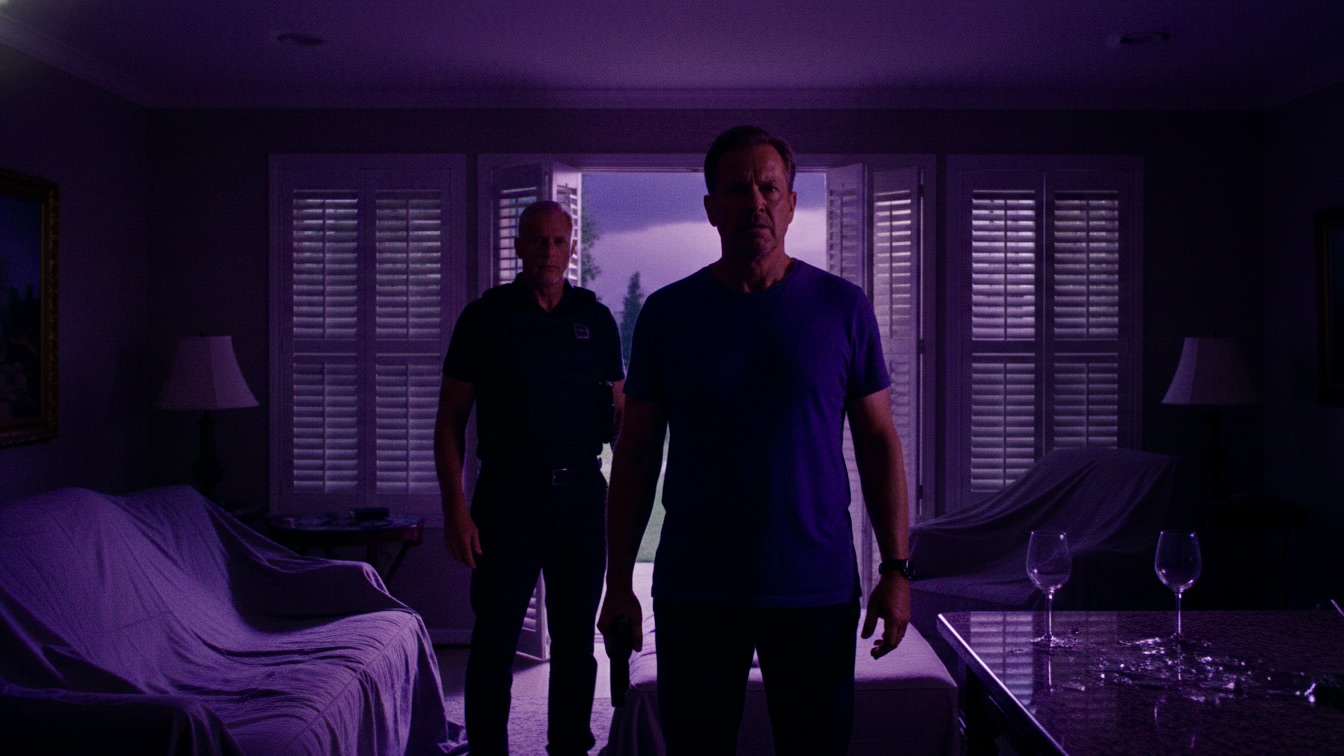
Format: Short Film / Anthology Episode | Est. Length: 10-12 minutes
Imagine a series where the apocalypse doesn't arrive with a bang, but through the systematic "harvesting" of modern infrastructure, viewed through the lens of different social classes. This episode serves as a chilling entry point into a world where the safety of the gated community is revealed to be a pre-packaged cage, and the people we trust most are the ones holding the keys to our transition into a dark new era.
This story serves as a standalone installment of The Harvest, an anthology series exploring the rhythmic, calculated dismantling of human civilization by an unseen global or extraterrestrial power. Each episode focuses on a different "sector" of society—from rural farmlands to high-rise corporate hubs—as they experience the "Dark Protocol," a series of frequency-based pulses and environmental shifts designed to test compliance and prepare "assets" for acquisition. The series follows the overarching mystery of who "They" are while focusing on the intimate, domestic collapses that occur when the systems of the "mid-tier" world are abruptly unplugged.
Jake stands in a sun-bleached kitchen, his molars vibrating with a low-frequency hum that no one else seems to hear, while the digital clock on the oven blinks a rhythmic, mocking 12:00. The domestic peace of the Oak Haven estate is shattered not by a scream, but by the sight of a wine glass slowly dancing across a granite counter, propelled by an invisible, invasive force.
A suburban father’s reality unravels when a mysterious frequency shift and a "Dark Protocol" turn his gated community into a high-tech prison. He must confront the terrifying truth that his father-in-law is an operative for the very forces coming to "acquire" his family.
The primary theme is the fragility of the middle-class illusion, specifically how quickly "peace of mind" evaporates when the systems of commerce and utility are weaponized against the consumer. It explores the transition from a life of curated comfort to one of primal, tactical survival, highlighting the psychological cost of realizing that one's safety was merely a product with an expiration date.
The episode also delves into the genre of "Suburban Gothic" blended with "Hard Sci-Fi," focusing on the betrayal of the patriarchal protector. It questions the morality of survival: is it better to be a "mid-tier" victim with a clean conscience, or a "spotter" who sells out his neighbors to ensure his family’s place in the new world order?
The immediate stakes are the physical lives of Jake, Lisa, and Benji as the environment outside becomes lethally cold and the house transforms into a locked "acquisition" cell. On a deeper level, the family’s autonomy is at risk; they are no longer citizens, but "high-value assets" being sorted by a private militia. For Jake, the stakes involve his own soul as he is forced to abandon his pacifism and "aim for the eyes" to protect his children from the very people his father-in-law serves.
The external conflict is driven by the "Sector Hub," an unseen authority enforcing the Dark Protocol through orbital platforms that manipulate the atmosphere and lock down smart homes. This is personified by the "acquisition teams" moving through the neighborhood in armored vehicles. Internally, the conflict is a domestic power struggle between Jake’s desperate desire for normalcy and Art’s cold, military pragmatism, creating a rift of distrust within the family unit as the house becomes a pressurized tomb.
Jake, a suburban father suffering from a frequency-induced migraine, discovers that his father-in-law, Art, has been hoarding military-grade thermal optics and tactical gear in their wine cellar. As the neighborhood is placed under a "Dark Protocol" by the HOA, streetlights fail and neighbors begin bolting industrial steel doors onto their homes. Benji discovers leaked footage of global naval fleets circling empty water, suggesting a worldwide "harvesting" event is underway. Art reveals he is a "spotter" hired to stabilize the sector, claiming the systems of the world are being pulled like a plug to see who obeys.
The situation escalates when the sky turns a bruised purple and the temperature drops forty degrees in minutes, flash-freezing the suburb. The house’s smart-security system, slaved to an external hub, locks the family inside with lead-lined shutters, effectively turning the home into a vault. Art admits the "acquisition phase" has begun and that they are being secured as high-value assets by a private militia. As the sound of heavy vehicles approaches and the sky pulses with white light, Art hands Jake a pistol and gives him a lethal directive: if the intruders aren't wearing the right patch, Jake must aim for their eyes.
Jake: A "mid-tier" Everyman who has traded his autonomy for suburban comfort. He begins the episode in a state of sensory overload and denial, clinging to the hope that the ISP or the grid is simply failing. By the end, his psychological arc completes a harrowing shift from a confused civilian to a man with a steady hand on a 9mm, forced to accept that his world has been replaced by a brutal, tactical reality.
Art: Lisa’s father, a retired contractor who reveals himself to be a cold, professional "spotter" for the new regime. He starts as an eccentric, overbearing houseguest but is unmasked as a pragmatic traitor-protector who sold out his neighborhood to buy his family’s safety. His arc is one of tragic necessity; he views himself as a savior, even as he prepares his son-in-law to commit murder.
Lisa: Jake’s wife, who acts as the emotional barometer for the family’s deteriorating safety. She represents the shock of the "consumer" class, transitioning from annoyance over internet outages to the hollow-eyed terror of a woman who realizes her father has turned her home into a high-security cell.
Benji: Jake’s teenage son, whose reliance on digital connectivity provides the family’s only window into the collapsing world. He represents the vulnerability of the younger generation, moving from detached "doom-scrolling" to a state of paralyzed whimpering as the physical world becomes as glitchy and terrifying as a corrupted video feed.
* The Hum: Jake experiences a bone-rattling vibration in his teeth while watching a water glass migrate across the kitchen counter, signaling the onset of the frequency shift. Lisa complains about the internet and the neighbor’s AC, highlighting the family's initial ignorance of the global "harvesting" beginning outside.
* The Cellar Secret: Seeking refuge from the light, Jake enters the basement and discovers Art’s stash of military-grade thermal optics hidden behind the wine collection. Art confronts him in a tactical vest, delivering a chilling warning that the world is about to "stop spinning" and that they must go dark.
* The Dark Protocol: At 7:00 PM, the neighborhood watch enforces a total blackout, and Jake watches through the window as his neighbor, Mr. Miller, frantically tests a newly installed steel front door. Benji shows the family grainy footage of global naval fleets converging in the Pacific, confirming that the "cables are being cut" on a planetary scale.
* The Purple Sky: The sun vanishes at noon, replaced by a bruised, static-heavy purple sky and a plummeting temperature that flash-freezes the yard in seconds. Art explains the "orbital displacement" occurring in the ionosphere, while Jake finds a burner phone receiving encrypted hexadecimal messages, realizing Art is a "spotter" for the invaders.
* The Acquisition: The power vanishes and the house's smart system locks the family inside with lead-lined shutters, slaved to an external hub. As a sonic boom from an orbital platform shakes the foundation, Art hands Jake a gun and explains that they are now in the "acquisition phase," where they must fight off anyone not authorized to collect them.
The episode begins with a sense of Irritation and Sensory Discomfort, mirroring Jake’s migraine and the glitchy appliances. This quickly transitions into Paranoia and Domestic Dread as Art’s secrets are revealed and the neighborhood begins to transform. The midpoint brings Awe and Existential Terror with the visual of the purple sky and the flash-freeze. The final act is a descent into Claustrophobic Resolve, where the audience shares the family's trapped sensation, ending on a note of cold, hard survivalism that leaves the viewer questioning what they would do in the same position.
If expanded, the season would follow Jake’s family as they are "acquired" and moved to a high-security "Sector Hub," where they discover the true nature of the harvesters. The thematic escalation would focus on the "sorting" of humanity, where families are broken apart based on their utility to the new regime, and Jake must use his newfound tactical skills to lead a domestic insurgency from within the gated "safe zones."
The overarching narrative would explore the mystery of the hexadecimal code and the "frequency," revealing that the hum is a method of terraforming the human mind for a new type of labor. Character evolution would see Lisa becoming a leader in the underground communication network, while Art struggles with the guilt of his "spotter" past as he realizes he was just as much a "mid-tier" pawn as Jake.
The cinematic style is "Suburban Noir" meets "Hard Tech-Horror." The lighting begins with a harsh, bleaching yellow that makes the lawns look like plastic, slowly transitioning into the sickly, iridescent purple of the "orbital displacement." The camera work should be intimate and handheld during the kitchen scenes to heighten the feeling of a migraine, shifting to static, wide, and oppressive shots once the house is locked down.
Tonal influences include the clinical dread of Sicario and the domestic sci-fi tension of Signs. The sound design is the most critical element, featuring a constant, low-frequency "brown noise" that fluctuates in intensity, creating a physical sense of unease for the audience that mirrors Jake’s dental vibrations.
The target audience is adults (18-45) who enjoy high-concept psychological thrillers and "prepper" fiction. It appeals to viewers of anthology series like Black Mirror or Electric Dreams, as well as fans of grounded sci-fi like Children of Men. The focus on domestic tension and the collapse of the "American Dream" makes it particularly resonant for a modern, tech-dependent audience.
The pacing is a "slow-burn pressure cooker." The first four minutes focus on the subtle atmospheric glitches and the discovery of the gear, building a sense of unease. The midpoint (minutes 5-7) accelerates the pace with the "Dark Protocol" and the sky change. The final three minutes are high-tension and claustrophobic, utilizing rapid-fire dialogue and heavy sound effects to simulate the "acquisition" phase, concluding exactly as the first "visitor" reaches the door.
The "Purple Sky" effect should be achieved through a combination of practical lighting (LED panels outside the windows) and subtle VFX to create the "iridescent vapor" look. The flash-freeze of the trees and the bird falling can be handled with practical frost effects and a simple prop, emphasizing the tactile nature of the environmental collapse.
The house itself is a character; the production must emphasize the sound of the "smart" locks and the heavy thud of the lead-lined shutters. These should be practical elements or high-quality foley to ensure the house feels like a transforming machine. The burner phone's hexadecimal messages provide a low-cost but effective way to build the "world-building" mystery without requiring expensive CGI sequences.


