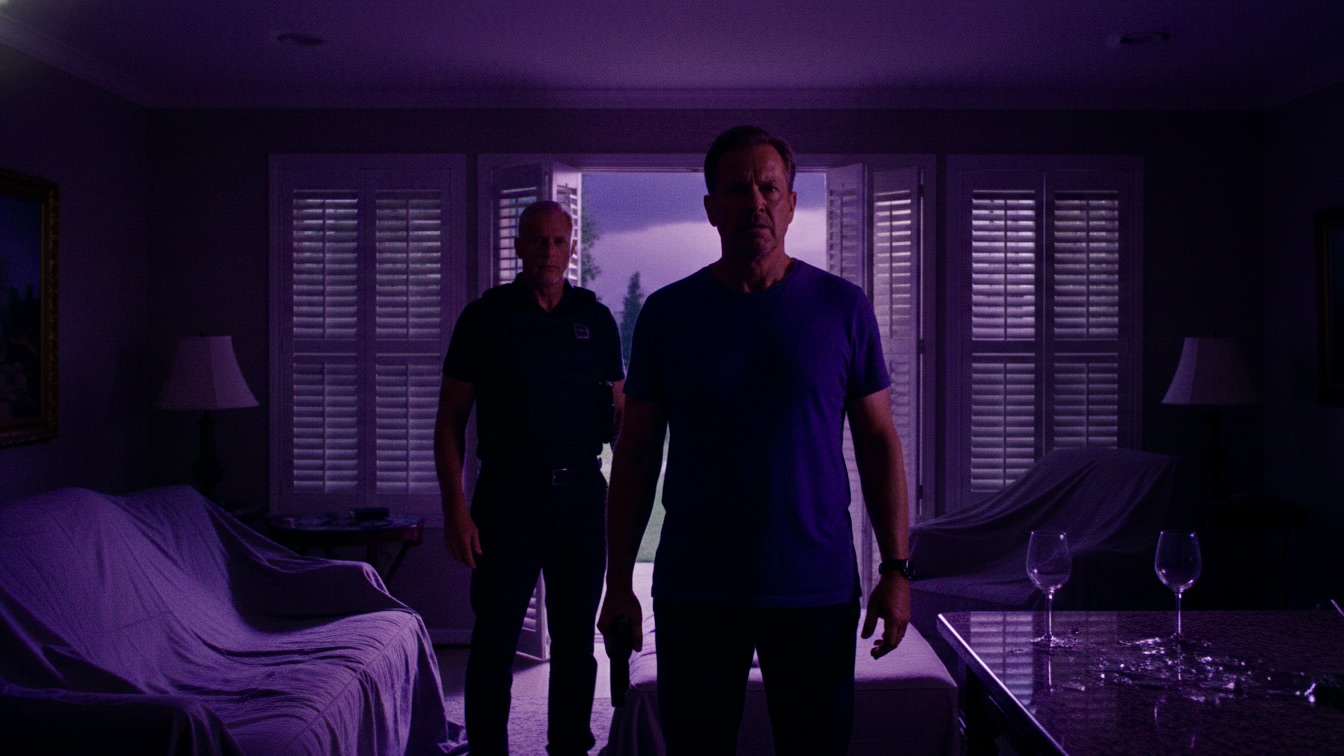
The narrative begins with a sensory disturbance as Jake experiences a persistent, low-frequency hum that vibrates through his very teeth, signaling an atmospheric shift in his upscale gated community. While his wife Lisa struggles with failing technology and their son Benji frets over lost internet connectivity, Jake discovers his father-in-law, Art, has been hoarding military-grade thermal optics in the wine cellar. This discovery coincides with a neighborhood-wide "Dark Protocol" that forces residents to extinguish all lights and retreat behind reinforced steel doors. As the sky turns a bruised purple and the temperature plummets to sub-zero levels, Art reveals his role as a "spotter" for a mysterious private entity. The chapter concludes with the house entering a total lockdown and Art forcing a handgun into Jake’s hand, warning him that they must defend themselves against an imminent "acquisition" by armed forces.
The story explores the profound fragility of the modern middle class, or what Art disparagingly refers to as the "mid-tier." Jake and Lisa live in a world where safety is a purchased commodity, represented by gated communities and smart-home systems that promise peace of mind. However, this security is revealed to be an illusion, easily dismantled by the very systems designed to provide it. When the "Dark Protocol" is enacted, the neighborhood is transformed from a sanctuary into a series of isolated cells, highlighting how quickly social contracts can dissolve under pressure.
Another central theme is the weaponization of technology and information. The internet is not merely failing; it is being "harvested" and manipulated to keep the populace distracted or compliant. Benji’s reliance on digital feeds for information illustrates the vulnerability of a generation that views reality through a screen. While the characters attempt to find truth in viral videos and encrypted messages, the physical world around them is being restructured by unseen forces. The smart home, once a symbol of convenience, becomes a literal prison when the security system slaves itself to a central hub.
The narrative also delves into the ethics of survival and the cost of complicity. Art justifies his involvement with a shadowy militia as a necessary evil to protect his family, yet his actions facilitate the downfall of his neighbors. He represents the pragmatic, often cold-hearted transition from a civilian mindset to a combatant mindset. By the end of the chapter, the story suggests that in a collapsing world, morality is often traded for the "tech" required to stay alive. Jake’s reluctant acceptance of the gun signifies the death of his old life and his forced entry into a brutal new reality.
Jake serves as the emotional and sensory anchor of the story, experiencing the world’s collapse through physical pain and somatic symptoms. His migraine and the vibrating hum in his molars suggest a deep-seated sensitivity to the environmental shifts that others, like Lisa, initially dismiss as mundane. Psychologically, he represents the "mid-tier" man who is ill-equipped for a sudden loss of agency. He clings to the logic of his old life, questioning the cost of his HOA dues even as his world literally freezes over. His transition from skepticism to terrified compliance is completed when he finally accepts the handgun from Art, signifying his loss of innocence.
Art is the "Protective Antagonist" of the narrative, a man whose love for his family is expressed through cold, calculated preparation and potential betrayal of the common good. He possesses a cynical understanding of global power structures that Jake lacks, viewing the world not as a community but as a series of assets to be secured. His transformation from a retired contractor into a tactical "spotter" reveals a man who has long anticipated the end of the social order. While he claims to be acting for the safety of his daughter and grandson, his secrecy and his role in the "acquisition" process make him a morally ambiguous figure. He is a man who has traded his humanity for a seat in the bunker.
Lisa embodies the domestic struggle to maintain a sense of normalcy in the face of an encroaching apocalypse. She focuses on the immediate needs of her family, such as the internet connection and the behavior of her neighbors, as a way to process her growing dread. Her jerky movements and puffy eyes indicate a state of chronic stress and sleep deprivation, suggesting that she is more aware of the danger than she admits. As the situation escalates, her role shifts from a manager of the household to a witness of her father’s radicalization and her husband’s forced militarization. She represents the civilian heart of the family, caught between the old world’s comforts and the new world’s violence.
Benji represents the vulnerability of the younger generation, whose primary connection to reality is mediated through digital devices. His anxiety is tied directly to his inability to "upload" or access the "doom-scroll," showing a psychological dependency on the virtual world for a sense of orientation. Even when the sky turns purple and the temperature drops, he looks to his phone for answers, finding only encrypted code and grainy satellite feeds. He is the most literal victim of the "distraction" Art describes, a boy whose world is being dismantled while he watches it on a six-inch screen. His shivering in the final scene highlights his physical helplessness in a world where digital literacy is no longer enough for survival.
The pacing of the story is masterfully handled, beginning with a slow, internal discomfort and escalating into a high-stakes domestic siege. The author uses the "hum" as a recurring motif to build tension, creating a sense of inevitable dread that mirrors Jake’s developing migraine. The transition from the mundane complaints about an AC unit to the discovery of military optics in a wine cellar effectively bridges the gap between the familiar and the terrifying. By the time the sky changes color, the narrative has moved from a psychological thriller into the realm of speculative science fiction. This shift is mirrored in the prose, which becomes sharper and more clinical as the "Dark Protocol" takes effect.
Sensory details are used to ground the more fantastical elements of the plot in a visceral reality. The description of the "bruised, static-heavy purple" sky and the "sickening, solid thud" of a frozen bird falling from the air creates a haunting atmosphere. The contrast between the cool granite of the kitchen island and the "oily and heavy" feel of the handgun emphasizes the intrusion of violence into the domestic sphere. These details force the reader to experience the cold and the pressure alongside the characters, making the environmental collapse feel personal. The use of technical jargon like "hexadecimal code" and "orbital displacement" adds a layer of realism that makes the unknown "they" feel even more formidable.
The narrative voice is one of suppressed panic, reflecting Jake’s internal state as he tries to make sense of a senseless situation. The dialogue is terse and functional, particularly Art’s speech, which serves to provide exposition while maintaining a sense of mystery. The story avoids long, flowery descriptions in favor of impactful, punchy sentences that mirror the mechanical clicks of the house’s locking system. This stylistic choice reinforces the theme of a world being "harvested" by efficient, cold forces. By the end of the chapter, the tone is one of absolute isolation, leaving the characters—and the reader—trapped in the dark.


