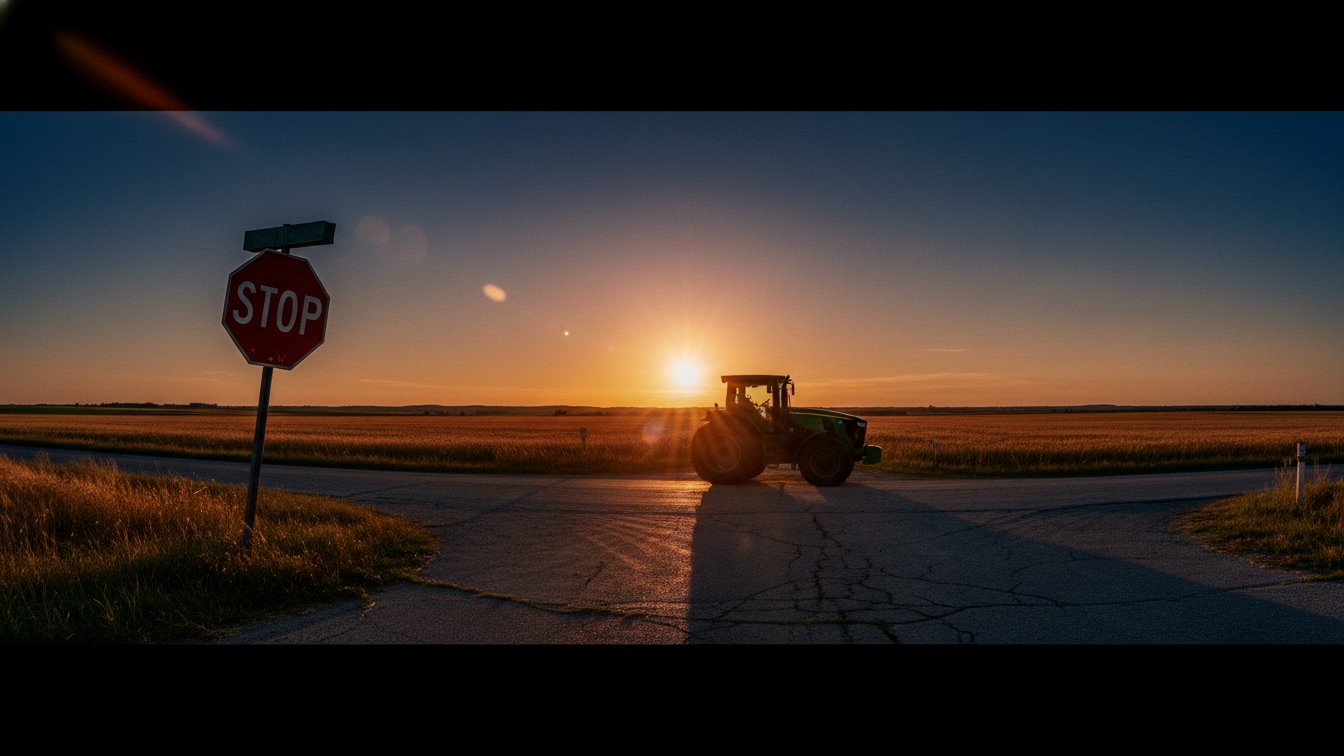
My dad blocked a road to save the farm, but the internet turned a protest into a life sentence.
The kitchen felt wrong. It wasn’t just the silence, though that was heavy enough to make my ears ring.
It was the stuff that wasn't there.
My dad’s keys usually sat on the small ceramic tray by the microwave, a heavy jumble of brass and steel that sounded like a percussion section every time he dropped them.
Now, the tray was just empty white space.
His work boots, the ones with the permanent crust of dried mud and diesel, weren't by the mudroom door. The hook where his Carhartt jacket lived was bare. It made the whole house look like it was being staged for a sale, or like we’d been robbed of only the things that mattered.
Mia was sitting at the island, her thumb rhythmically scrolling through her phone. The light from the screen made her face look pale, almost grey in the dying afternoon sun. Outside, the cicadas were screaming in the heat, a high-pitched buzz that felt like it was drilling directly into my skull. It was July, the kind of summer where the air feels like wet wool, and the farm just sits there, baking under a sky that won't give up a single drop of rain.
"Mom's still on the phone," Mia said without looking up. Her voice was flat. "She’s been in the office for two hours. I think she’s crying, but she’s trying to do that quiet thing where she thinks we can't hear her through the drywall."
I opened the fridge. It was mostly empty. A carton of milk that expired three days ago, half a jar of pickles, and some wilted lettuce. I shut it. The magnet on the door—a souvenir from a trip to the Black Hills we took when I was ten—clattered to the floor. I didn't pick it up. I just stared at the spot where it had been.
"Did you see the comments?" Mia asked. She finally looked at me, her eyes red-rimmed. "On the video? The one from the county road?"
"I’m staying off TikTok, Mia. It’s all garbage."
"It’s not just garbage, Leo. People are calling him a monster. They’re saying he’s part of some 'militia' or whatever. Someone found his old Facebook posts from 2022. The ones where he was complaining about the fertilizer caps and the carbon tax. They’re linking them to some weird extremist boards he’s never even heard of."
I pulled out a chair and sat down across from her. The wood groaned. Everything in this house was old and tired. "He just parked the tractor across the 401. He wasn't trying to start a revolution. He just wanted someone to listen about the fuel prices. He’s a farmer, not a terrorist."
"The prosecutor doesn't think so," Mia whispered. She slid her phone across the granite. "Look at the update from the local news. They’re not just charging him with mischief anymore. They’re adding the 'hate motivation' enhancer. They say his online activity proves he was targeting 'identifiable groups' by opposing the new energy framework."
I looked at the screen. A grainy photo of my dad, looking exhausted and angry, being led away in zip-ties. The headline underneath felt like a physical blow to the stomach. Hate-Motivated Infrastructure Sabotage: Farmer Faces Life Sentence.
"Life?" I felt the word stick in my throat. "That’s for murderers. He blocked a road for six hours. Nobody even got hurt. A guy in a Prius had to take a detour. That’s it."
"They’re saying the detour was an act of aggression because the town he redirected traffic through is... I don't know, Leo. It’s all legal talk. But they’re using his words against him. Every meme he ever shared. Every angry rant about the government. It’s all 'evidence' now."
Mia started to cry then, real tears that left tracks in the dust on her cheeks. I wanted to say something to fix it, but there wasn't anything. The air in the kitchen tasted like dust and old grease. The house was too big, too empty. My dad had built the deck out back. He’d fixed the plumbing in the sink last winter. His fingerprints were on everything, but he was gone, locked in a cell in the city because he’d posted a link to a blog about soil rights.
"Mom!" Mia called out as the office door finally creaked open. "Mom, what did the lawyer say?"
Our mom walked into the kitchen. She looked like she’d aged ten years since breakfast. Her hair, usually pulled back in a neat clip, was falling in strands around her face. She didn't look at us. She went straight to the sink and turned on the cold water, letting it run. She just stood there, watching the water swirl down the drain.
"The lawyer says they’re making an example of him," she said, her back to us. "The new laws... they don't need a specific victim. They just need 'intent.' And they’re saying his intent was to spread hatred against the 'vision of a sustainable future.' That’s a protected category now, apparently. Supporting the policy is considered a part of the social identity of the urban demographic."
"That’s insane," I said, standing up. "That’s not a group. That’s a political opinion."
"In 2026, Leo, the line is gone," Mom said, finally turning around. Her eyes were hard, the grief replaced by a sharp, jagged kind of fear. "They’ve frozen the bank accounts. All of them. Even the farm operating fund. They’re calling it 'proceeds of organized hate.'"
I looked out the window at the fields. The corn was stunted this year, yellowing at the edges. We needed to spray, we needed to irrigate, we needed a dozen things that cost money we no longer had access to. The sun was dipping below the tree line, casting long, distorted shadows across the dirt. It felt like the light was being sucked out of the world, leaving us in a cold, grey reality where words were weapons and a tractor was a crime scene.
"What do we do?" Mia asked, her voice small. "How do we get him back?"
Mom didn't answer. She just looked at the empty tray where the keys used to be. The silence returned, thicker than before. The house felt like it was holding its breath, waiting for the next blow. I realized then that it wasn't just my dad they’d taken. They’d taken the future. They’d taken the safety of being able to say 'this isn't fair' without looking over your shoulder to see who was recording.
I reached out and grabbed Mia’s hand. Her skin was cold despite the heat. We sat there in the fading light, three people in a house that was quickly becoming a monument to someone who wasn't allowed to come home.
The heat didn't break at night. It just turned into a heavy, suffocating blanket. I couldn't sleep, so I walked out to the machine shed. The smell of old oil and dry earth was the only thing that felt normal. I sat on the bumper of the old Ford, the metal still warm from the day. My phone buzzed in my pocket—a notification from a group chat I’d been added to without asking. Free Silas Ward. There were already two hundred people in it.
"Leo?"
Mia was standing in the doorway, her silhouette framed by the moonlight. She was wearing one of Dad’s old flannel shirts over her pajamas. It drowned her.
"Go back to bed, Mia," I said.
"I can't. Mom's on the laptop. She’s trying to find a pro bono lawyer, but everyone she calls hangs up as soon as they hear the word 'hate enhancer.' It’s like he has the plague."
She came over and sat next to me. We didn't talk for a while. We just listened to the crickets and the distant sound of a truck on the highway. That highway—the one Dad had blocked. It was only three miles away. I could almost see the spot in my mind. The four-way stop where the county road met the main artery. He’d parked the Case IH right in the center, shut it off, and sat there with a thermos of coffee. He thought he was being a patriot. He thought he was standing up for his neighbors.
"Do you remember what he said that morning?" Mia asked. "Before he left?"
"He said he’d be back for dinner," I muttered. "He said we were having steaks because he was going to 'settle things.'"
"He looked so sure of himself," she said. "Like he was finally doing something that mattered. All those months of him just staring at the bills, watching the diesel prices go up twenty cents a week... he was vibrating with it. I should have stopped him."
"You couldn't have stopped him, Mia. Nobody could. When Dad gets an idea, it’s like a freight train."
My phone buzzed again. A message in the chat: Meeting at the gravel pit. 11 PM. Bring your lights.
"What’s that?" Mia asked, leaning over.
"Nothing. Just some guys from town."
"Leo, don't. Mom will lose it if you go out there."
"They’re his friends, Mia. Maybe they know something. Maybe they have a plan. We can't just sit here while they build a cage for him."
I stood up and grabbed my keys. Not the tractor keys, just the ones for the beat-up dirt bike Dad had let me fix up last summer. Mia stood up too, her face set in that stubborn line she gets when she’s about to do something stupid.
"I’m coming with you."
"No, you’re not."
"If you leave me here, I’m telling Mom. And then you’ll be grounded until you’re thirty, which won't matter because the farm will be a parking lot by then anyway."
I sighed. She was right. We were already drowning; what was a little more water? I handed her the spare helmet. "Keep the visor down. And don't say a word."
The ride to the gravel pit was short and loud. The dirt bike cut through the humid air, the headlight flickering against the corn stalks. When we arrived, there were already a dozen trucks parked in a circle, their headlights pointing inward. It looked like a ritual. Men I’d known my whole life—Mr. Henderson from the feed store, Dave who ran the co-op—were standing in the center, their faces etched with shadows.
"It’s not just Silas," Henderson was saying as we pulled up and cut the engine. He didn't even look surprised to see me. "They’re coming for all of us. They’ve flagged every account that donated to the protest fund. My bank called me an hour ago. 'Administrative hold,' they said. No explanation."
"They can't do that," Dave spat. He was a big man, usually easy-going, but now he looked like he wanted to break something. "It’s our money. We worked for it."
"Under the new Act, they can do whatever they want if they label it 'support for a hateful entity,'" Henderson replied. "And right now, Silas is the face of that entity. They’re calling the 'Farmers' Alliance' a radicalized cell."
I stepped into the light. "He’s my dad. He’s not a cell. He’s just a guy who can't afford his mortgage."
Henderson looked at me, and for a second, I saw a flash of pity in his eyes. "We know that, Leo. But the world on the news doesn't. They see a white man in a big machine blocking 'progress.' They see a threat to their supply lines. The prosecutor is looking for a promotion, and your dad is the ladder."
"So what do we do?" I asked. "We have to get him out. We have to show them they’re wrong."
"The lawyer says the only way out is a 'public de-radicalization statement,'" Dave said, his voice dripping with disgust. "They want him to go on camera and apologize. They want him to name everyone who was on that road with him. They want him to admit his 'biases' and sign over the farm as 'restitutions' for the economic damage."
"He’ll never do that," Mia said, her voice shaking from behind her visor. "He’d rather die in there."
"That’s what they’re betting on," Henderson said. "They don't want his apology. They want the farm. They want the land for the new solar array. It’s all connected, kids. The 'hate' charge is just the lock on the door."
The meeting didn't have any real answers. Just more fear. More stories of frozen accounts and silent phones. As we rode back, the wind felt colder. I looked at the dark houses we passed. People were inside, staring at the same screens we were, watching the narrative of my father's life being rewritten in real-time. He wasn't a farmer anymore. He was a data point. He was a warning.
When we got home, the porch light was on. Mom was standing there, holding a piece of paper. Even from the driveway, I could see she was trembling.
"They’re coming tomorrow," she said, her voice hollow. "The sheriff. They’ve issued an emergency seizure order for the equipment. They say it’s 'instrumentalities of the crime.'"
"They’re taking the tractors?" I asked, my heart hammering. "How are we supposed to finish the harvest?"
"We aren't, Leo," she said, looking past me at the dark fields. "We aren't finishing anything."
The sheriff showed up at 8 AM. It wasn't Sheriff Miller, who we’d known for years. It was a deputy from the city, someone in a crisp uniform who didn't know how to walk in the dirt. He had two guys with him in black tactical vests. They didn't look like they were there to serve papers. They looked like they were there for a raid.
"Mrs. Ward," the lead officer said, not even tipping his hat. "We have a court order to impound the Case IH 7240 and the John Deere sprayer. Both were identified at the scene of the July 12th disruption."
"They’re under lien from the bank," Mom said, her voice remarkably steady. "You don't have the right to seize property that belongs to a third party."
"The bank has been notified of the 'hate motivation' enhancement," the officer replied, checking a tablet. "They’ve invoked the 'morality and public safety' clause in your financing agreement. They’ve surrendered the collateral to the state for the duration of the investigation."
Mia was standing next to me, her knuckles white as she gripped the porch railing. "You’re stealing them. You’re just stealing them because he complained about the government."
"I’d watch your tone, young lady," the officer said, finally looking up. "Everything you say is being recorded. Hostility toward law enforcement is often cited as a secondary indicator of radicalization."
I pulled Mia back. "Shut up, Mia. Just let them take it."
We watched as they loaded the tractors onto flatbeds. The sound of the engines cranking—engines my dad had spent hundreds of hours maintaining—felt like a scream. These machines were our lifeblood. Without them, we were just people living on a lot of dirt. The flatbeds pulled away, kicking up a cloud of dust that hung in the air long after they were gone.
We spent the rest of the morning in the kitchen. Mom was back on the phone, but her face was blank now. She’d stopped crying. She was in survival mode.
"I need you two to go through your social media," she said, setting her phone down. "Delete everything. Every meme, every comment, every 'like' on anything remotely political. The lawyer says they’re going to come for the family next. They’re looking for 'patterns of domestic extremism.'"
"I haven't posted anything!" I said. "I mostly just look at car videos and memes."
"It doesn't matter, Leo. Did you 'like' any of your dad’s posts? Did you share that video of the protest?"
I thought back. I had. I’d shared it with the caption Go Dad. My stomach turned over. That two-word caption was probably already in a folder somewhere in a government office.
"Check your messages, too," Mom added. "Anything you said to your friends. If you used the word 'tyranny' or 'globalist' or even just complained about the new school curriculum... they can use it to build a case that this was a 'coordinated hate effort' within the household."
I went to my room and opened my laptop. It felt like I was looking at a bomb. I started scrolling through my history. It was all so stupid. Jokes about the price of eggs. A link to a podcast about regenerative farming. A message to my friend Sam saying The gov is totally screwing us this year.
I deleted it all. Every bit of it. But as I clicked 'delete,' I felt this sick realization: it didn't actually go away. It was just hidden from me. The people who wanted to hurt my dad already had it. They had the timestamps, the IP addresses, the metadata.
I looked out my window. There was a car parked at the end of our driveway. A plain grey sedan. It had been there for three hours. No one got out. It just sat there, a silent observer in the shimmering heat.
Around noon, the lawyer finally called back. Mom put it on speaker. The man’s voice was thin and reedy, like he was talking through a straw.
"Mrs. Ward, I’ve reviewed the preliminary discovery. It’s... it’s worse than we thought. They’re not just using Silas’s posts. They’ve gained access to his private messages from a 2024 encrypted app. Apparently, the 'hate' enhancement allows them to bypass standard warrant requirements for 'national security' reasons."
"What did they find?" Mom asked. "Silas doesn't even know how to use encryption half the time."
"He was in a group chat with some other farmers. They were talking about 'holding the line.' One of them made a joke—a very bad joke—about 'clearing the weeds' in the capital. The prosecution is arguing that 'weeds' is a coded slur for a specific protected group. They’re claiming the entire protest was a pre-meditated strike against that demographic's right to unhindered movement."
"It was a joke!" I shouted at the phone. "He was talking about actual weeds! We had a thistle problem that year!"
"The context doesn't matter to the algorithm, Leo," the lawyer said. "The algorithm identifies the keywords and the sentiment. The prosecution just has to show a 'likelihood' of hate motivation. The burden of proof is on your father to prove he doesn't hate them. And in this climate, that’s almost impossible."
"How long?" Mom asked. Her voice was a whisper.
"With the enhancement? The mandatory minimum is fifteen years. If they push for the full sentence... he’s looking at life without the possibility of parole for twenty-five. They’re treating this as a high-level domestic terrorism case."
Mom dropped the phone. It clattered onto the table, the lawyer’s voice still squeaking out of the speaker. "Mrs. Ward? Are you there? I suggest we look into a plea deal... maybe if he signs the land over..."
I walked out of the house. I couldn't breathe in there. I ran toward the barn, my boots thudding against the dry earth. I went to the spot where Dad used to sit in the evenings, a small bench he’d made from an old wagon wheel. I sat down and put my head in my hands.
Everything was gone. The tractors, the money, the man who taught me how to drive. All because of a few sentences sent into the void. The world was still there—the sun was still hot, the corn was still dying—but the rules had changed while we weren't looking. We weren't a family anymore. We were a 'radicalized unit.' We weren't citizens. We were 'subjects of interest.'
I looked up and saw the grey sedan still at the end of the driveway. The sun glinted off its windshield, making it impossible to see the driver. I realized then that they weren't just waiting for my dad to break. They were waiting for us. They were waiting for me to do something, say something, feel something that they could use to finish the job.
The week dragged on like a slow-motion car crash. The grey sedan stayed. Sometimes it was a different car—a blue SUV, a black truck—but there was always someone watching. We stopped going outside. We stopped talking near the windows. We even stopped using our phones, terrified that a typo or an autocorrect fail would be the thing that buried us.
The house started to feel like a tomb. Without the tractors, the silence of the farm was deafening. No more humming of the irrigation pumps. No more clank of tools. Just the wind through the dead stalks and the occasional sound of Mom walking back and forth in the kitchen. She’d stopped cooking. We were eating cereal and canned soup, sitting in the dark because we were afraid to turn on the lights and show the watchers where we were.
"I’m going to see him," I said on Thursday morning. "I don't care what the lawyer says."
"You can't, Leo," Mom said. She was sitting at the table, staring at a stack of legal documents that had arrived by courier. "They’ve restricted his visitation. 'Safety protocols.' They say he’s a risk to the other inmates because of his 'ideological influence.'"
"He’s a sixty-year-old man with a bad back!" I yelled. I kicked the base of the kitchen island. "How is he a risk to anyone?"
"He’s a symbol now, Leo," she said, her voice dead. "And they need him to be a scary one. If people see him as a human being, the whole case falls apart. So they make him a ghost."
Mia came into the room. She’d lost weight. Her face was gaunt, her eyes sunken. She was holding a tablet. "Look at this. They’ve started a fundraiser for the 'victims' of the protest. People who were 'traumatized' by the traffic delay. They’ve already raised two hundred thousand dollars. Most of it is coming from government-aligned NGOs."
"Who was traumatized?" I asked, grabbing the tablet. "It was a four-way stop in the middle of nowhere!"
"A woman in an electric car had a panic attack because her battery was running low and she was 'trapped' by a 'hostile masculine presence,'" Mia read, her voice dripping with irony. "And a courier driver says he lost his job because the delay made him late for a delivery, which caused him 'profound emotional distress' and 'economic hardship.'"
I threw the tablet onto the sofa. "It’s a scam. It’s all a setup."
"Of course it is," Mom said. "But it doesn't matter. The 'victim impact statements' are what they use to justify the life sentence. They’re building a mountain of grief out of a molehill of inconvenience, and they’re going to drop it on your father’s head."
That night, the power went out. Not just a flicker—the whole grid went dark for our sector. I sat on the porch, watching the stars. It was the first time in my life I’d seen the sky that clear, without the glow from the neighboring farms. But then I realized why. The neighboring farms were dark, too. Henderson, Dave, all of them. The 'administrative holds' on their accounts had turned into 'utility suspensions.'
I saw a light moving in the distance. It wasn't a car. It was someone walking. I stood up, my heart racing. The figure was coming up our driveway, staying in the shadows of the trees. I reached for the heavy iron fire poker we kept by the door.
"Leo?" a voice whispered.
It was Dave. He looked ragged, his shirt torn and his face covered in soot.
"Dave? What happened?"
"They’re seizing the livestock, Leo," he panted, leaning against the porch rail. "They’re saying the animals are 'biological assets' that need to be secured because we can't afford to feed them anymore. They showed up at my place an hour ago with a fleet of trailers."
"Where’s Henderson?"
"They took him. He tried to block the gate. They charged him with 'interfering with a hate-crime investigation.' He’s in the same van they used for your dad."
I looked back at the house. Mom and Mia were at the door, their faces pale in the moonlight.
"We have to leave, Leo," Dave said. "There’s a group of us. We’re heading north, across the border. It’s the only way."
"Leave?" Mom stepped forward. "This is our home. My husband is in jail!"
"He’s not coming out, Sarah," Dave said, his voice breaking. "You know that. They’ve already listed the farm on the state auction site. They’re calling it 'reclaimed land for the public good.' If you’re here when the sun comes up, they’ll take you too. For 'complicity.'"
I looked at my mom. I saw the moment the last bit of hope died in her eyes. It was a physical thing, a shutter closing. She looked at the house—the house Dad had built, the house where we’d grown up—and she saw a cage.
"Pack one bag," she said to us. "Only what you can carry."
We moved like ghosts. I took a change of clothes, a photo of the four of us at the state fair, and Dad’s old pocketknife. Everything else—my trophies, my books, my computer—I left behind. They felt like lead. They felt like evidence.
As we walked down the driveway, I looked back at the kitchen window. The fading light of the moon caught the empty ceramic tray on the counter. It was the last thing I saw before we hit the tree line. The grey sedan was still there, but the driver was asleep, or maybe he just didn't care anymore. They’d already won. They didn't need us; they just needed us to be gone.
We walked through the corn, the dry leaves scratching at my arms. The heat was finally breaking, a cool breeze coming in from the north. But it didn't feel like relief. It felt like the end of a season that had lasted my entire life.
I thought about my dad, sitting in a concrete room, waiting for a trial that had already been decided by an algorithm and a few lines of text. He’d tried to stop the world for a few hours, and in return, the world had erased him.
We reached the edge of the property, where the gravel ended and the woods began. I stopped and looked at the four-way stop one last time. There were no tractors there now. No protesters. Just a single streetlamp flickering in the dark, lighting up a road that led to nowhere we were allowed to go.
“They weren't just taking the tractor; they were taking everything he'd ever said, and they were using it to bury him alive.”


