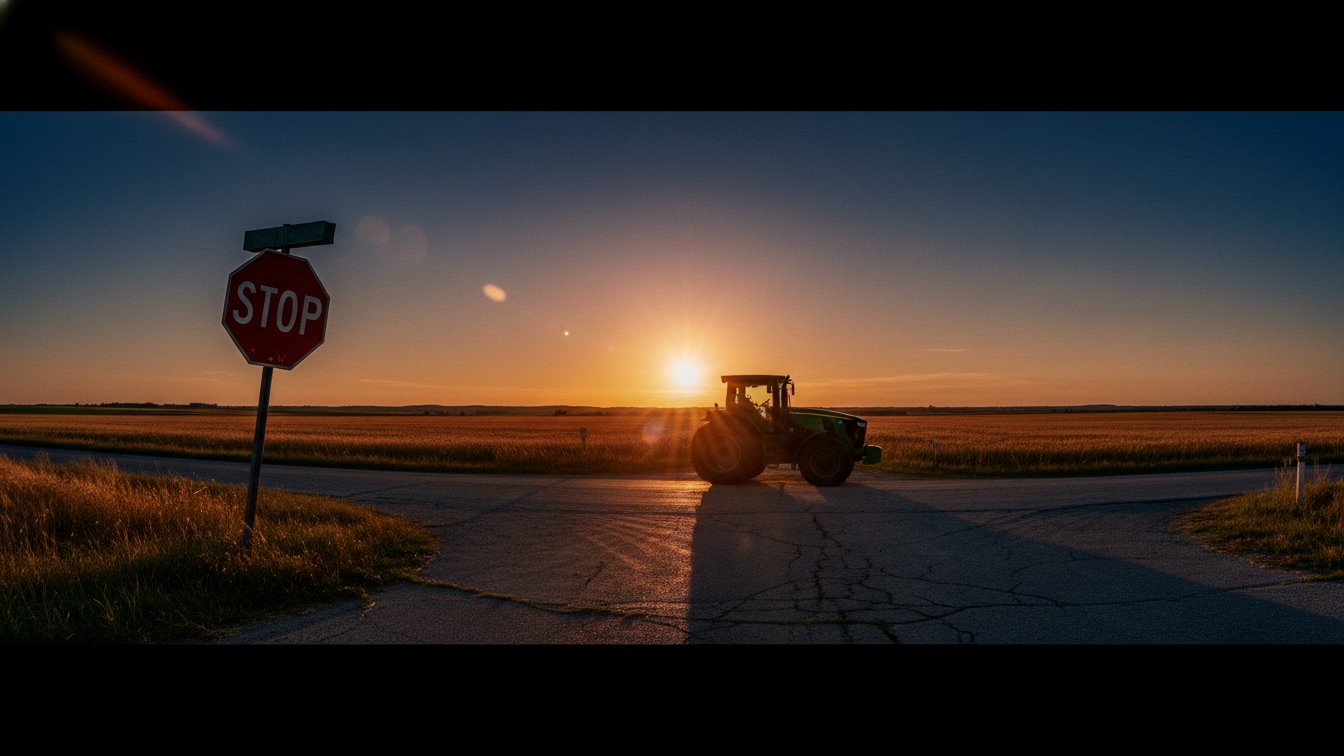
The story begins in the oppressive quiet of a farmhouse where Leo and his sister, Mia, grapple with the sudden absence of their father, Silas. Silas has been arrested for blocking a county road with his tractor to protest rising fuel prices, an act the state has escalated into a "hate-motivated infrastructure sabotage" charge. The family watches in horror as their bank accounts are frozen, their social media histories are weaponized against them, and their farming equipment is seized by the state.
As the legal pressure mounts, the family realizes that Silas is being used as a political example rather than a criminal defendant. The narrative shifts from domestic tension to a desperate flight when a neighbor, Dave, warns them that the state is beginning to seize livestock and arrest those associated with Silas. The chapter concludes with the family abandoning their home under the cover of night. They leave behind their history and the dying farm to escape a system that has already decided their guilt.
The central theme of the story is the weaponization of language and the loss of nuance in a digital age. Silas’s protest is not viewed as a simple act of civil disobedience but is instead filtered through an ideological lens that transforms a "thistle problem" into a "coded slur." This highlights the terrifying power of the state to redefine reality through the use of algorithms and "hate-enhancement" laws. The characters find themselves trapped in a world where intent is secondary to the "vision of a sustainable future" mandated by the government.
Another prominent theme is the erosion of the private sphere and the permanence of the digital footprint. Leo experiences a visceral sense of dread when he realizes that deleting his social media history does nothing to erase the data already collected by the state. The story suggests that in the near future, every joke, like, or angry comment becomes a permanent record that can be used to construct a narrative of radicalization. This surveillance creates a claustrophobic environment where even the home is no longer a sanctuary from the watchful eye of the law.
The narrative also explores the death of the rural way of life and the alienation of the working class. The farm, once a place of productivity and family heritage, is reduced to "biological assets" and "reclaimed land" by an urban-centric government. There is a deep psychological toll on the characters as they watch their livelihood be dismantled by people who do not understand the soil or the struggle of farming. The "four-way stop" becomes a symbol of the intersection between traditional independence and modern authoritarian control.
Leo serves as the grounding perspective of the story, acting as both an observer and a reluctant protector of his family. He experiences a profound sense of cognitive dissonance as he tries to reconcile the father he knows with the "terrorist" being portrayed on the news. His internal conflict is driven by a mix of anger at the system and a growing realization of his own vulnerability. He is a young man forced into premature adulthood, moving from the simple concerns of a farm boy to the high-stakes survival of a political refugee.
His psychological state is characterized by a "sick realization" of the power held by those in the grey sedan. He is observant, noting the sensory changes in his environment—the weight of the silence and the heat of the sun—which mirror his internal pressure. Leo’s decision to leave the farm signifies his ultimate acceptance that the world he knew is gone. He chooses the uncertainty of flight over the certainty of a "radicalized" label, showing a pragmatic but heartbroken resilience.
Mia represents the vulnerability of the younger generation in a hyper-connected society. She is the one most attuned to the digital backlash, suffering through the comments and news updates that dehumanize her father. Her emotional state fluctuates between flat despair and sharp, jagged outbursts of defiance. She is physically affected by the trauma, becoming gaunt and sunken-eyed as the state’s pressure increases.
Her role in the story highlights the psychological impact of being "watched" by an invisible, judgmental public. She provides the necessary information that drives the family's fear, acting as a herald of the digital storm. Despite her fear, she displays a stubborn streak, insisting on accompanying Leo to the gravel pit meeting. This suggests that while she is traumatized, she still possesses a core of familial loyalty that refuses to be completely suppressed by the state.
Sarah, the mother, undergoes the most dramatic psychological transformation in the chapter. She begins as a resilient figure trying to manage the legal crisis, but she eventually collapses under the weight of the state's systemic cruelty. Her transition from "survival mode" to the "shutter closing" in her eyes marks the narrative's move from hope to desperation. She is a woman who has lost her husband, her livelihood, and her sense of security in a matter of days.
Her decision to abandon the farm is the ultimate act of a mother protecting her children. She recognizes that the home has become a "monument" to a lost cause and that staying would lead to their collective destruction. Sarah’s character embodies the grief of the displaced, forced to walk away from everything her husband built. Her silence at the end of the story is not one of defeat, but of a grim, focused necessity.
Silas is an atmospheric presence whose absence drives the entire plot. He is characterized as a man of action and conviction, a "freight train" of a person who believed he could still appeal to his neighbors' sense of fairness. His tragic flaw is his failure to realize that the rules of engagement had changed. He thought he was a patriot standing up for his community, but the state saw him only as a data point to be corrected.
His fingerprints are on everything in the house, making his physical absence feel like a haunting. The psychological weight of his situation—facing a life sentence for a six-hour road blockage—serves as the catalyst for the family's flight. He represents the old world of physical labor and direct protest, which is being systematically erased by a new world of digital interpretation. Silas is the sacrificial lamb in a legal system that values ideological compliance over individual justice.
The pacing of the story is masterfully handled, beginning with a slow, heavy domestic tension that gradually accelerates into a frantic escape. The author uses the oppressive July heat as a metaphor for the escalating legal and social pressure on the Ward family. The air feeling like "wet wool" and the "screaming cicadas" create a sensory experience of claustrophobia. This environmental discomfort mirrors the psychological stifling of the characters as their world shrinks.
The narrative voice is bleak and grounded, utilizing stark imagery to emphasize the family's loss. The empty ceramic tray where the keys used to sit is a recurring motif that symbolizes the void left by Silas. By focusing on these small, domestic details, the author makes the grander political themes feel intimate and personal. The transition from the "empty white space" of the tray to the "dark woods" of the escape illustrates the total disintegration of the family's reality.
The tone is one of mourning, not just for a person, but for a way of life and a set of lost American ideals. The author avoids melodrama, choosing instead a cold, clinical description of the state’s actions, which makes the events feel more terrifyingly plausible. The use of the "grey sedan" as a silent, constant observer adds a layer of psychological horror to the rural setting. The final image of the flickering streetlamp at the four-way stop serves as a poignant coda to a story about a family left with nowhere to go.


