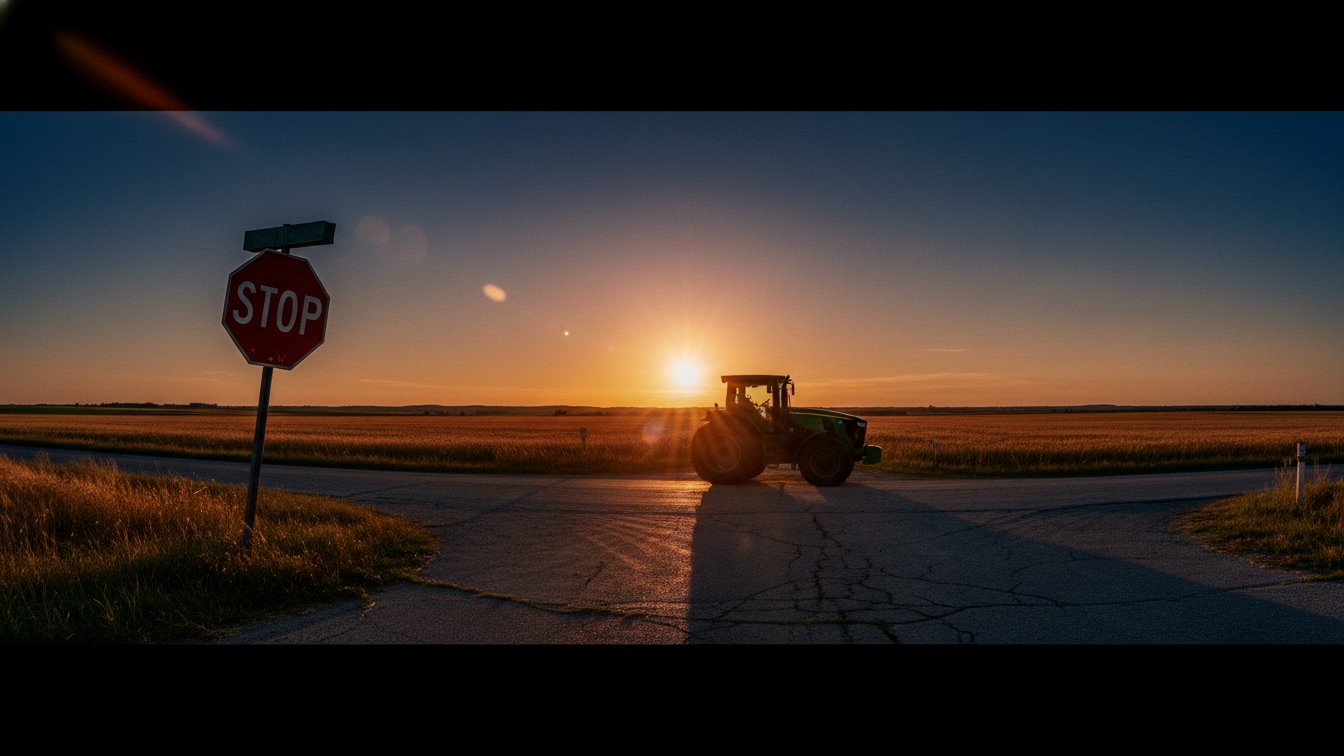
Format: Short Film / Anthology Episode | Est. Length: 10-12 minutes
Imagine a near-future anthology series titled The New Normal, where each episode explores the chilling intersection of hyper-regulated social policy and the erosion of individual liberty in rural America. "Four-Way Stop" serves as a grounded entry point into a world where digital footprints are weaponized and the definition of a "hate crime" has expanded to include any opposition to state-mandated sustainability goals. The series follows various families across different sectors as they navigate a landscape where the line between political dissent and domestic terrorism has been completely erased by algorithmic governance.
Leo stands in a silent, sterile kitchen, staring at the empty ceramic tray where his father’s keys used to sit, realizing that the man who built their home has been erased by the state in less than forty-eight hours. The distant, high-pitched scream of cicadas underscores the suffocating heat of a farm that is no longer theirs.
After a desperate farmer is branded a domestic terrorist for a peaceful road protest, his family must navigate a predatory legal system that weaponizes their digital history to seize their land. They are forced to choose between a life of state-mandated silence or becoming fugitives in the very country they once called home.
The story explores the terrifying evolution of "Lawfare," where legal frameworks are manipulated to suppress economic and political dissent under the guise of social harmony. It delves into the fragility of the American Dream in the face of algorithmic surveillance, highlighting how ordinary lives can be dismantled by the retrospective analysis of private communications and social media "likes."
Secondary themes include the death of the family farm and the widening chasm between urban policy-makers and rural providers. It captures the isolation of the modern dissident, where the "community" is silenced by fear and the state uses economic strangulation—freezing bank accounts and seizing assets—as a primary tool of subjugation.
For Leo and his family, the stakes are existential: they face the permanent loss of their father to a life sentence, the total forfeiture of their multi-generational heritage, and their own potential incarceration as "radicalized" accomplices. Beyond the family, the story suggests the total collapse of rural autonomy, where the right to protest and the right to own property are contingent upon ideological compliance with the urban majority.
The primary external conflict is the faceless, bureaucratic power of the State, represented by the "hate motivation" enhancement laws and the cold, efficient deputies who execute seizure orders. Internal conflict stems from the family’s paralyzing fear and the realization that their past digital lives have become a trap. The tension is exacerbated by the "watchers" in the grey sedan, a physical manifestation of a system that is no longer waiting for a crime to be committed, but for a "sentiment" to be expressed.
In the sweltering July of 2026, Leo and his sister Mia wait in their hollowed-out farmhouse while their father, Silas, is held on domestic terrorism charges for blocking a highway with his tractor. What Silas intended as a protest against rising fuel costs is reclassified by the state as a "hate-motivated infrastructure sabotage," using his old social media posts and private messages as evidence of radicalization. As the family’s bank accounts are frozen and their neighbors are picked off one by one, the reality sets in that Silas will never come home and the farm is being "reclaimed" for state use.
The situation escalates when the sheriff seizes the farm’s essential machinery, effectively killing the harvest and the family's livelihood. After a clandestine meeting with a neighbor reveals that the state is now targeting family members for "complicity," Leo’s mother, Sarah, realizes they have no legal recourse left. Under the cover of a state-imposed power outage, the family abandons their home and flees toward the northern border, leaving behind their past to escape a system that has turned their very existence into a crime.
Leo Ward: A resilient but disillusioned young man who begins the story hoping for a legal resolution and ends it as a pragmatic fugitive. His arc moves from disbelief and anger to a cold, survivalist clarity as he realizes the system he trusted has been weaponized against him.
Mia Ward: Leo’s younger sister, who is deeply plugged into the digital world and witnesses the real-time destruction of her father’s reputation via social media. She transitions from a state of panicked grief to a hollowed-out silence, mirroring the death of her digital and physical identity.
Sarah Ward: The matriarch who attempts to fight the system through traditional legal channels until she realizes the "rules" have changed. Her arc is the most tragic, as she is forced to abandon the home she built to save her children from the same fate as her husband.
Silas Ward (Off-Screen): The catalyst of the story, a hardworking farmer whose "common sense" protest is his undoing. He represents the "old world" values of direct action and vocal dissent that are no longer compatible with the new surveillance state.
The Empty House: Leo surveys the kitchen, noting the absence of his father’s boots and keys, while Mia reveals that the internet has already branded their father a "monster" based on years-old Facebook posts. The heat is oppressive, and the fridge is empty, symbolizing the immediate economic and social isolation the family has been plunged into. A souvenir magnet falls from the fridge, marking the symbolic collapse of their family history.
The Legal Blow: Their mother, Sarah, emerges from her office to announce that the state has frozen their bank accounts and enhanced Silas’s charges to "hate-motivated sabotage." The lawyer explains over speakerphone that the "intent" to oppose sustainable policy is now a protected category, making Silas’s protest a strike against a social identity. The realization hits that the legal system is no longer interested in facts, only in the "narrative" of radicalization.
The Gravel Pit: Leo and Mia sneak out to a secret meeting of local farmers, where they find their community in a state of total collapse as accounts are flagged and neighbors are arrested. Mr. Henderson explains that the "hate" charge is a legal loophole used to seize land for state solar projects, revealing the true economic motive behind the prosecution. Leo realizes that his father wasn't just a protester, but a target in a much larger land-grab operation.
The Seizure: A city deputy arrives with tactical officers to impound the farm’s tractors, citing a "morality clause" in their bank financing that allows the state to seize collateral from "hateful entities." Mia’s verbal protest is recorded as "secondary radicalization," forcing Leo to pull her back and accept the theft of their livelihood. The dust from the departing flatbeds hangs over the farm like a shroud, signaling the end of their ability to survive on the land.
The Digital Purge: Under Sarah’s orders, Leo and Mia attempt to delete their entire digital histories, realizing that even a "like" on a father’s post is now evidence of domestic extremism. Leo watches a mysterious grey sedan parked at the end of the driveway, realizing they are being surveilled and baited into a reaction. The lawyer calls back to reveal that the state is seeking a life sentence, using a "weed" joke from a private chat as proof of a genocidal plot.
The Flight: Following a power outage, a ragged neighbor named Dave arrives to warn the family that the state is coming to arrest them for "complicity" and seize the livestock. Sarah makes the agonizing decision to abandon the farm, and the family packs single bags of essentials while leaving their heritage behind. They walk through the dying corn stalks toward the woods, Leo looking back one last time at the flickering streetlamp of the four-way stop that destroyed his life.
The episode begins with a heavy, ringing silence and a sense of "wrongness" that evolves into a sharp, jagged fear. The middle section is characterized by a feeling of suffocating claustrophobia as the state’s net tightens around the family’s finances and digital lives. The climax is not an explosion of action, but a cold, hollowed-out acceptance of loss, ending on a note of somber survivalism as the family disappears into the darkness.
In a full season, "Four-Way Stop" would be the first of several interconnected stories showing the "Rural Reclamation Act" in action across the country. Subsequent episodes would follow Silas’s experience in a "de-radicalization" facility, Sarah’s struggle as an internally displaced person in the city, and Leo’s eventual recruitment into a burgeoning underground resistance movement.
The overarching narrative would track the escalation of state control from economic sanctions to the implementation of "Social Credit" scores that determine access to food and utilities. The season would conclude with the disparate characters from various episodes converging at a major "reclaimed" site, where the reality of the state’s "sustainable future" is revealed to be a high-tech feudal system.
The visual style should be "Dust-Bowl Noir," utilizing high-contrast lighting, long shadows, and a desaturated color palette of ochre, grey, and sickly yellow. The camera work should feel voyeuristic and tight, emphasizing the feeling of being watched, with frequent use of telephoto lenses to simulate surveillance from the perspective of the grey sedan.
The tone is one of "quiet horror," comparable to Children of Men or Winter’s Bone, where the threat is often unseen and bureaucratic rather than physical. The sound design will focus on the oppressive, high-pitched buzz of cicadas and the mechanical hum of drones, creating an auditory environment that feels like a constant, low-level assault on the senses.
The target audience includes fans of near-future dystopian thrillers (e.g., Black Mirror, The Handmaid’s Tale) and viewers interested in social commentary regarding digital privacy and civil liberties. It appeals to a mature audience (18-45) that appreciates grounded, character-driven drama with a high degree of tension and "ripped-from-the-headlines" relevance.
The pacing is a "slow burn" that accelerates in the final third as the legal threats turn into physical seizures. The 10-12 minute runtime is structured into three acts: the realization of the legal trap (0-4m), the physical loss of assets and community (4-8m), and the final flight into the unknown (8-12m).
Production will require a rural farmhouse location that feels both lived-in and increasingly sterile as items are removed. The use of practical effects for the heavy dust and the shimmering heat haze is essential to ground the story in a physical reality that contrasts with the "digital" nature of the father's crimes.
Special attention must be paid to the "State" vehicles and uniforms, which should look slightly more advanced and "cleaner" than the rural setting to emphasize the disconnect between the government and the governed. The lighting for the final night sequence should rely on naturalistic moonlight and the harsh, flickering glow of a single streetlamp to underscore the family’s transition into the shadows.


