Leo tries to pitch a failing food program to a starving community while keeping an illegal seedling alive.
The air in the community hall felt like someone had already breathed it a hundred times. It was thick, wet, and smelled like old gym mats and desperation. Outside, the summer sun was baking the city into a brick, but inside, the AC was just moving the heat around. I stood on the small wooden stage, looking at forty people who wanted to scream. My shirt was sticking to my back. My tablet was glitching because my palms were sweaty. I wiped the screen on my jeans, but it just smeared the grease.
"The Bio-Credit system isn't a punishment," I said. My voice sounded thin through the shitty speakers. "It’s a way to ensure the calories go where they’re needed. If you register your biometric data, the distribution is guaranteed. No more waiting in lines for the trucks that never show up."
Nobody clapped. A man in the front row, wearing a shirt that had more holes than fabric, stood up. His name was Arthur. I knew him. He’d taught my sister how to fix a bike five years ago when things were better. Now his face was just a map of exhaustion. "Guaranteed by who, Leo? The same Board that shut down the district pumps last week? We’re eating gray paste and you want our thumbprints?"
"The pumps were a mechanical failure, Arthur," I lied. The subtext was heavy in the room. Everyone knew the pumps were diverted to the Upper Tier gardens. "The Bio-Credits help us track the demand in real-time. It prevents the black market from siphoning the rations."
A woman at the back laughed. It was a sharp, ugly sound. "The black market is the only reason my kids had fruit this month. You work for them now, so you think you're safe. You think that blue lanyard makes you different."
I felt the weight of the backpack resting against my leg. Inside, tucked into a padded compartment, was a small, plastic hydro-pod. It held a Cherokee Purple tomato seedling. It was illegal. It wasn't 'Bio-Optimized.' It didn't have a tracking tag. It was a stubborn, green spark of life that I’d found growing in the cracks of a decommissioned greenhouse. If I got caught with it, the Board would strip my credits and probably send me to a reclamation camp. But it was the only thing that felt real.
"I’m just the messenger," I said, which was the most pathetic thing I could have said.
"Then tell them to send someone we can actually talk to," Arthur spat. He sat back down, crossing his arms. The room was a pressure cooker. I could see the heat haze shimmering near the ceiling. The fluorescent lights flickered, a rhythmic buzz that felt like a migraine in the making. I looked for Mia in the crowd. My sister was sitting near the exit, her hood up despite the heat. She didn't look at me. She looked at her shoes. That hurt worse than Arthur’s yelling.
I tried to pull up the slide for the nutritional breakdown. The projector hummed, then projected a giant, distorted image of a barcode onto the peeling white paint of the wall. Someone hissed. The digital static was loud. It sounded like the world was tearing. I felt a drop of sweat run down my spine.
"Look," I said, stepping away from the mic for a second. "I live here too. I’m in Section 4. I see the trucks. I know the paste tastes like chalk. But if we don't sign up, they’ll cut the district off entirely. They’re looking for a reason to de-prioritize us."
"They already have," someone yelled.
I checked my watch. Ten minutes left in the session. If I could just survive ten more minutes of this, I could get out, get home, and give the seedling some actual light. It was wilting. I could feel its thirst through the bag. It was a hallucination, probably, but I felt a connection to that plant that I didn't feel toward the people in this room anymore. The plant didn't argue. It just tried to grow.
The tablet screen flickered red. 'System Error: Connection Lost.' The crowd saw it too. A low murmur started, the kind of sound that usually precedes a riot. I took a breath, trying to steady my hands. My stomach was in knots. I hadn't eaten since yesterday. The Board gave us credits, sure, but the kiosks were always empty by the time I finished my shift.
"We’ll get the connection back," I promised, knowing it was a lie. The infrastructure was rotting. The fiber cables were being stripped for copper faster than the Board could replace them.
Arthur stood up again. He didn't look angry anymore. He just looked sad. "Leo, go home. Tell them we aren't selling our blood for paste. Tell them we’re still people."
I didn't have an answer for that. I just watched him walk out. One by one, the others followed. The heavy metal doors groaned as they swung open, letting in a blast of outside air that was even hotter than the air inside. It felt like a physical blow. Mia was the last to leave. She stopped at the door, turned, and looked at me for a split second. Her eyes were hard. She didn't say a word.
I stood on the stage alone, the projector still humming, casting a giant, useless barcode over my head. I reached down and touched the strap of my bag. The seedling was still there. It was the only thing I had left that wasn't a lie.
I stayed on the stage until the hum of the projector became unbearable. It was a high-pitched whine, like an insect trapped in my skull. I finally reached over and punched the power button. The room dropped into a murky, gray twilight. The only light came from the high, dirty windows near the ceiling, filtered through layers of city grime and the orange haze of the summer smog.
I sat on the edge of the stage, my legs dangling. My boots were scuffed and the soles were thinning. Everything was wearing out. The world was a machine that had stopped being maintained decades ago. I pulled my backpack into my lap and carefully unzipped the side pocket. I didn't take the hydro-pod out—too risky—but I peeled back the edge of the thermal wrap.
The seedling was sagging. Its two tiny leaves were curled, the vibrant green turning a sickly, translucent yellow at the edges. It was dying in the heat. I reached into my bag and pulled out my water bottle. It was metal, dented, and the water inside was lukewarm and tasted like iron. I used a small plastic dropper to put three drops of water directly onto the base of the stem.
"Hang on," I whispered.
It was stupid. I was talking to a plant. But in a world where everything was tracked, tagged, and processed, this little bit of biology felt like a rebellion. It was a Cherokee Purple. My grandfather used to talk about them. He said they were sweet and acidic and tasted like the sun. The paste we ate tasted like nothing. It was designed to keep you alive, not to make you happy.
I heard a footstep near the back of the hall. I quickly zipped the bag and stood up, my heart hammering against my ribs. It was Miller. My supervisor. He was wearing a suit that was too expensive for this district, and he was sweating through it. He looked like he wanted to hit someone.
"That went well," Miller said. His voice was dripping with sarcasm.
"They’re hungry, Miller. They don't want to talk about biometrics when they haven't seen a fresh vegetable in three years."
Miller walked down the center aisle, his shoes clicking on the linoleum. "The Board doesn't care what they want. They care about data. If this district doesn't hit its registration quota by Friday, the energy subsidies are gone. You know what that means? No AC. No lights. Just the sun and the silence."
"I told them," I said, stepping down from the stage. "They don't believe me. They think we’re bluffing."
Miller stopped in front of me. He was shorter than me, but he had the kind of authority that came from having a full stomach and a secure apartment in the Upper Tier. He smelled like expensive cologne and air-conditioned air. It was a scent that didn't belong here. "We aren't bluffing, Leo. You’re one of them. Talk to them. Find the influencers. Tell them to sign the damn forms or start digging graves."
I looked at the blue lanyard around my neck. It felt like a leash. "I’m trying."
"Try harder. And keep that bag closed. What have you got in there?"
My heart skipped. I felt a cold chill despite the heat. "Just my gear. Tablets, chargers. The usual."
Miller squinted at me. For a second, I thought he was going to ask to see inside. He was the kind of man who enjoyed the small exercises of power. He liked to see people squirm. But then his phone buzzed in his pocket. He pulled it out, frowned at the screen, and turned away.
"Fix it, Leo. Or I’ll find someone who can. There are plenty of people in this slum who would kill for your job."
He walked out without looking back. I stood there for a long time, the silence of the hall pressing in on me. The heat was a physical weight. I felt like I was being buried alive in it. I thought about the graves Miller mentioned. It wasn't a metaphor. Last summer, the heat dome had killed three hundred people in this district alone. Most of them were elderly. They just sat in their rooms and cooked.
I picked up my bag and headed for the side exit. I didn't want to go through the main doors. I didn't want to see the people waiting for the trucks that wouldn't come. I took the stairs down to the basement, where the air was slightly cooler, though it smelled like damp earth and rot.
There was a maintenance tunnel that ran under the street, connecting the hall to the old subway system. Most people didn't know about it, or they were too afraid of the dark to use it. I liked the dark. In the dark, nobody could see my face. Nobody could see the lanyard.
I pulled out my flashlight, a small LED thing that was dying. The beam was weak and yellow. I navigated the tunnel, stepping over puddles of stagnant water and piles of discarded trash. The walls were covered in old graffiti, layers of names and dates that stretched back to a time when people had something to say.
I stopped near a venting grate. A tiny sliver of light fell through the bars, hitting the floor. I opened my bag again. The seedling looked worse. The stems were drooping further. I felt a surge of panic. If this plant died, it felt like everything else would too. It was a symbol I hadn't asked for, but I was stuck with it.
I sat on a rusted pipe, feeling the vibration of the city above me. The heavy thrum of the transit mag-levs, the distant sirens, the hum of the power grid. It was a symphony of a dying civilization. I closed my eyes and tried to imagine what a Cherokee Purple tasted like. I couldn't. I had no frame of reference for 'sweet and acidic.' I only knew the metallic tang of the paste and the chemical sweetness of the hydration packets.
I took another sip of my water, then gave the rest to the plant. I would be thirsty for the walk home, but the plant needed it more. I was a human; I could endure. The plant was fragile. It was a ghost of a world that didn't exist anymore.
I checked my tablet. A notification popped up. A message from Mia.
'Don't come home tonight. They're looking for you.'
I stared at the words until they blurred. My own sister. My own house. I was the enemy now. I was the face of the Board. I was the guy telling them to trade their souls for a meal.
I leaned my head against the cold, damp wall of the tunnel. The 'Stubborn Spark' wasn't just the plant. It was the fact that I was still sitting here, breathing this foul air, trying to figure out a way to make it to tomorrow. It was a low bar, but it was all I had.
I didn't go home. I couldn't. If Mia was warning me, it meant the neighborhood council was planning something. They wouldn't kill me—probably—but they’d take my bag, my tablet, and my credits. They’d leave me with nothing, and then the Board would finish the job.
I spent the next three hours moving through the sub-levels. I knew the guts of the district better than most. My dad had been a pipe-fitter before the automation took over. He’d shown me the 'hidden city' when I was a kid. The places where the sensors didn't reach.
I found a small alcove behind a massive air-scrubbing unit. It was loud, a constant industrial roar that drowned out everything else, but it was safe. The air coming out of the unit was filtered, though it was hot enough to singe my hair. I crawled into the space and sat down, pulling my knees to my chest.
I took the hydro-pod out of my bag. I had to see it. In the dim light of the alcove, the seedling looked like a miracle. It was so small. Two leaves, a thin stem, and a network of tiny roots visible through the clear plastic of the pod. It was a fragile piece of software in a world of hardware.
I needed to find a place to plant it. The pod was just a holding cell. It needed soil. Real soil, not the sterile substrate the Board used in the vertical farms. I thought about the old park on the edge of the district. It was a dust bowl now, but there was a corner near the old fountain where the ground stayed damp.
But the park was patrolled. The Board didn't want people 'loitering' in spaces they couldn't monetize. They wanted us in our units, watching the feeds, clicking the ads, and waiting for our credits.
I felt a vibration in my pocket. My tablet was buzzing again. I didn't want to look at it, but I had to. It was Miller.
'Leo, where are you? The registration numbers are flat. I need a report by 20:00.'
I ignored it. I switched the tablet to airplane mode. Let him sweat. Let him explain to his bosses why the 'Bio-Credit' initiative was a disaster.
I must have fallen asleep, because the next thing I knew, the roar of the air-scrubber had changed pitch. It was the night cycle. The city was trying to cool down, dumping its heat into the atmosphere. I felt stiff and sore. My mouth felt like it was full of sand.
I checked the seedling. It was holding on. Barely. The leaves were still sagging, but they hadn't turned brown yet.
"Okay," I said to the darkness. "Let’s go."
I moved out of the alcove and back into the tunnels. I headed toward the park. I had to move carefully. The 'Peacekeepers'—the Board’s private security force—were more active at night. They liked to catch people out of their units. It gave them something to do.
I reached the maintenance hatch that opened into the park’s utility shed. I listened at the door. Silence. I pushed it open and stepped out into the night.
The heat was still there, but the sun was gone, replaced by the pale, sickly glow of the city’s light pollution. The sky was a hazy purple, no stars visible. The park was a graveyard of dead trees and rusted playground equipment. A swing set creaked in the hot breeze, a lonely, rhythmic sound.
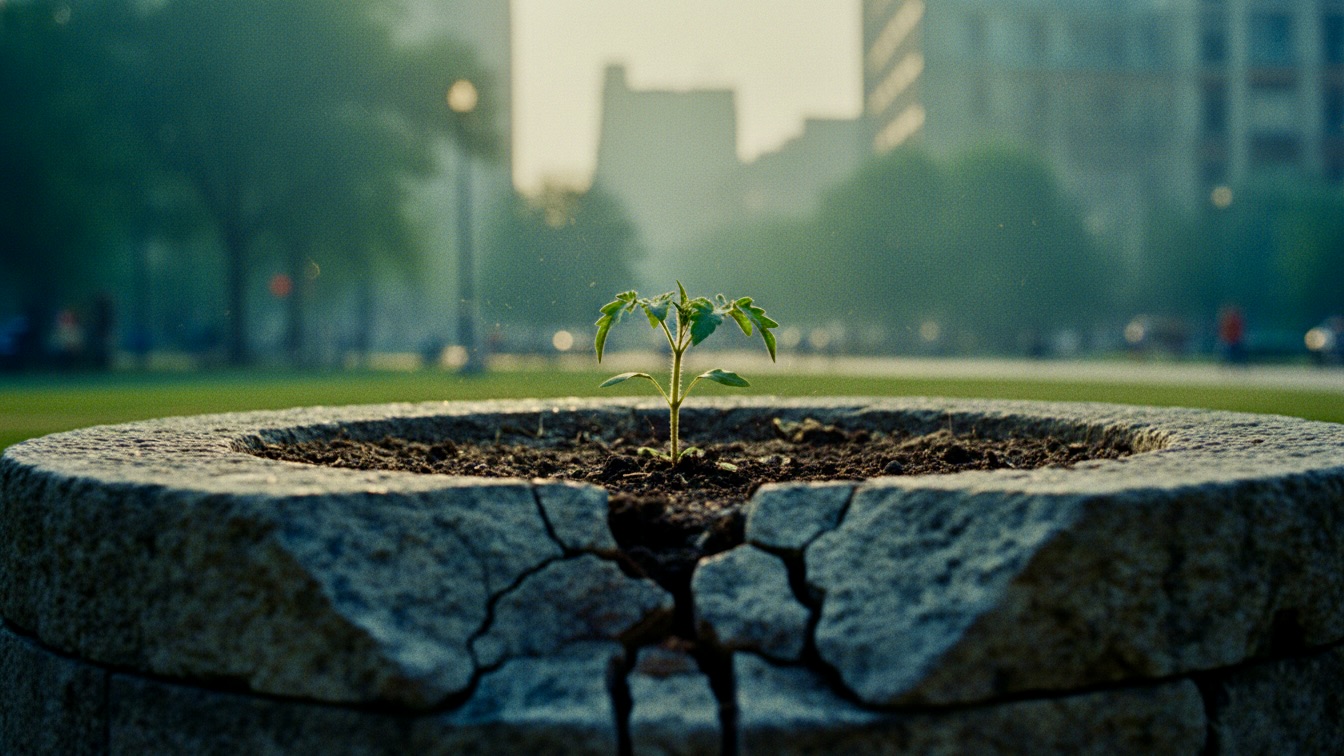
I stayed in the shadows, moving toward the fountain. It was a grand, stone structure that hadn't seen water in a decade. But the pipes underneath were leaky. There was a patch of ground near the base that was surprisingly soft.
I knelt down and started digging with my hands. The dirt was warm, but it felt good. It felt real. I dug a hole about six inches deep. I carefully removed the seedling from the hydro-pod, making sure not to disturb the roots. I placed it in the hole and pushed the dirt back around it, tamping it down gently.
"This is it," I whispered. "Grow or don't. It’s up to you."
I poured the last few drops of my water onto the soil. I felt a strange sense of peace. For the first time in months, I wasn't doing something for the Board. I wasn't doing something for the credits. I was doing something for the world.
I heard a voice behind me.
"What are you doing, Leo?"
I froze. I knew that voice. I turned around slowly. Mia was standing there, her face silhouetted against the city lights. She had her hands in her pockets. She looked tired.
"I’m planting something," I said.
"In this dirt? Nothing grows here. It’s poison."
"Maybe this one will. It’s different."
Mia walked closer. She looked down at the tiny green speck in the darkness. "Is that what’s in the bag? The reason you’ve been acting like a freak for weeks?"
"It’s a Cherokee Purple. A real tomato."
Mia laughed, but it wasn't mean this time. It was just tired. "You’re an idiot. If they find this, they’ll kill you. And for what? A tomato? You can't even eat it for months."
"It’s not about eating it, Mia. It’s about... I don't know. Having something that isn't theirs."
Mia looked at me for a long time. The subtext was there, the years of us drifting apart, me taking the Board job to keep us fed, her joining the resistance groups. We were on opposite sides of a war neither of us could win.
"They’re coming for the hall tomorrow," she said quietly. "The council. They’re going to burn the registration terminals."
"Miller will call in the Peacekeepers. They’ll lock down the whole district."
"Let them. People are done waiting. They’d rather starve on their own terms than live on the Board’s."
I looked at my sister. She looked so small in the vast, decaying park. "What are we doing, Mia?"
"We’re surviving," she said. "That’s all there is."
She reached into her pocket and pulled out a small, crumpled protein bar. She handed it to me. "Eat this. You look like hell."
I took it. It was dry and tasted like sawdust, but it was the best thing I’d ever eaten. We sat there in the dark, next to the fountain, watching the city glow. Two kids in a broken world, guarding a tiny green spark that shouldn't have been there.
"You should go," I said. "If a patrol comes..."
"I know. See you around, Board boy."
She turned and vanished into the shadows. I stayed. I wanted to watch the plant for a little longer. I wanted to believe that the dirt wasn't poison. I wanted to believe that tomorrow would be different, even though I knew it wouldn't.
I checked my tablet one last time before turning it off. There was a new message from the Board.
'Quota not met. District 7 energy subsidies suspended effective immediately.'
The lights in the distant apartment blocks flickered, then went out. One by one, the windows went dark. The hum of the city changed, losing its high-frequency buzz. The silence that followed was terrifying.
I looked down at the seedling. It was just a shadow in the dark now. I reached out and touched a leaf. It felt firm.
"Stay," I whispered.
The darkness was absolute. Without the streetlights and the building glows, the city felt like a hollowed-out shell. The heat seemed to intensify in the stillness, a heavy, suffocating blanket. I could hear the sounds of the district reacting to the blackout. Shouts in the distance. The sound of breaking glass. A dog barking somewhere far away.
I didn't move. I sat by the fountain, my back against the stone. I felt like the last person on earth. The Board had pulled the plug, literally. It was a tactic they used to break dissent. Cold, calculated, and effective. By morning, the heat in the units would be unbearable. People would be begging for the Bio-Credits just to get the fans spinning again.
I thought about Miller, sitting in his Upper Tier apartment with its independent power grid and its climate control. He wouldn't even notice the blackout. To him, we were just numbers on a spreadsheet that hadn't added up.
I looked at the seedling. I couldn't see it anymore, but I knew where it was. I reached into my bag and pulled out the empty hydro-pod. I had an idea. It was a small, desperate idea, but it was all I had.
I climbed into the fountain. The stone was rough and hot. I found the main intake pipe. It was dry, but there was a slow, rhythmic drip coming from a cracked seal deep inside the plumbing. Drip. Drip. Drip.
It wasn't much, but it was consistent. I spent the next hour rigging a system. I used a piece of plastic tubing from my bag and the casing of my broken tablet. I channeled the drip, guiding it out of the fountain and toward the patch of dirt where I’d planted the Cherokee Purple.
It was a crude piece of engineering, but it worked. A tiny, steady stream of water began to soak into the ground at the base of the plant.
"There," I said. "You’ve got a chance now."
I felt a strange sense of accomplishment. I hadn't saved the district. I hadn't stopped the Board. I hadn't even fixed my relationship with Mia. But I had secured the survival of one tiny, illegal thing.
I walked back toward the maintenance hatch. I couldn't stay in the park. The Peacekeepers would be out in force now, using the blackout as cover to 'clean up' the streets. I had to find a place to hide until morning.
As I moved through the dark, I felt a shift in the air. A breeze. It wasn't the hot, dry wind from before. It was cooler. It smelled like rain.
I stopped and looked up. For the first time in months, I saw a flash of lightning behind the smog. A real storm was coming. The heat dome was breaking.
The first drop hit my forehead. It was cold. Then another. Then a deluge.
The rain slammed into the city, washing away the dust and the grime. It hissed on the hot pavement. It pounded against the empty buildings. I stood there, letting it soak through my clothes, letting it wash the sweat and the failure off my skin.
I laughed. It was a crazy, jagged sound. The Board could cut the power, they could track the food, they could tag the people, but they couldn't control the sky. They couldn't stop the rain.
I ran back to the fountain. The seedling was being hammered by the downpour. I knelt over it, shielding it with my hands. "Easy," I said. "Too much of a good thing."
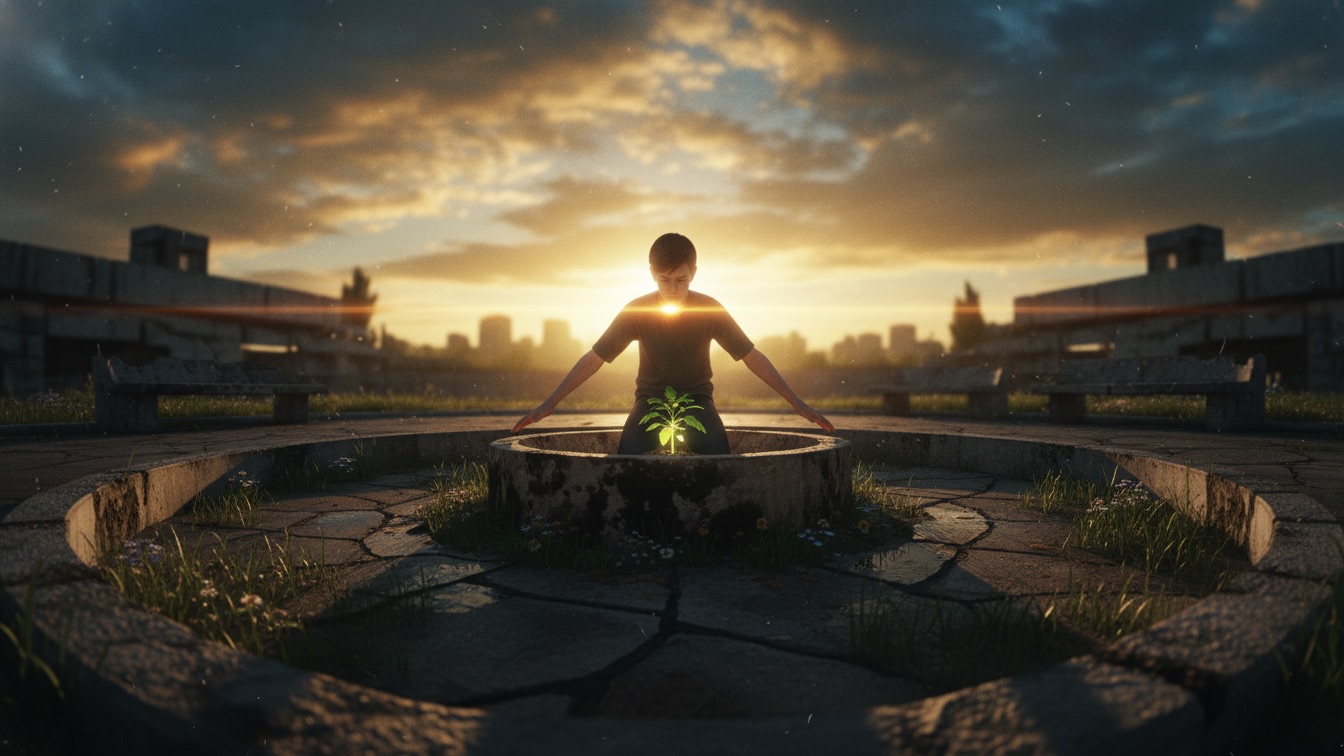
I stayed there for the rest of the night, a human umbrella in a summer storm. My hands were cramped, my legs were numb, and I was shivering, but I didn't care. The water was filling the fountain. The pipes were gurgling. The city was drowning and breathing at the same time.
When the sun finally rose, it wasn't the angry, orange eye of the previous weeks. It was pale and soft, filtered through the retreating clouds. The air was crisp. The district looked different. It looked washed.
I looked down at the Cherokee Purple. It was standing tall. The leaves were wide and dark green, shimmering with droplets of rainwater. It looked strong. It looked like it belonged there.
I stood up and stretched my aching back. My tablet was ruined, my lanyard was soaked, and I was probably out of a job. I didn't care. I felt light. I felt like I’d finally disconnected from the machine.
I walked out of the park and onto the main street. People were coming out of their units. They were standing on the sidewalks, looking at the puddles, looking at the sky. There was a different energy in the air. Not anger, but a quiet, collective realization.
I saw Arthur standing near the hall. He was holding a bucket, catching the runoff from a clogged gutter. He saw me and nodded. It wasn't a friendly nod, but it wasn't hostile either. It was a recognition. We were both still here.
I kept walking. I headed toward Section 4. I wanted to find Mia. I wanted to tell her about the rain. I wanted to tell her that I wasn't a Board boy anymore.
I reached our apartment block. The elevator was dead, so I climbed the twelve flights of stairs. I was exhausted, but my heart was light. I reached our door and knocked.
No answer.
I tried the handle. It was unlocked. I walked in. The apartment was empty. Mia’s bag was gone. Her shoes were gone.
On the kitchen table, there was a single, small object. A piece of paper. In a world of digital everything, a piece of paper was a profound statement.
I picked it up. There were four words written in Mia’s messy handwriting.
'Keep the spark alive.'
I sat down in the dark, quiet kitchen. The sun was coming through the window, hitting the linoleum. I looked at my hands. They were stained with dirt. Real dirt.
I didn't know what would happen next. I didn't know if the Peacekeepers would come knocking. I didn't know if we’d have food next week. But I knew that somewhere in the park, a tomato plant was growing in the ruins.
I leaned back and closed my eyes. The city was waking up, and for the first time in a long time, it didn't sound like a machine breaking down. It sounded like people trying to live.
I took a breath. The air was clean.
I’ll go back to the park tonight, I thought. I’ll make sure the drip is still working. I’ll make sure the dirt is still wet.
It was a small thing. A tiny, stubborn thing. But it was enough.
“I looked at the empty space where my sister used to be and realized the real work was only just beginning.”