Leo navigates a district-wide lockdown, attempting to smuggle seeds from a high-security vault while the city begins to burn.
The morning was a physical weight. I woke up on the floor of my kitchen, my cheek pressed against the linoleum that still held the ghost of the previous night’s cool. It was gone now. The power was still out. The fridge had stopped humming hours ago, and a slow, warm drip was hitting the bottom of the vegetable crisper. It sounded like a ticking clock. I sat up, my bones clicking in protest. My skin felt tacky, covered in a layer of salt and city grime that no amount of splashing lukewarm water from a bucket would ever truly fix.
I looked at the kitchen table. Mia’s note was still there. 'Keep the spark alive.' I folded it into a small, tight square and tucked it into the pocket of my jeans. My hands were still stained with the dark earth from the park. I didn't want to wash it off. It felt like a secret I was wearing. I checked my reflection in the darkened screen of my tablet. I looked like a ghost. Dark circles under my eyes, hair matted with sweat. I looked exactly like the people I’d been trying to sell the Bio-Credits to yesterday.
I reached for my backpack. The hydro-pod was empty, but the thermal lining was still damp. I had to get back to the park. I had to see if the rain had drowned the Cherokee Purple or if it had actually taken hold. But the silence outside was wrong. Usually, Section 4 was a riot of noise—kids yelling, the mag-levs screaming on the rails, the distant hum of the industrial fans. Today, it was just the wind whistling through the gaps in the window seals and the sound of my own breathing.
I walked to the window and peeled back the heavy blackout curtain. The street below was a graveyard of abandoned dreams. The Peacekeepers had set up a perimeter at the end of the block. I could see the matte-black finish of their APCs shimmering in the early sun. They weren't moving. They were just waiting. The lockdown was total. The Board had pulled the plug, and now they were waiting for the fever to break. Or for us to die. Whichever came first.
I put on my blue lanyard. It felt heavier than usual. It was a target, but it was also a pass. If I was going to move through the district, I needed to look like I belonged to the people holding the leash. I grabbed a stale protein bar from the counter—the last one—and took a bite. It felt like chewing on a piece of a drywall. I forced myself to swallow. I needed the calories. Today was going to be a long day.
I headed for the stairs. The elevator was a dead metal box, its doors slightly ajar. I didn't look inside. I didn't want to know who was stuck in there. Twelve flights down. My knees ached by the time I reached the lobby. The air down here was even worse, thick with the smell of stagnant water and old trash. I pushed through the heavy fire door and stepped out into the sun.
It hit me like a physical blow. The heat was already climbing toward a hundred. The rain from the night before hadn't cooled anything down; it had just turned the city into a giant steamer. I kept my head down, my hand gripping the strap of my bag. I needed a plan. The park was five blocks north, but the Peacekeepers were blocking the main artery. I’d have to use the alleys.
I felt eyes on me. People were watching from the shadows of their doorways. I could feel their heat, their hunger, their quiet rage. They saw the blue lanyard and they saw a traitor. I didn't blame them. I’d be thinking the same thing. I turned the corner into a narrow alleyway, the walls covered in peeling posters for products that hadn't been manufactured in a decade.
"Leo."
I jumped, my heart slamming against my ribs. Arthur was sitting on a rusted crate behind a pile of discarded shipping pallets. He looked older than he had yesterday. His eyes were bloodshot, and he was holding a heavy iron pipe across his knees. He didn't look like he was planning on using it on me, but he didn't look like he wouldn't, either.
"Arthur," I said, trying to keep my voice steady. "What are you doing out here?"
"Watching the world end," he said. He spat on the ground. "They cut the water ten minutes ago. No power, no water. We’re just meat in a slow cooker now."
"The Board says it’s a temporary measure," I lied. The words felt like ash in my mouth.
Arthur laughed, a dry, hacking sound. "The Board says a lot of things. You going to work, Leo? Going to tell them how much we love the silence?"
"I’m going to see what I can do," I said. I looked at the pipe. "Stay safe, Arthur."
"Don't tell me what to do, boy. Just go. Before someone less patient than me sees that blue string around your neck."
I didn't need to be told twice. I moved past him, my heart still racing. The alley opened up near the edge of the park. I could see the fountain in the distance, a gray island in a sea of brown dust. I stayed low, moving from the shadow of one dead tree to the next. The Peacekeepers were patrolling the perimeter, their scanners humming a low, rhythmic tone that made my teeth ache.
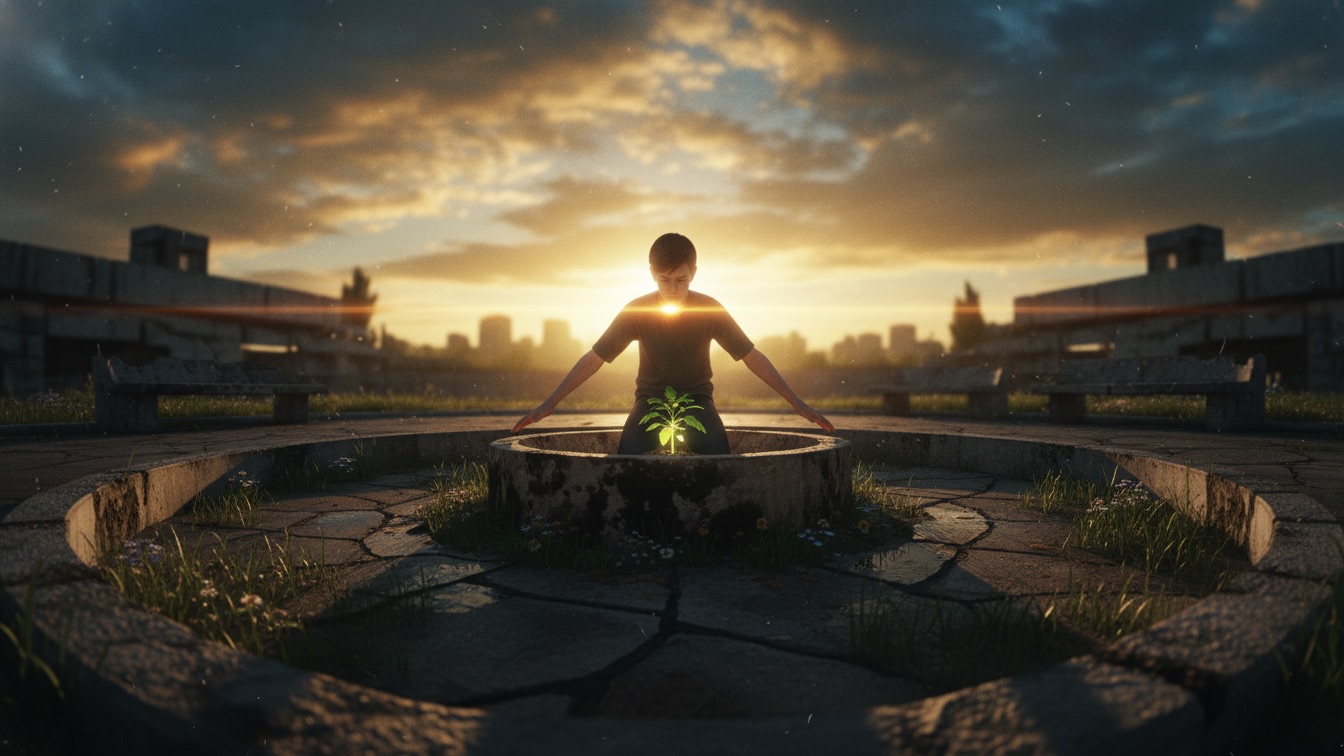
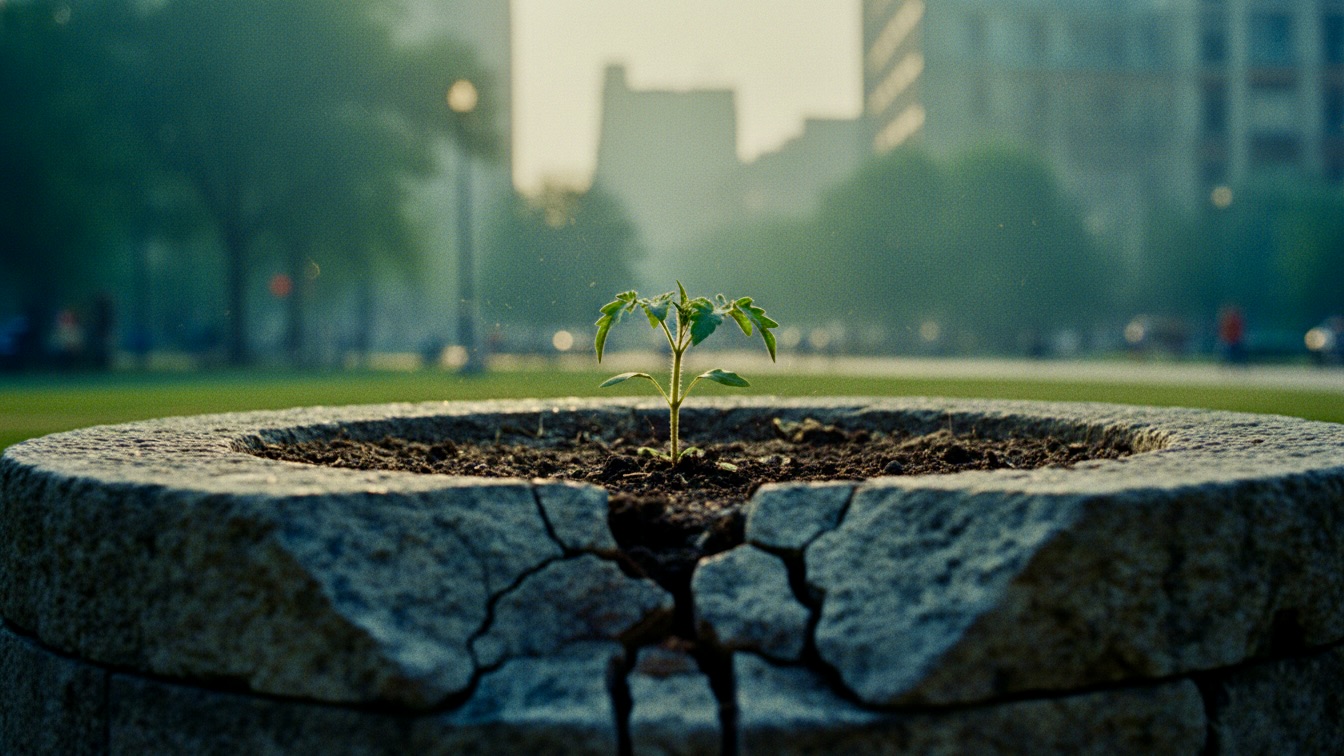
I reached the fountain. The ground was still damp, the mud clinging to my boots. I knelt down, my hands trembling. There it was. The Cherokee Purple. It was still there. It wasn't just surviving; it was changing. The two tiny leaves I’d seen yesterday were now joined by a third—a real leaf, jagged and dark green. It was a 'true leaf.' The plant was growing. It was actually growing.
I felt a surge of something I hadn't felt in years. Hope. It was a dangerous, stupid thing to feel in a place like this, but I couldn't help it. I reached out and touched the leaf. It was cool and firm. It felt like a promise.
But a single plant wasn't enough. Not for what was coming. If the district was going to survive, we needed more. We needed a garden. We needed a revolution. And I knew exactly where to find the seeds.
The Board’s regional headquarters was a jagged tooth of glass and steel that rose out of the center of District 7 like it was trying to escape. It had its own power grid, its own water filtration, and its own atmosphere. When you stepped through the airlock of the main lobby, the temperature dropped twenty degrees instantly. It didn't feel good; it felt wrong. It felt like stepping into a tomb.
I swiped my lanyard at the security gate. The light stayed red for a heartbeat too long. I felt the sweat start to prickle at the back of my neck. My thumb twitched against the strap of my bag. Then, the light turned green and the gate hissed open. I walked through, trying to keep my breathing regular. The lobby was empty, save for two Peacekeepers standing by the elevators. They didn't even look at me. To them, I was just another drone, a low-level data-pusher coming in to do his shift during a crisis.
I pressed the button for the forty-second floor. The elevator moved with a silent, stomach-churning speed. I watched the numbers climb on the digital display. Forty-two was where the 'Agricultural Research and Development' wing was located. It was also where they kept the 'Legacy Bank'—a climate-controlled vault containing the seeds that existed before the Bio-Optimization era. It was a museum of biology that the Board kept for 'contingency purposes.'
I stepped out into a hallway that smelled like nothing. Not even air. Just a sterile, chemical void. I headed toward the back of the floor, toward the labs. I needed to find Alston. He was my only way into the vault. He was also the biggest obstacle.
I found him in his office, his face buried in a holographic display. He looked like he’d been through a blender. His shirt was wrinkled, his hair was a mess, and there were three empty caffeine-pod containers on his desk. He didn't look up when I walked in.
"The registration numbers are still at zero, Leo," he snapped. "I don't need you here. I need you in the streets. I need you making people sign those forms."
"The streets are a war zone, Alston," I said. I leaned against the doorframe, trying to look bored. "The Peacekeepers have the district on lockdown. Nobody’s signing anything until the power comes back on."
Alston finally looked up. His eyes were wide and twitchy. "The power isn't coming back on until the quota is met. That’s the directive. The Board is making an example of Section 4. If they don't fold, the whole district is going to be de-prioritized."
"Then we’re both out of a job," I said. I walked over to the window. From here, the city looked like a circuit board that had shorted out. Small plumes of smoke were rising from the residential blocks. "Unless we give them something else. Something that isn't a Bio-Credit."
Alston scoffed. "Like what? A hug? We’re in the calorie business, Leo. Not the charity business."
"I was looking at the Legacy Bank inventory this morning," I said, keeping my voice casual. "There are heirloom strains in there that are drought-resistant. Strains that don't need the Board’s proprietary fertilizer. If we could distribute those, maybe the community leaders would listen. It would show we’re willing to compromise."
Alston stared at me for a long time. I could see the gears turning in his head. He wasn't thinking about the people; he was thinking about his own career. He was thinking about how he could frame this to his bosses as a 'strategic localized empowerment initiative.'
"The Legacy Bank is off-limits," Alston said, but his voice lacked conviction. "The security protocols require a Grade 4 clearance."
"You have Grade 4 clearance," I reminded him. "And the system is on backup power. Half the internal sensors are offline to save energy. I could go in, grab a few sample packs, and be out before the next audit cycle."
Alston rubbed his face with his hands. "You’re asking me to commit a felony, Leo."
"I’m asking you to save your skin. If Section 4 riots, they’re going to blame the supervisor. That’s you. But if you 'pioneer' a new distribution model that stabilizes the district? You’re a hero."
I watched the sweat bead on his forehead. He was weak. He was the kind of person who survived by following the rules until the rules started to kill him. Now, he was looking for a new set of rules to follow.
"I can't go with you," he whispered. "I have a meeting with the Board directors in twenty minutes."
"Then give me your override key," I said. I held out my hand. My heart was hammering so hard I thought he could see it through my shirt.
Alston hesitated. He looked at his desk, then at the window, then back at me. He reached into his pocket and pulled out a small, silver disk. It was his biometric override. He slid it across the desk like it was a piece of poison.
"Ten minutes," he said. "If you’re not out in ten minutes, I’m reporting the key as stolen."
"Ten minutes is all I need," I said. I grabbed the disk and walked out. I didn't look back. I didn't want to see the regret on his face.
The hallway to the vault felt a mile long. Every time a maintenance bot whirred past, I felt a jolt of adrenaline that made my fingers go numb. I reached the heavy, reinforced door of Storage Room B. There were no windows, no signs, just a small keypad and a biometric scanner. I held Alston’s override disk to the sensor. The machine hummed, processing the data.
'Clearance Confirmed: Supervisor Alston. Access Granted.'
he door hissed open, releasing a puff of air that was so cold it made my lungs ache. I stepped inside. The room was small, lined with floor-to-ceiling stainless steel cabinets. Each drawer was labeled with a string of numbers and a QR code. This was it. The history of the world’s food supply, reduced to a collection of tiny, refrigerated drawers.
I didn't have time to browse. I pulled out my tablet and synced it to the room’s local network. The screen flickered, showing the inventory list. I searched for 'Solanum lycopersicum'—tomatoes. There were hundreds of entries. Most were 'Optimized,' 'Enhanced,' or 'Terminator-Linked.' I filtered for 'Heirloom.'
There were only six.
Cherokee Purple. Brandywine. San Marzano. I felt a weird tightening in my chest. These were names from my grandfather’s stories. They weren't just seeds; they were memories. I opened the drawer for the Cherokee Purples. Inside were small, foil-lined packets, each no bigger than a business card. I grabbed ten of them. Then I moved to the peppers. Habaneros, Bell, Cayenne. I took whatever I could find that wasn't marked with a Board patent.
I was stuffing the packets into the hidden compartment of my bag when the lights in the room flickered. The hum of the cooling system changed pitch, dropping into a lower, more ominous vibration.
'Warning: Power Draw Exceeding Backup Parameters. Emergency Lockdown Initiated in Five Minutes.'
I froze. Five minutes. The elevator would be the first thing to go. I’d be trapped on the forty-second floor with a bag full of stolen property. I scrambled to the next cabinet. Squash. Beans. Carrots. I didn't even look at the labels anymore. I just grabbed handfuls of packets and shoved them into my bag.
I was reaching for a box of cucumber seeds when I heard a sound from the hallway. A heavy, rhythmic thud. Boots. Peacekeepers. They weren't supposed to be on this floor. Alston must have panicked. Or the system had flagged the unauthorized access despite his key.
I looked around the room. There was no other exit. The vault was a dead end. I looked at the ceiling. There was a maintenance hatch for the HVAC system. It was small, maybe eighteen inches wide. I’d have to leave my bag behind if I wanted to fit.
No. The bag was the whole point.
I shoved the last of the packets into the bag and zipped it tight. I looked at the door. The handle was turning. I didn't think. I dived behind a heavy storage rack just as the door swung open. Two Peacekeepers stepped into the room, their rifles raised. Their helmets were dark, reflecting the sterile white light of the vault.
"Clear," the first one said. His voice was modulated, sounding more like a machine than a person.
"The system says the key was used sixty seconds ago," the second one replied. He walked over to the console. "Alston’s ID. He’s in a meeting on forty-five. Someone’s playing games."
I held my breath. My chest was pressed against the cold metal of the rack. My heart was a drum in my ears. One of the Peacekeepers started walking toward my row. I could see his boots—heavy, black, reinforced leather. He stopped three feet away. I could hear the faint whine of his armor’s servo-motors.
"Check the vents," the first one ordered.
I looked at the floor. There was a small gap between the bottom of the rack and the wall. I slowly, agonizingly, slid myself into the space, the metal edge of the rack digging into my shoulder. I squeezed my eyes shut. I was a ghost. I wasn't there. I was just part of the room.
"Nothing," the Peacekeeper said. He was standing right over me now. If he looked down, I was dead. "Maybe it was a ghost in the system. The power grid is failing. Everything’s glitching."
"Let’s get back to the lobby. The crowd at the perimeter is getting restless. We might have to clear the street."
They turned and walked out. I waited until I heard the hiss of the door closing and the click of the lock. I stayed under the rack for another minute, my body shaking so hard I thought I’d rattle the shelves. Then, I crawled out.
I didn't use the elevator. I found the service stairs and started to run. Forty-two flights. I didn't care about the pain in my legs. I didn't care about the heat. I just needed to get out. I needed to get back to the soil.
The sun was setting by the time I reached the park, but it didn't bring any relief. The sky was a bruised, angry purple, and the air was thick with the smell of woodsmoke and burnt rubber. The riot had started. I could hear the distant roar of the crowd and the sharp, staccato pops of tear-gas canisters. The district was finally breaking.
I was stumbling, my lungs burning, my vision blurring at the edges. I reached the fountain and collapsed against the stone. I didn't have any water left. I didn't have any strength left. I just wanted to sleep.
But I looked down at the Cherokee Purple.
In the dying light, the true leaf looked almost black. It was beautiful. It was a tiny, stubborn defiance against everything that was happening a few blocks away. I reached into my bag and pulled out the stolen seed packets. I spread them out on the flat edge of the fountain. Hundreds of them. Thousands of lives, waiting for a chance to start.
"Leo?"
I looked up. Mia was standing there. She was covered in soot, her clothes torn, a makeshift bandage wrapped around her arm. She looked like she’d been through a war. Maybe she had.
"You’re still here," she said. She walked over and looked at the packets. Her eyes went wide. "Where did you get these?"
"The Board," I said. I tried to laugh, but it came out as a cough. "I think I’m fired."
Mia knelt down next to me. She picked up a packet of tomato seeds. She looked at the label, then at me. For the first time in years, I saw the sister I used to know. Not the radical, not the survivor, but the girl who used to help me fix my bike.
"You’re insane," she whispered. "They’ll hunt you for this."
"Let them," I said. I looked toward the center of the district, where the smoke was thickest. "The Bio-Credits are gone, Mia. The power’s gone. The Board doesn't have anything left to offer. But we have this."
Mia looked at the tiny plant in the dirt. She reached out and touched the stone of the fountain. "The water is still dripping."
"It’s enough," I said.
We sat there in the dark, the two of us, while the city burned around us. It was a strange, quiet pocket of peace in the middle of a catastrophe. I felt the weight of the seeds in my bag. They weren't just food. They were a future. A hard, dirty, difficult future, but one that belonged to us.
I looked at my hands. They were covered in dirt and blood and grease. I looked at Mia. She was watching the horizon, her jaw set, her eyes reflecting the orange glow of the fires. We were just two kids in a broken world, but for the first time, I didn't feel small. I felt like the most important person on earth.
I reached down and pushed a little more dirt around the base of the Cherokee Purple.
"Stay," I whispered.
The wind picked up, carrying the heat of the fires and the scent of the coming rain. I didn't know what tomorrow would bring. I didn't know if we’d survive the night. But I knew that the spark was alive. It was right here, in the mud, growing its first true leaf.
I leaned my head against the cold stone of the fountain and closed my eyes. The sounds of the riot faded into the background, replaced by the slow, rhythmic drip of the water.
Drip. Drip. Drip.
It was the sound of a clock starting over. It was the sound of the world beginning again. I felt a single drop of rain hit my cheek. It was cold. It was real. I wasn't afraid anymore.
“I looked at the glowing horizon and realized that for the first time, the fire wasn't something to fear—it was the only light I had left to see what was coming next.”