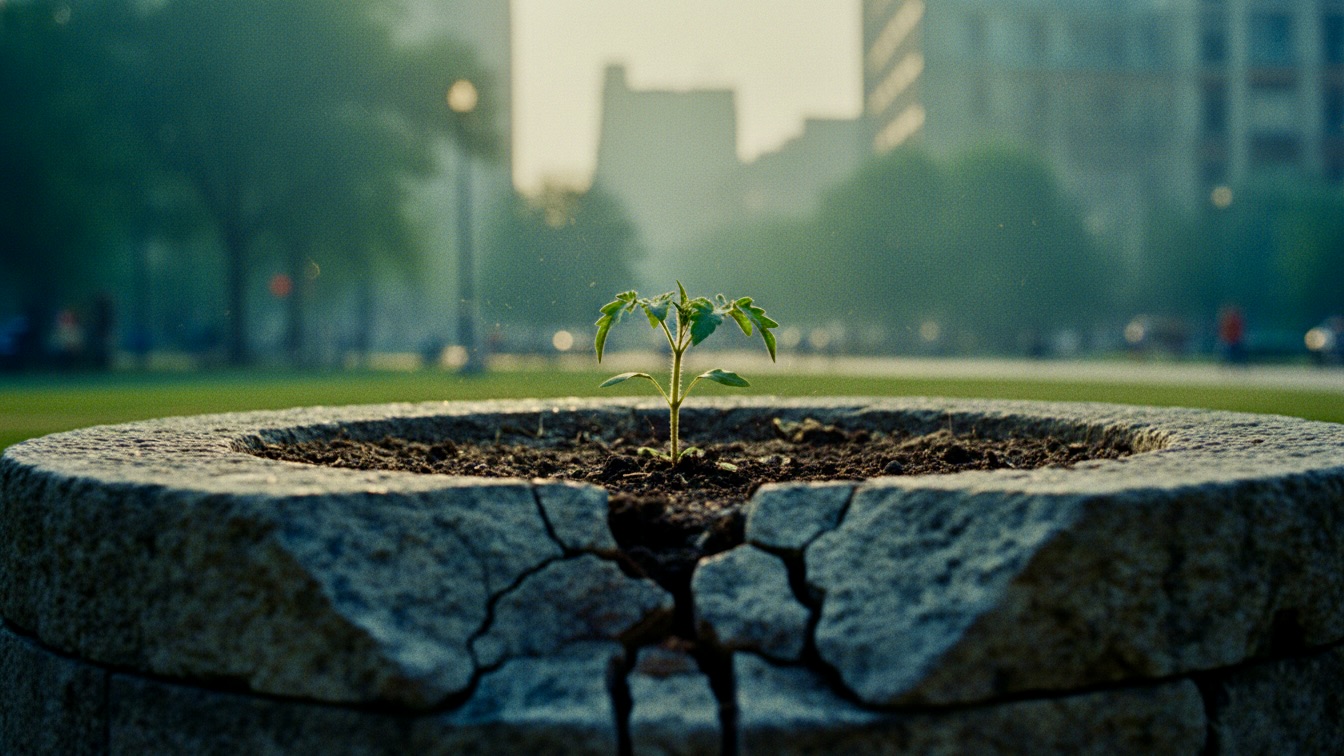
The narrative follows Leo, a corporate employee living in the decaying, powerless environment of Section 4. He wakes to a world of heat and stagnant water, burdened by the weight of his "Bio-Credit" sales job and the societal collapse unfolding outside his window. After checking on a resilient "Cherokee Purple" tomato plant he has been secretly tending in a local park, Leo decides to infiltrate his employer’s high-security headquarters. He manipulates his supervisor, Alston, to gain access to a vault of non-patented heirloom seeds, narrowly escaping a security lockdown and patrolling Peacekeepers.
Returning to the park as the district erupts into a violent riot, Leo reunites with his sister, Mia, who has been participating in the uprising. He reveals his stolen prize: thousands of seeds representing a future independent of corporate control. Amidst the smoke and fire of the burning city, the siblings find a moment of profound hope in the small plant’s growth. The story concludes with Leo accepting the uncertainty of the future, comforted by the rhythmic sound of water and the symbolic "true leaf" of his plant.
The primary theme of the text is the struggle for autonomy against corporate monopolization of life itself. The Board represents a technocratic tyranny that has patented the very act of survival through "Bio-Optimization" and proprietary fertilizers. Leo’s theft of heirloom seeds is a radical act of reclamation, asserting that nature should belong to the community rather than a balance sheet. This conflict between the "iron" of the corporate towers and the "soil" of the park serves as a metaphor for the broader human struggle to remain connected to the earth in a hyper-industrialized society.
Hope is explored not as a passive sentiment, but as a dangerous and necessary catalyst for change. Leo initially views hope as "stupid," yet he is driven by the sight of a "true leaf" emerging from the dust. This biological milestone signifies that growth is possible even in a "steamer" of a city meant to suppress it. The narrative suggests that while the old world—symbolized by the failing power grid and the silent mag-levs—is dying, a new world can be cultivated if individuals are willing to risk their lives for a "spark" of life.
The contrast between sterile technology and organic decay highlights the theme of sensory reality versus corporate illusion. The Board’s headquarters is a "sterile, chemical void" that smells like nothing, while the streets are thick with the smell of "stagnant water and old trash." Leo’s preference for the dirt under his fingernails over the blue lanyard around his neck indicates his psychological migration toward authenticity. The story posits that the "fever" of the riot is a natural reaction to an artificial environment, a necessary purging before a true beginning can occur.
Leo functions as a bridge between the complicit corporate class and the burgeoning revolution. He is a man defined by his internal dissonance, wearing a blue lanyard that he recognizes as both a "target" and a "pass." This dual identity causes him significant psychological strain, as he sees his own reflection in the desperate people he exploits for Bio-Credits. His decision to steal the seeds is his way of resolving this fractured self, moving from a "drone" who follows rules to an architect of his own destiny.
His relationship with the environment is deeply tactile and grounded in a need for physical connection. He refuses to wash the "dark earth" from his hands because it feels like a "secret" he is wearing, a physical manifestation of his true loyalties. Leo is not a traditional hero driven by grand ideologies; instead, he is motivated by the memory of his grandfather’s stories and the tangible reality of a cool leaf. He finds his importance not in his job title, but in his role as a protector of the "Legacy Bank" he has liberated.
Alston represents the moral vacuum of middle management within a dystopian system. He is characterized by his physical and emotional frailty, appearing "wide and twitchy" under the pressure of failing quotas. Unlike Leo, who looks toward the soil for answers, Alston is trapped by the "holographic display" of corporate directives. He is a man who survives by adhering to the rules, but he lacks the fortitude to stand by them when his own skin is on the line.
Psychologically, Alston is driven by fear and the desire for self-preservation. Leo easily manipulates him by framing the theft as a "strategic localized empowerment initiative," playing on Alston’s need to look like a "hero" to his bosses. He is a tragic figure in his own right, a man who has traded his humanity for a "Grade 4 clearance" that ultimately offers him no protection. He is the "iron" of the story—rigid, cold, and destined to be overtaken by the "soil" of the coming change.
Mia serves as the emotional and ideological anchor for the narrative’s climax. While Leo represents the internal sabotage of the system, she represents the external, visceral resistance. Her appearance—covered in soot and blood—marks her as a survivor who has already transitioned into the "hard, dirty, difficult future" that Leo is just beginning to embrace. She provides the necessary validation for Leo’s actions, shifting his perspective from that of a criminal to that of a revolutionary.
Despite her involvement in the violent riots, Mia retains a sense of wonder that links her back to her brother. When she touches the stone of the fountain and acknowledges the dripping water, she is looking for the same biological "promise" that Leo found. She is the one who recognizes that the "Bio-Credits are gone," and her presence allows Leo to feel like "the most important person on earth." She is the catalyst that turns Leo’s individual act of theft into a collective hope for the community.
The narrative voice is characterized by a heavy, oppressive atmosphere that mirrors the protagonist’s physical and mental exhaustion. The author uses visceral sensory details, such as the "physical weight" of the morning and the "tacky" feeling of salt on the skin, to ground the reader in the story’s heat and humidity. This focus on physical discomfort makes the moments of relief—the "cool and firm" leaf or the "cold" rain—feel earned and significant. The prose is lean and rhythmic, often using short, punchy sentences to convey the urgency of Leo’s movements through the city.
Pacing is effectively managed through the use of tension and release. The slow, meditative opening in the kitchen establishes the stakes of the environmental collapse before the narrative accelerates into the high-stakes heist at Floor Forty-Two. The suspense in the vault is heightened by mechanical sounds, such as the "whine" of armor servos and the "hiss" of the door. This creates a cinematic quality that contrasts sharply with the quiet, reflective ending at the fountain, allowing the reader to feel the "fever" of the city break alongside the characters.
The recurring motif of the "drip" serves as a structural and symbolic device throughout the chapter. Initially, the drip in the vegetable crisper is an ominous sound, compared to a "ticking clock" that signals the end of the old world’s comforts. By the end of the story, the drip at the fountain becomes a "rhythmic" and hopeful sound, representing the "clock starting over." This shift in the meaning of a single sound encapsulates the protagonist’s journey from despair to a hard-won sense of renewal.


