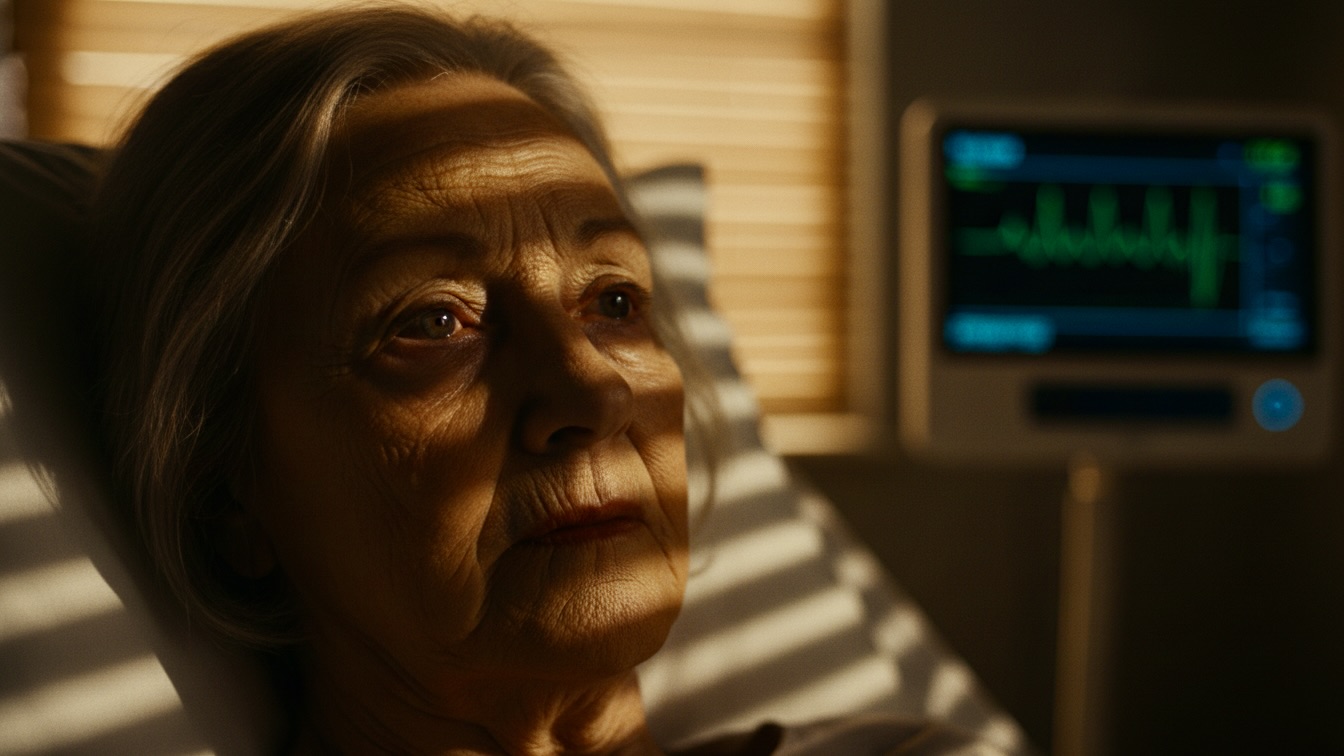
A hospice patient reveals historical secrets that defy medical explanation, forcing doctors to confront the reality of genetic memory.
The dust in Room 402 didn't dance; it hung suspended in the stagnant July heat. Grace’s fingers, translucent and mapped with violet veins, clawed at the thin cotton of her hospital sheet. She wasn't looking at the beige walls or the digital monitor flickering with her erratic heart rate. She was looking through them. Her eyes, clouded by cataracts but sharp with an alien intensity, tracked something invisible to the medical staff. The air conditioner hummed a low, vibrating B-flat that seemed to grate against the silence of the hospice wing. It was 3:11 PM. The sun was a white-hot blade pressing against the closed blinds, bleeding through the gaps in jagged, overexposed lines. Grace’s breathing was a rhythmic rasp, the sound of dry parchment being folded and unfolded.
"The rivets," Grace whispered, her voice a dry rattle. "They aren't steel. They’re iron. S.S. Iberia. 1894. We used the slag-heavy batches because the strike was on. My hands... they didn't stop bleeding for a week. The lye. The lye in the wash-bucket was too strong."
Damon stood at the foot of the bed, his tablet glowing a soft, sterile blue against his scrubs. He didn't look up from the data. He’d heard this for three days. "Grace, you’re in the Mercy Hospice. It’s 2026. You’ve never been to a shipyard. You were a librarian in Des Moines."
"The manifests," Grace continued, ignoring him. HER eyes snapped to the corner of the ceiling. "Check the bottom of the hull. Near the ballast tanks. I carved the initials. J.M. For Joseph. He didn't make it off the docks in Liverpool. The crane snapped. A clean break. No one saw it coming. Just a sound like a gunshot and then... the crate was through the deck."
Timothy entered the room, the door hissing shut behind him. He looked at Damon, then at the frail woman who was supposed to be fading into a quiet, morphine-induced haze. Instead, she looked like she was witnessing a birth or a murder. "Still on the Iberia?" Timothy asked, checking the IV drip. The bag was nearly empty. The clear fluid moved with agonizing slowness.
"She’s specific, Tim. Too specific," Damon said, finally looking up. His face was pale. "I did a search on the break-room computer. The S.S. Iberia was a real ship. It sank in the North Atlantic in 1902. But the construction details... the iron rivets, the lye strike... that’s not in the general Wikipedia entry. I had to dig into the Lloyd’s Register archives. She’s describing the 1894 refit at the Harland and Wolff yards."
Timothy paused, his hand on the bedrail. He felt the vibration of the AC through the metal. "She’s ninety-two, Damon. Maybe she read a book. Librarians read things. It’s a deep-seated memory of a narrative. Cryptomnesia. It happens all the time with end-of-life delirium."
"She’s naming the dock foreman," Damon countered, his voice dropping an octave. "A man named Silas Thomas. I found him in the 1891 census. He lived three blocks from the yard. How does a woman from Iowa, who never left the Midwest until she was sixty, know the name of a dead foreman from Victorian Belfast?"
Grace’s hand shot out, grasping Timothy’s wrist with a strength that shouldn't have existed in her wasted frame. Her skin was hot, dry, and felt like sun-baked earth. "The water wasn't blue," she hissed, her eyes locking onto his. "It was gray. Like lead. And the oil... it slicked the surface. We had to scrub the hull with vinegar and sand. Don't let them tell you the rivets held. They sheared. I saw them pop like buttons on a fat man's vest. Tell Joseph. Tell him the iron was bad."
"Grace, Joseph isn't here," Timothy said, his voice steady but his heart beginning to thud against his ribs. "You’re safe. It’s summer. It’s hot outside. You’re just... you’re remembering a story."
"It’s not a story!" Grace barked. The monitor spiked. The green line became a jagged mountain range. "I can feel the cold! The North Atlantic isn't a story. It’s a grave! My lungs... they’re full of it. Not air. Salt. Brine. The weight of the boilers pulling us down. Can’t you hear the steel screaming?"
The silence that followed was unnatural. The hum of the building seemed to vanish, leaving only the sound of Grace’s labored, wet breathing. Outside, a bird hit the window with a dull thud, a momentary interruption of the heavy July heat. Timothy looked at his wrist where Grace had held him. Red marks were already blooming on his skin, a perfect map of her grip. He felt a sudden, violent shiver despite the eighty-degree room. It wasn't fear, exactly. It was the feeling of being watched by someone who wasn't in the room.
"We need to run the screening," Damon said, his voice urgent. "Not the psych eval. The epigenetic panel. Robert is in the lab. He’s been working on the transgenerational markers for the state university. If this is what I think it is... if this is a literal recall..."
"You’re talking about genetic memory," Timothy snapped, shaking his head. "That’s sci-fi, Damon. It’s theoretical at best. You can’t inherit a specific memory of a shipyard strike. That’s not how DNA works. It’s not a hard drive."
"Isn't it?" Damon gestured to Grace, who had slumped back into the pillows, her eyes still tracking the invisible ghosts of 1894. "Look at her. She’s not hallucinating. She’s experiencing. There’s a difference. Her pupillary response, her heart rate... it’s a physiological reaction to a real stimulus. We just can’t see the stimulus. But her cells can."
Timothy looked at Grace. She was mumbling again, something about the price of coal. The sun moved an inch, shifting the light across the floor, highlighting the thick layer of dust on the baseboards. The room felt crowded, though only the three of them were there. The sense of an unseen threat, a weight of history pressing into the present, was palpable. It was as if the walls of the hospice were thinning, the veil between 2026 and 1894 becoming a translucent membrane. He reached for the phone to call the lab. His fingers were trembling. The urgency was a physical pressure in his chest, a realization that they were running out of time before Grace—and the secrets she carried in her marrow—vanished forever.
The hallway outside Room 402 was a gauntlet of fluorescent light and the frantic, rhythmic squeak of rubber soles on linoleum. Damon didn't wait for the elevator. He took the stairs two at a time, his breath hitching in the humid stairwell. The heat had seeped into the concrete core of the building, making the air feel stagnant and heavy. He reached the records office on the second floor, a cramped space filled with the low-frequency drone of servers and the frantic clicking of keyboards. He needed the manifests. Not just the digital summaries, but the high-resolution scans of the original Harland and Wolff logs he'd requested an hour ago.
"Did they come through?" Damon asked, leaning over the desk of a startled clerk.
"The Belfast files? Yeah, just now. But Damon, this is historical data. Why do you need this for a hospice patient?" the clerk asked, her eyes narrowing behind thick glasses.
"Just give me the screen," Damon snapped. He didn't have time for the bureaucracy of curiosity. He scrolled through the monochromatic images of handwritten ledgers. The ink was faded, a ghostly sepia against the yellowed parchment of the nineteenth century. He searched for the name. Silas Thomas. He found it on page 42 of the October 1894 log. Foreman. Berth 4. S.S. Iberia refit.
His heart skipped. He scrolled further. Incident Report: October 12, 1894. Failure of iron rivets in Section 7. Slag contamination noted. Strike action by Riveters Local 4 led to use of unskilled labor and substandard materials. Foreman Thomas reports multiple injuries.
Damon felt a cold sweat break out on his forehead. Grace had mentioned the slag. She had mentioned the strike. She had mentioned the iron. He looked at the next entry. Casualty: Joseph Miller. Shipwright’s Assistant. Crushed by falling crate during winch failure. Body recovered from Berth 4.
"Joseph," Damon whispered.
He pulled his phone out and dialed Timothy. The connection was fuzzy, filled with the static of a building that was struggling under the electrical load of a heatwave. "Tim? Listen to me. She’s right. Every word. I’m looking at the casualty report from 1894. Joseph Miller. He died exactly how she described it. The crate, the winch, the dock. She couldn't have known this. There’s no book, Tim. This specific incident report isn't digitized in any public library. It was only scanned into the professional maritime archive three months ago. She hasn't had internet access in three years."
"Damon, slow down," Timothy’s voice came through, sounding strained. "She’s spiking again. She’s talking about the color of the paint. Lead-based white. She’s describing the texture of it on her skin. She’s... she’s scratching at her arms, Damon. Like she’s trying to wash something off."
"Don't let her hurt herself!" Damon shouted, turning back toward the stairs. "I’m coming up. And I’ve got Robert on the line. He’s coming from the university. He wants to do a live sequencing of the blood. He says if the methylation patterns match a trauma signature from that era, we’re looking at a breakthrough that changes everything we know about consciousness."
"It’s 102 degrees outside, Damon. The grid is failing," Timothy said, his voice tight. "The backup generators are already humming. If we lose power, the sequencing equipment is useless. We have maybe an hour of stable electricity left. Just get back here."
Damon burst back into Room 402. The light had changed again. It was the deep, honeyed gold of late afternoon, but it felt sickly. Grace was sitting upright now, her eyes wide, her chest heaving. She looked younger, somehow, the lines of her face smoothed by a terrifying clarity.
"The water!" she screamed. "It’s coming through the seams! The iron is snapping! I can hear it! Like teeth breaking in a giant’s mouth!"
"Grace, look at me!" Timothy was holding her shoulders, trying to keep her from lurching out of the bed. "You’re in a hospital. You’re in Iowa. The year is 2026. There is no water."
"You’re lying!" she spat, her saliva hitting Timothy’s cheek. "I can feel the salt! It’s in my throat! The Iberia is going down, and Joseph is already at the bottom. He’s waiting for me. He’s in the dark with the iron rivets!"
Robert entered then, carrying a heavy, black Pelican case. He was a tall man with a shock of white hair and a face that seemed carved from granite. He didn't say hello. He didn't look at the doctors. He went straight to the bedside table and began unfolding a portable sequencer. The machine hummed into life, a sound that felt like a swarm of angry bees.
"Is she still in the retrieval state?" Robert asked, his voice a low rumble.
"She’s been in it for twenty minutes," Damon said, breathing hard. "She’s describing the sinking now. 1902. The Iberia. She’s describing the physical sensation of the hull failing."
"Good," Robert said, snapping on a pair of nitrile gloves. The snap was like a gunshot in the quiet room. "If she’s in the middle of a high-arousal recall, the chemical markers will be at their peak. We need a clean draw. Now."
Timothy watched as Robert prepared the needle. "Robert, is this ethical? She’s a hospice patient. She’s supposed to be having a 'good death.' This looks like an interrogation."
"This is a recording, Timothy," Robert said, not looking up. "The 'good death' is a luxury of the ignorant. This woman is carrying a ghost in her marrow. If we don't catch it now, the ghost dies with her. Do you want to be the one who explains to the world that we let the first verified case of ancestral memory slip away because we wanted her to be 'comfortable'?"
Grace’s eyes suddenly cleared. She looked at Robert, then at the needle. For a second, she was just a ninety-two-year-old woman again, terrified and small. "Who are you?" she whispered.
"I’m someone who believes you, Grace," Robert said, his voice surprisingly gentle. "I want to see what you see. I want to help you tell Joseph’s story."
Grace nodded slowly, her hand going limp. "The iron was bad," she said, a final, weary repetition. "Tell them the iron was bad."
As the needle entered her vein, the lights in the room flickered. The air conditioner groaned and died. The sudden silence was deafening. The only sound was the frantic, mechanical whir of Robert’s sequencer, running on its internal battery. The heat began to rise immediately, a physical presence that seemed to lean against them. The unseen threat wasn't the sinking ship anymore; it was the ticking clock of the dying grid and the fading woman. The July sun was setting, casting long, distorted shadows across the room, turning the medical equipment into strange, jagged monuments to a past that refused to stay buried.
The sequencer's screen was a chaotic waterfall of green and amber text. Robert’s eyes were fixed on the scroll, his lips moving as he read the raw data. The room was getting hotter. Without the AC, the hospice smelled of floor wax and stale air. The silence outside the room was absolute, as if the rest of the world had stopped to watch this frantic micro-drama. Damon and Timothy stood on either side of the bed, watching the clear tube of Grace’s blood move into the machine’s intake. It looked too dark, almost black, against the clinical white of the sequencer.
"Look at the chromosome 15 markers," Robert muttered, his finger tracing a line on the screen. "The methylation density is off the charts. We’re seeing a classic stress-response imprint, but it’s... it’s aged. It’s not her stress. These tags were set generations ago."
"Explain that for those of us who aren't geneticists," Timothy said, his voice tight. He was watching Grace’s pulse on the manual monitor. It was thinning out, becoming a thready, desperate rhythm.
"It’s called the 'cellular ghost'," Robert said, his voice trembling with a mix of exhaustion and excitement. "When an ancestor undergoes a massive trauma—like, say, a shipwreck or a violent death—it can leave a chemical mark on their DNA. Not a mutation in the code itself, but a change in how the code is read. It’s an epigenetic tag. Usually, these tags affect things like cortisol levels or anxiety predispositions. But what we’re seeing here... this is a high-fidelity information transfer. The tags aren't just saying 'be afraid'; they’re carrying the structural data of the event."
"The iron rivets," Damon whispered. "The slag."
"Exactly," Robert said. "The trauma of the 1894 strike and the subsequent death of Joseph Miller must have been so profound that it literally etched the details into the germline of whoever survived to have Grace’s mother or father. And for some reason—maybe the proximity of death, maybe the heat, maybe just a fluke of her brain chemistry—Grace has unlocked the file. She’s not remembering. She’s decoding."
"Wait, wait," Timothy interrupted. "If this is true, then we all have this? I have the memories of my great-grandfather’s life?"
"Potentially," Robert said, his eyes never leaving the screen. "But the brain usually keeps these files locked. It’s an evolutionary survival mechanism. You can’t function in the present if you’re constantly reliving the horrors of the past. Grace’s filters have failed. The wall between her own life and the lives of her ancestors has collapsed."
Grace’s eyes snapped open. She wasn't looking at them. She was looking at the ceiling again, but her pupils were blown wide, swallowing the blue of her irises. "The captain is crying," she said. Her voice was no longer a rattle; it was a clear, haunting soprano. "He’s in the chart room. He knows the pumps can’t keep up. He’s looking at a picture of a girl in a white dress. He keeps saying her name. Clara. Clara."
"Damon, check the manifest again," Robert ordered. "Captain of the Iberia. 1902. Did he have a daughter named Clara?"
Damon’s fingers flew across his tablet. The screen was dim, the battery warning flashing red. "Searching... searching... Iberia... Captain Edward Smithson. No, that’s not right... Captain Arthur Victor. Here it is. Arthur Victor. Deceased 1902. Survivors... daughter, Clara Victor, age six. She wasn't on the ship. She was in Liverpool."
Timothy felt the air leave his lungs. "There’s no way. There’s absolutely no way she could know the name of the captain’s daughter from a ship that sank a hundred and twenty-four years ago. That wasn't in the manifest summary you read earlier."
"It wasn't," Damon said, his face ashen. "I’m looking at a genealogical record from a historical society site. It’s behind a paywall. I had to bypass the cookies. Grace couldn't have seen this. Ever."
"The light," Grace said, her voice dropping to a whisper. "It’s turning green. The sun is going under the water. It’s so quiet now. The screaming stopped because the water filled their mouths. It’s just the bubbles now. And the iron... the iron is groaning. It’s saying goodbye."
"Robert, the sequencer is losing power," Damon warned. "The battery is at four percent."
"I just need the final sequence on the hippocampal integration markers!" Robert shouted, his composure finally breaking. He banged his fist on the table. "Come on, you piece of junk! Give me the link!"
"The heart rate is dropping," Timothy said, his hand on Grace’s neck. He could feel the heat radiating from her skin, a fever that seemed to be burning her from the inside out. "Grace? Grace, stay with us. Tell us more about the shipyard. Tell us about Joseph."
"Joseph is holding my hand," Grace said. A faint smile touched her cracked lips. "His hand is cold, but it’s him. He’s got the soot on his forehead. He says the iron didn't matter in the end. He says we’re all made of the same stuff as the stars, but the water is what we come back to. He’s taking me to the berth. Berth 4. The 1894 sun is so bright, Timothy. It’s not like this sun. It’s a young sun. It’s full of hope."
"The data is through!" Robert yelled, triumphantly lifting his hands. "I’ve got the full map! It’s all there. The hippocampal bridge is lit up like a Christmas tree. It’s a literal neural bypass. She’s using her ancestral DNA as a secondary memory bank."
At that moment, the final backup generator in the basement failed with a distant, muffled boom. The sequencer’s screen flickered once and went black. The room was plunged into the sudden, heavy gloom of a July twilight. The only light came from the corridor, where the emergency red lights cast long, bloody shadows across the floor.
In the sudden silence, the sound of Grace’s breathing stopped.
Timothy didn't move. He kept his fingers on her pulse. He waited. Ten seconds. Twenty. The heat in the room felt like it was thickening, becoming a physical weight that pressed against his eardrums. He looked at Grace’s face. The tension was gone. The terror was gone. She looked like a librarian from Iowa who had finally finished a very long, very difficult book.
"She’s gone," Timothy said quietly.
Robert didn't move. He was staring at the dark screen of his sequencer, his hands still hovering over the keyboard. "I got it, though," he whispered. "I got the proof. We can sequence the rest of the family. We can see if the bridge is still there in her children. In her grandchildren."
Damon looked at the body of the woman who had just spent her last hours reliving a century-old tragedy. He looked at the red marks on Timothy’s wrist. He felt a sudden, visceral revulsion for the machine and the data. "At what cost, Robert?" he asked. "Look at her. She didn't die in 2026. she died in 1902. She died in the cold and the dark, a thousand miles from home. Is that what we’re going to find in everyone? A library of horrors?"
"It’s the truth, Damon," Robert said, his voice cold and clinical again. "The truth doesn't care if it’s a horror story. It just is."
Outside, the first thunder of a summer storm rolled across the plains, a low, heavy sound that mimicked the groan of a sinking ship. The heat didn't break. It just sat there, a silent witness to the ghosts that had finally been set free.
The storm didn't bring rain; it just brought more heat, a dry electrical tension that made the hair on Timothy’s arms stand up. The red emergency lights in the hallway gave the hospice the look of a submarine running silent and deep. He stood by the window, watching the heat lightning dance across the horizon. Grace’s body had already been taken away. The room felt cavernous now, stripped of her presence, leaving only the ghost of the hum from the dead AC unit. Damon was sitting in the corner, his head in his hands, while Robert sat obsessed with a handheld backup drive, protecting the data like it was a religious relic.
"We should go," Timothy said. "The facility is on lock-down until the power grid stabilizes. There’s nothing more to do here."
"I’m not leaving this drive," Robert said. "This is the only copy of the raw sequencing. If the university servers are down, this is the most valuable piece of information on the planet. Do you realize what this means? We can map the history of the human race not through potsherds and bones, but through the living tissue of the survivors."
"It’s not just history, Robert," Damon said, looking up. His eyes were bloodshot. "It’s trauma. You saw her. She felt the water. She felt the cold. If we unlock this in everyone, we’re not just giving them their ancestors' names. We’re giving them their ancestors' deaths. Think about the implications. Every war, every famine, every drowning... it’s all sitting there, waiting for a trigger."
"And the joy?" Robert countered. "The shipyard. She said the 1894 sun was beautiful. She saw Joseph. She had a moment of connection that transcended a century of time. Why do you only see the dark side?"
"Because the dark side is what leaves the mark," Timothy said, turning from the window. "That’s how evolution works. You don't need to remember the taste of a perfect peach to survive. You need to remember the wolf in the tall grass. The trauma is what methylates the DNA. The pain is the ink."
They sat in silence for a long time. The heat in the room was reaching a breaking point. Timothy felt a bead of sweat slide down his spine. He looked at the bed where Grace had died. The sheets were still rumpled, a frantic topography of her final struggle. He noticed something then, a small, metallic object glinting on the floor near the bedframe. He walked over and picked it up.
It was a button. A heavy, tarnished piece of metal, embossed with a fouled anchor. It looked old. Very old.
"Where did this come from?" Timothy asked, holding it up in the red light.
Damon leaned forward. "Grace wasn't wearing anything with buttons. Just the hospital gown."
Robert stood up, his eyes widening. "Let me see that."
Timothy handed it to him. The metal felt strangely cold, despite the sweltering room. Robert turned it over in his hand. "This is a White Star Line uniform button. Late nineteenth century. Probably a stoker’s or a shipwright’s coat."
"How did it get here?" Damon asked, his voice shaking. "She didn't have any personal effects. We checked her in with a plastic bag of toiletries and a paperback novel."
"Maybe it was stuck in the mattress?" Timothy suggested, but he didn't believe it. The hospice was new. The mattresses were replaced every six months.
Robert looked at the bed, then at the button, then back at the dark sequencer. "There are things about the bridge we don't understand. If the DNA can carry the memory, can the memory... can it affect the physical world?"
"Don't," Damon said. "Just don't go there, Robert. That’s not science."
"Neither was genetic memory six hours ago!" Robert snapped. He pocketed the button, his face set in a mask of grim determination. "I’m going to the lab. I don't care if I have to run the centrifuges by hand. I’m going to find out how deep this goes."
Robert walked out, his footsteps heavy and echoing in the silent hallway. Timothy and Damon remained in the room. The red light flickered, then died, leaving them in absolute darkness. The heat felt like a solid thing now, a presence that filled the space between them.
"Do you think she’s with him?" Damon asked from the shadows. "With Joseph?"
"I think she’s exactly where she thought she was," Timothy said. "In 1894. At Berth 4. Watching the sun rise over a ship that hasn't sunk yet."
"I’m scared, Tim," Damon said. "I’m scared of what’s inside me. I’m scared of who’s waiting to wake up."
Timothy didn't answer. He reached out and touched the bedrail. The metal was vibrating again. Not from the AC, but from something deeper, a low-frequency hum that seemed to come from the earth itself. Or perhaps from the building. Or perhaps from the very air of the July night. He thought about his own grandfathers, men he had never known, men who had fought in wars he only read about in school. He wondered what they were saying in the silent rooms of his own cells. He wondered if they were waiting for him to get old, to get weak, to let the filters fail.
Outside, the storm finally broke, but there was still no rain. Just a sudden, violent gust of wind that rattled the windowpanes and sent the dust motes spinning into a frantic, invisible dance. The heat remained, a thick, unyielding blanket over the world, while the secrets of the Iberia and a thousand other ships lay dormant in the blood of the living, waiting for the next long, hot summer to speak.
“He wondered if they were waiting for him to get old, to get weak, to let the filters fail.”


