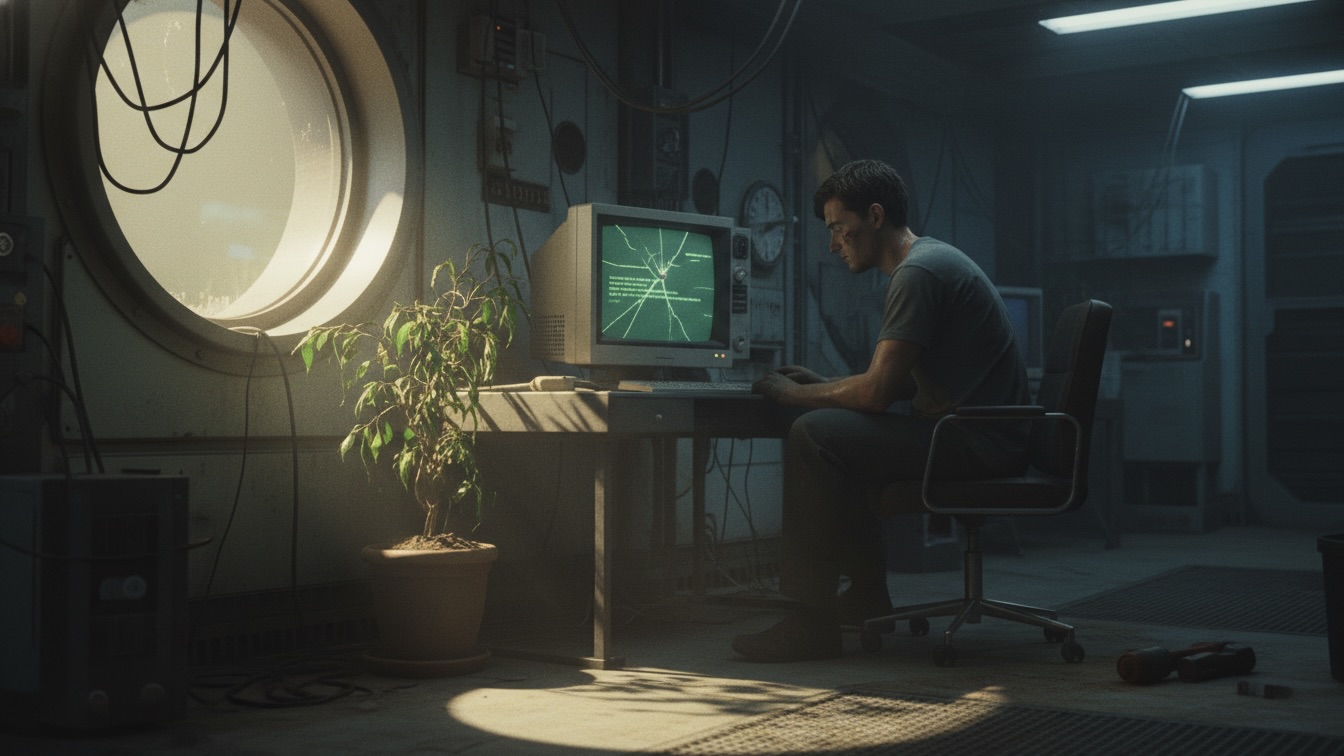
The air in New Calgary Station tasted like copper and old sweat. John needed a new filter.
The station's summer cycle hit Sector Four like a physical blow. The artificial sun lamps ran at ninety percent, baking the curved metal bulkheads until they were hot to the touch. The air scrubbers whined, a high-pitched mechanical scream that never stopped. John wiped grease from his forehead. It smeared across his skin, a thick black line. He stared at the diagnostic screen on the wall. The numbers were bad. The carbon dioxide levels in the lower residential blocks were creeping up by the hour.
He hit the side of the monitor with his palm. The screen flickered, briefly displaying a bright green diagnostic chart before settling back into a dull, pixelated red warning.
"That does not fix it," Linda said.
John did not turn around. His sister was leaning against the doorframe of the Atmosphere Trust's main office. She held a lukewarm pouch of recycled water.
"It makes me feel better," John said.
"It damages the hardware," Linda replied. She walked into the room, her boots sticking slightly to the cheap adhesive flooring. "And we cannot afford new hardware. Edith is asking for you in the boardroom."
John felt his stomach tighten. The boardroom was just a repurposed storage closet with a plastic table, but today it held the corporate sponsors. The people who paid for the filters.
"Are they still pushing the premium tier?" John asked.
"Miller has a whole presentation," Linda said. She took a sip from her water pouch and made a face. "He brought charts. Pie charts, John. About oxygen monetization."
John grabbed a rag from the desk and wiped his hands. The grease did not come off. It just moved around into the creases of his knuckles. He threw the rag onto the keyboard.
"Tell me she is fighting it," John said.
"She is tired," Linda said softly.
That was the truth they did not say out loud very often. Edith was seventy-two. She had founded the Atmosphere Trust forty years ago when New Calgary Station was just a mining hub. She had fought the original corporate charters to ensure that clean air was a universal right on the station. Now, her hands shook when she held a tablet. She coughed, a deep, rattling sound that John heard through the thin walls of their shared apartment every night.
John walked past his sister and headed down the narrow corridor. The lights overhead flickered. Power was always routed to the upper sectors first during the summer cycle. The rich needed their climate control. Sector Four got the leftovers.
He pushed open the door to the boardroom. The air inside was stifling. Six people were crammed around the plastic table. Edith sat at the head, looking small and fragile in her oversized grey sweater. She looked up when John entered.
"There he is," Edith said. Her voice was raspy. "Our head technician."
Miller, the representative from the station's primary logistics conglomerate, did not look up from his tablet. He wore a crisp, dark blue suit that looked ridiculous in the sweltering heat of the lower sector.
"We are wasting time," Miller said. "The numbers are the numbers. The Trust is operating at a deficit. You are giving away Class-A filtered oxygen to residential blocks that do not generate revenue. It is unsustainable."
"It is our mandate," Edith said. She leaned forward, resting her elbows on the table. "The Trust was established to provide a baseline standard of living."
"The station charter has changed," Miller said. He finally looked up. His eyes were cold, calculating. "We are proposing a simple pivot. A subscription model. Residents who opt-in receive priority airflow. Those who do not receive the baseline station standard."
"The baseline standard is recycled exhaust," John said. He stepped up to the table. "It is full of particulates. You are asking us to choke out Sector Four unless they pay a premium."
"I am asking you to be realistic," Miller said. "If you do not accept this restructuring, the conglomerate will pull its funding. The Trust will be bankrupt by the end of the month."
Edith started to speak, but a coughing fit interrupted her. It was a violent, hacking sound. She covered her mouth with a handkerchief. John moved toward her, his chest tightening with panic.
"Grandma," John said.
She held up a hand, waving him off. But the coughing did not stop. Her face turned pale, then a terrifying shade of grey. She tried to stand up, pushing her chair back. The legs scraped loudly against the floor.
"Edith?" Linda asked, stepping into the room from the hallway.
Edith looked at John. Her eyes were wide, filled with a sudden, sharp fear. Then, her eyes rolled back. She collapsed, hitting the plastic table hard with her shoulder before sliding to the floor.
"Get a med-tech!" John yelled. He dropped to his knees beside her. Her skin was freezing cold despite the heat of the room. Her breathing was shallow, barely there.
Miller stood up slowly, smoothing the front of his suit. He looked down at Edith with mild annoyance.
"We will table this discussion," Miller said. "But the deadline remains. You have forty-eight hours to approve the pivot, or we freeze the accounts."
John did not look at him. He was pressing two fingers against his grandmother's neck, searching for a pulse. It was there, but it felt like a failing engine, skipping beats, stuttering.
"Get out," John said.
Miller and the other suits filed out of the room. Linda was screaming into her comms unit, demanding an emergency medical evacuation. John stayed on the floor, holding Edith's hand. The grease from his fingers stained her pale skin. The air scrubber in the corner continued to whine. The noise filled John's head, drowning out everything else. He realized, with a sudden, crushing weight in his chest, that if Edith did not wake up, he was the only one left to run the Trust. And he had no idea what he was doing.
The hospital wing in Sector Two was bright, clean, and entirely silent. It was a completely different world from the noisy, hot corridors of Sector Four. John sat in a hard plastic chair outside the intensive care unit. His legs bounced up and down. He could not stop the motion.
Linda walked out of the sliding glass doors. She looked exhausted.
"She is stable," Linda said. "But the doctor says her lungs are failing. Years of breathing the lower sector air before the scrubbers were installed. It caught up to her."
"Did she wake up?" John asked.
"For a minute," Linda said. She sat down next to him. "She asked about the filters. I told her you were handling it."
John put his head in his hands. He pressed his palms against his eyes until he saw bursts of static color. "I am not handling it. The primary intake manifold on the eastern quadrant is completely shot. We need parts. Miller froze the accounts pending the board vote."
"We have the emergency reserve," Linda said.
"It is not enough to buy from the official station vendors," John said. "They mark up the prices for the summer cycle."
Linda looked at him. Her eyes narrowed. "Do not do anything stupid, John."
"I am just going to fix the filter," John said. He stood up. "Stay with her."
John took the transit tram down to the cargo bays. The docks were a massive, cavernous space filled with shipping containers and the constant roar of loading machinery. It smelled like ozone, burnt fuel, and unwashed bodies. This was where the black market operated.
He found Kevin sitting on a crate of industrial solvent. Kevin was a mid-level logistics supervisor who skimmed off the top of official shipments. He was eating a synthetic protein bar, chewing slowly.
"John," Kevin said. He tossed the wrapper onto the floor. "I heard about Edith. Tough break."
"I need a Class-Four intake manifold," John said. He did not want to make small talk. His chest felt heavy. Every minute he wasted, the air quality in Sector Four dropped.
Kevin smiled. It was not a friendly smile. "Class-Four is military grade. Hard to come by."
"I know you have one in your secondary lockup," John said. "I also know you do not have the paperwork for it."
"I can let it go," Kevin said. "But it will cost you the entire emergency reserve of the Trust. Plus a signature."
Kevin pulled a datapad from his jacket and handed it to John. The screen was cracked. The contract was a dense block of text.
"What is this?" John asked.
"It says the Atmosphere Trust assumes all liability for the hardware," Kevin said. "If the station security finds out it is stolen, the Trust takes the fall, not me."
John stared at the screen. If he signed it, he was putting the entire NGO at risk. If he did not sign it, three thousand people in the lower blocks would be breathing toxic air by midnight.
He pressed his thumb against the biometric scanner at the bottom of the pad. The screen flashed green.
"Pleasure doing business," Kevin said.
John dragged the heavy metal crate back to the transit tram. His muscles burned. He spent the next six hours in the access shafts, wrenching the old, rusted manifold out and slamming the new one into place. When he finally powered up the system, the diagnostic screen flashed green. The airflow stabilized.
He walked back into the Trust office, covered in dirt and sweat, expecting to crash on the small cot in the back room. Instead, he found a stranger sitting at his desk.
The stranger was young, maybe twenty-two, wearing a sharp, minimalist grey jacket. They had short, dark hair and a tablet propped up on the desk. They were scrolling rapidly through the Trust's financial logs.
"Who are you?" John asked.
"Nori," the stranger said without looking up. "Sector Arts and Governance Incubator. Edith enrolled you in our mentorship program three months ago. I am your assigned auditor."
John stared at them. "Mentorship program? Edith never mentioned that."
"She probably knew you would resist," Nori said. They finally looked up. Their eyes were sharp, scanning John from head to toe. "You look terrible. But more importantly, your ledger is a disaster."
Nori tapped the screen. "I just saw a massive withdrawal from your emergency reserve. And an unregistered piece of hardware logging into the central network. Care to explain why you just signed a shadow contract with a known smuggler?"
John felt his face get hot. "I kept the air running."
"You handed the corporate board the exact ammunition they need to shut you down," Nori said. "This is illegal. It violates your charter. If Miller sees this, he will not just defund you. He will have you arrested."
Linda walked into the office. She stopped when she saw Nori, then looked at the diagnostic screen, then back to John.
"What did you do?" Linda asked. Her voice was dangerously quiet.
"I fixed the filter," John said.
"By doing what?" Linda demanded.
"He bought stolen hardware from the docks and signed away your legal immunity," Nori supplied helpfully.
Linda closed her eyes. She took a deep breath. When she opened her eyes, she looked at John with total disgust.
"You sold us out," Linda said.
"I kept us breathing!" John shouted. The sudden volume hurt his throat. "What was I supposed to do? Let them choke?"
"You are supposed to be smart!" Linda yelled back. "Edith built this place on transparency. If the station authorities see that contract, they will revoke our charter. You need to resign."
"I cannot resign," John said. "I am the only one who knows how to keep the system running."
"You are a mechanic," Linda said bitterly. "Not a director."
She turned and walked out of the office. The door slammed shut behind her. The sound echoed in the small room. John stood there, his hands shaking slightly. He looked at Nori.
"She is right," Nori said. "You are a terrible director. But you are the one I am stuck with. Sit down. We have a lot of work to do."
The office smelled like stale coffee and ozone. It had been thirty-six hours since John signed the deal with Kevin. He had not slept. His eyes felt dry, like they were coated in sand. Nori sat across from him, relentlessly tapping the cracked screen of their tablet.
"Read section four, paragraph twelve again," Nori said.
John rubbed his face. He leaned over the massive physical binder of the station's legal charter. The pages were yellowing. "I cannot read anymore. The words are just floating."
"Read it," Nori commanded.
John sighed. "Any vendor supplying critical infrastructure to an orbital NGO must maintain a certified hazard transport license. Failure to produce this license upon audit renders all liability transfers null and void."
John stopped. He looked up at Nori. Nori was smiling. It was a very small, very terrifying smile.
"Kevin is a smuggler," Nori said. "Do you think he has a certified hazard transport license?"
John's heart started to beat faster. "No. He operates entirely off the grid. He avoids the official transport logs."
"Exactly," Nori said. "Which means the contract you signed is legally void. He cannot enforce the liability clause without exposing himself to the station authorities for operating without a license. He trapped himself."
John leaned back in his chair. A massive weight lifted off his chest. He could breathe again. "So we are safe. The Trust is safe."
"Do not get comfortable," Nori said, dropping the tablet onto the desk. "We still have to deal with Miller and the corporate board. They are going to vote to implement the premium subscription model tomorrow. And since Edith is incapacitated, you hold her proxy vote. But it is still three against two. You lose."
"Unless we change the board," John said.
"Now you are thinking," Nori said. "The charter allows for emergency appointments to the board if a member is deemed unfit. But we need a reason to deem them unfit."
Before John could respond, the comms unit on the desk began to chime. It was a harsh, repetitive electronic tone. The caller ID flashed red. It was the hospital wing.
John stared at the flashing light. His stomach dropped. The somatic response was immediate: cold sweat on the back of his neck, a sudden tightness in his throat. He reached out and tapped the receiver.
"This is John," he said.
"John," Linda's voice came through the speaker. It was broken, wet. She was crying. "You need to come down here."
"What happened?" John asked. He already knew.
"She is gone," Linda said. "Her heart just stopped. The doctors tried, but she is gone."
John did not say anything. He stared at the yellowing pages of the charter binder. The text blurred together. He tapped the receiver to end the call.
He stood up slowly. Nori watched him, their expression unreadable.
"I have to go to Sector Two," John said. His voice sounded hollow, like it was coming from someone else.
"Go," Nori said softly. "I will handle the logs here."
The walk to the transit tram felt like moving underwater. The heat of the station pressed against him, but he felt entirely numb. When he reached the hospital wing, he found Linda sitting in the same plastic chair. She looked up at him. She did not yell. She just looked incredibly small.
John sat next to her. He put his arm around her shoulder. She leaned into him, crying quietly. They sat there for an hour, watching the med-techs move past them in the pristine white hallway.
When John finally returned to the Trust office, the digital clock on the wall read 0400. Nori was still there.
"I am sorry," Nori said as John walked in.
"Do not be," John said. He walked over to the sink in the corner and splashed cold water on his face. "What is the situation?"
Nori hesitated, then pulled up a new document on the screen. "Miller did not wait. The moment the hospital logged Edith's death into the central station registry, he filed an emergency motion."
John dried his face with his shirt. "A motion for what?"
"Hostile takeover," Nori said. "He is claiming that with Edith dead and you lacking official certification, the Trust is fundamentally insolvent and without leadership. He is bypassing the premium tier vote entirely. He wants to liquidate the NGO's assets and fold the air scrubbers directly into the conglomerate's control."
John stared at the screen. The legal document was dense, filled with corporate jargon, but the intent was clear. They were stealing the Trust. They were going to monetize the air by force.
"When is the vote?" John asked.
"Noon today," Nori said. "It is a public hearing on the live sector-feed. They want to make a show of it. Show the station that the conglomerate is stepping in to save a failing system."
John slammed his fist onto the desk. The coffee cup rattled. "We cannot let them take it. Edith built this. She died for this."
"Then we fight them," Nori said. "The incubator program taught me how to restructure. But we need leverage. We need the community. Miller is relying on apathy. He thinks Sector Four is too tired and too hot to care who owns the air, as long as it flows."
John looked at the diagnostic screen. The green light blinked steadily. He thought about the people sleeping in the cramped bunks below them.
"We have eight hours," John said. "We are going to wake them up."
Sector Four woke up to noise. Not the usual whine of the air scrubbers, but the sound of megaphones and heavy boots on the metal grating.
John stood on a cargo crate in the middle of the main concourse. He held a battered megaphone. Beside him, Linda was handing out hand-painted signs on scraps of canvas and broken plastic plating. The paint was bright, stark red against the grey station walls.
"They want to charge you for breathing!" John yelled into the megaphone. The audio crackled, distorted by the cheap speaker. "Miller and the board are voting at noon. If they win, your air supply is cut in half unless you pay the premium."
People stopped walking. They gathered around the crate. Tired faces, covered in the grime of the lower decks. At first, there was just murmuring. Skepticism. The people of Sector Four were used to being ignored.
"Why should we trust you?" a man in dirty coveralls shouted. "You are just a kid. Edith was the one who kept things running."
"Edith is gone," John said. The words tasted like ash. "She passed away last night. And the second she did, the corporate board moved to steal this Trust. I am a kid. I am a mechanic. But I know how the filters work. I know that right now, we are pumping clean air to your block. If Miller takes over, that stops."
Linda stepped up onto the crate next to him. "We are walking to Sector Two. We are taking the concourse. They are broadcasting the vote on the live feed. We are going to show them that we are watching."
The crowd swelled. Nori had used the incubator network to ping every comms unit in the lower sectors. By 1100 hours, there were five hundred people marching up the primary transit ramp. By 1130, there were a thousand. The heat of so many bodies in the enclosed space was suffocating, but no one stopped.
The administrative hub in Sector Two was a glass-walled atrium. Miller and the two other corporate board members sat at a raised podium. Cameras hovered on drones, recording the proceedings for the station-wide feed.
When John pushed through the heavy glass doors, followed by a sea of angry residents holding red signs, Miller's face went completely pale.
"Security!" Miller shouted into his microphone. "Clear the atrium!"
"This is a public hearing!" John shouted back. He walked straight up to the podium. Nori flanked him on the left, holding the tablet. Linda was on his right. The crowd pressed up against the glass walls outside, chanting loudly.
"You have no standing here, John," Miller said, trying to regain his composure. He looked at the hovering camera drones. "The Trust is insolvent. We are liquidating the assets to protect the station."
"You are liquidating to create a monopoly," John said. He turned to face one of the camera drones. He spoke directly to the lens. "My name is John. My grandmother founded the Atmosphere Trust. Today, the corporate sponsors want to implement a premium air subscription."
John reached out and took the tablet from Nori. He plugged it into the podium's central console.
"I am uploading the conglomerate's internal projections to the public feed right now," John said.
The massive screens in the atrium, which had been displaying the Trust's logo, suddenly flashed with spreadsheets and graphs.
"Look at the numbers," John said. "They are not planning to increase filter efficiency. They are planning to throttle the baseline flow to Sector Four by thirty percent to create artificial scarcity. They want to choke us so we pay more."
The crowd outside roared. The sound vibrated through the glass.
Miller stood up. "That data is proprietary!"
"It is evidence of a breach of the station's human rights charter," Nori said loudly, stepping up to the microphone. "Under Section Eight, any board member found actively conspiring to reduce baseline life-support standards is subject to immediate expulsion."
John looked at Miller. "I hold Edith's proxy vote. I vote to expel Miller and the corporate representatives from the board of the Atmosphere Trust, effective immediately."
The two other corporate suits looked at the angry mob pressing against the glass. They looked at the camera drones broadcasting the damning data to every screen on the station. They looked at Miller.
"I resign," one of the suits said quickly into his microphone. He stood up and practically ran toward the back exit.
"Me too," the second suit said, following right behind him.
Miller was left standing alone at the podium. His face was flushed red. He glared at John. "You think you won? You have no funding. The accounts are frozen. The hardware is degrading. You will be bankrupt in a week."
"We will figure it out," John said. "Get out of my chair."
Miller straightened his suit jacket, scowled at the camera, and walked away. The crowd outside erupted into cheers. Linda hugged John tightly. Nori just nodded, a look of grim satisfaction on their face.
Two weeks later, the summer cycle finally broke. The station's radiators caught up, and the temperature in Sector Four dropped to a tolerable level.
John sat in the Trust office. It was quiet. The air scrubber hummed steadily in the corner. The desk was covered in paperwork. Budget forecasts, maintenance schedules, grant applications.
Linda walked in. She was carrying a box of spare wiring.
"The primary manifold is holding," Linda said, setting the box down. "But Sector Three is reporting a pressure drop."
"I will check the seals after I finish these forms," John said. He rubbed his eyes. He was exhausted. Winning the vote had not been a magical fix. It had just meant the beginning of a relentless, brutal grind. There was no money. Every day was a fight to keep the lights on and the air flowing.
"Nori sent over a list of potential new board members," Linda said. "People from the community. A retired engineer, a teacher, a union rep."
"Good," John said. "Set up interviews for tomorrow."
Linda looked at him. She smiled softly. "You look like her, you know. When you sit at that desk."
John looked down at his hands. They were still stained with grease, deep in the creases. He thought about Edith. He thought about the weight of the station pressing down on them.
"I am trying," John said.
"I know," Linda said. She walked out, heading back toward the maintenance shafts.
John turned back to the monitor. The screen flickered. He hit the side of it with his palm, and the display stabilized. The green light blinked on the console, promising nothing but another twelve hours of work.
“The green light blinked on the console, promising nothing but another twelve hours of work.”


