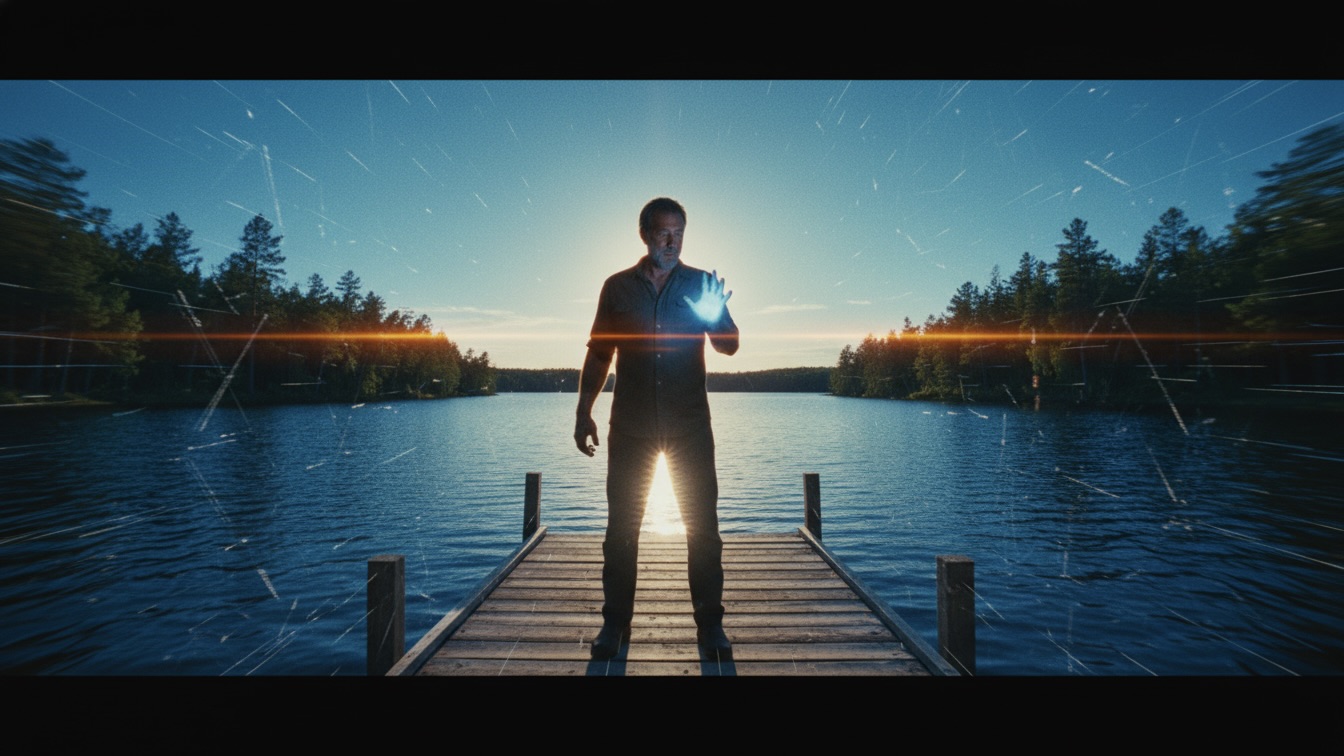
Tom watches the blue drop sink into his palm, turning the summer heat into a grid of shimmering data.
The blue drop did not splash. It sat at the bottom of Mae’s white ceramic mug, a perfect sphere of electric cobalt that defied gravity and surface tension. Tom Hardin leaned over it. The kitchen was silent, save for the rhythmic clicking of the cooling refrigerator. The heat of the morning pressed against the windowpanes, but inside the kitchen, the air felt brittle. He reached out. His thumb hovered over the liquid. The drop shivered. It wasn't a liquid; it was a frequency.
"Don't," he whispered to himself.
His hand moved anyway. The tip of his thumb touched the sphere. There was no wetness. Instead, a sharp, needle-like sting lanced up his arm. The blue light vanished. It didn't coat his skin. It sank through the pores, a localized invasion of his bloodstream. Tom pulled his hand back, his heart hammering against his ribs like a trapped bird. He expected his skin to glow. He expected his heart to stop. Nothing happened for three seconds.
Then the world stuttered.
The kitchen table flickered. For a fraction of a second, the distressed pine surface was replaced by a sleek, chrome-edged laminate from the 1950s. A glass ashtray appeared where the mug had been. Then it was gone. The modern world snapped back into place, but the colors were wrong. The green of the trees outside the window was too vivid, the saturation turned up until it hurt to look. The edges of the cupboards were outlined in thin, glowing lines of cyan.
"Mae?" he called out. His voice sounded like it was coming through a long pipe. He knew she wasn't there. He had seen the quarry. He had seen the void. But the part of him that was a father, the part that had spent twenty years worrying about curfews and scraped knees, refused to accept the evidence of the crater.
He stood up. His knees didn't pop this time. They felt lubricated, almost frictionless. He walked toward the sink. As he moved, a trail of after-images followed his hands—translucent echoes of his own motion. He looked at the stainless steel. He didn't just see the metal. He saw the molecular structure of the alloy, a lattice of iron and chromium atoms vibrating in a low, humming grid. He saw the date of manufacture: May 12, 2014. It was etched in the air above the faucet in a font that looked like a digital ghost.
"The ledger," he muttered. He needed his boots. He needed the truck. He needed to be moving. Pacing was the only way to keep the panic from curdling into a stroke. He grabbed his boots from the mudroom. The leather was old, cracked by salt and years of lake water. As he pulled them on, he saw the history of the boots. He saw the cow they came from. He saw the factory in Red Wing, Minnesota. The information flooded his brain, a relentless stream of metadata that he hadn't asked for.
He stood on the porch. The August heat hit him, but it didn't feel like heat anymore. It felt like a specific thermal energy reading: 32.4 degrees Celsius. 68 percent humidity. Wind from the southwest at 12 kilometers per hour. He could see the wind. It wasn't just a feeling; it was a series of transparent ribbons flowing through the pines, carrying pollen and dust in visible trajectories.
"I'm a sensor," Tom said. He gripped the porch railing. The wood was cedar. Rotting at the base. Infested with carpenter ants. He could see the ants moving inside the grain, their tiny heat signatures glowing like embers.
He walked to the GMC Sierra. The truck was a relic. It was a 2019 model, heavy on iron and light on software. He needed that. He needed something that didn't have a brain. He climbed into the cab and turned the key. The engine didn't just roar. It communicated. He felt the spark plugs firing in sequence. He felt the oil pressure rising. He saw the fuel injection as a series of precise, timed bursts of chemical energy.
"Drive," he told himself. "Just drive."
He backed down the driveway. The gravel was no longer just rocks. Each stone had a weight and a volume. He was calculating the displacement of the tires in real-time. The paranoia that had started in the library was now a physical presence. If he could see this much, what could they see? What was Keller—or whatever was wearing Keller’s face—seeing right now? He looked in the rearview mirror. He expected to see his own face. Instead, he saw a flickering composite of a younger man and an older man, his features shifting like a television with bad reception.
He turned onto the logging road. The dust kicked up behind him. He didn't look back. He kept his eyes on the road, trying to ignore the way the trees were beginning to look like wireframe models. The world was being stripped down to its code, and he was the only one with the decryption key. He pushed the accelerator. The truck surged forward. He needed to get to Kenora. He needed to find Officer Morris. He needed a witness who was still human.
"Focus," he whispered. "Stay in the lane. Don't look at the ghosts."
But the ghosts were everywhere. As he passed the crossroads where the man in the red shirt had dropped the corn, he saw it again. The event was looped. A translucent red ATV rounded the corner. A translucent crate fell. Translucent corn spilled. It happened over and over, a recording stuck in the fabric of the road. Tom drove right through it. He felt a slight chill as the truck passed through the holographic memory. It was like driving through a cold mist.
He hit the highway. The pavement was a gray ribbon of data. He saw the tire tracks of every car that had passed in the last hour. They were glowing neon streaks. Blue for diesel. Yellow for gasoline. He followed the freshest streaks. He was a hound on a digital scent. He was moving toward the town, toward the hive of people who had no idea the summer was a simulation that was starting to fail.
"I'm coming, Mae," he said, though he didn't know where she was. He only knew that if the world was becoming an archive, he had to find the index. He had to find the point where the data started and the life ended.
The highway was a corridor of screaming information. Tom gripped the steering wheel, his knuckles white against the black plastic. The GMC Sierra felt like a vibrating cage. Every time a car passed him in the opposite direction, a burst of data exploded in his peripheral vision. License plate numbers. VINs. The heart rates of the drivers. The remaining tread life on their tires. It was too much. He squinted, trying to narrow his field of vision to the two yellow lines in the center of the road.
"Shut up," he snapped at the empty cab. "Just shut up."
He wasn't talking to himself. He was talking to the truck’s dashboard. The digital clock was ticking, but the numbers were moving backward. 8:54 AM. 8:53 AM. 8:52 AM. He looked at his watch—an old mechanical Seiko. The second hand was twitching, unable to decide which direction to rotate. The time-loop that had started at the lake was expanding. It was no longer a localized event; it was a contagion.
He saw a hitchhiker standing on the shoulder. The man was wearing a denim jacket and a baseball cap. As Tom approached, the man’s face blurred. He wasn't a person. He was a placeholder. A generic human asset inserted into the scene to provide a sense of scale. When the truck roared past, the hitchhiker didn't turn his head. He didn't stick out a thumb. He just stood there, his body vibrating at a different frame rate than the trees behind him.
"Fake," Tom whispered.
He looked at the forest. The pines were massive, ancient sentinels. But as he watched, a section of the woods flickered. For a split second, the green needles were replaced by a white, sterile void. Then the trees returned, but they were slightly out of alignment. A branch was floating three inches away from its trunk. A bird was frozen mid-flight, its wings a blur of static.
Tom reached the outskirts of Kenora. The 'Welcome' sign was peeling. In his vision, the sign was a layer of history. He saw the previous version of the sign beneath the current one. He saw the wood before it was cut. He saw the forest fire of 1923 that had cleared the land where the sign now stood. The archives were opening, and he was falling into the pages.
He pulled into a gas station. He didn't need fuel, but he needed to stop. He needed to touch something that wasn't moving at eighty kilometers per hour. He stepped out of the truck. The pavement felt soft, like walking on high-density foam. He walked toward the convenience store. The glass door was covered in stickers for lottery tickets and ice cream.
"Help you?" the clerk asked.
The clerk was a teenager with acne and a name tag that read 'Kyle.' Tom looked at him. Kyle’s skin was a map of cellular regeneration. Tom saw the boy’s DNA. He saw a predisposition for heart disease. He saw the breakfast the boy had eaten—a frozen burrito and a sugar-filled energy drink.
"Water," Tom said. "Just water."
"Aisle four," Kyle said. He didn't look up from his phone.
Tom walked to the back. The refrigerator unit was humming. He saw the cooling coils. He saw the Freon circulating through the copper pipes. He grabbed a plastic bottle. The water inside was 4 degrees Celsius. It was purified by reverse osmosis. He could see the micro-plastics floating in the liquid like tiny, jagged stars.
He took the bottle to the counter. He reached into his pocket and pulled out a ten-dollar bill.
"Keep it," Tom said.
"I need to give you change, man."
"Keep it, Kyle."
Tom walked out. He didn't look back. He climbed into the truck and unscrewed the cap. He poured the water over his hands. It felt real. It felt cold. But as the water hit the floor mat, it didn't soak in. It beaded up into perfect spheres, just like the blue drop in the mug. The physical laws of the world were being overwritten. Surface tension was no longer a constant. Gravity was becoming a suggestion.
He drove toward the police station. He passed the library. It was gone. In its place was a vacant lot filled with tall weeds and a 'For Sale' sign that looked fifty years old. He slammed on the brakes.
"No," he said. "I was just there. We were just there."
He got out of the truck and walked to the edge of the lot. He saw the foundations of the library. They weren't fresh. They were overgrown with moss. The brickwork was crumbled. To the rest of the town, the library had been a ruin for decades. But Tom remembered the smell of the floor wax. He remembered the librarian. He remembered the microfiche.
He looked at his hands. The blue light was pulsing under his fingernails.
"It’s changing," he said. "It’s rewriting the town."
He looked across the street. A black Ford Expedition was idling. It was the same one from the library. Or a copy of it. The windows were opaque. No heat signature came from the engine. It was a ghost in the machine. A cursor waiting to delete him from the file.
He didn't run. He couldn't. He walked back to the truck, his movements heavy. He felt like he was wading through molasses. The air was getting thicker, the data density increasing as he approached the center of town. He could hear the voices now—a low, rhythmic chanting that sounded like binary code translated into a choir.
"Where is she?" he screamed at the black SUV.
The SUV didn't move. It didn't honk. It just sat there, a black void in the shimmering heat of the summer morning. Tom got into his truck and slammed it into gear. He didn't go to the police station. He went to the harbor. If the world was a record, the water was the only thing that could hold the reflection. He needed to see the lake. He needed to see if the Lake of the Woods was still there, or if it had been replaced by a digital sea.
The harbor was a massacre of pixels. Tom stood at the edge of the wooden boardwalk, gripping the weathered railing. The wood felt like dry bone. Below him, the water of the Lake of the Woods wasn't water. It was a flat, shimmering plane of cerulean glass. There were no ripples. There was no tide. The boats moored at the docks were floating an inch above the surface, held in place by invisible anchors of code.
"Hello?" Tom called out.
A group of tourists stood twenty feet away. They were dressed in bright Hawaiian shirts and khaki shorts. They were holding ice cream cones. They weren't moving. They were frozen in a tableau of summer leisure. One man had a scoop of mint chocolate chip mid-fall, suspended in the air like a marble.
Tom walked toward them. He reached out and touched the man’s arm. The fabric of the shirt felt like static electricity. It crackled under his fingers. The man didn't blink. He didn't breathe. He was a high-resolution statue, a detail added to the scene to fill the space.
"Morris!" Tom shouted.
He saw the officer. Morris was standing by a patrol car near the public boat launch. He wasn't frozen. He was pacing, but his movements were repetitive. He would take three steps left, stop, adjust his belt, and take three steps right. It was a patrol loop.
Tom ran toward him, his boots thudding on the hollow-sounding boardwalk.
"Morris! Look at the water! Look at the people!"
Morris stopped. He turned to look at Tom. His eyes were different. They weren't the bored, cynical eyes of the young officer from the station. They were flat, gray discs. They looked like camera lenses.
"Citizen Hardin," Morris said. His voice was a perfect synthesis of the previous Morris, but the inflection was gone. "You are out of bounds."
"What are you talking about? Look at the lake! It’s a mirror!"
"The environment is undergoing a scheduled update," Morris said. He didn't move his mouth. The words just emanated from his chest. "Please return to your primary residence and wait for the re-initialization sequence."
"Where is my daughter?"
"Entity Mae Hardin has been integrated into the core archive. She is currently serving as a primary data node. Her physical form is no longer required for this iteration."
Tom felt a surge of cold fury. He reached out and grabbed Morris by the collar of his uniform. The fabric felt like cold plastic. He expected the officer to fight back, to use his training. Instead, Morris just stood there, his body yielding like a bag of sand.
"Bring her back," Tom hissed.
"Request denied," Morris said. "The archive is closed. The harvest is ninety-eight percent complete. You are the final uncompressed file, Tom."
Tom let go. He backed away. He looked around the harbor. The world was dissolving. The buildings on the far shore were losing their textures, turning into gray boxes. The sun was a static white circle in a sky that was becoming a grid of blue lines.
"I'm not a file," Tom said.
He looked at his thumb. The blue light was no longer just under the skin. It was bleeding out, turning his hand into a translucent limb of glowing circuitry. He could see the bones. He could see the archive inside himself. He saw the history of the lake. He saw the indigenous tribes who had fished these waters a thousand years ago. He saw the fur traders. He saw the gold miners. He saw his grandfather burying the silver boxes in the bush.
It was all there. He was the ledger.
"You can't have it," Tom said. "You can't have the history if I don't give it to you."
He turned and ran toward the docks. He jumped onto a small motorboat—a Boston Whaler with a sixty-horsepower Mercury engine. He didn't need a key. He touched the ignition wires and felt the engine roar to life. The sound was distorted, a digital scream that echoed off the glass water.
He slammed the throttle forward. The boat didn't cut through the water; it slid across the surface like a puck on air. He headed for the open lake, toward the center of the bay where the crystal had first appeared.
Behind him, the harbor began to collapse. The tourists shattered into white dust. The patrol car folded in on itself like a piece of paper. Morris stood on the edge of the disappearing boardwalk, his gray eyes fixed on Tom.
"There is nowhere to go, Tom," the voice echoed in his head. "The map is being deleted behind you."
Tom didn't look back. He watched the islands. They were vanishing one by one. The pines were being erased. The granite was being unmade. The world was shrinking, a circle of reality that was closing in on his boat.
He reached the center of the bay. He killed the engine. The silence was absolute. The boat sat in the middle of a vast, white void. The lake was gone. The sky was gone. There was only Tom, the boat, and the blue light in his veins.
"Mae!" he screamed.
Suddenly, the floor of the void rippled. A figure appeared. It wasn't Mae, but it had her shape. It was made of the same silver liquid that had been in the eggs at the quarry. It stood on the surface of the void, its features shifting and blurring.
"Dad?"
The voice was a whisper, a thousand miles away.
"Mae! Is that you?"
"I'm the record now," the figure said. It reached out a hand. The fingers were long, tapering into threads of light. "I'm everything that ever happened here. Every summer. Every winter. Every death."
"Come home," Tom said. He reached out his own hand.
"There is no home. The gardeners are leaving. They're taking the hard drive with them. We're on it, Dad. We're the data."
Tom looked at his hand. It was almost entirely transparent. He could see the white void through his palm. He wasn't a man anymore. He was a sequence of bits and bytes, a story being saved to a silver egg.
"I don't want to be a story," Tom said.
"It’s better this way," Mae said. "No more pain. No more getting old. Just the memory of the sun on the water. Forever."
Tom felt a tear roll down his cheek. It wasn't salty. It was a drop of blue light. It fell onto the deck of the boat and vanished into the void. He looked up at the silver figure. He saw her eyes—the real Mae’s eyes, buried deep inside the light.
"Is it summer there?" he asked.
"It’s always summer," she said.
He stepped off the boat. He didn't fall. He stood on the void. He walked toward her, his body dissolving into a cloud of cobalt static. He felt the heat of the sun one last time—not as a reading, not as data, but as a memory of a kitchen, a mug of coffee, and a daughter who was safe.
The void didn't last. Reality snapped back with the violence of a breaking bone. Tom found himself standing in the middle of the Lake of the Woods Brewing Company parking lot. The sun was a brutal, physical weight. The smell of asphalt and exhaust was gone—he could smell nothing. He looked at his hands. They were solid. No blue light. No transparency. The grease was back under his fingernails.
But the town was wrong.
He looked at the brewery. It was a massive, modern complex of glass and steel that hadn't been there ten minutes ago. The sign didn't say 'Kenora.' It said 'Sector 4: Archive Hub.' The people walking past weren't tourists. They were all wearing the same charcoal-gray suits. They moved with a synchronized, mechanical precision. They didn't talk. They didn't laugh. They just walked.
Tom backed away, his heart hammering. He looked for his truck. The GMC Sierra was gone. In its place was a row of identical black Toyota Corollas. Three of them were idling near the exit, their engines humming with a low-frequency vibration that made Tom’s teeth ache.
"Hardin," a voice said.
Tom turned. It was Keller. But it wasn't the Keller from the quarry. This one looked younger. His suit was crisp. His skin was the color of unbaked dough. He was holding a tablet that glowed with a familiar blue light.
"The integration was successful," Keller said. "Mostly. There was some residual data leakage. You."
"Where am I?" Tom asked. His voice was hoarse.
"You're in the version of Kenora that serves the harvest," Keller said. "The one you remember was a draft. A staging area. This is the final product. We’ve optimized the layout. More efficient. Less waste."
"You killed them," Tom said. "All those people. The tourists. The town."
"We didn't kill them. We archived them. They’re much happier now. No more taxes. No more climate change. Just a perfect, eternal loop of a Tuesday in July."
Keller stepped closer. The three black Corollas began to move. They circled the parking lot like sharks, their tires silent on the smooth pavement.
"You're an anomaly, Tom. You absorbed a core data node. The drop in the mug. It was a backup. We can't have a backup running around in the hardware. It creates feedback loops."
"Try and take it," Tom said. He reached for the pry bar he’d left in the truck, but his hands found only empty air.
"We don't need to take it," Keller said. "We just need to format the drive."
Keller tapped the screen of his tablet.
Tom felt a sudden, agonizing pressure in his skull. His vision flickered. He saw the world as it was—a wireframe skeleton of a town, a hollow shell built on a dead rock. He saw the agents. They weren't men. They were tall, spindly shadows with multiple limbs, wrapped in holographic skins to look like humans in suits.
He fell to his knees. The pavement felt like cold metal.
"Delete," Keller whispered.
Tom closed his eyes. He didn't look at the wireframe. He looked inside. He looked at the blue light that was still pulsing in his marrow. He didn't fight the pressure. He leaned into it. He reached for the memory of Mae. Not the silver figure in the void, but the girl. The girl who used to complain about the mosquitoes. The girl who loved the smell of rain on hot gravel.
He found the memory and he expanded it. He pushed it out of his mind and into the air.
Suddenly, the smell returned.
No, it wasn't a smell. It was a sensory ghost. A phantom of ozone and pine. The black Corollas stopped. The charcoal-suited agents froze. The glass and steel of the 'Archive Hub' began to crack.
"What are you doing?" Keller screamed. His holographic skin was flickering, revealing the dark, oily shadow beneath.
"I'm rewriting," Tom said.
He stood up. The blue light flared from his eyes. He wasn't just a file. He was the author. He was fifty-six years of living, breathing, dirty, messy history. He was the grease on the sink. He was the ice on the lake. He was the heat of the summer.
He pushed the memory harder. He visualized the old library. He visualized the muddy logging roads. He visualized the rusting GMC Sierra.
The world around him began to warp. The modern buildings dissolved into the brick and mortar of the old town. The Corollas turned back into mud-caked SUVs. The agents stumbled, their forms losing cohesion.
"Stop it!" Keller yelled. He tried to tap the tablet, but the device turned into a block of wood in his hands.
Tom walked toward him. He felt powerful. He felt ancient. He was the spirit of the lake, the ghost in the machine. He reached out and touched Keller’s chest.
"The harvest is over," Tom said.
Keller shattered. Not into pixels, but into dry, black leaves that blew away in a sudden, warm breeze.
Tom stood alone in the parking lot. The brewery was back to its old self. The tourists were there, laughing, eating ice cream, complaining about the heat. They were real. They were breathing. They were messy and beautiful.
He looked toward the lake. The water was blue, ruffled by a gentle wind. The boats were bobbing on the waves.
He walked to the edge of the water. He sat on a bench and watched the sun begin its slow descent toward the horizon. He felt a profound, aching loneliness, but also a strange peace. He had saved the world, but he had lost his place in it. He was a man out of time, a living archive in a town that didn't remember it had almost been deleted.
He reached into his pocket and found the small, clear pebble. It was warm now. It felt like a heartbeat.
"We're still here, Mae," he whispered.
A seagull cried out overhead. The sound was sharp and real. Tom closed his eyes and listened to the rhythmic lapping of the water against the docks. It was a beautiful summer evening. It was the only thing that mattered.
“He looked at the pebble in his hand, and for the first time, the blue light inside it began to pulse in time with his own heart.”


