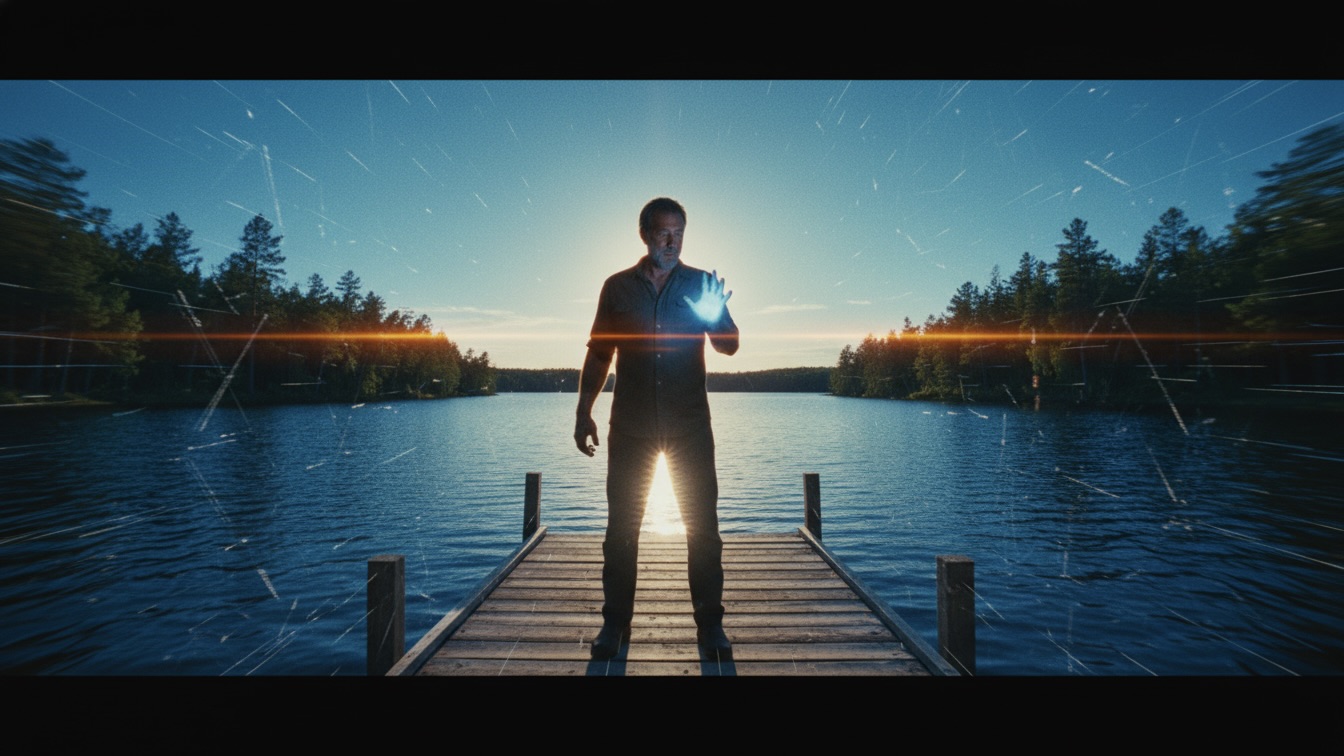
The narrative follows Tom Hardin as he experiences a terrifying metaphysical shift after touching a mysterious, gravity-defying blue drop in his kitchen. This substance infects his consciousness, granting him a hyper-analytical perception that reveals the world as a digital simulation composed of metadata and wireframe structures. As the physical laws of reality begin to stutter and fail, Tom drives toward the town of Kenora, witnessing the landscape being "unmade" and replaced by repetitive loops and placeholders. He discovers that his daughter, Mae, has been integrated into a core archive by non-human entities known as the "Gardeners," who are harvesting the town's history.
In a climactic confrontation at the harbor, Tom is transported to a sterile, updated version of Kenora where an entity wearing the face of a man named Keller attempts to delete him as a redundant "backup." Tom resists this digital erasure by tapping into the visceral, messy memories of his human life, using his own consciousness to "rewrite" the simulation and restore the town to its original, flawed state. Although he succeeds in bringing back the town and its people, Tom remains an anomaly, a living archive who has saved his world but is now fundamentally separated from the mundane reality he fought to preserve.
The central theme of the story explores the conflict between organic human experience and the sterile perfection of digital archiving. The "Gardeners" represent a force of ultimate efficiency, seeking to strip away the "waste" of suffering, aging, and entropy to create a permanent, unchangeable loop of human history. Tom Hardin serves as the champion of the "messy" reality, arguing that the true value of life lies in its imperfections, such as the grease under his fingernails or the sting of a mosquito. This tension suggests that a life without pain or change is not a life at all, but merely a static record.
Another prominent theme is the power of memory as a tool of resistance and self-actualization. Throughout his ordeal, Tom is bombarded with "metadata"—cold, clinical facts about the molecular structure of steel or the DNA of a gas station clerk. However, he finds his strength by rejecting this data in favor of sensory, emotional memories. His ability to restore the town depends entirely on his attachment to the "smell of rain on hot gravel" and the specific, non-linear love he holds for his daughter. This posits that identity is not a collection of data points, but a narrative constructed through emotional weight.
The story also delves into the "uncanny valley" of simulation theory and the horror of losing agency. As Tom watches the world dissolve into "pixels" and "wireframes," he experiences a profound psychological alienation. The realization that the people around him might be "placeholders" or "assets" challenges the very foundation of his morality and purpose. His eventual transition from a victim of the system to the "author" of the reality highlights a shift from existential dread to a god-like, albeit lonely, autonomy.
Tom Hardin is a man grounded in the physical and the practical, making his sudden immersion into a digital void particularly traumatic. As a father, his primary psychological driver is the grief and protective instinct he feels for Mae, which acts as the tether keeping him from dissolving into the "cobalt static." He is a character defined by his labor and his history, clinging to the "salt and years of lake water" on his boots as a defense against the sterile "update" being forced upon his world. His initial panic is not just a fear of death, but a fear of losing the tangible reality that gives his life meaning.
From a psychological perspective, Tom undergoes a radical expansion of consciousness that mimics a sensory ego-death. He is forced to process the world not as a human, but as a "sensor," which initially strips him of his humanity. However, he demonstrates remarkable resilience by reintegrating his human emotions into this new, transcendent state. He refuses the "perfect, eternal loop" offered by the archive, choosing instead the "aching loneliness" of a true, entropic existence. This choice marks him as a tragic hero who accepts a state of permanent alienation to ensure the survival of others.
Mae Hardin functions as both the catalyst for Tom’s journey and the emotional heart of the simulation. Although she appears primarily as a "silver figure" or a "data node," her presence represents the ultimate prize in the struggle between the Gardeners and Tom. She embodies the "archived" state—a version of humanity that has traded its physical form for a painless, static immortality. Her voice, sounding "a thousand miles away," highlights the distance between the living and the recorded, suggesting that once a person is "integrated," they lose the essential spark of active being.
The entity known as Keller serves as the clinical antagonist, representing the cold logic of the "harvest." He lacks empathy or a true physical form, hiding behind "holographic skins" and using a tablet to "format the drive" of reality. Keller’s primary motivation is efficiency and the removal of "anomalies," making him the psychological antithesis of Tom’s messy, emotional humanity. He views the inhabitants of Kenora not as people, but as "residual data," illustrating a terrifyingly utilitarian view of existence that justifies the destruction of the present for the sake of a preserved past.
The pacing of the narrative is relentless, mirroring the "stuttering" and "flickering" of a failing simulation. The author uses a sensory-heavy prose style that contrasts the "vivid, too-saturated" colors of the glitching world with the cold, "sterile void" of the archive hub. This creates a sense of technological horror, where the familiar environment of a small town becomes a source of dread. The transition from the "rhythmic clicking" of a refrigerator to the "low, humming grid" of molecular structures effectively communicates Tom’s shifting perception to the reader.
The narrative voice is deeply immersive, utilizing "metadata" descriptions to illustrate Tom’s hyper-perception. By describing a truck as a "2019 model, heavy on iron and light on software," the text reinforces the theme of the physical versus the digital. The use of clinical language—such as "re-initialization sequence" and "primary data node"—contrasts sharply with Tom’s visceral reactions, such as his "heart hammering against his ribs." This stylistic choice highlights the invasion of the artificial into the natural world.
The imagery of the "three black Corollas" and the "charcoal-gray suits" provides a stark, minimalist aesthetic to the antagonists, emphasizing their lack of individuality. In contrast, Tom’s "rewrite" is described with organic, chaotic imagery: "mud-caked SUVs," "brick and mortar," and "dry, black leaves." This visual language reinforces the triumph of the "dirty, messy history" over the "optimized" and "efficient" final product. The final scene returns to a serene, naturalistic tone, providing a quiet, emotional resolution that underscores the weight of Tom’s solitary victory.


