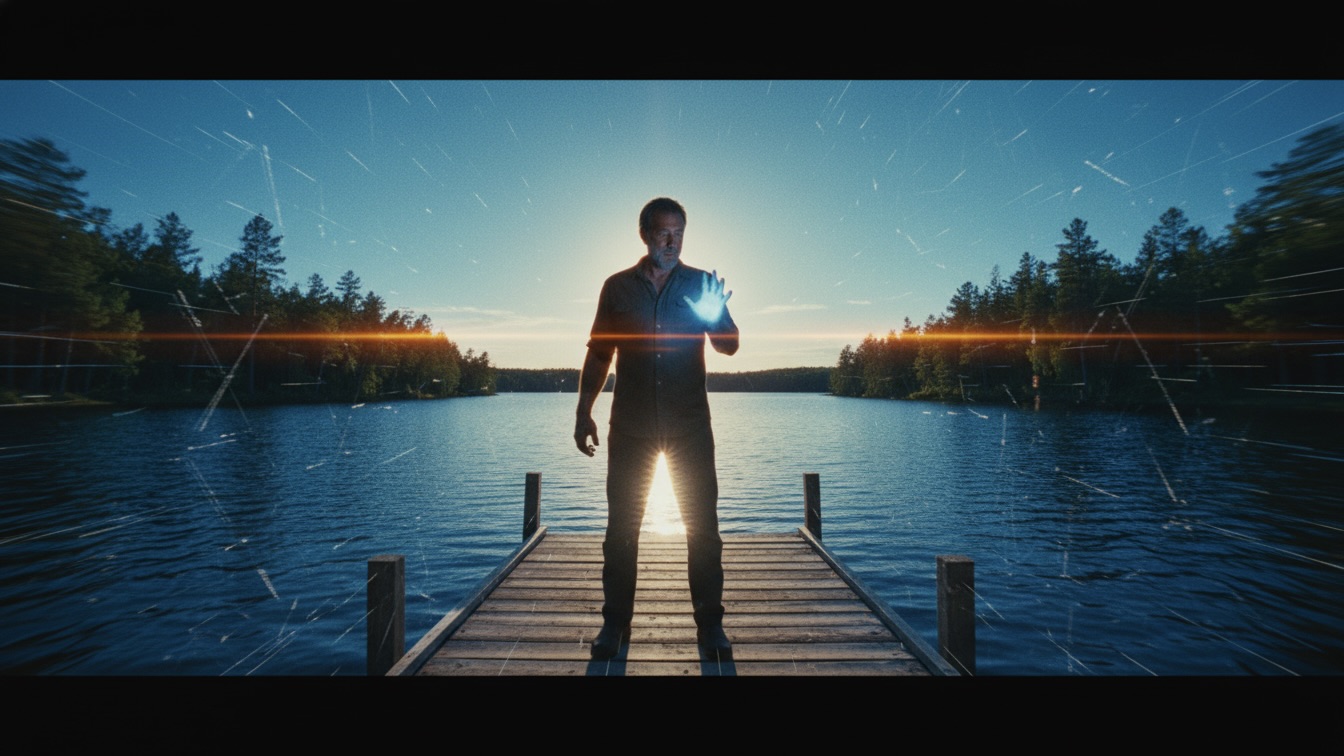
Tom scrubs grease from his knuckles as the unseasonal ice vanishes, replaced by a heat that feels like surveillance.
Tom gripped the edge of the stainless steel sink until his knuckles turned white. The water was scalding. It turned the black grease on his hands into a gray slurry. He didn't feel the heat. He only felt the vibration in his bones, a residual hum from the crystal that was no longer there. Outside, the summer sun was reclaiming the bay. The ice was gone. The snow was a memory of mud. The transition was too fast. It felt like a film edit.
"Drink this," Mae said.
She shoved a mug of black coffee toward him. The steam hit his chin. He didn't look at her. He looked at the window. The black SUVs were gone. There weren't even ruts in the driveway where they had idled. The mud looked undisturbed, a smooth, wet surface reflecting the morning sky.
"They were there," Tom said.
"I know,"
"Keller. He stood right there. He ruined his shoes."
Mae sat at the table. She was rubbing her palms. The skin was pink, slightly raw. She didn't look like a girl who had just paused time. She looked like a teenager who had spent too much time in the sun. She picked up her own mug, her fingers trembling against the ceramic.
"He's not coming back," she said.
"You don't know that."
"I do."
Tom finally looked at her. Her eyes were different. They were too bright. They didn't settle on any one object. They flitted around the room, tracking things he couldn't see. He reached out and touched her wrist. Her pulse was a frantic, irregular rhythm.
"We're going to town," Tom said.
"Why?"
"I need to see the ledger. I need to see if Transport Canada has a record of this."
"They won't."
"Maybe. But we aren't sitting here waiting for them to reappear in the middle of the kitchen."
Tom grabbed his keys from the hook. They were heavy, cold, and familiar. He needed familiar. He needed the weight of the GMC Sierra and the sound of a real internal combustion engine. He didn't want any more blue light. He didn't want any more silence. He walked to the door and stepped out onto the porch. The heat hit him like a physical barrier. It was ninety degrees. Ten minutes ago, it was minus ten. The humidity was a wet towel over his face.
He walked to the workshop. The padlock was still there. He snapped it open. The interior was exactly as he had left it, except for the lack of the black box. The table was empty. The tarp was folded on the floor. He looked at the floorboards where they had dragged the payload. The scratches were there. Physical proof. He knelt and ran his fingers over the gouged wood. The splinters were real. They bit into his skin.
"Dad?" Mae was standing in the doorway. She was squinting against the glare.
"Coming," Tom said.
He stood up, his knees popping. The sound echoed in the empty shop. He felt old. Older than fifty-six. He felt like a relic from a century that didn't understand crystals or time-loops. He walked past her to the truck. The tires were caked in mud. He climbed into the driver's seat and waited for Mae to get in. She hesitated, looking toward the lake. The water was a flat, impossible blue.
"Get in the truck, Mae."
She climbed in and slammed the door. The sound was a sharp, metallic punctuation mark. Tom turned the key. The engine roared, a beautiful, dirty, loud sound. He put it in gear and backed down the driveway. He watched the rearview mirror. He expected to see Keller standing in the middle of the road, holding a bullhorn. There was only the green wall of the pines and the shimmering heat of the gravel road.
As they hit the main logging road, the truck fishtailed in the deep sludge. Tom fought the wheel. He liked the resistance. It was something he could calculate. He shifted into four-wheel drive and felt the front tires bite. They drove in silence for three miles before Mae spoke.
"He's going to drop it," she said.
"Who?"
"The man in the red shirt. At the crossroads."
Tom slowed down. There was nobody at the crossroads. It was a desolate intersection of two gravel paths. He looked at the clock on the dash. 8:14 AM. He looked at Mae. She was staring straight ahead.
"There's nobody there, Mae."
Ten seconds later, a red ATV rounded the corner. The driver was wearing a bright red sun-shirt. As the ATV hit a pothole near the intersection, a plastic crate strapped to the back snapped loose. A dozen ears of corn spilled across the road. The man stopped, cursing, and hopped off to retrieve them.
Tom slammed on the brakes. The truck skidded to a halt twenty feet from the man.
"How did you do that?" Tom asked. His voice was a whisper.
Mae didn't answer. She was watching the man pick up the corn. Her face was pale. She looked like she was about to be sick.
"Mae?"
"It's happening again," she said. "But small. Just the little things. I see them before they arrive. It’s like a double exposure."
Tom watched the man in the red shirt. The man waved an apology for blocking the road. Tom didn't wave back. He couldn't move his hand. The paranoia that had been a low hum in his chest flared into a roar. This wasn't over. The crystal hadn't just gone back to the sky. It had left something behind, a shard of itself embedded in his daughter's mind.
The drive into Kenora took forty minutes. The further they got from the lake, the more the world looked like a standard North American summer. Tourists in SUVs with Manitoba plates crowded the highway. They had kayaks strapped to their roofs and coolers in their back seats. They were smiling. They were complaining about the heat. They had no idea that forty miles away, the world had been frozen solid three hours ago.
Tom felt like a ghost. He looked at the other drivers. He saw a woman in a minivan laughing at something on her phone. He saw a teenager eating a burger. None of it felt real. It felt like a stage set that could be disassembled at any moment. He gripped the steering wheel so hard his forearms ached. He kept checking the mirrors. Every black vehicle was a threat. Every SUV was Keller.
"Stop looking," Mae said. She was leaning her head against the window. The glass was vibrating with the road noise.
"I'm driving,"
"You're hunting."
"Someone has to."
They passed the 'Welcome to Kenora' sign. The town was buzzing. The sidewalk was crowded with people in flip-flops and tank tops. The sun reflected off the windows of the boutiques and the gift shops. It was a postcard of normalcy. Tom pulled the truck into a parking spot near the harbor. The truck looked ridiculous. It was covered in thick, drying gray mud from the logging roads, a violent contrast to the polished cars surrounding it.
He stepped out. The heat was even worse here, trapped by the pavement. He didn't have sunglasses. The glare was blinding. He walked toward the regional RCMP detachment, his boots heavy on the sidewalk. People moved out of his way. He realized he still had grease on his face and blood on his jeans from the night before. He looked like a man who had survived a wreck.
Mae followed him. She looked smaller in the town. The bright colors of the tourists seemed to wash her out. She kept her hands in her pockets. She was looking at the ground.
They reached the glass doors of the police station. The air conditioning inside was a sharp, artificial chill. It didn't feel like the freeze on the lake. It felt like a grocery store. Tom walked up to the high plexiglass counter. A young officer was typing behind it. He had a clean-shaven face and a name tag that read 'Morris.'
"Help you?" Morris asked. He didn't look up.
"I need to speak with whoever is coordinating with Transport Canada," Tom said.
Morris stopped typing. He looked up, his eyes scanning Tom’s disheveled appearance. He didn't look impressed. He looked bored. "Transport Canada? We don't have anything on file with them today. Is this about a drone?"
"No. It's about a high-altitude recovery operation. Four black SUVs. Agent named Keller. They were on my property this morning."
Morris frowned. He turned to a second computer terminal and started clicking. The sound of the mouse was rhythmic and annoying. Tom waited. He could hear the hum of the fluorescent lights. He could hear the distant murmur of a radio in the back. The silence between clicks felt a mile wide.
"Nothing," Morris said. "No Transport Canada activity in the district. No registered agents named Keller in the federal database for this region. You sure they were feds?"
"They had badges. They had tactical gear. They knew my land lease details."
"Anybody can buy tactical gear online, sir. And land leases are public record if you know where to look. Did you get a plate number?"
"No. It was a whiteout."
Morris leaned back. A smirk played at the corner of his mouth. "A whiteout? Sir, it’s been thirty degrees since sunrise. The weather station at the airport hasn't seen a cloud all day."
Tom felt the blood rush to his face. He leaned against the counter. "I'm not crazy. My bay froze over. It was minus ten degrees at four in the morning. A silver balloon crashed in the water. I saw it. My daughter saw it."
Morris looked past Tom at Mae. She was standing by the water fountain. She didn't look at him. She was staring at a poster on the wall about boating safety.
"Miss?" Morris called out. "Did you see a snowstorm this morning?"
Mae turned slowly. She looked at the officer. Her eyes were vacant. "I saw a lot of things. I don't think they're on your computer."
Morris sighed. He looked back at Tom. "Look, Mr....?"
"Hardin. Tom Hardin."
"Mr. Hardin. It's a hot summer. Dehydration does strange things. Maybe you had a localized weather event, but there's no record of any federal agency being out near the Lake of the Woods. If they come back, call us. We’ll send a car out. But right now, I’ve got nothing for you."
Tom didn't move. He wanted to reach through the plexiglass and grab the man. He wanted to drag him to the bay and show him the scorch marks on the granite. But he knew it wouldn't matter. The world had reset. The ledger was empty.
"Fine," Tom said. He turned and walked out. The glass door hissed shut behind him.
The heat on the street was a slap. He stood on the sidewalk, his chest heaving. He felt the paranoia morphing into a cold, hard certainty. They weren't just being ignored. They were being erased. Keller hadn't just left; he had never been there. The system was closed. The only two people who knew the truth were standing on a street corner in a tourist town, covered in mud.
"He's going to sneeze," Mae said.
"What?"
"The man with the dog. In three seconds."
A man walking a golden retriever passed them. He stopped, tilted his head back, and let out a massive, wet sneeze. The dog barked. The man wiped his nose and kept walking.
Tom felt a shiver that had nothing to do with the temperature. He grabbed Mae’s arm. "We're leaving. Now."
"Where?"
"To the library. If the government isn't going to tell me who Keller is, I'm going to find out myself. We're looking at the old archives. This isn't the first time something has fallen in that lake. I remember stories from when I was a kid. My grandfather talked about the silver lights in the fifties. I thought he was just drinking. I was wrong."
They walked toward the library, two shadows moving through a world that didn't believe in them. The town continued its bright, summer dance, oblivious to the fact that the clock was starting to stutter.
The Kenora Public Library was a brick building that smelled of old paper and floor wax. It was quiet. The only sound was the clicking of a keyboard from the reference desk. Tom led Mae to the back, where the microfiche machines sat like ancient, hooded monks. He didn't know how to use them, but he knew what he was looking for. He looked for the years his grandfather had mentioned. 1954. 1955.
A librarian approached them. She was an older woman with sharp eyes and a cardigan despite the heat. She looked at Tom’s muddy clothes and then at his face. She didn't look away. She saw the urgency.
"Can I help you find something specific?" she asked.
"The 1954 archives. The Miner and News. Especially the August editions."
She nodded and went to a cabinet. She pulled out a drawer and handed him a spool of film. "The reader is in the corner. You'll need to adjust the focus. It’s a bit finicky."
Tom sat down. He threaded the film. The screen flickered to life, a ghostly white rectangle in the dim corner of the library. He spun the wheel. Headlines blurred past. Local Fishermen Find Record Muskellunge. New Bridge Construction Delayed. High School Football Schedule Announced.
He slowed down as he reached August. The dates ticked by. August 12th. August 13th.
Then he saw it. A small blip on page four. Unexplained Atmospheric Phenomenon Over Lake of the Woods. Local residents report a silver object falling into the water near Crow Lake. Department of National Defence denies any activity. Residents report sudden drop in temperature. Local crop failure due to frost.
Tom’s heart hammered. "Mae, look."
She leaned over his shoulder. Her breath was warm on his neck. She stared at the grainy black-and-white text. "It happened before."
"Exactly like this. The frost. The silver object. The denial."
He scrolled further. The next day’s edition had a follow-up. Federal Agents Arrive in Kenora. Men in suits seen questioning residents. Crow Lake road closed for 'maintenance.' Public warned to stay away from the water due to chemical runoff concerns.
"Chemical runoff," Tom muttered. "That was their excuse back then. Now it's weather monitoring."
He turned the wheel again. He wanted a name. He wanted to see if Keller had an ancestor. He searched for any mention of the agents. He found nothing but generic descriptions. Men in gray suits. Men with black cars. It was the same script, seventy years apart.
"Wait," Mae said. She pointed to a photo at the bottom of the page. It was a picture of the town square in 1954. A group of men were standing in front of a black sedan. The photo was blurry, the resolution poor. But in the center of the group was a man with pale skin and dark, restless eyes. He was wearing a suit that didn't fit right.
Tom leaned in until his nose almost touched the screen. The man in the 1954 photograph was identical to the man who had stood in his driveway four hours ago.
It wasn't a relative. It wasn't a coincidence. It was the same man.
"That’s him," Tom whispered. "That’s Keller."
"He doesn't age," Mae said. Her voice was flat, devoid of surprise. It was as if she already knew. "The crystal. It doesn't just move things through space. It moves them through time. He’s not a federal agent, Dad. He’s a gardener."
"A gardener?"
"He waits for the seeds to fall. He collects them. He’s been doing it forever."
Tom felt a wave of nausea. The paranoia wasn't just about being watched; it was about being part of a cycle. He wasn't a man defending his home. He was an ant in a terrarium, and the owner had just reached in to pick up a dropped marble.
He stood up, pushing the chair back. It screeched against the linoleum. The librarian looked over, her brow furrowed. Tom didn't care. He needed to leave. The walls of the library felt like they were closing in. The books, the records, the history—it was all a cage.
"We have to go back," Tom said.
"Why?"
"I left the gate open. I left the shop unlocked. If he’s been here since 1954, he knows everything about that land. He knows where the other ones are."
"Other ones?"
"My grandfather. He didn't just tell stories. He buried things. He used to spend weeks out in the bush with a metal detector and a shovel. I thought he was looking for gold. He was looking for more of those boxes."
They ran out of the library. The sun was at its zenith now, a punishing white orb that drained the color from the world. They reached the truck. Tom fumbled with the keys. He dropped them in the mud. He swore, reaching down into the filth to grab them. As he stood up, he saw a black Ford Expedition parked at the end of the block. The windows were tinted. The engine was idling, a low, rhythmic thrumming that he felt in his teeth.
He didn't wait. He jumped into the truck and slammed it into gear. He peeled out of the parking spot, the tires screaming. He didn't look at the speed limit. He drove like a man possessed. He saw the black SUV pull out into traffic behind them. It didn't rush. It just followed, a steady, predatory shadow in the rearview mirror.
"He’s behind us," Tom said.
"I know," Mae said. She was looking at her hands again. The pink skin was beginning to glow with a faint, translucent blue light. "He’s not going to stop us. He wants to see where we're going."
"Then we'll give him a show."
Tom pushed the truck to eighty on the narrow highway. The woods blurred into a green smear. The heat inside the cab was stifling, but he didn't turn on the AC. He wanted to feel the sweat. He wanted to feel the reality of his own body. He looked at Mae. She was humming a low, dissonant tune. It was the same sound the crystal had made before it vanished.
"Stop that," Tom said.
"I can't. It's in my head."
"Fight it."
"I don't think I want to."
Tom gripped the wheel. He realized then that he wasn't just losing his home or his history. He was losing his daughter to a force that didn't have a name. The summer was a lie. The town was a lie. The only thing that was real was the weight of the truck and the man in the rearview mirror who had been waiting since 1954 for this moment.
The logging road was a tunnel of dust. The heat had baked the mud from the morning into a hard, cracked crust that pulverized under the truck's tires. A massive plume of brown powder trailed behind them, obscuring the black SUV, but Tom knew it was there. He could feel the pressure of it, like a weight on the back of his neck. He turned off the main trail and headed toward the old granite quarry. He wasn't going home. He was going to the high ground.
"He’s going to turn left," Mae said suddenly.
"There is no left. It's a dead end."
"He’s going to turn left."
Tom watched the mirror. The black SUV reached a fork in the road that Tom usually ignored—a narrow, overgrown path used by timber cruisers twenty years ago. The SUV didn't hesitate. It veered left, disappearing into the thick brush. It wasn't following them anymore. It was flanking them.
"How does he know the trails?" Tom growled.
"He built them," Mae whispered. She was leaning forward now, her eyes wide. "He’s been here since before the trees were this tall. He knows the shape of the rock under the dirt."
Tom pushed the GMC up the steep incline toward the quarry. The engine strained, the temperature gauge creeping toward the red. They broke through the tree line and onto the flat expanse of gray granite. The world opened up. From here, you could see the entire bay, the islands scattered like emeralds on the blue water, and the distant, hazy horizon of the American border.
He killed the engine. The silence was absolute. The heat on the rock was shimmering, creating a mirage of water where there was only stone. He stepped out of the truck. His boots crunched on the grit. He walked to the edge of the drop-off and looked down.
The black SUV was already there. It was parked at the base of the granite cliff, three hundred feet below. Keller was standing on the roof of the vehicle. He was looking up. He wasn't holding a weapon. He was holding a small, silver device that looked like a compass.
"What do you want?" Tom screamed. His voice was swallowed by the vastness of the woods.
Keller didn't answer. He pointed the device at the rock face. A thin beam of red light hit the granite and began to scan, moving in a slow, methodical grid.
"He’s looking for the others," Tom said. He turned to the truck. "Mae, stay inside."
But Mae was already out. She was walking toward the center of the quarry, toward the spot where the blue beam had shot into the sky earlier that morning. She wasn't walking like herself. Her movements were fluid, graceful, and entirely alien. She reached the center of the flat rock and knelt. She pressed her palms against the sun-baked granite.
"Mae, get back!"
"They're under here," she said. Her voice carried clearly in the still air. "Six of them. They've been waiting for a long time. The one this morning was just the key. It woke them up."
The ground beneath Tom’s feet began to vibrate. It wasn't the rhythmic pulse of the crystal. It was a deep, tectonic grinding. The granite began to crack. Not jagged, natural breaks, but perfectly straight lines, forming a geometric pattern across the quarry floor. Blue light began to leak through the fissures, dimming the bright summer sun.
Tom ran to her. He tried to grab her shoulders, but as his hands touched her, a shock of static electricity threw him backward. He hit the stone hard, the breath leaving his lungs in a sharp grunt. He looked up, dazed. The air around Mae was warping. The double-vision she had described was now visible to him. He saw two Maes. One was his daughter, terrified and shaking. The other was a towering figure of light, ancient and cold.
Down below, Keller began to climb the cliff. He moved with impossible speed, his fingers finding holds in the sheer rock as if he were weightless. He was laughing. The sound drifted up, a high, thin cackle that sounded like dry leaves.
"Tom!" Keller shouted. "Don't fight it! It's been seventy years! Do you know how hard it is to maintain a cover this long? Do you know how many boring reports I've had to write for Transport Canada?"
Keller vaulted over the edge of the cliff and landed on the flat rock. He wasn't sweating. He wasn't out of breath. He looked at the glowing fissures in the ground with a look of pure, avaricious joy.
"The harvest is early this year," Keller said. He looked at Tom. "Thank you for the tow rope, by the way. Very industrious of you."
Tom scrambled to his feet. He reached into the bed of his truck and grabbed a heavy iron pry bar. It was a pathetic weapon against a man who didn't age, but it was all he had. "Get away from her."
"She’s fine, Tom. She’s just the conduit. Once the others are up, she’ll go back to being a bored teenager who hates her dad. Well, mostly."
Keller stepped toward Mae. The red light from his device was pulsing in sync with the blue light from the ground. The grinding sound grew louder. A slab of granite the size of a house began to tilt upward, revealing a hollow chamber beneath the stone. Inside, Tom could see the shapes. Silver teardrops. Dozens of them. They were nested like eggs in a hive.
"Why?" Tom asked. He felt the heat from the chamber hitting his face. "What are they?"
"They aren't bombs, if that’s what you’re worried about," Keller said, his eyes fixed on the silver objects. "They’re data. The history of this planet, recorded in real-time. Every thought, every action, every biological shift. We come back every few decades to swap the drives. But this cycle... this cycle is special. We’re taking the whole array this time. The experiment is over."
"The experiment?"
Keller looked at Tom with something like pity. "You didn't think you were the point of all this, did you? You’re just the medium we’re growing the data in."
He reached out to touch the first silver egg. As his hand approached, Mae’s eyes snapped open. They were entirely blue. No pupils. No iris. Just a solid, glowing field of light.
"Access denied," Mae said. Her voice wasn't hers. It was a chorus of a thousand voices, echoing from the deep stone.
Keller froze. The smile vanished. "What?"
"The data has been corrupted," the chorus said. "The medium has integrated with the record. You cannot harvest what has become sentient."
Suddenly, the blue light from the ground flared with a blinding intensity. The heat vanished, replaced by a cold so sudden it cracked the remaining granite. Tom watched in horror as the silver eggs began to dissolve. They weren't breaking; they were turning into liquid, flowing toward Mae like mercury. They merged with her shadow, stretching it out across the quarry until it covered the entire peak.
Keller screamed. It wasn't a human scream. It was a mechanical screech of feedback. He tried to run, but the shadow caught his feet. He began to sink into the solid rock as if it were water. He clawed at the stone, his pale face twisted in a mask of terror.
"Tom!" Keller yelled. "Help me!"
Tom stood frozen, the iron bar heavy in his hands. He looked at Mae. She was standing in the center of the storm, her hair whipping in an invisible wind. She looked at him. For a second, the blue light faded from her eyes. He saw his daughter. He saw the girl who liked old movies and hated the cold.
"Dad," she whispered. "Run."
The ground gave way. A massive shockwave rippled out from the quarry, shattering the glass in the truck and sending Tom flying toward the tree line. He hit the dirt and rolled, the world turning into a blur of gray stone and blue fire.
When he finally stopped moving, the silence returned. The heat of the August sun returned. He sat up, his head spinning. He was covered in dust and small cuts. He looked back at the quarry.
The granite peak was gone. In its place was a perfectly smooth, circular crater, three hundred feet across. There was no silver. There were no black SUVs. There was no Keller.
And there was no Mae.
Tom crawled to the edge of the crater. His hands were shaking. He looked down into the pit. It was empty. The rock was polished to a mirror finish. He saw his own reflection looking back at him—a tired, old man with grease on his face and tears in his eyes.
He sat on the edge of the void for a long time. The sun began to set, casting long, orange shadows over the woods. The crickets began to chirp. The summer evening was peaceful, beautiful, and utterly hollow. He reached into his pocket and found a small piece of the clear gel from the machine. It was hard now, like a pebble. It felt cold.
He stood up and walked back to his broken truck. He didn't look back. He drove down the mountain in the dark, the headlights cutting a path through the dust. He went back to the cabin. He went into the kitchen and sat at the table. He didn't turn on the lights. He just sat there, listening to the house creak in the cooling air. The paranoia was gone. There was nothing left to be afraid of. The gardeners had left, and they had taken the harvest with them.
On the table, Mae’s coffee mug was still there. It was cold. A single drop of blue liquid sat at the bottom, glowing faintly in the moonlight.
“He picked up the mug, and the blue drop vanished into his skin, the first echo of a future he had already lived.”