Format: Short Film / Anthology Episode | Est. Length: 10-12 minutes
This story serves as a standout installment in a gritty sci-fi anthology series titled New Calgary Chronicles, which explores the intersection of survival and class warfare aboard a decaying mining station. The series focuses on the "invisible" workers who maintain the life-support systems of the orbital colony, highlighting the friction between the idealistic founders of the station's infrastructure and the cold, corporate entities seeking to privatize basic human rights. Each episode functions as a self-contained pressure cooker, building toward a season-long arc concerning a station-wide uprising against the monetization of the atmosphere.
In the sweltering, grease-slicked corridors of Sector Four, a mechanic realizes the air scrubbers are failing just as the corporate sponsors announce a plan to charge residents for the right to breathe.
When his grandmother’s death leaves a non-profit air utility leaderless, a desperate mechanic must choose between illegal black-market deals and a hostile corporate takeover. He must weaponize the station's own legal charter to prevent his community from being choked out by a tiered oxygen subscription model.
The central theme is the commodification of essential resources, specifically the moral and physical cost of turning life-sustaining oxygen into a tiered luxury product. It explores the transition from idealism to pragmatism, as the protagonist discovers that maintaining a legacy requires more than mechanical skill; it requires the willingness to engage in the same cutthroat politics as the antagonists.
Secondary themes include the weight of generational legacy and the fragility of social contracts in isolated environments. The story examines how the "baseline" of human existence is eroded by corporate "efficiency," and how the collective power of a marginalized community can be the only effective catalyst for systemic change.
The immediate stakes involve the physical survival of three thousand residents in Sector Four, who face respiratory failure if the air filters are not repaired or if the corporate "throttling" begins. On a personal level, John risks his freedom and the legal standing of his family's NGO by engaging in smuggling. Ultimately, the soul of the station is at risk; if the Atmosphere Trust falls, the precedent is set for the total privatization of life-support across the entire colony.
The primary conflict is a David-vs-Goliath struggle between John and Miller, a corporate representative who views the Atmosphere Trust as an inefficient deficit. Miller uses financial strangulation and legal maneuvers to force a "hostile takeover" under the guise of sustainability. Internally, John faces conflict with his sister Linda, who fears his desperate tactics will destroy their grandmother's legacy of transparency, and Nori, an auditor whose cold logic initially appears to be a threat to John’s survivalist instincts.
After the founder of the Atmosphere Trust, Edith, collapses during a heated negotiation with corporate sponsors, her grandson John is thrust into a leadership role amidst a mechanical and financial crisis. With the station's heat rising and the air filters failing, John is forced to bypass the frozen corporate accounts by signing a dangerous, illegal contract with a dockside smuggler to secure a military-grade manifold. His sister, Linda, views this as a betrayal of their grandmother’s integrity, while a new auditor named Nori reveals that John’s "fix" has provided the corporate board with the legal ammunition they need to seize the Trust and monetize the air.
Following Edith’s death, the corporate representative Miller moves to liquidate the Trust’s assets and implement a tiered oxygen subscription model. John, guided by Nori’s legal expertise and fueled by grief, realizes that technical repairs are insufficient to save Sector Four. He organizes a massive, station-wide protest, storming the public hearing to expose the conglomerate’s plan to artificially throttle the air supply. By leveraging the station’s human rights charter and the power of the public feed, John forces the board’s resignation and secures the Trust’s independence, though he realizes the fight to keep the air flowing has only just begun.
John: A weary, grease-stained mechanic who begins the story as a reactive problem-solver and ends as a defiant political leader. His psychological arc is defined by the realization that his grandmother’s legacy cannot be saved with a wrench alone, requiring him to embrace the burden of leadership he spent years avoiding.
Linda: John’s sister and the emotional anchor of the Trust, she starts as a cynical survivor and shifts into a state of moral outrage when John compromises their legal standing. Her arc concludes in a reconciliation with John as she recognizes that his "dirty" tactics were the only way to honor the spirit, if not the letter, of Edith’s mission.
Miller: The corporate antagonist who personifies the station’s shift toward predatory capitalism, remaining cold and calculating throughout. He views the residents of Sector Four as "non-revenue generating units" and serves as the catalyst for John’s transformation from a mechanic into a revolutionary.
Nori: A sharp-eyed auditor from the Sector Arts and Governance Incubator who initially appears as a bureaucratic threat. Their arc is one of professional detachment giving way to a calculated alliance, as they use their knowledge of the station's legal loopholes to help John outmaneuver the corporate board.
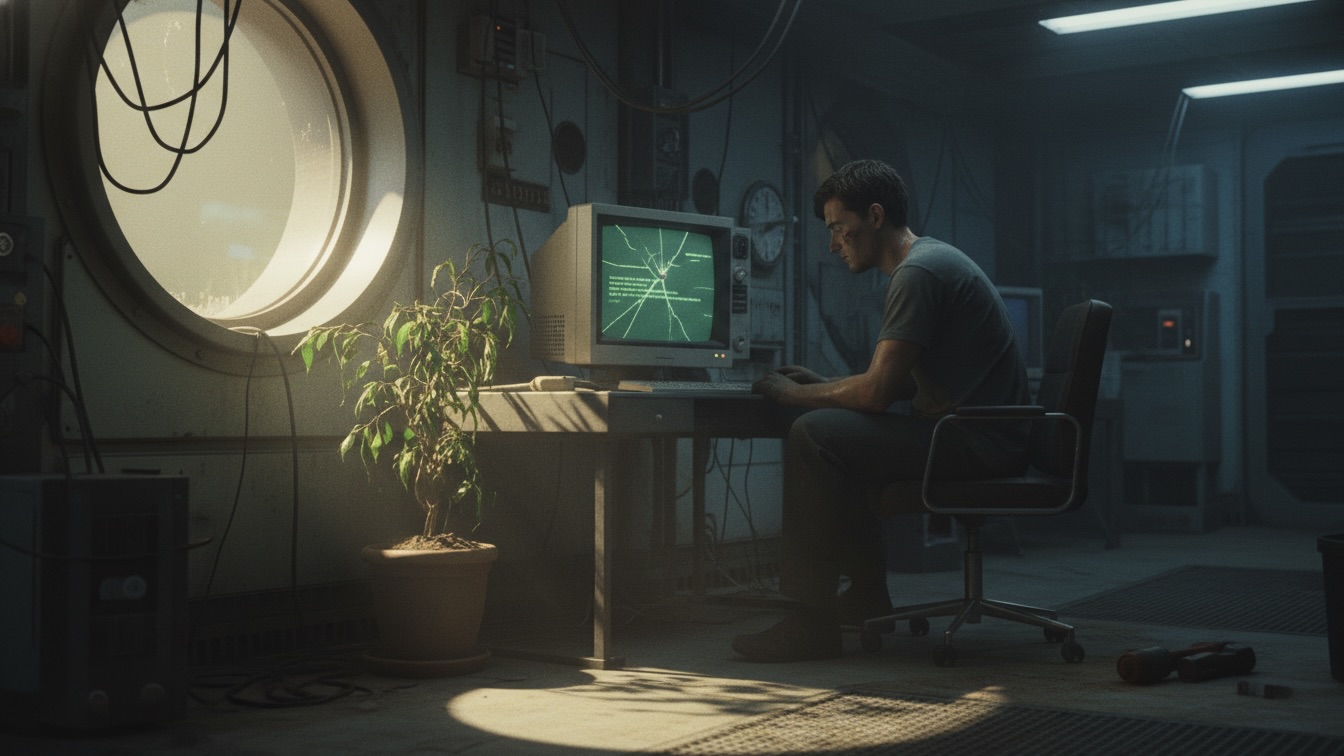
Beat 1: The Breaking Point. The episode opens with the suffocating heat of Sector Four and the high-pitched scream of a failing air scrubber, establishing the immediate physical threat. John attempts a violent mechanical fix on a diagnostic monitor before being summoned by Linda to a boardroom meeting that will decide the fate of their oxygen supply.
Beat 2: The Collapse of the Old Guard. In a repurposed storage closet, Miller demands the implementation of a "premium tier" for air, leading to a confrontation that causes Edith to suffer a fatal respiratory collapse. As Edith is rushed to the hospital, Miller issues a forty-eight-hour ultimatum to the Trust: approve the privatization or face total bankruptcy.
Beat 3: The Shadow Deal. John realizes the emergency reserves are insufficient to buy parts legally, so he descends into the grimy cargo bays to sign a liability-shifting contract with a smuggler for a stolen manifold. He successfully repairs the filter, but returns to the office to find Nori, who informs him that his illegal deal has handed Miller the perfect excuse for a hostile takeover.
Beat 4: The Death of the Founder. John receives the call that Edith has passed away, a moment of profound loss that is immediately interrupted by Miller filing an emergency motion to liquidate the Trust. Nori and John discover a legal loophole in the smuggler’s contract regarding hazard licenses, providing them with a slim chance to invalidate the liability clause and fight back.
Beat 5: The Public Catalyst. John and Linda lead a massive, angry mob from Sector Four to the pristine administrative hub of Sector Two, interrupting the live-broadcast vote on the Trust’s liquidation. John plugs Nori’s tablet into the podium, broadcasting the conglomerate’s internal plans to throttle air supply to the entire station and forcing the corporate board to resign in disgrace.
The episode follows a trajectory of rising claustrophobia and frantic desperation, mirroring the physiological effects of carbon dioxide poisoning. The middle act is characterized by a "dirty," high-stakes tension as John navigates the black market, leading to a somber, low-point following Edith's death. The climax provides a cathartic, high-energy release of public defiance, ending on a "weary victory" note that emphasizes the grueling, unglamorous reality of long-term resistance.
If expanded, the season would follow the Atmosphere Trust’s struggle to remain independent as other station utilities—water, power, and transit—begin to face similar corporate "restructuring." John and Nori would form an unlikely political duo, navigating a series of sabotages and "accidental" infrastructure failures designed to turn the public against the Trust.
The overarching mystery would involve the "summer cycles," with John discovering that the station’s radiators are being intentionally under-maintained to create the very resource scarcity the conglomerate is exploiting. The season finale would see the various sector-based movements uniting into a station-wide "Life Support Union," with John forced to decide if he will lead a full-scale revolution against the station's central command.
The visual style is "Industrial Noir," defined by high-contrast lighting and a palette of sickly oranges, deep shadows, and metallic greys in Sector Four, contrasting with the sterile, clinical whites and blues of Sector Two. Handheld camera work should be used in the lower sectors to create a sense of instability and heat-induced agitation, while the administrative hub scenes should be shot with cold, static, and wide-angled precision.
Tonal influences include the grounded, blue-collar sci-fi of Alien and the political-thriller tension of Andor. The sound design is a critical component, featuring a constant, low-frequency mechanical hum and the intermittent, shrill whine of air scrubbers that increases in volume during moments of high stress to subconsciously affect the audience's comfort levels.
The target audience consists of adult viewers (18-45) who gravitate toward "hard" science fiction, political dramas, and stories of social justice. It appeals to fans of world-building-heavy series like The Expanse or Snowpiercer, who appreciate narratives where the primary antagonist is systemic corruption and the "monsters" are corporate spreadsheets.
The pacing is "breathless" and relentless, utilizing a three-act structure compressed into a tight 10-12 minute window. The first act (0-3 mins) establishes the environmental and medical stakes; the second act (3-8 mins) focuses on the desperate "fix" and the subsequent legal trap; the third act (8-12 mins) is a fast-paced, high-stakes public confrontation and resolution.
Production will require a heavy emphasis on practical set dressing to create the "lived-in" and decaying feel of Sector Four, utilizing rusted pipes, exposed wiring, and steam effects. The contrast between the cramped, cluttered Atmosphere Trust office and the vast, empty glass atrium of Sector Two is essential for visually communicating the wealth gap on the station.
Special attention must be paid to the "sweat" and "grime" makeup for the Sector Four characters, which should visibly worsen as the episode progresses to sell the rising temperature. The use of drone-mounted cameras for the "live-feed" perspective in the climax can provide a modern, surveillance-state aesthetic that enhances the feeling of a public, televised revolution.


